
How to Read a Stotra Here
Every stotra here can be read at four depths, in ten scripts. This page shows you the controls — and tells you plainly how much of it is finished.
One control, four depths
Near the top of every stotra there is a pill marked Reading depth. Drag it right and the page gets deeper; drag it left and everything folds away until only the verse is left.
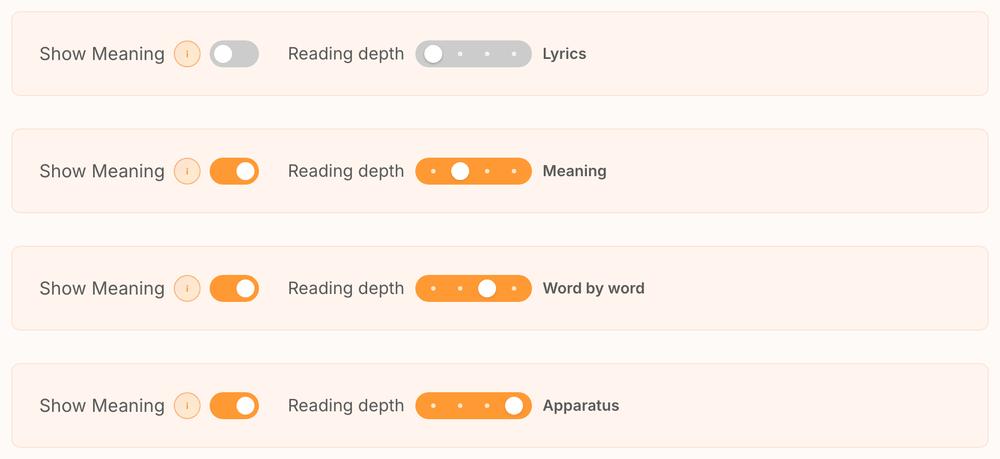
The pill is only as long as the text's own data. A depth that would open onto nothing is not greyed out — it is not there.
Most stotras show two stops. Some show three. A few show all four. If you see a fourth dot, there is a fourth layer behind it.
What each depth gives you
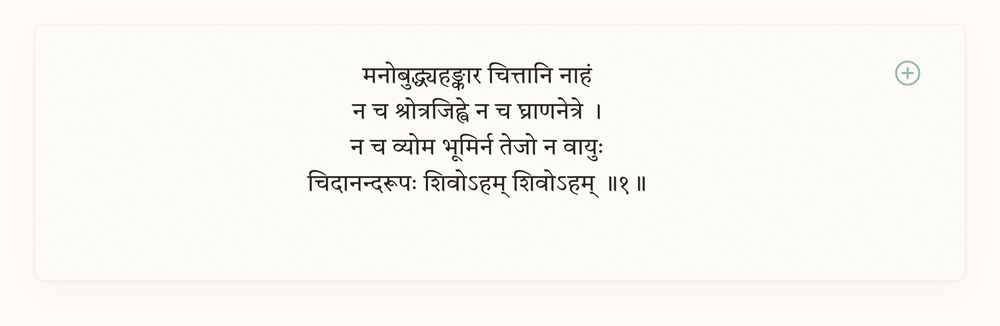
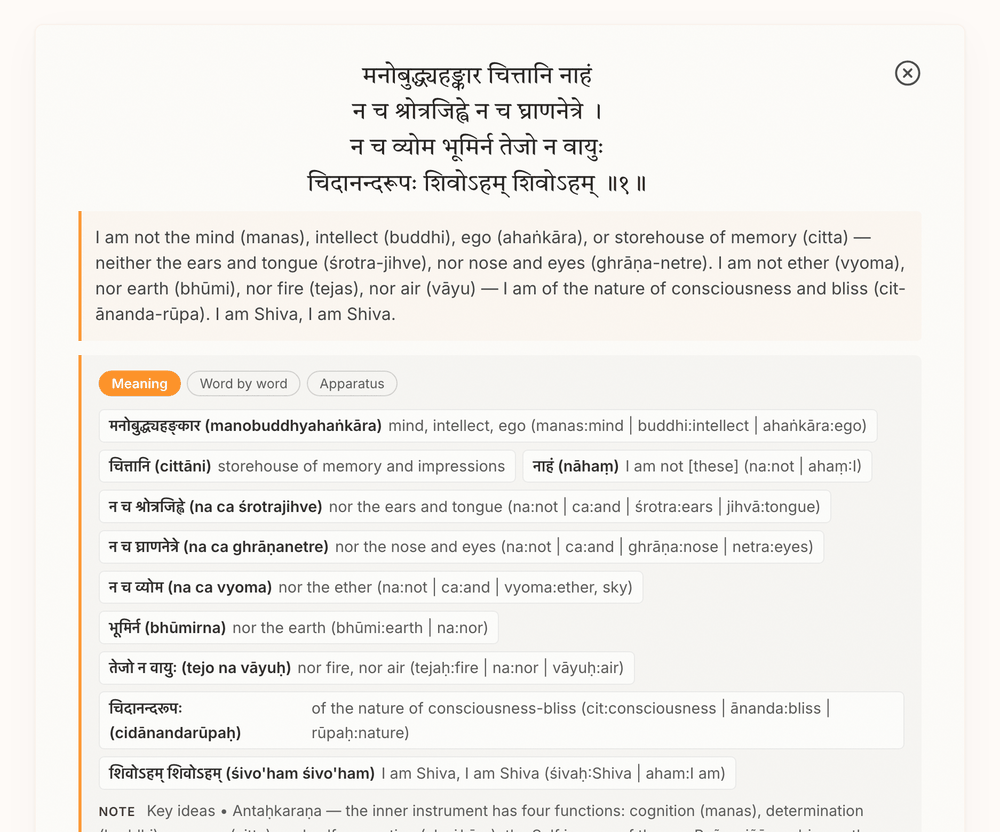
The screenshots below are the same verse — the first of the Nirvāṇa Ṣaṭkam of Śaṅkarācārya — photographed at each setting.
What is said.
Clean chanting text, and nothing else on the page competing with it. This is where every stotra opens, because most people arriving at one have come to recite it, not to study it.
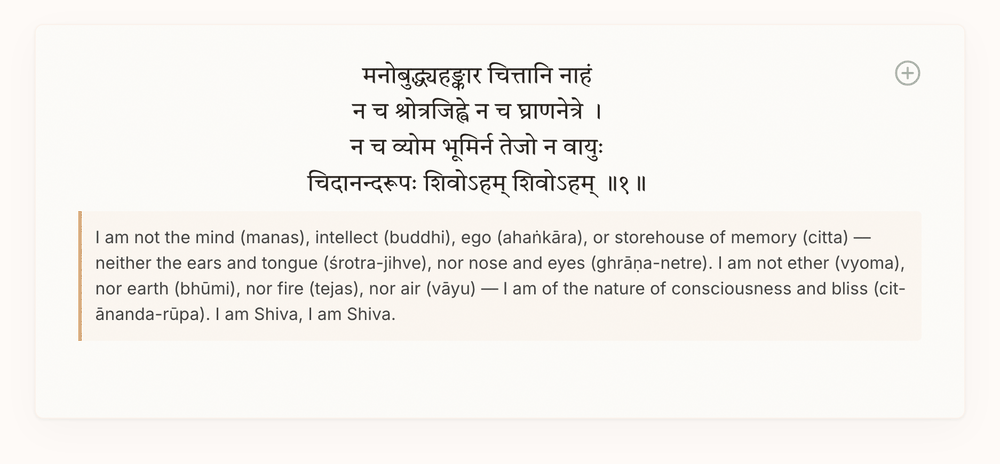
What it means.
One English rendering per verse, set directly beneath the Sanskrit so your eye can move between them. Key terms keep their Sanskrit in brackets, so a word you already know stays recognisable.
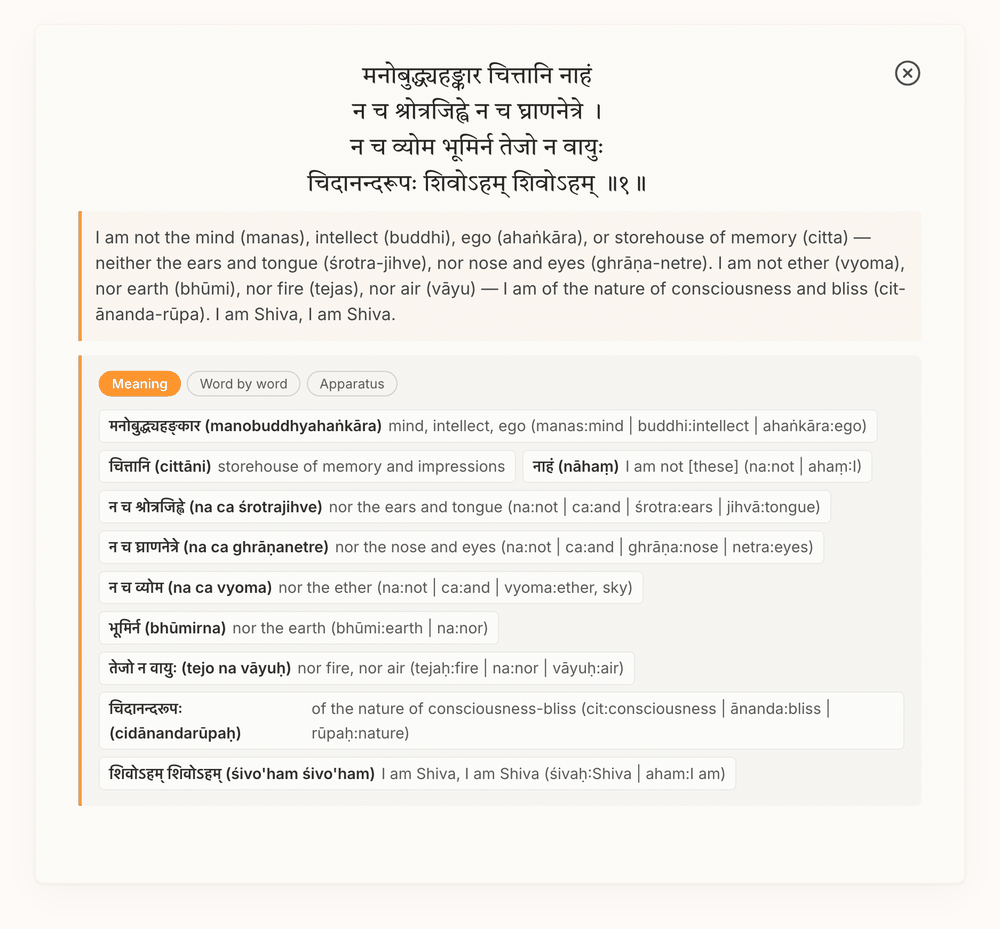
How it means it.
Every word of the verse separated out, transliterated, and glossed — including the pieces inside a compound. मनोबुद्ध्यहङ्कार comes apart into manas, buddhi and ahaṅkāra, each with its own sense, so you can see how the line is assembled rather than taking the translation on trust.
What stands behind it.
Grammar, metre, compound resolution, and the traditional exposition of the verse — what the terms mean inside the system they belong to, and where the same idea is stated elsewhere in the literature.
Or open one verse, and leave the rest quiet
Two people read a stotra in completely different ways, so there are two controls.
Someone chanting a thousand-name nāmāvalī wants every meaning open at once and cannot click a thousand times — that is the pill. Someone studying a single verse wants that verse deep and everything around it silent — that is the ⊕ beside each verse. Open it and that verse gets its own depth tabs; your choice for one verse always beats the setting for the page.
Long texts: go straight to a verse
A sahasranāma runs to a thousand names and the Brahma Sūtras to more than five hundred sūtras, and past a certain length scrolling stops being a way to find your place. Any text longer than sixty verses has a Go to verse box beside the reading controls: type a number and the page takes you there. A row of ranges above the verses — 1–100, 101–200 and on — moves a hundred at a time.

Every verse also has an address of its own, so a link can open a text at the verse you mean —/stotra/brahma-sutras#v12 opens at the twelfth verse on the page. Some long works open with a table of contents as well.
Ten scripts, ten real pages
A stotra is not only Devanāgarī. Someone who reads Tamil, or Telugu, or Kannada, but not Devanāgarī, should be able to recite the same text without learning a second script first.
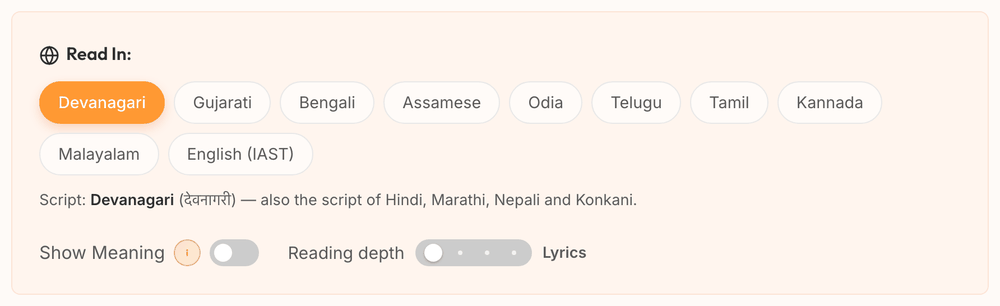
Each of those is a real page with its own address, built ahead of time —/stotra/nirvana-shatakam/tamil is a page, not a button that rearranges the one you are on. It can be bookmarked, sent to someone, found in a search engine, read by a screen reader, and opened with no signal on the train.
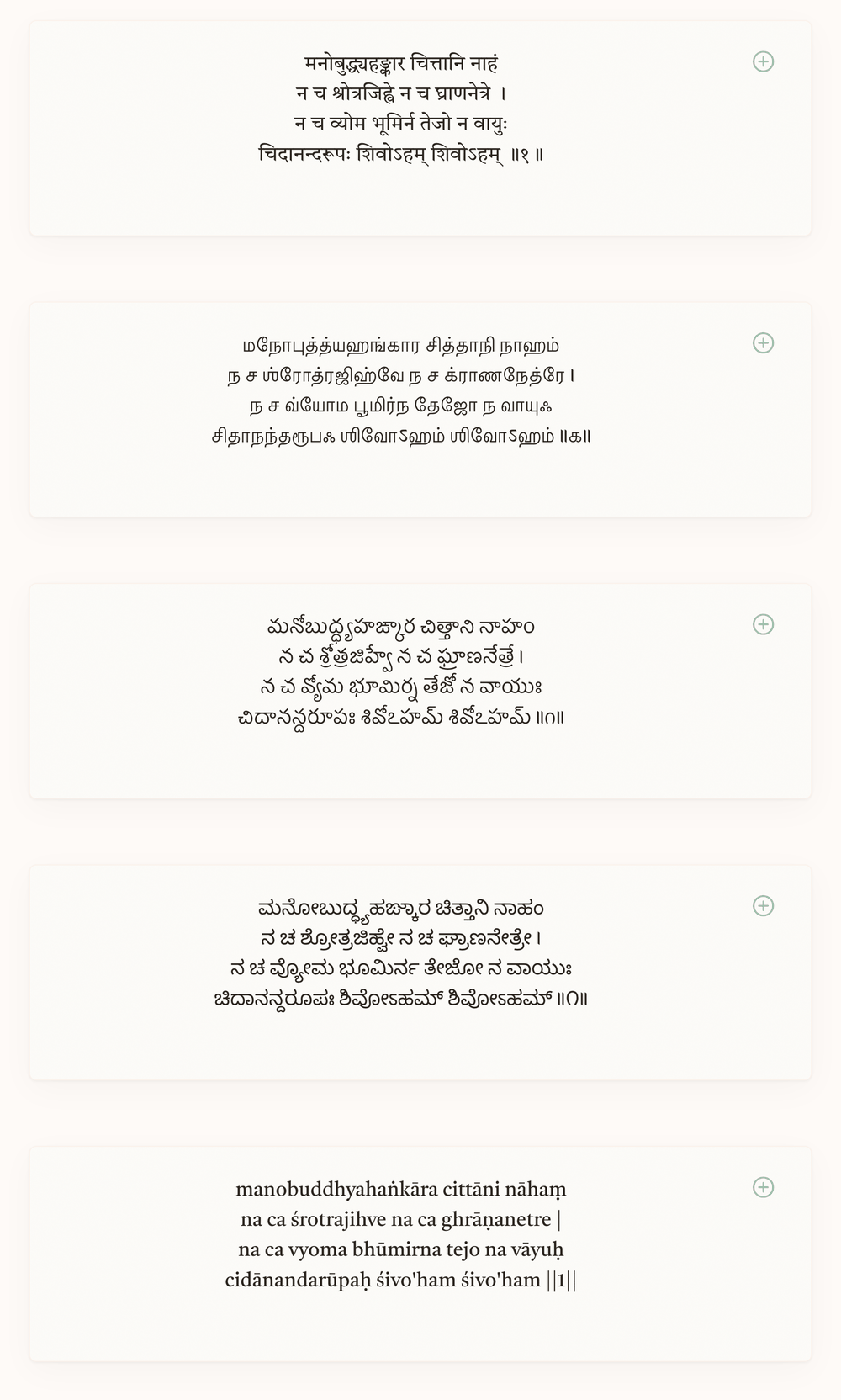
Sanskrit in your script, or a song in your language
Two different things can both be called a Telugu stotra, and the site keeps them apart. The script pages above are Sanskrit: the same text, letter for letter, in Telugu or Tamil or Kannada letters. The language shelves hold verse composed in the language itself — the chalisas and aartis of Hindi, the aartis, abhangas and granthas ofMarathi, and devotional poetry in Tamiland Telugu.
A Hindi or Marathi text is written in Devanāgarī, so it has script pages like any Sanskrit one. A poem held in Tamil or Telugu script stays in that script only: it is a Tamil or Telugu poem, not Sanskrit waiting for a rendering.
Finding a text when you only remember a line
Most people know a hymn by a line they have heard, not by its name. The search box — at the top of every page, or press / — takes a text's name, another name it goes by, its opening line, or its deity. Type the line the way you would say it: the usual differences of Roman spelling are forgiven, so aigiri and ayigiri, or shiv and shiva, find the same texts.
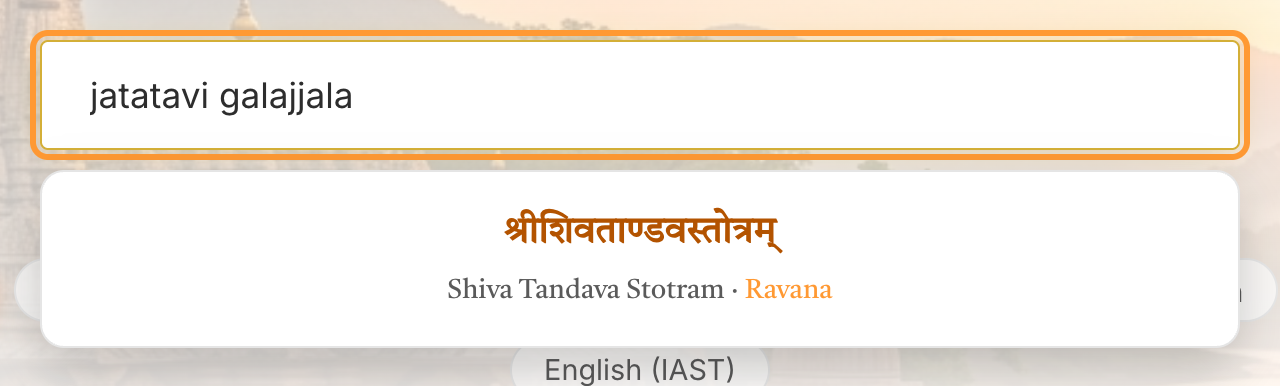
A line from the middle of a long text is harder, because search knows texts by how they begin. For a verse of the Devī Māhātmya, search for the Devī Māhātmya.
Or browse. Each shelf answers a different question — which deity, which kind of text (an aarti, a chalisa, a kavacham, a sahasranāma), which scripture or saint, which composer, which festival, what a text is traditionally recited for — and Browse the library lays them all out. The A–Z index files every text by name, and Top 500gathers the ones people chant most.
Where the words come from
The Sanskrit is not ours. It comes from established public-domain repositories of classical literature — the same digitised collections reciters and scholars have used for years. We don't rewrite verses, shorten them or modernise them. What we change is presentation: verse breaks, headings and spacing, so a text reads cleanly on a screen instead of arriving as one undifferentiated block.
The English is a different matter, and we would rather say so plainly. Translations, word-by-word glosses and notes on this site are drafted with machine assistance and then checked, line by line, against the Sanskrit by volunteers who read it. That process catches a great deal and misses some things. Devotional Sanskrit is dense, it is old, and a compound can often be read two defensible ways — so treat a translation here as help following the verse, not as a verdict on it.
Where we are unsure, we would rather mark it than write a confident sentence we cannot stand behind. Our disclaimer puts this in plainer terms.
Every text also carries a provenance record: where its Sanskrit came from, which fields came from that source rather than from us, and whether its English has been through review. Older texts predate the convention and are being filled in as they are revisited. We screen the corpus for translations lifted from copyrighted editions and remove what we find — that is why some texts here have no English at all rather than a borrowed one.
What is finished, and what is not
Not every text here has a meaning yet, and the ones that do are not all at the same depth. A stotra may sit at Lyrics for a long time before anyone has read it against the Sanskrit closely enough for us to publish a translation, and longer still before it has a word-by-word gloss.
The texts whose word-by-word layer is done are gathered on one shelf, Word by word, and each opens straight at that depth. It grows as the queue moves.
That is a queue, not an oversight. Texts move up it every week, and which ones move is partly up to you — if a stotra you recite is sitting at Lyrics,tell us, and it goes nearer the front. Depth is slow to make and easy to get wrong, and we would rather a text waited than went out with a translation nobody had checked.
The honest summary is that this library is unfinished and will stay unfinished for a long while. What we can promise is that the depth you can see on a page is depth that is really there — the control never offers a layer that opens onto nothing.
No account, no ads, no paywall
There is nothing to sign up for and nothing to buy, and nothing here is going behind a paywall. The site installs as an app if you want it to, and the texts you have opened stay readable with no connection. Search keeps working offline too, on any device that has opened the site before.
The texts aren't ours to sell. They belong to everyone who recites them, which by now is a fairly large number of people across a fairly long stretch of time.
Found a letter that has gone astray, or a translation that reads wrong against the Sanskrit? A verse number and a line is enough to start with — tell us what and where. Corrections to the Sanskrit are checked against the source before anything changes, so it isn't instant, but it does happen.