
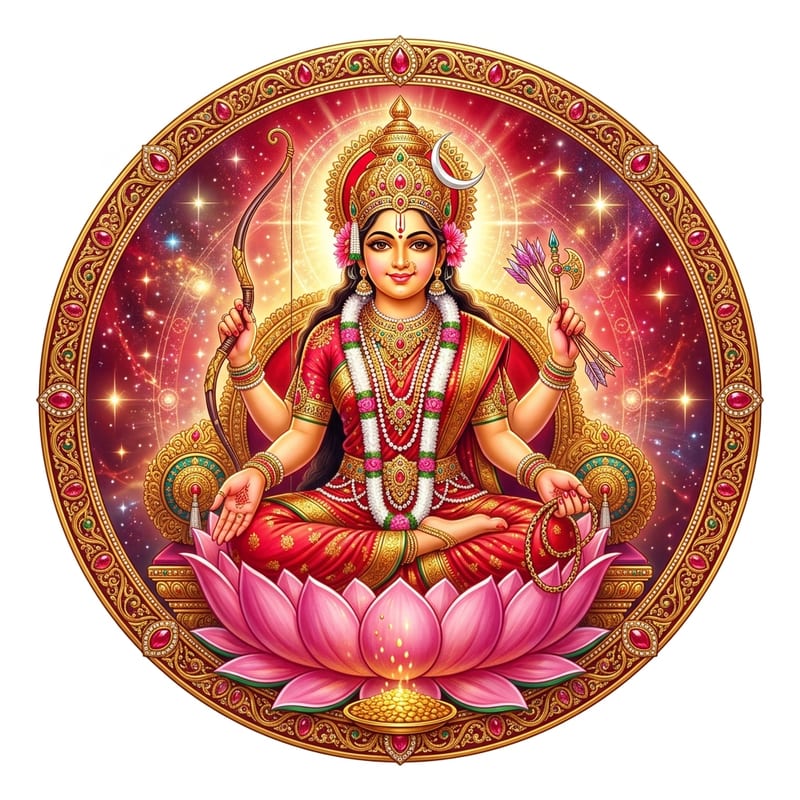
पञ्चस्तवि – 2 चर्चास्तवः >>
सौन्दर्यविभ्रमभुवो भुवनाधिपत्य-
-सङ्कल्पकल्पतरवस्त्रिपुरे जयन्ति ।
एते कवित्वकुमदप्रकरावबोध-
-पूर्णेन्दवस्त्वयि जगज्जननि प्रणामाः ॥ 1 ॥
सौन्दर्यविभ्रमभुवो भुवनाधिपत्य-
-सङ्कल्पकल्पतरवस्त्रिपुरे जयन्ति ।
एते कवित्वकुमदप्रकरावबोध-
-पूर्णेन्दवस्त्वयि जगज्जननि प्रणामाः ॥ 1 ॥
- saundarya-vibhrama-bhuvaḥ = born (bhuvaḥ = born from) of the dazzlement (vibhrama) of beauty (saundarya)
- bhuvana-ādhipatya-saṅkalpa-kalpataraḥ = wish-trees (kalpataru) that fulfill the desire (saṅkalpa) for sovereignty (ādhipatya) over the worlds (bhuvana)
- tripure = O Tripurā (the three-city Goddess, Tripurasundarī)
- jayanti = may they triumph/prevail
- ete = these
- kavitva-kumuda-... = causing the waterlilies (kumuda) of poetry/poethood (kavitva) to bloom.
देवि स्तुतिव्यतिकरे कृतबुद्धयस्ते
वाचस्पति प्रभृतयोऽपि जडी भवन्ति ।
तस्मान्निसर्गजडिमा कतमोऽहमत्र
स्तोत्रं तव त्रिपुरतापनपत्नि कर्तुम् ॥ 2 ॥
वाचस्पति प्रभृतयोऽपि जडी भवन्ति ।
तस्मान्निसर्गजडिमा कतमोऽहमत्र
स्तोत्रं तव त्रिपुरतापनपत्नि कर्तुम् ॥ 2 ॥
- devi = O Goddess
- stuti-vyatikare = in the undertaking (vyatikara = engagement, attempt) of praises (stuti)
- kṛta-buddhayaḥ = those who have applied (kṛta) their intellect (buddhi)
- te = those
- vācaspati-prabhṛtayaḥ api = even Vācaspati (Bṛhaspati, lord of speech, guru of the gods) and those of his stature (prabhṛti = beginning with)
- jaḍī bhavanti = become dull/inert (jaḍa)
- tasmān = therefore
- nisarga-jaḍimaḥ = one naturally dull (nisarga = by nature
- jaḍima = dullness/inertness).
मातस्तथापि भवतीं भवतीव्रताप-
-विच्छित्तये स्तुतिमहार्णव कर्णधारः ।
स्तोतुं भवानि स भवच्चरणारविन्द-
-भक्तिग्रहः किमपि मां मुखरी करोति ॥ 3 ॥
-विच्छित्तये स्तुतिमहार्णव कर्णधारः ।
स्तोतुं भवानि स भवच्चरणारविन्द-
-भक्तिग्रहः किमपि मां मुखरी करोति ॥ 3 ॥
- mātar = O Mother
- tathāpi = yet even so
- bhavatīm = you (honorific 2nd person)
- bhava-tīvra-tāpa-vicchhittaye = for the purpose of cutting (vicchhitti) the fierce (tīvra) heat (tāpa) of saṃsāra (bhava)
- stuti-mahā-arṇava-karṇadhāraḥ = the helmsman (karṇadhāra) of the great ocean (mahārṇava) of praises (stuti)
- stotum bhavāni sa bhavati = he who becomes (bhavati) the one to praise (stotum) you, O Bhavāni
- sa = that one.
सूते जगन्ति भवती भवती बिभर्ति
जागर्ति तत्क्षयकृते भवती भवानि ।
मोहं भिनत्ति भवती भवती रुणद्धि
लीलायितं जयति चित्रमिदं भवत्याः ॥ 4 ॥
जागर्ति तत्क्षयकृते भवती भवानि ।
मोहं भिनत्ति भवती भवती रुणद्धि
लीलायितं जयति चित्रमिदं भवत्याः ॥ 4 ॥
- sūte = she creates/gives birth to
- jaganti = the worlds
- bhavatī = you (also 'she who is')this word is used throughout with a wordplay: 'bhavatī' = you (honorific) + 'bhava' = existence
- bibharti = she sustains/bears
- jāgarti = she is awake/vigilant
- tat-kṣaya-kṛte = for the purpose of their dissolution (kṣaya = dissolution/decay)
- moham = delusion
- bhinatti = she pierces/shatters (√bhid)
- bhavatī = you
- bhavāni = O Bhavāni (the spouse of Bhava/Śiva).
यस्मिन्मनागपि नवाम्बुजपत्रगौरीं
गौरीं प्रसादमधुरां दृशमादधासि ।
तस्मिन्निरन्तरमनङ्गशरावकीर्ण-
-सीमन्तिनीनयनसन्ततयः पतन्ति ॥ 5 ॥
गौरीं प्रसादमधुरां दृशमादधासि ।
तस्मिन्निरन्तरमनङ्गशरावकीर्ण-
-सीमन्तिनीनयनसन्ततयः पतन्ति ॥ 5 ॥
- yasmin = on whomever
- manāg api = even the slightest (manāk = slightly)
- nava-ambuja-patra-gaurīm = white (gauri = white/fair) as a fresh (nava) lotus petal (ambuja-patra)
- gaurīm = O Gaurī
- prasāda-madhurām = sweet (madhura) with grace/favor (prasāda)
- dṛśam ādadhāsi = you bestow (ādadhāsi = you place) your glance (dṛś)
- tasmin = in that one
- nirantaram = perpetually
- anaṅga-śara... = Kāmadeva's arrows (śara) of Anaṅga (the bodiless Kāma) [find their mark].
पृथ्वीभुजोऽप्युदयनप्रभवस्य तस्य
विद्याधर प्रणति चुम्बित पादपीठः ।
तच्चक्रवर्तिपदवीप्रणयः स एषः
त्वत्पादपङ्कजरजः कणजः प्रसादः ॥ 6 ॥
विद्याधर प्रणति चुम्बित पादपीठः ।
तच्चक्रवर्तिपदवीप्रणयः स एषः
त्वत्पादपङ्कजरजः कणजः प्रसादः ॥ 6 ॥
- pṛthvī-bhujaḥ api = even among earth-rulers
- udayana-prabhavaya tasy = of that one born of the Udayana lineage (Udayana was the king of Vatsa, a renowned figure of ancient India)
- vidyādhara-praṇati-cumbita-pāda-pīṭhaḥ = whose footstool (pīṭha) is kissed (cumbita) by the bowing (praṇati) Vidyādharas (the semi-divine beings of the sky)
- tac-cakravarti-padavī = that imperial status (padavī) of a cakravarti (wheel-turning emperor)
- implied: is easily obtained by one who takes refuge in your feet-dust.
त्वत्पादपङ्कजरज प्रणिपातपूर्वैः
पुण्यैरनल्पमतिभिः कृतिभिः कवीन्द्रैः ।
क्षीरक्षपाकरदुकूलहिमावदाता
कैरप्यवापि भुवनत्रितयेऽपि कीर्तिः ॥ 7 ॥
पुण्यैरनल्पमतिभिः कृतिभिः कवीन्द्रैः ।
क्षीरक्षपाकरदुकूलहिमावदाता
कैरप्यवापि भुवनत्रितयेऽपि कीर्तिः ॥ 7 ॥
- tvat-pāda-paṅkaja-rajaḥ-praṇipāta-pūrvaiḥ = by [merits] preceded by prostration (praṇipāta) at the pollen (rajas) of your lotus-feet (pāda-paṅkaja)
- puṇyaiḥ = by accumulated merit
- analpam-atibhiḥ = of surpassing (atibhiḥ) keen intellect
- kṛtibhiḥ kavīndraiḥ = by accomplished (kṛtin) great poets (kavīndra)
- kṣīra-kṣapākara-dala... = like the full moon (kṣapākara = the moon
- kṣīra-sāgara = Milk Ocean) whose petals/rays are the nectar of the Milk Ocean.
कल्पद्रुमप्रसवकल्पितचित्रपूजां
उद्दीपित प्रियतमामदरक्तगीतिम् ।
नित्यं भवानि भवतीमुपवीणयन्ति
विद्याधराः कनकशैलगुहागृहेषु ॥ 8 ॥
उद्दीपित प्रियतमामदरक्तगीतिम् ।
नित्यं भवानि भवतीमुपवीणयन्ति
विद्याधराः कनकशैलगुहागृहेषु ॥ 8 ॥
- kalpadrum-a-prasava-kalpita-citra-pūjām = one who is worshipped (pūjā) with diverse (citra) offerings fashioned (kalpita) from the blooms (prasava) of the wish-tree (kalpadruma)
- uddīpita-priyatamā-mada-rakta-gītim = [you who are invoked through] songs (gīti) that are red (rakta) with intoxication (mada) aroused (uddīpita) by the beloved (priyatamā)
- nityam = daily
- bhavāni = O Bhavāni
- bhavatīm upavandaye = I seek/salute (upavandaye) you (bhavatīm).
लक्ष्मीवशीकरणकर्मणि कामिनीनां
आकर्षणव्यतिकरेषु च सिद्धमन्त्रः ।
नीरन्ध्रमोहतिमिरच्छिदुरप्रदीपो
देवि त्वदङ्घ्रिजनितो जयति प्रसादः ॥ 9 ॥
आकर्षणव्यतिकरेषु च सिद्धमन्त्रः ।
नीरन्ध्रमोहतिमिरच्छिदुरप्रदीपो
देवि त्वदङ्घ्रिजनितो जयति प्रसादः ॥ 9 ॥
- lakṣmī-vaśīkaraṇa-karmaṇi = in the work (karma) of bringing Lakṣmī under control (vaśīkaraṇa)
- kāminīnām = of desired women/of passionate ones
- ākarṣaṇa-vyatikareṣu ca = and in the procedures/occasions (vyatikara) of attraction (ākarṣaṇa)
- siddha-mantraḥ = the perfected/accomplished mantra
- nīrandhra-moha-timira-cchid... = the cutter (cchid) of the dense (nīrandhra = without gap) darkness (timira) of delusion (moha).
देवि त्वदङ्घ्रिनखरत्नभुवो मयूखाः
प्रत्यग्रमौक्तिकरुचो मुदमुद्वहन्ति ।
सेवानतिव्यतिकरे सुरसुन्दरीणां
सीमन्तसीम्नि कुसुमस्तबकायितं यैः ॥ 10 ॥
प्रत्यग्रमौक्तिकरुचो मुदमुद्वहन्ति ।
सेवानतिव्यतिकरे सुरसुन्दरीणां
सीमन्तसीम्नि कुसुमस्तबकायितं यैः ॥ 10 ॥
- devi = O Goddess
- tvad-aṅghri-nakha-ratna-bhuvaḥ = rays born from (bhuvaḥ) the gems (ratna) in the nails (nakha) of your feet (aṅghri)
- mayūkhāḥ = rays of light
- pratya-gra-mauktika-rucaḥ = with the luster (ruci) of fresh (pratyagra) pearls (mauktika)
- mudam udvahanti = they carry/bring (udvahanti) joy (mud)
- sevā-nati-vyatikara... = through the constant engagement (vyatikara) of bowing (nati) in service (sevā).
मूर्ध्नि स्फुरत्तुहिनदीधितिदीप्तिदीप्तं
मध्ये ललाटममरायुधरश्मिचित्रम् ।
हृच्चक्रचुम्बि हुतभुक्कणिकानुकारि
ज्योतिर्यदेतदिदमम्ब तव स्वरूपम् ॥ 11 ॥
मध्ये ललाटममरायुधरश्मिचित्रम् ।
हृच्चक्रचुम्बि हुतभुक्कणिकानुकारि
ज्योतिर्यदेतदिदमम्ब तव स्वरूपम् ॥ 11 ॥
- mūrdhni = at the crown
- sphurat-tuhina-dīdhiti-dīpti-dīptam = blazing (dīptam) with the blazing brilliance (dīpti) of the cold-rayed (tuhina-dīdhiti = moon, tuhina = cold/snow) shining brilliance
- madhye = in the middle
- lalāṭam = the forehead
- amarāyudha-raśmi-citram = multicolored (citra) with the rays (raśmi) of divine weapons (amara-āyudha), i.e., adorned with the crescent moon (Śiva's weapon) and other marks
- hṛc-cakra-cumb... = the heart-lotus (hṛt-cakra = the heart-chakra) kissed (cumbita).
रूपं तव स्फुरितचन्द्रमरीचिगौरं
आलोकते शिरसि वागधिदैवतं यः ।
निःसीमसूक्तिरचनामृतनिर्झरस्य
तस्य प्रसादमधुराः प्रसरन्ति वाचः ॥ 12 ॥
आलोकते शिरसि वागधिदैवतं यः ।
निःसीमसूक्तिरचनामृतनिर्झरस्य
तस्य प्रसादमधुराः प्रसरन्ति वाचः ॥ 12 ॥
- rūpam tava sphurta-candra-marīci-gauram = your (tava) form (rūpa) white (gaura) as the shimmering (sphurta) rays (marīci) of the moon (candra)
- ālokata = who perceives/meditates on
- śirasi = at the crown/head
- vāg-adhidaivataṃ = the presiding deity (adhidaivata) of speech (vāc)
- yaḥ = whoever
- niḥsīma-sūkti-racanā-amṛta-nirjhar... = endless (niḥsīma) streams/cascades (nirjhara) of the nectar (amṛta) of beautiful verse-compositions (sūkti = beautiful speech
- racanā = composition).
सिन्दूरपांसुपटलच्छुरितामिव द्यां
त्वत्तेजसा जतुरसस्नपितामिवोर्वीम् ।
यः पश्यति क्षणमपि त्रिपुरे विहाय
व्रीडां मृडानि सुदृशस्तमनुद्रवन्ति ॥ 13 ॥
त्वत्तेजसा जतुरसस्नपितामिवोर्वीम् ।
यः पश्यति क्षणमपि त्रिपुरे विहाय
व्रीडां मृडानि सुदृशस्तमनुद्रवन्ति ॥ 13 ॥
- sindūra-pāṃsu-paṭala-cchuritām iva dyām = the sky (dyā) as if (iva) sprinkled/dusted (cchurita) with a layer (paṭala) of vermilion dust (sindūra-pāṃsu)
- tvat-tejasā = by your brilliance/energy (tejas)
- jaturasa-snapitām iva urvīm = the earth (urvī) as if bathed (snapita) in lac-resin (jaturasa = red resin/lac)
- yaḥ paśyati kṣaṇam api = whoever sees even for a moment.
मातर्मुहूर्तमपि यः स्मरति स्वरूपं
लाक्षारसप्रसरतन्तुनिभं भवत्याः ।
ध्यायन्त्यनन्यमनसस्तमनङ्गतप्ताः
प्रद्युम्नसीम्नि सुभगत्वगुणं तरुण्यः ॥ 14 ॥
लाक्षारसप्रसरतन्तुनिभं भवत्याः ।
ध्यायन्त्यनन्यमनसस्तमनङ्गतप्ताः
प्रद्युम्नसीम्नि सुभगत्वगुणं तरुण्यः ॥ 14 ॥
- mātar = O Mother
- muhūrtam api = even for a moment (muhūrta = 48 minutes, but colloquially 'a moment')
- yaḥ smarati = whoever remembers
- svarūpam = the form
- lākṣā-rasa-prasara-tantu-nibham = resembling (nibha) the spreading (prasara) threads (tantu) of lac-dye (lākṣā-rasa = lac juice, deep red)
- bhavatayāḥ = of you (honorific genitive)
- dhyāyanti = they meditate
- ananya-manasaḥ = with single-pointed (ananya = non-other) mind.
योऽयं चकास्ति गगनार्णवरत्नमिन्दुः
योऽयं सुरासुरगुरुः पुरुषः पुराणः ।
यद्वाममर्धमिदमन्धकसूदनस्य
देवि त्वमेव तदिति प्रतिपादयन्ति ॥ 15 ॥
योऽयं सुरासुरगुरुः पुरुषः पुराणः ।
यद्वाममर्धमिदमन्धकसूदनस्य
देवि त्वमेव तदिति प्रतिपादयन्ति ॥ 15 ॥
- yo'yam cakāsti gagana-arṇava-ratnam induḥ = this moon (indu) that shines (cakāsti) as the jewel (ratna) of the ocean (arṇava) of space (gagana)
- yo'yam sura-asura-guruḥ = this one who is the guru of gods (sura) and demons (asura)i.e., Bṛhaspati, or more likely Śiva as the universal preceptor
- puruṣaḥ purāṇaḥ = the ancient (purāṇa) Puruṣa
- yad vāmam ardham = this left (vāma) half (ardha)referring to the Ardhanārīśvara form, in which Śiva occupies the left half
- idam ananyam = this is uniquely yours.
इच्छानुरूपमनुरूपगुणप्रकर्ष
सङ्कर्षिणि त्वमभिमृश्य यदा बिभर्षि ।
जायेत स त्रिभुवनैक गुरुस्तदानीं
देवः शिवोऽपि भुवनत्रयसूत्रधारः ॥ 16 ॥
सङ्कर्षिणि त्वमभिमृश्य यदा बिभर्षि ।
जायेत स त्रिभुवनैक गुरुस्तदानीं
देवः शिवोऽपि भुवनत्रयसूत्रधारः ॥ 16 ॥
- icchā-anurūpam = according to the measure (anurūpa) of your will (icchā)
- anurūpa-guṇa-prakarṣa = with excellence (prakarṣa) of qualities (guṇa) that match (anurūpa)
- saṅkarṣiṇī = O Saṅkarṣiṇī (the drawing-in aspect of the Goddess, one of the four vyūha-śaktis in the Pāñcarātra tradition: Vāsudevī, Saṃkarṣaṇī, Pradyumna, Aniruddha
- here used for Tripurā's drawing power)
- tvam abhimṛśya = you, having touched/infused him
- yadā bibharṣi = when you bear him
- jāyeta sa = he becomes
- tri-bhuvanaikaguruḥ = the sole (eka) guru of the three worlds.
ध्यातासि हैमवति येन हिमांशुरश्मि-
-मालामलद्युतिरकल्मषमानसेन ।
तस्याविलम्बमनवद्यमनन्तकल्पं
अल्पैर्दिनैः सृजसि सुन्दरि वाग्विलासम् ॥ 17 ॥
-मालामलद्युतिरकल्मषमानसेन ।
तस्याविलम्बमनवद्यमनन्तकल्पं
अल्पैर्दिनैः सृजसि सुन्दरि वाग्विलासम् ॥ 17 ॥
- dhyātāsi = you are meditated upon
- haimavati = O Haimavati (daughter of Himavān, i.e., Pārvatī)
- yena = by whom
- himāṃśu-raśmi-mālā-mala-dyutiḥ = one of pure (mala-free) brilliance (dyuti) like a garland (mālā) of moonbeams (himāṃśu-raśmi = rays of the cold-rayed moon)
- akalmaṣa-mānasena = with a stainless/spotless (akalmaṣa) mind (mānasa)
- tasya = for them
- avilamabam = without delay
- anavadyam = faultless
- anantam = infinite.
आधारमारुतनिरोधवशेन येषां
सिन्दूररञ्जितसरोजगुणानुकारि ।
दीप्तं हृदि स्फुरति देवि वपुस्त्वदीयं
ध्यायन्ति तानिह समीहितसिद्धिसार्थाः ॥ 18 ॥
सिन्दूररञ्जितसरोजगुणानुकारि ।
दीप्तं हृदि स्फुरति देवि वपुस्त्वदीयं
ध्यायन्ति तानिह समीहितसिद्धिसार्थाः ॥ 18 ॥
- ādhāra-māruta-nirodha-vaśena = by means of (vaśena) the restraint (nirodha) of the ādhāra-māruta (the root/base breaththe prāṇa associated with the mūlādhāra chakra
- māruta = wind/breath)
- yeṣām = for those who
- sindūra-rañjita-saroja-guṇa-anukāri = resembling (anukāri) the quality (guṇa) of a lotus (saroja) tinged (rañjita) with vermilion (sindūra)
- dīptam hṛdi sphuratidevī = your blazing (dīptam) form flashes (sphurasi) in the heart, O Goddess.
ये चिन्तयन्त्यरुणमण्डलमध्यवर्ति
रूपं तवाम्ब नवयावकपङ्कपिङ्गम् ।
तेषां सदैव कुसुमायुधबाणभिन्न-
-वक्षःस्थला मृगदृशो वशगा भवन्ति ॥ 19 ॥
रूपं तवाम्ब नवयावकपङ्कपिङ्गम् ।
तेषां सदैव कुसुमायुधबाणभिन्न-
-वक्षःस्थला मृगदृशो वशगा भवन्ति ॥ 19 ॥
- ye cintayanti = those who contemplate
- aruṇa-maṇḍala-madhya-varti = dwelling in the center (madhyavarti) of the red orb (aruṇa-maṇḍala)the red solar disc, or the maṇḍala of the rising sun
- rūpam tava amba = your form, O Amba
- nava-yāvaka-paṅka-piṅgam = of golden-red/tawny (piṅga) hue like fresh (nava) barley-paste (yāvaka-paṅka)
- teṣām sadaiva = for them always
- kusumāyudha... = Kāmadeva (kusumāyudha = flower-weaponed) [favors them].
त्वामैन्दवीमिव कलामनुफालदेशं
उद्भासिताम्बरतलामवलोकयन्तः ।
सद्यो भवानि सुधियः कवयो भवन्ति
त्वं भावनाहितधियां कुलकामधेनुः ॥ 20 ॥
उद्भासिताम्बरतलामवलोकयन्तः ।
सद्यो भवानि सुधियः कवयो भवन्ति
त्वं भावनाहितधियां कुलकामधेनुः ॥ 20 ॥
- tvām = you
- aindavīm iva kalām = like (iva) the lunar digit (kalā) of the moon (aindavī = pertaining to Indu/moon)
- anu-phāla-deśam = at the region (deśa) of (anu = along) the forehead (phāla)
- udbhāsita-ambara-talām = illuminating (udbhāsita) the expanse of sky (ambara-tala)
- avalokyantaḥ = those who behold
- sadyaḥ = instantly
- bhavāni = O Bhavāni
- sudhiyaḥ = the wise ones
- kavayaḥ = poets
- bhavanti = become.
शर्वाणि सर्वजनवन्दितपादपद्मे
पद्मच्छदद्युतिविडम्बितनेत्रलक्ष्मि ।
निष्पापमूर्तिजनमानसराजहंसि
हंसि त्वमापदमनेकविधां जनस्य ॥ 21 ॥
पद्मच्छदद्युतिविडम्बितनेत्रलक्ष्मि ।
निष्पापमूर्तिजनमानसराजहंसि
हंसि त्वमापदमनेकविधां जनस्य ॥ 21 ॥
- śarvāṇī = O Śarvāṇī (wife of Śarva/Śiva)
- sarva-jana-vandita-pāda-padme = whose lotus-feet (pāda-padma) are worshipped (vandita) by all people (sarva-jana)
- padma-cchada-dyuti-viḍambita-netra-lakṣmi = whose eye-beauty (netra-lakṣmi) rivals (viḍambita) the luster (dyuti) of lotus petals (padma-cchada)
- niṣpāpa-mūrti-jana-māna... = O delight (māna) of those (jana) of sinless/pure form (niṣpāpa-mūrti).
उत्तप्तहेमरुचिरे त्रिपुरे पुनीहि
चेतश्चिरन्तनमघौघवनं लुनीहि ।
कारागृहे निगलबन्धनयन्त्रितस्य
त्वत्संस्मृतौ झटिति मे निगलास्त्रुटन्ति ॥ 22 ॥
चेतश्चिरन्तनमघौघवनं लुनीहि ।
कारागृहे निगलबन्धनयन्त्रितस्य
त्वत्संस्मृतौ झटिति मे निगलास्त्रुटन्ति ॥ 22 ॥
- uttapta-hema-rucire = O one beautiful (rucira) as heated/refined (uttapta) gold (hema)
- tripure = O Tripurā
- punīhi = purify (punī = imperative of √pū = to purify)
- cetaḥ = mind (cetas)
- cirantana = long-accumulated (over ages)
- agha-ogha-vanaṃ lunīhi = mow down (lunīhi = imperative of √lū = to cut/reap) the forest (vana) of floods (ogha) of sin (agha)
- kārāgṛhe nigala-bandhana-yantra... = in the prison (kārāgṛha) with its chains (nigala), bonds (bandhana), and mechanisms (yantra) [release me].
त्वां व्यापिनीति सुमना इति कुण्डलीति
त्वां कामिनीति कमलेति कलावतीति ।
त्वां मालिनीति ललितेत्यपराजितेति
देवि स्तुवन्ति विजयेति जयेत्युमेति ॥ 23 ॥
त्वां कामिनीति कमलेति कलावतीति ।
त्वां मालिनीति ललितेत्यपराजितेति
देवि स्तुवन्ति विजयेति जयेत्युमेति ॥ 23 ॥
- tvāṃ vyāpinīti = you [called] Vyāpinī (the all-pervading one)
- sumanā iti = Sumanā (good-minded, or having beautiful flowerssu = good + mana)
- kuṇḍalī iti = Kuṇḍalī (the coiled onethe Kuṇḍalinī Śakti)
- tvāṃ kāminīti = you Kāminī (the desirous/passionate onelove-personified)
- kamaleti = Kamalā (the lotus-one, Lakṣmī)
- kalāvatīti = Kalāvatī (full of kalāsthe 64 art-forms or the 16 lunar phases)
- tvāṃ mālinīti = you Mālinī (the garlanded one, or the one associated with the Mālinī scriptan important Trika Śaiva alphabet system).
उद्दामकामपरमार्थसरोजखण्ड-
चण्डद्युतिद्युतिमपासितषड्विकाराम् ।
मोहद्विपेन्द्रकदनोद्यतबोधसिंह-
-लीलागुहां भगवतीं त्रिपुरां नमामि ॥ 24 ॥
चण्डद्युतिद्युतिमपासितषड्विकाराम् ।
मोहद्विपेन्द्रकदनोद्यतबोधसिंह-
-लीलागुहां भगवतीं त्रिपुरां नमामि ॥ 24 ॥
- uddāma-kāma-paramārtha-saroja-khaṇḍa = the abundant lotus-grove (khaṇḍa) of the supreme purpose (paramārtha) of Kāmahere kāma = the highest kāma = mokṣa (liberation), the fourth puruṣārtha
- caṇḍa-dyuti = blazing brilliance (caṇḍa = fierce/intense
- dyuti = brilliance)
- apāsita-ṣaḍ-vikārām = having dispelled (apāsita) the six modifications (ṣaḍ-vikāra = birth, existence, growth, transformation, decay, deaththe six transformations of all material beings)
- moha-dvipa-indra-kadana-udyata-siṃha-rūpā... = of the form (rūpa) of a lion (siṃha) poised (udyata) to destroy (kadana) the great elephant (dvipa-indra = elephant king) of delusion (moha).
गणेशवटुकस्तुता रतिसहायकामान्विता
स्मरारिवरविष्टरा कुसुमबाणबाणैर्युता ।
अनङ्गकुसुमादिभिः परिवृता च सिद्धैस्त्रिभिः
कदम्बवनमध्यगा त्रिपुरसुन्दरी पातु नः ॥ 25 ॥
स्मरारिवरविष्टरा कुसुमबाणबाणैर्युता ।
अनङ्गकुसुमादिभिः परिवृता च सिद्धैस्त्रिभिः
कदम्बवनमध्यगा त्रिपुरसुन्दरी पातु नः ॥ 25 ॥
- gaṇeśa-vaṭuka-stutā = praised (stutā) by Gaṇeśa (elephant-headed god) and Vaṭuka (Vaṭuka Bhairavathe young/boyish form of Bhairava)
- rati-sahāyaka-kāma-anvitā = accompanied by (anvitā) Rati (the goddess of desire) and her helper/companion Kāma (Manmatha, the god of love)
- smara-āri-vara-viṣṭarā = enthroned (viṣṭara = seat/throne) on the best (vara) seat of the enemy of Smara (Kāma's enemy = Śiva = Tripurāri)
- kusuma-bāṇa-bāṇaiḥ yutā = armed (yutā) with flower-arrows (kusuma-bāṇa)
- anaṅga-kusumā-ādi... = the attendant deities of the Goddess's retinue.
रुद्राणि विद्रुममयीं प्रतिमामिव त्वां
ये चिन्तयन्त्यरुणकान्तिमनन्यरूपाम् ।
तानेत्य पक्ष्मलदृशः प्रसभं भजन्ते
कण्ठावसक्तमृदुबाहुलतास्तरुण्यः ॥ 26 ॥
ये चिन्तयन्त्यरुणकान्तिमनन्यरूपाम् ।
तानेत्य पक्ष्मलदृशः प्रसभं भजन्ते
कण्ठावसक्तमृदुबाहुलतास्तरुण्यः ॥ 26 ॥
- rudrāṇī = O Rudrāṇī (consort of Rudra, i.e., Pārvatī)
- vidruma-mayīm pratimām iva tvām = you, like (iva) a statue (pratimā) made of coral (vidruma-mayī)
- ye cintayanti = those who contemplate
- aruṇa-kāntim = of reddish (aruṇa) splendor (kānti)
- ananya-rūpām = of unique (ananya = non-other) form
- tān etya = coming to them (etya = having come)
- implied: at the time of death or the final hour, she appears and grants liberation.
त्वद्रूपैकनिरूपणप्रणयिताबन्धो दृशोस्त्वद्गुण-
-ग्रामाकर्णनरागिता श्रवणयोस्त्वत्संस्मृतिश्चेतसि ।
त्वत्पादार्चनचातुरी करयुगे त्वत्कीर्तितं वाचि मे
कुत्रापि त्वदुपासनव्यसनिता मे देवि मा शाम्यतु ॥ 27 ॥
-ग्रामाकर्णनरागिता श्रवणयोस्त्वत्संस्मृतिश्चेतसि ।
त्वत्पादार्चनचातुरी करयुगे त्वत्कीर्तितं वाचि मे
कुत्रापि त्वदुपासनव्यसनिता मे देवि मा शाम्यतु ॥ 27 ॥
- tvad-rūpa-eka-nirūpaṇa-praṇayitā-bandho = bound (bandha) by the attachment (praṇayitā = love/attachment) of contemplating (nirūpaṇa) only (eka = alone) your form (rūpa)
- dṛśoḥ = of the eyes (dual)
- tvad-guṇa-grāma-ākarṇana-rāgitā = tinged with passion (rāgitā) for hearing (ākarṇana) the collection (grāma) of your qualities (guṇa)
- śravaṇayoḥ = of the ears (dual)
- tvat-saṃsmṛti... = the mind [in] constant remembrance (saṃsmṛti) of you.
त्वद्रूपमुल्लसितदाडिमपुष्परक्तं
उद्भावयेन्मदनदैवतमक्षरं यः ।
तं रूपहीनमपि मन्मथनिर्विशेषं
आलोकयन्त्युरुनितम्बतटास्तरुण्यः ॥ 28 ॥
उद्भावयेन्मदनदैवतमक्षरं यः ।
तं रूपहीनमपि मन्मथनिर्विशेषं
आलोकयन्त्युरुनितम्बतटास्तरुण्यः ॥ 28 ॥
- tvad-rūpam = your form
- ullasita-dāḍima-puṣpa-raktam = red (rakta) as the blossoming (ullasita) pomegranate (dāḍima) flower
- udbhāvayet = whoever meditates/conceives
- madana-daivata-akṣaram = the imperishable seed (akṣara) of the deity (daivata) of Kāma (madana = Kāmadeva
- the 'akṣara' is the Kāma-bīja mantra, or the imperishable nature of Kāma as an aspect of the divine)
- yaḥ = whoever
- tam rūpa-hīnam api = that person even if lacking beauty (rūpa-hīna)
- manmatha-nirvibhāvaḥ = by Kāmadeva (manmatha) [is made irresistibly attractive].
ब्रह्मेन्द्ररुद्रहरिचन्द्रसहस्ररश्मि-
-स्कन्दद्विपाननहुताशनवन्दितायै ।
वागीश्वरि त्रिभुवनेश्वरि विश्वमातः
अन्तर्बहिश्च कृतसंस्थितये नमस्ते ॥ 29 ॥
-स्कन्दद्विपाननहुताशनवन्दितायै ।
वागीश्वरि त्रिभुवनेश्वरि विश्वमातः
अन्तर्बहिश्च कृतसंस्थितये नमस्ते ॥ 29 ॥
- brahma-indra-rudra-hari-candra-sahasra-raśmi-skanda-dvipānana-hutāśana-vanditāyai = to her saluted by: Brahmā (creator), Indra (king of gods), Rudra (destroyer), Hari (Viṣṇu), Candra (moon), sahasraraśmi (thousand-rayed Sun), Skanda (Kārttikeya, son of Śiva), dvipānana (Gaṇapati, elephant-faced), hutāśana (Agni, fire-god)
- vāgīśvari = O Vāgīśvarī (the Mistress/Queen of speech)
- tri-bhuvanā... = of the three worlds
- implied salutation and prayer for grace.
कस्तोत्रमेतदनुवासरमीश्वरायाः
श्रेयस्करं पठति वा यदि वा शृणोति ।
तस्येप्सितं फलति राजभिरीड्यतेऽसौ
जायेत स प्रियतमो मदिरेक्षणानाम् ॥ 30 ॥
श्रेयस्करं पठति वा यदि वा शृणोति ।
तस्येप्सितं फलति राजभिरीड्यतेऽसौ
जायेत स प्रियतमो मदिरेक्षणानाम् ॥ 30 ॥
- kas = whoever
- stotram etat = this hymn
- anuvāsaram = daily
- īśvarāyāḥ = to the Goddess (Īśvarā = Mistress/Queen)
- śreyaskaram = auspicious/welfare-giving
- paṭhati vā = either recites
- yadi vā śṛṇoti = or hears
- tasya = for them
- īpsitam = the desired (thing)
- phalati = bears fruit
- rāja... = kings (become favorable, implied)
- implied: Sarasvatī (vāgdevī) dwells permanently in their speech.
इति श्रीकालिदास विरचित पञ्चस्तव्यां द्वितीयः चर्चास्तवः ।