
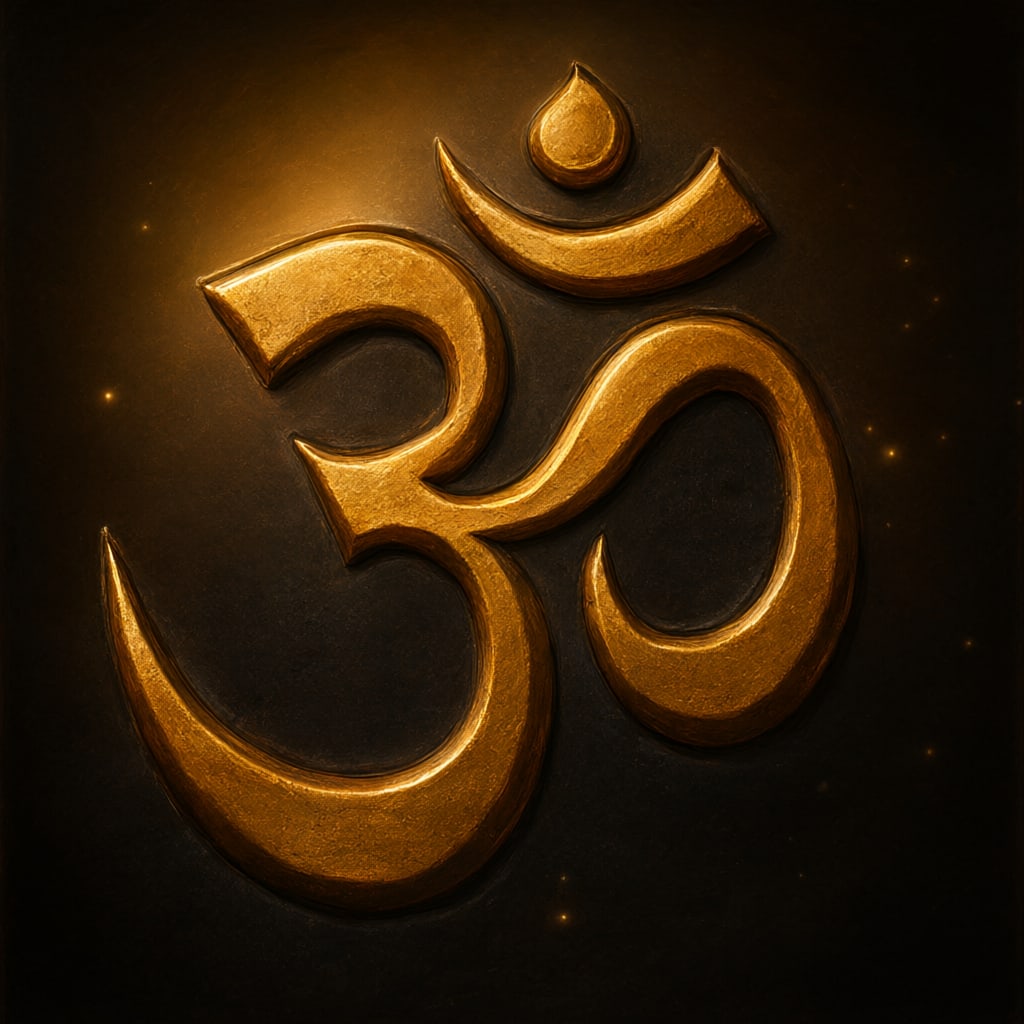
Almost every prayer in India begins with it. So does every chapter of the Gītā, every Vedic recitation, every peace-chant at the close of a ceremony. Most of us have said it thousands of times. Very few of us were ever told what it's supposed to mean.
The usual answer is that it's a holy sound, the sound of the universe. That isn't wrong, but it explains almost nothing. The Upaniṣads say something much more specific, and much stranger. They say the syllable has a structure; that the structure is the same as yours; and that this is why paying attention to it takes you somewhere.
This essay follows that claim. We'll read the Māṇḍūkya Upaniṣad, which examines Oṃ more carefully than any other text, and then look at the older Upaniṣads that arrive at the same place by different roads. Nothing here asks for belief. It asks only that you check the claims against your own experience, which is exactly what these texts want you to do.
A very short book with a very large claim
The Māṇḍūkya Upaniṣad is twelve verses long. You can read it aloud in three minutes. It's the shortest of the principal Upaniṣads and, by wide agreement, the hardest. Gauḍapāda wrote a commentary on it several times longer than the text, and Śaṅkara then commented on both. There's an old saying that if a seeker could study only one Upaniṣad, this would be the one.
It wastes no time:
ॐ इत्येतदक्षरमिदं सर्वं तस्योपव्याख्यानं भूतं भवद् भविष्यदिति सर्वमोङ्कार एव ।
oṃ ityetad akṣaram idaṃ sarvaṃ tasyopavyākhyānaṃ bhūtaṃ bhavad bhaviṣyad iti sarvam oṃkāra eva
Oṃ — this syllable is all this. And here is the explanation of it: whatever was, whatever is, whatever will be — all of it is Oṃ.
Before the philosophy, notice one word. अक्षर (akṣara) means "syllable." It also means "that which doesn't perish", from अ (a, "not") and क्षर (kṣara, "decaying"). Sanskrit lets both senses sit in the same word, and the Upaniṣad is using both at once. It's talking about a sound, and about something that never passes away, and it wants you to hold the two together.
Now the claim itself. Taken flat, it's nonsense. A noise made in a mouth isn't the past, present and future. If somebody told you the word "water" was actually all the water in the world, you'd correct them. So we should be careful about what's being asserted here.
The very next verse tells us:
सर्वं ह्येतद् ब्रह्म अयमात्मा ब्रह्म सोऽयमात्मा चतुष्पात् ।
sarvaṃ hyetad brahma ayam ātmā brahma so'yam ātmā catuṣpāt
All this is Brahman. This Self is Brahman. And this same Self has four quarters.
Three statements in one line. The world is Brahman. You are Brahman. So the world and you aren't two separate things. Only after laying this down does the text come back to the syllable, and that order is deliberate. Oṃ isn't being offered as a magic noise. It's being offered as a map of something the text has already pointed at.
A map is a useful way to think about it. A map of a city isn't the city. But a good map has the same structure as the city, and that's exactly why it works. The Māṇḍūkya is about to argue that Oṃ has the same structure as you.
Three states you already know
Here the Upaniṣad does something you rarely see in a religious text. It doesn't appeal to a vision, a revelation, or an authority. It asks you to look at your own last twenty-four hours.
You spent part of them awake. Eyes open, aware of a world outside you: chairs, noise, other people. The Upaniṣad calls this वैश्वानर (vaiśvānara) and gives it the first quarter (verse 3).
You spent part of them dreaming. Eyes shut, nothing outside reaching you, and yet there was still a world. Places, faces, conversations, fear or delight, all of it built out of your own mind. This is तैजस (taijasa), the second quarter (verse 4).
And you spent part of them in deep sleep, with no dreams at all. No world, no body, no thoughts, no you-as-a-person. The text calls this प्राज्ञ (prājña) and gives it a lovely name: प्रज्ञानघन (prajñānaghana), a single solid mass of awareness, undivided (verse 5).
Most accounts of the mind stop at three. This one doesn't, and the reason is worth taking slowly, because everything else rests on it.
The question that opens the fourth
Think about what you say when you get up after a good night's sleep. You say: "I slept really well. Didn't dream at all."
Look closely at that sentence. You're reporting on deep sleep. You're saying something happened, or rather that nothing happened, during a stretch when by your own account you weren't conscious of anything. But a report needs a witness. If absolutely nothing had been present, there'd be nothing to report and nobody to report it. You'd have to say "I've no idea what happened," the way you would about a stranger's night. You don't say that. You say it was peaceful, and you say it with confidence.
Something was present through the night that noticed the absence. It wasn't your waking mind, because that had shut down. It wasn't your dreaming mind, because there were no dreams. Whatever it was, it was there before you fell asleep, it was there while you slept, and it was still there when you woke up.
That's what the Upaniṣad means by the fourth. It calls it simply तुरीय (turīya), "the fourth," and refuses to give it a better name:
नान्तःप्रज्ञं न बहिष्प्रज्ञं नोभयतःप्रज्ञं न प्रज्ञानघनं न प्रज्ञं नाप्रज्ञम् । अदृष्टमव्यवहार्यमग्राह्यमलक्षणमचिन्त्यमव्यपदेश्यमेकात्मप्रत्ययसारं प्रपञ्चोपशमं शान्तं शिवमद्वैतं चतुर्थं मन्यन्ते स आत्मा स विज्ञेयः ।
nāntaḥprajñaṃ na bahiṣprajñaṃ … prapañcopaśamaṃ śāntaṃ śivam advaitaṃ caturthaṃ manyante sa ātmā sa vijñeyaḥ
Not aware of what is inside, not aware of what is outside, not aware of both, not a mass of awareness, neither aware nor unaware. Unseen. Beyond transaction. Not to be grasped, not to be marked out, not to be thought about, not to be named. Its essence is the certainty of being one Self. In it the whole spread of things comes to rest. Peaceful. Kind. Without a second. That is what they consider the fourth. That is the Self. That is what is to be known.
Every positive word is withdrawn the moment it's offered. The text isn't being evasive; it's being accurate. Anything you can describe is something you're aware of, an object. Turīya isn't an object. It's the awareness in which the other three states show up.
A film is a useful comparison, and Indian teachers have used it since cinema arrived. On a screen you watch a city burn, a river flood, a man walk into a room. The screen isn't burned, isn't wet, and doesn't move aside for the man. The three states are three films: the waking film, the dreaming film, the blank film of deep sleep. Turīya is the screen. Not a fourth film that comes on after the others, but the thing all three appear on, unchanged when they change.
Which is also why you can't get into turīya the way you get into sleep. You don't enter it. You are it, and you never have been anything else. The other three have been appearing in it the whole time.
Now the syllable
Only in verse 8, more than halfway through, do the two halves come together. This is the hinge of the whole text:
सोऽयमात्माध्यक्षरं ओङ्कारोऽधिमात्रं पादा मात्रा मात्राश्च पादा अकार उकारो मकार इति ।
so'yam ātmādhyakṣaraṃ oṃkāro'dhimātraṃ pādā mātrā mātrāś ca pādā akāra ukāro makāra iti
This same Self, considered as a syllable, is Oṃ. Considered as measures: the quarters are the measures and the measures are the quarters — a, u, and m.
पादा मात्रा मात्राश्च पादाः (pādā mātrā mātrāś ca pādāḥ): the quarters are the measures, and the measures are the quarters. It says it both ways round, and that repetition is doing real work. Say it one way only and you have a comparison: the states are like the sounds, the way a photograph is like a face. Say it both ways and there’s no room left for "like". A photograph is never the face. Here the text is claiming there aren’t two things being compared at all, only one thing described twice, once as sound and once as experience. That’s why this isn’t a poetic flourish. अ (a) is waking. उ (u) is dream. म् (m) is deep sleep (verses 9–11).
Why those three sounds and not others? Try it. It takes five seconds.
Open your mouth and make a sound without shaping it at all. Don't move your tongue, don't move your lips. What comes out is अ (a). It's the sound your voice makes when you do nothing to it: the beginning, the most open position.
Now close your lips completely and make a sound. The only thing available is म् (m). Once the lips are shut nothing else is physically possible: the end, the most closed position.
Now travel slowly from one to the other, letting your lips round on the way. In the middle you pass through उ (u).
So अ (a), उ (u) and म् (m) aren't three letters somebody picked out of the alphabet. They're the two boundaries of the human voice and the point between them. Every sound you can make lives inside that range. When the tradition says all speech is contained in Oṃ, that isn't poetry. At the level of the mouth it's just a fact.
The match with the states is just as physical. अ (a) is the wide-open sound, and waking is the wide-open state, turned outward to a whole world. उ (u) is formed in the middle of the mouth, and dream is the inner state, made of mind alone. म् (m) is the closed sound with nothing coming out, and deep sleep is where everything has been drawn back in. The Upaniṣad's own reasons run the same way: अ (a) because it comes first and pervades everything, उ (u) because it's in between and holds both, म् (m) because in it everything is measured up and taken back.
The part with no sound
Then the last verse, where the analysis does something analysis usually doesn't. It runs out of things to measure:
अमात्रश्चतुर्थोऽव्यवहार्यः प्रपञ्चोपशमः शिवोऽद्वैत एवमोङ्कार आत्मैव संविशत्यात्मनाऽऽत्मानं य एवं वेद ।
amātraś caturtho'vyavahāryaḥ prapañcopaśamaḥ śivo'dvaita evam oṃkāra ātmaiva saṃviśaty ātmanā''tmānaṃ ya evaṃ veda
The fourth has no measure. It cannot be transacted with. In it the spread of things comes to rest. It is kind, without a second. So Oṃ is the Self itself. One who knows this enters the Self by the Self.
अमात्र (amātra): without a measure. The fourth part of the syllable is the silence the sound falls into.
It's easy to read past that too fast. The claim isn't that you should pause politely before the next repetition. The claim is that the silence does the same work in the syllable that turīya does in your experience. Sound arises out of silence, moves, and dies back into it, and the silence isn't louder or quieter or altered in any way for having had a sound in it. That's the relation the screen has to the film. It's the relation turīya has to your waking, dreaming and sleeping.
Which is why chanting is taught the way it is. Let the sound fade instead of cutting it off, and keep your attention through the fading into what's left. What's left was there before you started. The chant doesn't produce it.
It's also why writing "AUM" only ever shows three-quarters of the point. The fourth part can't be written, because it isn't a letter.
The same syllable, approached from other directions
The Māṇḍūkya is the most systematic treatment, but it isn't the earliest. Older Upaniṣads were already circling this syllable, and it's worth seeing how they converge. One text making a bold claim is one thing. Five or six independent texts arriving at the same place is another.
The Chāndogya Upaniṣad opens with Oṃ and treats it as an extract. It traces a chain: from beings comes earth, from earth water, from water plants, from plants speech, from speech the Ṛg verse, from the Ṛg the Sāman melody, and from the Sāman the उद्गीथ (udgītha), which is Oṃ. It calls it the essence of essences, the highest (1.1.1–3). Later it tells the story of Prajāpati brooding over the three Vedas until this syllable comes out of them, the way heat draws oil from a seed (2.23.3). That's an image of concentration, not invention.
The Kaṭha Upaniṣad is blunter. A boy called Naciketas has cornered Death himself and asked for the teaching about what lies beyond right and wrong, beyond done and not done. Death answers:
सर्वे वेदा यत्पदमामनन्ति तपांसि सर्वाणि च यद्वदन्ति । यदिच्छन्तो ब्रह्मचर्यं चरन्ति तत्ते पदं संग्रहेण ब्रवीम्योमित्येतत् ॥
sarve vedā yat padam āmananti tapāṃsi sarvāṇi ca yad vadanti | yad icchanto brahmacaryaṃ caranti tat te padaṃ saṃgraheṇa bravīmy om ityetat ||
The goal that all the Vedas speak of, that all disciplines declare, wanting which people live a life of restraint — that goal, I will tell you in one word: it is Oṃ.
Two verses later comes a word worth keeping: एतदालम्बनं श्रेष्ठम् (etad ālambanaṃ śreṣṭham), "this is the best support" (1.2.17). An आलम्बन (ālambana) is what you take hold of. The handrail on a dark staircase. The rope you grip crossing a river. Not the far bank, but the thing in your hand while you get there. The Upaniṣads are unusually careful to describe Oṃ this way, as equipment rather than destination.
The Muṇḍaka Upaniṣad turns that into the image nobody has improved on:
प्रणवो धनुः शरो ह्यात्मा ब्रह्म तल्लक्ष्यमुच्यते । अप्रमत्तेन वेद्धव्यं शरवत्तन्मयो भवेत् ॥
praṇavo dhanuḥ śaro hyātmā brahma tal lakṣyam ucyate | apramattena veddhavyaṃ śaravat tanmayo bhavet ||
Oṃ is the bow. The self is the arrow. Brahman is the target. Aim without distraction, and become one with it as an arrow does.
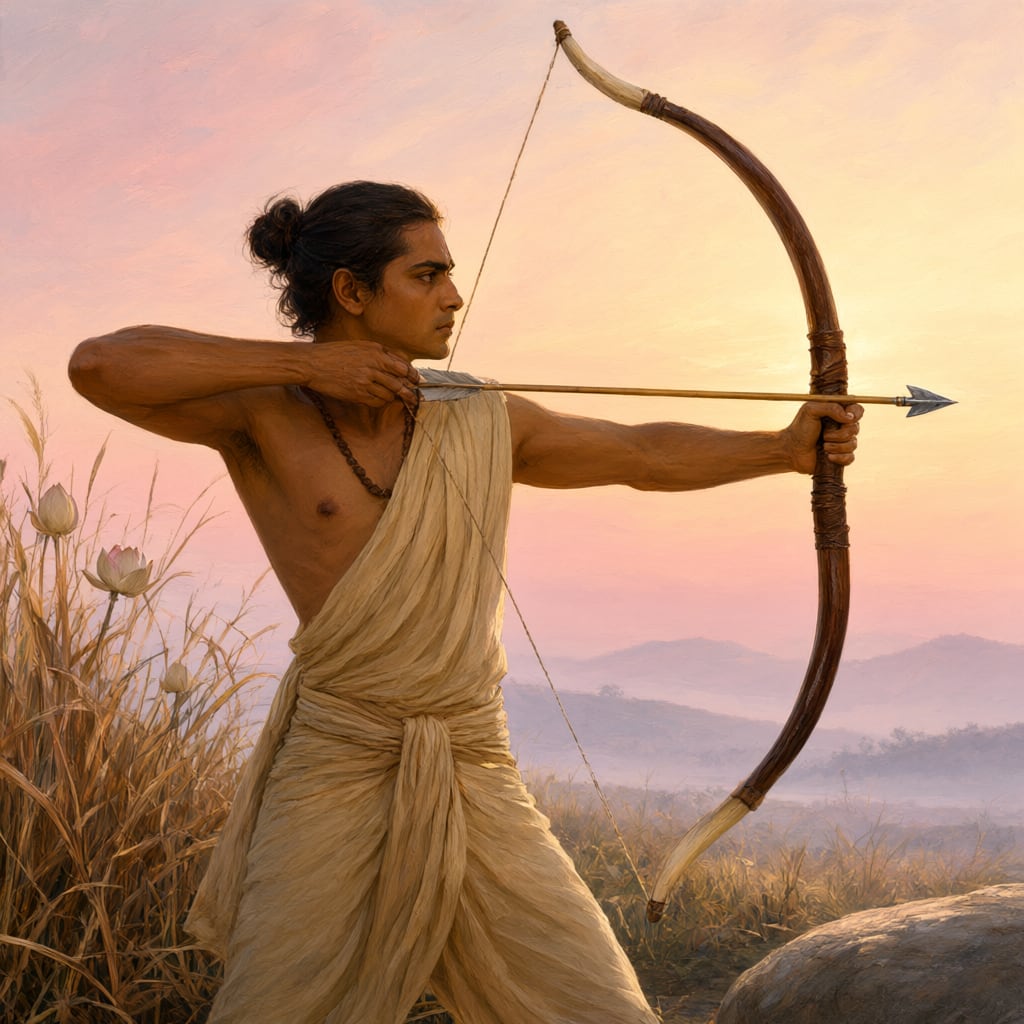
An archer who loved his bow so much that he never let go of the arrow would be missing the point of archery. The verse is warning against exactly that: against falling in love with the practice and forgetting what it was for.
The Praśna Upaniṣad gives its whole fifth chapter to Oṃ. A student called Satyakāma asks what a person gains by meditating on it until death. Pippalāda answers that the syllable is both the lower and the higher Brahman (5.2), and then does something unusual. He grades the outcome. Meditate on one measure and you come back to this world quickly. On two, you reach the lunar realm and still return. On all three, you reach the solar realm, shed what's unclean, and are led to the highest (5.3–5).
That's a striking thing for a scripture to say. It won't promise a fixed reward. The syllable gives back what you bring to it, no more and no less. Muttering it absently isn't the same act as giving it your whole attention, and the text doesn't pretend otherwise.
The Taittirīya Upaniṣad is the shortest on the matter: ॐ इति ब्रह्म, ॐ इतीदं सर्वम् (om iti brahma, om itīdaṃ sarvam), "Oṃ is Brahman; Oṃ is all this" (1.8.1). Then it adds the plain observation that recitation begins with Oṃ and that agreement is given with it, which is still true in any Indian household.
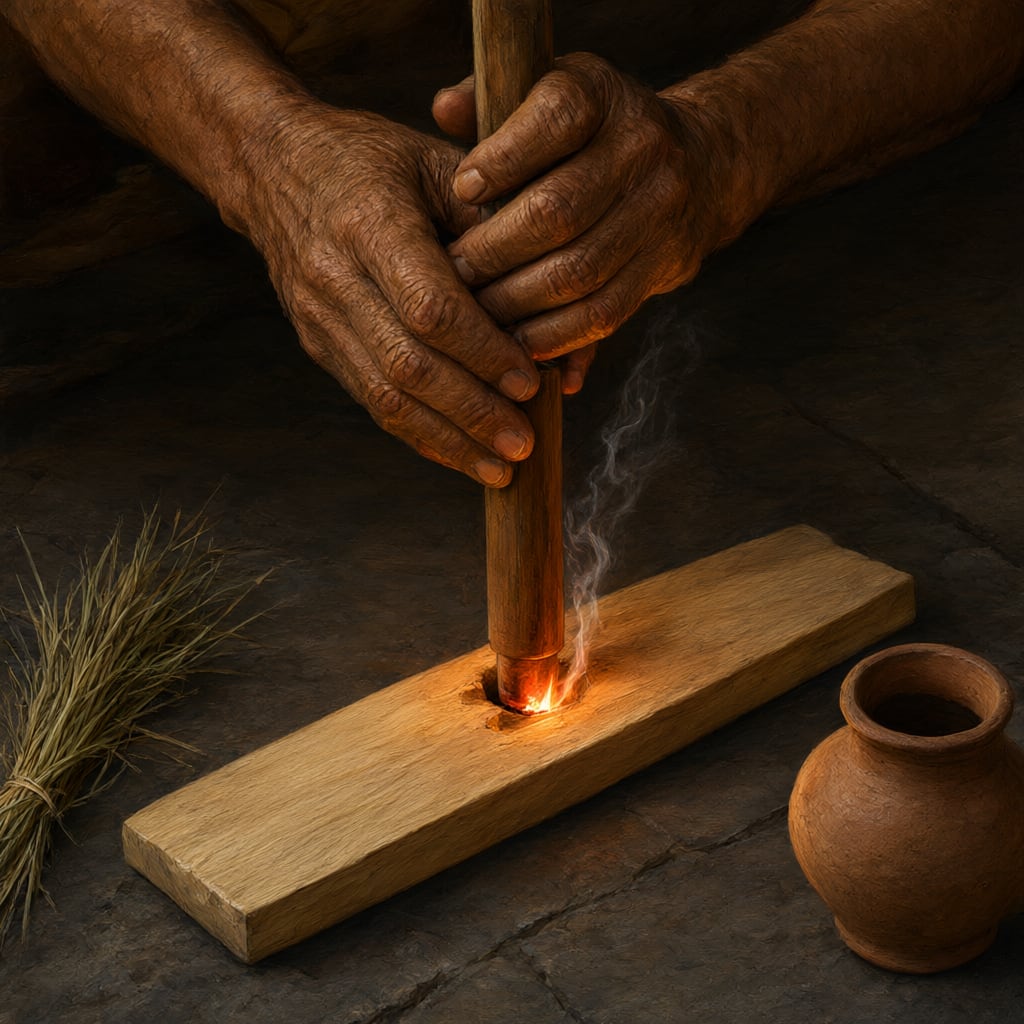
And the Śvetāśvatara Upaniṣad supplies the most practical image of the lot. Take your own body as the lower fire-stick, it says, and Oṃ as the upper one. Rub them together steadily, and see the god hidden inside the way fire is seen hidden in wood (1.13–14).
That image quietly corrects the commonest misunderstanding about practice. Rubbing two sticks doesn't manufacture fire. The fire was latent in the wood the whole time; the friction only brings it out. Applied to Oṃ, the claim isn't that repetition earns you Brahman, or summons it, or accumulates it in you over the years. It uncovers what was never missing. Nobody chants their way into being the Self. They chant their way out of not noticing.
Is Oṃ a name for Brahman, or is it Brahman?
Underneath all of this sits a question that decides what the practice actually is.
Take an ordinary word. "Water" isn't water. You can't drink it, wash in it, or put out a fire with it. It points at water and has no wetness of its own. That gap between a word and its object is normal, and it's complete.
So is Oṃ like that? If it is, chanting is a reminder and nothing more, and the syllable is a label the tradition agreed on, no more sacred in itself than any other set of sounds.
The Upaniṣads take the other view, and this is the part outsiders most often miss. The technical term is शब्दब्रह्म (śabda-brahman), Brahman in the form of sound. The claim is that in this one case the gap isn't there. The name isn't other than what it names.
Patañjali states the relation with a grammarian's economy. तस्य वाचकः प्रणवः (tasya vācakaḥ praṇavaḥ), "its designator is Oṃ" (Yoga Sūtra 1.27), followed straight away by the instruction to repeat it and dwell on its meaning (1.28). In Sanskrit grammar वाचक (vācaka) is the naming word and वाच्य (vācya) is the thing named, and normally they're two different things. The whole force of the sūtra is that here, uniquely, they aren't. The Gītā puts the same point in four words: ॐ इत्येकाक्षरं ब्रह्म (om ityekākṣaraṃ brahma) (8.13).
Whether or not you accept the claim, it's worth seeing that it is a claim, made deliberately and consistently. It's why these texts speak of Oṃ as a support to hold rather than a description to understand. You don't hold a description.
What it all adds up to
Put the passages side by side, written centuries apart, and one position emerges.
The Chāndogya arrives at Oṃ by boiling the Vedas down to what's left. The Kaṭha names it as the goal every Veda points at, and calls it the best thing to hold on to. The Muṇḍaka makes it the bow and tells you not to confuse the bow with the target. The Praśna measures what you get by what you brought. The Taittirīya simply equates it with Brahman and with everything there is. The Śvetāśvatara says the fire was always in the wood.
And the Māṇḍūkya explains why all of these can be true at once. The syllable is built the way you're built: three parts and a silence, three states and the awareness they happen in. That's the whole argument. Not that the sound is powerful, but that it's shaped like the truth about you, which is why attending to it carefully goes somewhere instead of nowhere.
None of these texts asks you to believe in a syllable. They ask you to pay attention to one, and they're unusually precise about where that attention ends up. Not in a vision. Not in an experience you could describe to somebody afterwards. In the recognition that what you were looking for was never absent for a moment, and that the awareness reading this sentence is the same awareness that sat undisturbed through last night's dreamless sleep.
The Māṇḍūkya's closing words are careful about this. It doesn't say one reaches the Self. It says: संविशत्यात्मनाऽऽत्मानम् (saṃviśaty ātmanā''tmānam), one enters the Self by the Self.
ॐ शान्तिः शान्तिः शान्तिः ॥