
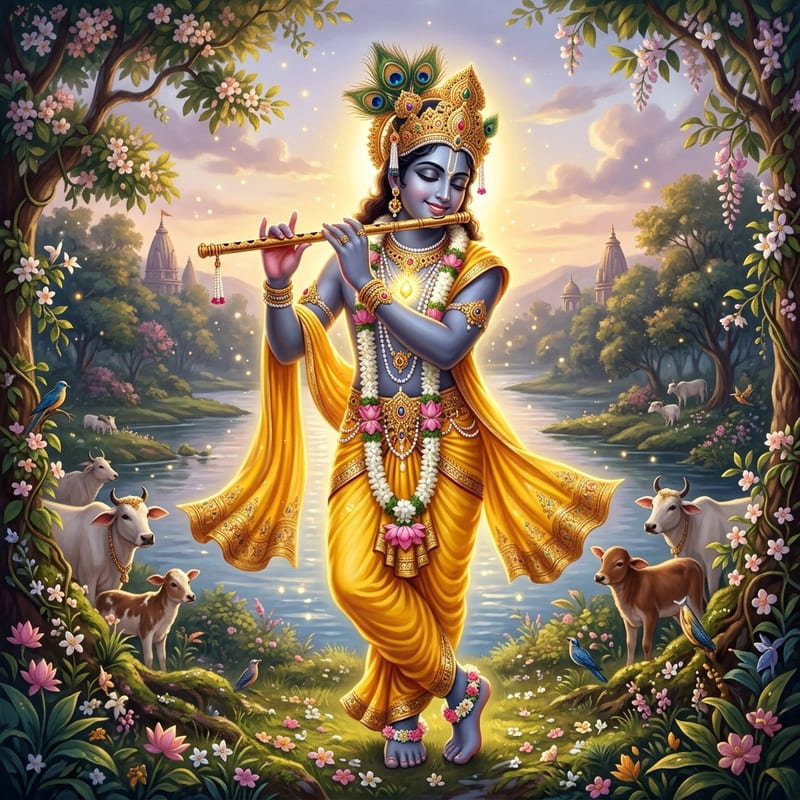
भज गोविन्दं भज गोविन्दं
गोविन्दं भज मूढमते |
सम्प्राप्ते सन्निहिते काले
नहि नहि रक्षति डुकृञ्करणे ‖ 1 ‖
गोविन्दं भज मूढमते |
सम्प्राप्ते सन्निहिते काले
नहि नहि रक्षति डुकृञ्करणे ‖ 1 ‖
- भज गोविन्दं (bhaja govindaṃ)worship Govinda (bhaja:worship | govindaṃ:Govinda, the Lord)
- मूढमते (mūḍhamate)O foolish-minded one (mūḍha:foolish | mate:O mind/intellect)
- सम्प्राप्ते सन्निहिते काले (samprāpte sannihite kāle)when the time has arrived and drawn near (samprāpte:arrived | sannihite:drawn near, imminent | kāle:the time of death)
- नहि नहि रक्षति (nahi nahi rakṣati)it surely does not protect (nahi nahi:surely not, by no means | rakṣati:protects)
- डुकृञ्करणे (ḍukṛñkaraṇe)the rules of grammar, the memorizing of grammatical formulas (ḍukṛñ:the grammatical root-marker for 'to do' | karaṇe:the doing/reciting)
मूढ जहीहि धनागमतृष्णां
कुरु सद्बुद्धिम् मनसि वितृष्णाम् |
यल्लभसे निज कर्मोपात्तं
वित्तं तेन विनोदय चित्तम् ‖ 2 ‖
कुरु सद्बुद्धिम् मनसि वितृष्णाम् |
यल्लभसे निज कर्मोपात्तं
वित्तं तेन विनोदय चित्तम् ‖ 2 ‖
- मूढ (mūḍha)O deluded one
- जहीहि (jahīhi)abandon
- धनागमतृष्णाम् (dhanāgamatṛṣṇām)the thirst for the acquisition of wealth (dhana:wealth | āgama:acquisition | tṛṣṇām:thirst, craving)
- कुरु (kuru)cultivate, make
- सद्बुद्धिम् (sadbuddhim)right understanding (sat:good, true | buddhim:intellect)
- मनसि (manasi)in the mind
- वितृष्णाम् (vitṛṣṇām)free from craving (vi:without | tṛṣṇām:craving)
- यल्लभसे (yallabhase)whatever you obtain (yat:whatever | labhase:you obtain)
- निज कर्मोपात्तम् (nija karmopāttam)acquired through your own actions (nija:one's own | karma:action | upāttam:obtained)
- वित्तम् (vittam)wealth
- तेन (tena)with that
- विनोदय (vinodaya)gladden, delight
- चित्तम् (cittam)the heart, mind
यावद्-वित्तोपार्जन सक्तः
तावन्-निजपरिवारो रक्तः |
पश्चाज्जीवति जर्जर देहे
वार्तां कोऽपि न पृच्छति गेहे ‖ 5 ‖
तावन्-निजपरिवारो रक्तः |
पश्चाज्जीवति जर्जर देहे
वार्तां कोऽपि न पृच्छति गेहे ‖ 5 ‖
- यावत् (yāvat)as long as
- वित्त-उपार्जन-सक्तः (vitta-upārjana-saktaḥ)capable of earning wealth (vitta:wealth | upārjana:earning | saktaḥ:able, engaged)
- तावत् (tāvat)so long
- निज-परिवारः (nija-parivāraḥ)one's own family (nija:one's own | parivāraḥ:family)
- रक्तः (raktaḥ)attached, devoted
- पश्चात् (paścāt)afterward
- जीवति (jīvati)lives on
- जर्जर-देहे (jarjara-dehe)in the frail, decrepit body (jarjara:worn out, decrepit | dehe:in the body)
- वार्ताम् (vārtām)news, tidings of welfare
- कः अपि न (ko'pi na)no one (kaḥ:who | api:even | na:not)
- पृच्छति (pṛcchati)asks
- गेहे (gehe)in the house
यावत्-पवनो निवसति देहे
तावत्-पृच्छति कुशलं गेहे |
गतवति वायौ देहापाये
भार्या बिभ्यति तस्मिन् काये ‖ 6 ‖
तावत्-पृच्छति कुशलं गेहे |
गतवति वायौ देहापाये
भार्या बिभ्यति तस्मिन् काये ‖ 6 ‖
- यावत् (yāvat)as long as
- पवनः (pavanaḥ)the breath, vital air
- निवसति देहे (nivasati dehe)dwells in the body (nivasati:dwells | dehe:in the body)
- तावत् (tāvat)so long
- पृच्छति कुशलम् (pṛcchati kuśalam)inquire after welfare (pṛcchati:asks | kuśalam:well-being)
- गेहे (gehe)in the household
- गतवति वायौ (gatavati vāyau)when the breath has departed (gatavati:having gone | vāyau:the vital air)
- देहापाये (dehāpāye)at the destruction of the body (deha:body | apāye:departure, perishing)
- भार्या बिभ्यति (bhāryā bibhyati)the wife shrinks in fear (bhāryā:wife | bibhyati:fears)
- तस्मिन् काये (tasmin kāye)from that body/corpse (tasmin:that | kāye:body)
मा कुरु धनजन यौवन गर्वं
हरति निमेषात्-कालः सर्वम् |
मायामयमिदम्-अखिलं हित्वा
ब्रह्मपदं त्वं प्रविश विदित्वा ‖ 11 ‖
हरति निमेषात्-कालः सर्वम् |
मायामयमिदम्-अखिलं हित्वा
ब्रह्मपदं त्वं प्रविश विदित्वा ‖ 11 ‖
- मा कुरु (mā kuru)do not make (mā:not | kuru:make)
- धनजन यौवन गर्वम् (dhanajana yauvana garvam)pride in wealth, people, and youth (dhana:wealth | jana:people/followers | yauvana:youth | garvam:pride)
- हरति (harati)takes away
- निमेषात् (nimeṣāt)in an instant, in a moment
- कालः (kālaḥ)Time
- सर्वम् (sarvam)everything
- मायामयम् (māyāmayam)consisting of illusion (māyā:illusion | mayam:made of)
- इदम् अखिलम् (idam akhilam)this entire world (idam:this | akhilam:whole/entire)
- हित्वा (hitvā)having abandoned
- ब्रह्मपदम् (brahmapadam)the state of Brahman (brahma:Brahman | padam:state/abode)
- त्वम् (tvam)you
- प्रविश (praviśa)enter
- विदित्वा (viditvā)having realized/known
सुरमन्दिर तरु मूल निवासः
शय्या भूतलम्-अजिनं वासः |
सर्व परिग्रह भोगत्यागः
कस्य सुखं न करोति विरागः ‖ 19 ‖
शय्या भूतलम्-अजिनं वासः |
सर्व परिग्रह भोगत्यागः
कस्य सुखं न करोति विरागः ‖ 19 ‖
- सुरमन्दिर-तरु-मूल-निवासः (suramandira-taru-mūla-nivāsaḥ)dwelling in a temple of the gods or at the foot of a tree (suramandira:temple of the gods | taru-mūla:root/foot of a tree | nivāsaḥ:dwelling)
- शय्या भूतलम् (śayyā bhūtalam)the ground/earth as one's bed (śayyā:bed | bhūtalam:surface of the earth)
- अजिनं वासः (ajinaṃ vāsaḥ)a deerskin as clothing (ajinam:deerskin | vāsaḥ:garment)
- सर्व-परिग्रह-भोग-त्यागः (sarva-parigraha-bhoga-tyāgaḥ)the renunciation of all possessions and pleasures (sarva:all | parigraha:possessions | bhoga:enjoyments | tyāgaḥ:renunciation)
- कस्य सुखं न करोति (kasya sukhaṃ na karoti)to whom does it not bring happiness (kasya:for whom | sukham:happiness | na karoti:does not make)
- विरागः (virāgaḥ)dispassion, detachment
भगवद्गीता किञ्चिदधीता
गङ्गा जललव कणिका पीता |
सकृदपि येन मुरारी समर्चा
क्रियते तस्य यमेन न चर्चा ‖ 21 ‖
गङ्गा जललव कणिका पीता |
सकृदपि येन मुरारी समर्चा
क्रियते तस्य यमेन न चर्चा ‖ 21 ‖
- भगवद्गीता (bhagavadgītā)the Bhagavad Gita (bhagavat:the Lord | gītā:song)
- किञ्चित् अधीता (kiñcid adhītā)studied even a little (kiñcit:a little | adhītā:has been studied)
- गङ्गा-जललव-कणिका (gaṅgā-jalalava-kaṇikā)a droplet of the Ganga's water (gaṅgā:Ganga | jala-lava:a bit of water | kaṇikā:a tiny drop)
- पीता (pītā)has been drunk
- सकृत् अपि (sakṛd api)even once (sakṛt:once | api:even)
- येन (yena)by whom
- मुरारी समर्चा (murārī samarcā)Murari has been worshipped (murārī:slayer of Mura, Vishnu | samarcā:well worshipped)
- क्रियते (kriyate)is done
- तस्य (tasya)with him
- यमेन न चर्चा (yamena na carcā)Yama holds no argument (yamena:by Yama, lord of death | na:not | carcā:discussion, dispute)
पुनरपि जननं पुनरपि मरणं
पुनरपि जननी जठरे शयनम् |
इह संसारे बहु दुस्तारे
कृपयाऽपारे पाहि मुरारे ‖ 22 ‖
पुनरपि जननी जठरे शयनम् |
इह संसारे बहु दुस्तारे
कृपयाऽपारे पाहि मुरारे ‖ 22 ‖
- पुनरपि जननम् (punarapi jananam)birth again (punar-api:again | jananam:birth)
- पुनरपि मरणम् (punarapi maraṇam)death again (punar-api:again | maraṇam:death)
- पुनरपि जननी-जठरे शयनम् (punarapi jananī-jaṭhare śayanam)again lying in a mother's womb (punar-api:again | jananī:mother | jaṭhare:in the womb | śayanam:lying, resting)
- इह संसारे (iha saṃsāre)in this cycle of worldly existence (iha:here | saṃsāre:in the world of transmigration)
- बहु दुस्तारे (bahu dustāre)very hard to cross over (bahu:very | dustāre:difficult to traverse)
- कृपया अपारे (kṛpayā apāre)with boundless compassion (kṛpayā:by compassion | apāre:boundless)
- पाहि मुरारे (pāhi murāre)protect me, O Murāri (pāhi:protect | murāre:O slayer of Mura, Krishna)
गेयं गीता नाम सहस्रं
ध्येयं श्रीपति रूपम्-अजस्रम् |
नेयं सज्जन सङ्गे चित्तं
देयं दीनजनाय च वित्तम् ‖ 28 ‖
ध्येयं श्रीपति रूपम्-अजस्रम् |
नेयं सज्जन सङ्गे चित्तं
देयं दीनजनाय च वित्तम् ‖ 28 ‖
- गेयम् (geyam)should be sung
- गीता (gītā)the Bhagavad Gītā
- नाम सहस्रम् (nāma sahasram)the thousand names (nāma:name | sahasram:thousand)
- ध्येयम् (dhyeyam)should be meditated upon
- श्रीपति रूपम् (śrīpati rūpam)the form of Śrīpati, the consort of Lakṣmī (śrīpati:lord of Lakṣmī, Viṣṇu | rūpam:form)
- अजस्रम् (ajasram)ceaselessly, constantly
- नेयम् (neyam)should be led
- सज्जन सङ्गे (sajjana saṅge)into the company of the virtuous (sajjana:good people | saṅge:in the company)
- चित्तम् (cittam)the mind
- देयम् (deyam)should be given
- दीनजनाय (dīnajanāya)to the poor and afflicted (dīna:poor, distressed | janāya:to people)
- च (ca)and
- वित्तम् (vittam)wealth
अर्थमनर्थं भावय नित्यं
नास्ति ततः सुख लेशः सत्यम् |
पुत्रादपि धनभाजां भीतिः
सर्वत्रैषा विहिता रीतिः ‖ 30 ‖
नास्ति ततः सुख लेशः सत्यम् |
पुत्रादपि धनभाजां भीतिः
सर्वत्रैषा विहिता रीतिः ‖ 30 ‖
- अर्थम् अनर्थम् (artham anartham)wealth as worthless / calamitous (artham:wealth | anartham:worthless, harmful)
- भावय नित्यम् (bhāvaya nityam)reflect constantly (bhāvaya:contemplate | nityam:always)
- नास्ति (nāsti)there is not
- ततः (tataḥ)from it
- सुख-लेशः (sukha-leśaḥ)the slightest happiness (sukha:happiness | leśaḥ:a trace, particle)
- सत्यम् (satyam)truly
- पुत्रात् अपि (putrāt api)even from one's own son (putrāt:from the son | api:even)
- धनभाजाम् (dhanabhājām)of those who possess wealth (dhana:wealth | bhājām:of the possessors)
- भीतिः (bhītiḥ)fear
- सर्वत्र (sarvatra)everywhere
- एषा (eṣā)this
- विहिता (vihitā)ordained, established
- रीतिः (rītiḥ)the way, custom
गुरु चरणाम्भुज निर्भरभक्तः
संसाराद्-अचिराद्-भव मुक्तः |
सेन्द्रिय मानस नियमादेवं
द्रक्ष्यसि निज हृदयस्थं देवम् ‖ 32 ‖
संसाराद्-अचिराद्-भव मुक्तः |
सेन्द्रिय मानस नियमादेवं
द्रक्ष्यसि निज हृदयस्थं देवम् ‖ 32 ‖
- गुरु-चरणाम्भुज (guru-caraṇāmbhuja)the lotus feet of the Guru (guru:teacher | caraṇa:feet | ambhuja:lotus)
- निर्भरभक्तः (nirbharabhaktaḥ)one of complete devotion (nirbhara:full, wholehearted | bhaktaḥ:devotee)
- संसारात् (saṃsārāt)from the cycle of worldly existence
- अचिरात् (acirāt)soon, before long
- भव मुक्तः (bhava muktaḥ)may you become liberated (bhava:become, be | muktaḥ:freed)
- सेन्द्रिय-मानस (sendriya-mānasa)of the senses and the mind (sa-indriya:together with the senses | mānasa:mind)
- नियमात् (niyamāt)through restraint, discipline
- एवम् (evam)thus, in this way
- द्रक्ष्यसि (drakṣyasi)you shall behold, you will see
- निज-हृदयस्थम् (nija-hṛdayasthaṃ)dwelling within your own heart (nija:one's own | hṛdaya:heart | stham:situated in)
- देवम् (devam)the Divine, God