
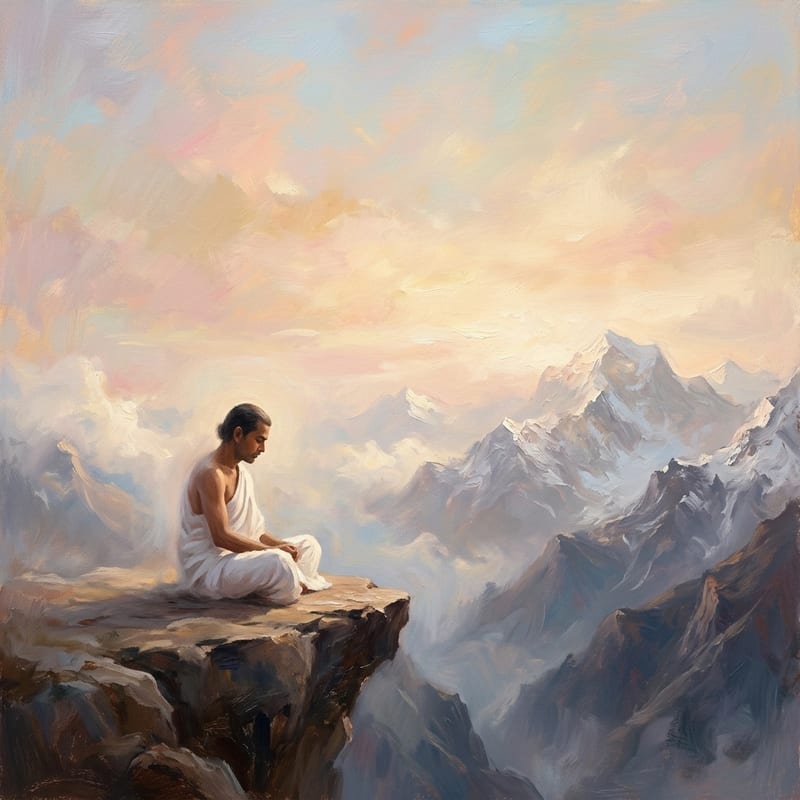
na ca śrotrajihve na ca ghrāṇanetre |
na ca vyoma bhūmirna tejo na vāyuḥ
cidānandarūpaḥ śivo'ham śivo'ham ||1||
- manobuddhyahaṅkāramind, intellect, ego (manas:mind | buddhi:intellect | ahaṅkāra:ego)
- cittānistorehouse of memory and impressions
- nāhaṃI am not [these] (na:not | ahaṃ:I)
- na ca śrotrajihvenor the ears and tongue (na:not | ca:and | śrotra:ears | jihvā:tongue)
- na ca ghrāṇanetrenor the nose and eyes (na:not | ca:and | ghrāṇa:nose | netra:eyes)
- na ca vyomanor the ether (na:not | ca:and | vyoma:ether, sky)
- bhūmirnanor the earth (bhūmi:earth | na:nor)
- tejo na vāyuḥnor fire, nor air (tejaḥ:fire | na:nor | vāyuḥ:air)
- cidānandarūpaḥof the nature of consciousness-bliss (cit:consciousness | ānanda:bliss | rūpaḥ:nature)
- śivo'ham śivo'hamI am Shiva, I am Shiva (śivaḥ:Shiva | aham:I am)
note Key ideas • Antaḥkaraṇa — the inner instrument has four functions: cognition (manas), determination (buddhi), memory (citta), and self-arrogation (ahaṅkāra); the Self is none of these • Pañca-jñānendriya — the five sense organs (ears, tongue, nose, eyes, skin) are instruments of perception; the Self is not any instrument • Pañca-bhūta — the five elements (ether, earth, fire, air, water) constitute all matter; the Self is not made of matter • Cidānanda-rūpa — the Self's nature is pure consciousness (cit) and bliss (ānanda), not any function or form In all these verses the term 'I' stands for the pure Atma. The mind is defined thus in Brihadaranyaka upanishad, 1.5.3 - "Desire, resolve, doubt, faith, lack of faith, steadiness, unsteadiness, shyness, intelligence, fear - all these are nothing but the mind". The idea brought out here is that all emotions are in the mind and not in the Atma. A person identifies himself with his mind when he says, "I desire this", "I have resolved to do this", etc. This verse points out that this identification is wrong and is due to ignorance of the fact that everyone is in reality the Atma or self, which is identical with the supreme Brahman. The question arises, why have the intellect, ego-sense and the chittam been mentioned separately, when they are all included in the mind itself? The reason is that, though the mind is only one, it is given four different names in Vedanta according to the four different functions performed by it. This has been explained by Sri Sankara in Vivekachudamani in slokas 95 and 96 as below: "The one antahkarana or inner organ is known by four different names, manas, buddhi, ahankara and chittam according to the different functions. When the mind cogitates it is called manas. When it comes to a decision it is called buddhi. When it stores memories, it is called chittam. When it identifies itself with each of these functions it is known as ahankara. The manner in which these functions take place can be explained by taking an illustration. I am walking along the road and I see at a distance a person whose gait seems to resemble that of a certain friend of mine, named Raman. I begin to debate whether the person I see at a distance is Raman or not. This function of debating is what is called 'manas'. When he comes nearer and I am able to see his face clearly, I compare it with the memory of the face of Raman stored in my mind. This memory is 'chittam'. If I find that the two tally, I decide that he is Raman and I greet him. This function of deciding is called 'buddhi'. The performer of all these three functions is 'I', which is known as 'ahankara'. The term 'manas' is also generally used to denote all these four collectively, when these distinctions are not intended. By the statement "I am not the mind, etc.", we are asked not to identify ourselves with these activities of the mind and to look upon ourselves as the pure Atma which is actionless and is a mere witness of the activities of the mind. In this way we will not be affected by the joys and sorrows that arise in the mind. In the Bhagavad Gita, 3.27, the Lord says that all actions are performed by the body, mind and senses, but because of delusion everyone thinks that he is the doer. A person identifies himself with his body and his sense organs when he says, "I am stout, I am fair-complexioned, I hear, I taste, I smell, I see, etc". The second line points out that this identification is also wrong and is due to delusion. The body is made up of the five elements, space, air, fire, water, and earth. By denying identification with these in the third line, identification with the physical body is denied. The last line says that we are none other than the supreme Brahman which is existence-consciousness-bliss. The word Siva should not be mistaken to mean Lord Siva. Those who want to attack Advaita interpret this as meaning that Advaita asks the individual to arrogate to himself the status of God Himself. This is a wrong understanding. The term 'Siva' is used here in the same sense as in the Mandukya Upanishad, 7, where it means 'auspiciousness' and denotes the supreme Brahman. The identity declared by Advaita is not between the individual or jiva as such and God. What Advaita says is that the jiva, as well as God, are in reality none but the pure Brahman, with the vesture of the body, mind, and senses in the case of the jiva and Maya in the case of God. These vestures are not real. When these unreal vestures are negated, what remains in both cases is only the pure Brahman. The body and mind have only empirical reality, i.e. they appear to be real only until the dawn of self-knowledge. Atma, which is identical with Brahman, is alone the absolute reality which is eternal and changeless. Thus, the very essence of Advaita Vedanta, namely, the identity of the jivAtma and paramAtma is brought out in this verse and in all the subsequent verses.
na vā saptadhātuḥ na vā pañcakośaḥ |
na vākpāṇipādaṃ na copasthapāyu
cidānandarūpaḥ śivo'ham śivo'ham ||2||
- na ca prāṇasaṃjñaḥnor that known as the vital breath (na:not | ca:and | prāṇa:breath | saṃjñaḥ:known as)
- na vai pañcavāyuḥnor indeed the five vital airs (na:not | vai:indeed | pañca:five | vāyuḥ:airs)
- na vā saptadhātuḥnor the seven bodily constituents (na:not | vā:or | sapta:seven | dhātuḥ:constituents – marrow, fat, flesh, blood, lymph, skin, cuticle)
- na vā pañcakośaḥnor the five sheaths (na:not | vā:or | pañca:five | kośaḥ:sheaths)
- na vākpāṇipādamnor speech, hands, and feet (na:not | vāk:speech | pāṇi:hands | pādam:feet)
- na copasthapāyunor the organs of generation and elimination (na:not | ca:and | upastha:organ of generation | pāyu:organ of elimination)
- cidānandarūpaḥof the nature of consciousness-bliss (cit:consciousness | ānanda:bliss | rūpaḥ:nature)
- śivo'ham śivo'hamI am Shiva, I am Shiva (śivaḥ:Shiva | aham:I am)
note Key ideas • Pañca-vāyu — the five vital forces (prāṇa, apāna, samāna, udāna, vyāna) animate the body but are themselves inert; the Self is not any of these • Sapta-dhātu — according to Āyurveda, the seven bodily constituents (rasa:plasma, rakta:blood, māṃsa:flesh, meda:fat, asthi:bone, majjā:marrow, śukra:reproductive tissue) make up the physical frame; the Self is not the body • Pañca-kośa — the five sheaths (annamaya, prāṇamaya, manomaya, vijñānamaya, ānandamaya) envelop the Self like sheaths around a sword; the Self is not any of them • Pañca-karmendriya — the five organs of action (speech, hands, feet, generation, elimination); the Self is not the agent of action In the very first and second verses, Adi Shankaracharya proclaims that Atman is different from the gross/Stula, subtle/Sukshma and the casual body/Karana sharira of a Jiva. The praana or life breath is given five names in Vedanta according to the five functions performed by it. These are what are spoken of as the five vital airs in this sloka. The five vital airs are praana, vyaana, apaana, samaana, and udaana. These are described in Sri Sankara's Bhashya on Prasnopanishad. 3.5, thus: He (praana) places apaana, a division of himself, in the two lower apertures, as engaged in the work of ejecting the excreta. Praana himself, who occupies the position of the sovereign, resides in the eyes and the ears and issues out through the mouth and nostrils. In the navel is samaana, which is so called because it assimilates all that is eaten or drunk, distributes them equally in all parts of the body and effects digestion. Udaana, another division of praana, moves throughout the body and functions upwards. It leads the soul out of the body at the time of death and takes it to other worlds according to one's punya and paapa. Vyaana regulates praana and apaana and is the cause of actions requiring strength. All these are only air and are therefore insentient. Kathopanishad, 2.2.5 says, "Mortals do not live by praana or apaana, but by something else on which these two depend". They depend on the Atma which is what gives them sentiency. Here we are told not to identify ourselves with the life-breath. The seven dhatus are the constituents of the body such as marrow, fat, flesh, blood, lymph, skin, and the cuticle. The five sheaths: These are described in the Taittiriya Upanishad. The physical body is the outermost sheath. It is called the annamayakosha or sheath of food because it is nourished by food. Within this is the praanamayakosha or sheath of vital air, which is made up of the vital air with its five divisions and the organs of action, namely, speech, hands, feet, the genitals, and the organ of excretion. The next inner sheath is the manomayakosha or sheath of the mind, which is made up of the mind and the five organs of perception, namely, ear, eye, and the senses of smell. taste, and touch. The next sheath is vijnaanamayakosha or the sheath of the intellect. This consists of the intellect or buddhi and the five organs of perception. The innermost sheath is the anandamayakosha or sheath of bliss. This is the primal ignorance or avidya which is the cause of transmigratory existence. These five sheaths constitute the body-mind complex. The instruction is that we should not identify ourselves with these which are all ephemeral and always undergoing changes. The third line says that we are not the five organs of action. The last line is the same as in the first sloka.
mado naiva me naiva mātsaryabhāvaḥ |
na dharmo na cārtho na kāmo na mokṣaḥ
cidānandarūpaḥ śivo'ham śivo'ham ||3||
- na me dveṣarāgauI have neither hatred nor attachment (na:not | me:mine | dveṣa:hatred | rāgau:attachment)
- na me lobhamohaunor greed nor delusion (na:not | me:mine | lobha:greed | mohau:delusion)
- mado naiva meneither is pride mine (madaḥ:pride | naiva:not at all | me:mine)
- naiva mātsaryabhāvaḥnor the feeling of envy (naiva:not at all | mātsarya:envy | bhāvaḥ:feeling)
- na dharmoneither righteousness (na:not | dharmaḥ:righteousness)
- na cārthonor wealth (na:not | ca:and | arthaḥ:wealth)
- na kāmonor desire (na:not | kāmaḥ:desire)
- na mokṣaḥnor liberation (na:not | mokṣaḥ:liberation)
- cidānandarūpaḥof the nature of consciousness-bliss (cit:consciousness | ānanda:bliss | rūpaḥ:nature)
- śivo'ham śivo'hamI am Shiva, I am Shiva (śivaḥ:Shiva | aham:I am)
note Key ideas • Ṣaḍ-ripu — the six inner enemies (kāma, krodha, lobha, moha, mada, mātsarya) are modifications of the mind; the Self is the untouched witness • Catur-puruṣārtha — the four human goals (dharma, artha, kāma, mokṣa) belong to the empirical self; the pure Self transcends all four • Na mokṣaḥ — the deepest point: liberation is not something the Self attains, because the Self was never bound; seeking mokṣa is itself a superimposition on what is already free After explaining that Atman is devoid of any bodies or any sheaths, now Adi Shankaracharya explains about the state of Jnani who has realized Atman. All the emotions such as likes, dislikes, greed, etc., belong to the mind and so the Atma has no connection with them. The rules of Dharma apply only when there is identification with the body-mind complex. The Atma has no desire for wealth or pleasures. The Atma is ever liberated. It is only when the Atma is identified with the body-mind complex that there is the notion of bondage and it is only then that liberation has to be sought. The pure Atma is ever free. A person who has become totally free from identification with his body and mind is already liberated. As far as the Atma itself is concerned, it has neither bondage nor liberation, just as there is neither day nor night in the sun itself.
na mantro na tīrthaṃ na vedā na yajñāḥ |
ahaṃ bhojanaṃ naiva bhojyaṃ na bhoktā
cidānandarūpaḥ śivo'ham śivo'ham ||4||
- na puṇyaṃ na pāpaṃneither merit nor sin (na:not | puṇyaṃ:merit | pāpaṃ:sin)
- na saukhyaṃ na duḥkhaṃneither worldly joy nor sorrow (na:not | saukhyaṃ:worldly joy | duḥkhaṃ:sorrow)
- na mantro na tīrthaṃneither sacred hymn nor holy place (na:not | mantraḥ:sacred hymn | tīrthaṃ:sacred place)
- na vedā na yajñāḥneither the Vedas nor sacrifices (na:not | vedāḥ:sacred scriptures | yajñāḥ:sacrifices)
- ahaṃ bhojanaṃ naiva bhojyaṃ na bhoktāI am not the act of experiencing, nor the object of experience, nor the experiencer (ahaṃ:I | bhojanaṃ:act of experiencing | naiva:not at all | bhojyaṃ:object of experience | na:nor | bhoktā:experiencer)
- cidānandarūpaḥof the nature of consciousness-bliss (cit:consciousness | ānanda:bliss | rūpaḥ:nature)
- śivo'ham śivo'hamI am Shiva, I am Shiva (śivaḥ:Shiva | aham:I am)
note Key ideas • Puṇya-pāpa — merit and sin accrue only to the doer (kartā); the Self is pure witness, never a doer, so karma cannot touch it • Sādhanā — mantra, tīrtha, Veda, and yajña are means for the bound jīva seeking what it lacks; the Self, lacking nothing, has no need of any means • Bhoktṛ-triad — the verse negates the complete experiential triad: the experiencer (bhoktā), the act of experiencing (bhojana), and the object of experience (bhojya); the Self stands outside all three Now this verse continues with the explanations about Jivanmukta and state of Jnana. All these are only for the jiva who identifies himself with his body and mind. The Atma is pure, untainted, and actionless. Once a person has realized that he is the pure Atma, he has no need of mantras, pilgrimage, etc., because there is nothing more to be attained. The joy and sorrow referred to in this sloka are those which arise due to external circumstances. These have a beginning and an end and these pertain only to the mind and not the Atma. The Atma is of the very nature of supreme eternal bliss. I am neither the enjoyed nor the enjoyer, nor enjoyment - What is enjoyed is an object. So this means that the Atma is not an object. The enjoyer is one who performs an action, a doer. So this means that the Atma is not a doer. Enjoyment is an act. Atma is not an act.
pitā naiva me naiva mātā na janmaḥ |
na bandhurna mitraṃ gururnaiva śiṣyaṃ
cidānandarūpaḥ śivo'ham śivo'ham ||5||
- na mṛtyurna śaṅkāneither death nor fear (na:not | mṛtyuḥ:death | na:nor | śaṅkā:fear)
- na me jātibhedaḥnor any distinction of birth or caste (na:not | me:mine | jāti:birth, caste | bhedaḥ:distinction)
- pitā naiva me naiva mātāneither father nor mother is mine (pitā:father | naiva:not at all | me:mine | mātā:mother)
- na janmaḥnor birth (na:not | janmaḥ:birth)
- na bandhurna mitraṃneither kinsman nor friend (na:not | bandhuḥ:kinsman | na:nor | mitraṃ:friend)
- gururnaiva śiṣyaṃneither teacher nor disciple (guruḥ:spiritual teacher | naiva:nor at all | śiṣyaṃ:disciple)
- cidānandarūpaḥof the nature of consciousness-bliss (cit:consciousness | ānanda:bliss | rūpaḥ:nature)
- śivo'ham śivo'hamI am Shiva, I am Shiva (śivaḥ:Shiva | aham:I am)
note Key ideas • Na mṛtyuḥ — the Self was never born, so it cannot die; birth and death belong only to the body • Na śaṅkā — fear arises from duality (Bṛhadāraṇyaka Up. 1.4.2: 'where there is another, there is fear'); in the non-dual Self there is no other, hence no fear • Jāti-bheda — distinctions of birth and caste are superimposed on the body; the Self has no caste, no lineage, no birth • Na guru, na śiṣya — even the most sacred relationship belongs to the realm of appearance; the Self is beyond all relational identities This verse too continues with the description of a state of Jnana. All relationships exist only as long as a person looks upon himself as the body-mind complex. The Atma is eternal and so it has no birth and no death.
vibhutvācca sarvatra sarvendriyāṇām |
na cāsaṅgataṃ naiva muktirna meyaḥ
cidānandarūpaḥ śivo'ham śivo'ham ||6||
- ahaṃ nirvikalpaḥI am beyond thought and mental distinctions (ahaṃ:I | nir:without | vikalpa:thought-modification, distinction)
- nirākārarūpaḥof formless nature (nirākāra:formless | rūpaḥ:form)
- vibhutvāccaand by virtue of all-pervasiveness (vibhutvāt:due to pervasiveness | ca:and)
- sarvatra sarvendriyāṇāmeverywhere, through all the sense organs (sarvatra:everywhere | sarva:all | indriyāṇām:of the sense organs)
- na cāsaṅgataṃneither the unattached (na:not | ca:and | asaṅgataṃ:unattached)
- naiva muktirnanor liberation (naiva:not at all | muktiḥ:liberation | na:nor)
- meyaḥthe object of knowledge (from the root √mā, to measure or know)
- cidānandarūpaḥof the nature of consciousness-bliss (cit:consciousness | ānanda:bliss | rūpaḥ:nature)
- śivo'ham śivo'hamI am Shiva, I am Shiva (śivaḥ:Shiva | aham:I am)
note Key ideas • Nirvikalpa — beyond all thought-modifications (vṛtti) and mental distinctions; pure undifferentiated awareness with no division into subject and object • Nirākāra — without form or attribute; not limited to any name, shape, or quality • Vibhutva — all-pervasiveness; the Self is not confined to any body, yet is present everywhere as the luminous ground behind all sensing • Na āsaṅgatam — the Self has no attachment; even non-attachment is not a quality the Self possesses — it is simply untouched • Na muktiḥ — liberation is not an object the Self attains; the seeking of liberation implies prior bondage, which is a superimposition on what was always free • Na meyaḥ — the Self cannot be an object of knowledge (prameya); it is always the subject, the knower (pramātṛ), never the known After explaining what Atman is not and explaining about the state of Jivanmukta, Adi Shankaracharya now explains what Atman is. In the Paramartika Dasha, Atman is one, without a second, without parts. It is without any limitations of time, space or form. It is one Changeless, that is eternal, infinite and Birth-less. It is devoid of the Universe/Jagat and all its limitations. Yet through its power of Maya, it manifests the Universe as a mirage or imagination. And in such a state of manifestation or Vyavaharika Dasha, Atman inhabits every object, everything in the Universe as their own Self. It is omnipresent and omnipotent and both the material and intelligent cause of the Universe. Adi Shankaracharya concludes the Nirvana Shatakam by repeating that, Atman is Shiva-Auspiciousness which is of the nature of Knowledge and Bliss. The pure Atma is not conditioned or limited by the body and mind. The Atma, being identical with Brahman, is all-pervading and changeless. Bondage is nothing but identification with the body and mind. This is due to ignorance of our real nature. When this ignorance is destroyed by the knowledge of our real nature it will be realized that there never was any bondage at all. It is not as if everyone is in bondage and becomes liberated on attaining self-knowledge. Everyone is in reality none other than the supreme Brahman even before the dawn of self-knowledge. Liberation is not the production of a new state that did not exist earlier. Liberation is only the realization that one has always been Brahman but has been wrongly thinking of himself as a limited being. This can be understood by taking the classic example of the rope being mistaken for a snake. In the presence of light when it is found that there is only a rope, no one will say that there was previously a snake, but now there is only a rope. Similarly, it is wrong to say that there was previously bondage and after the dawn of knowledge there is liberation. In reality, there is neither bondage nor liberation, but both are attributed to the jiva due to ignorance.