
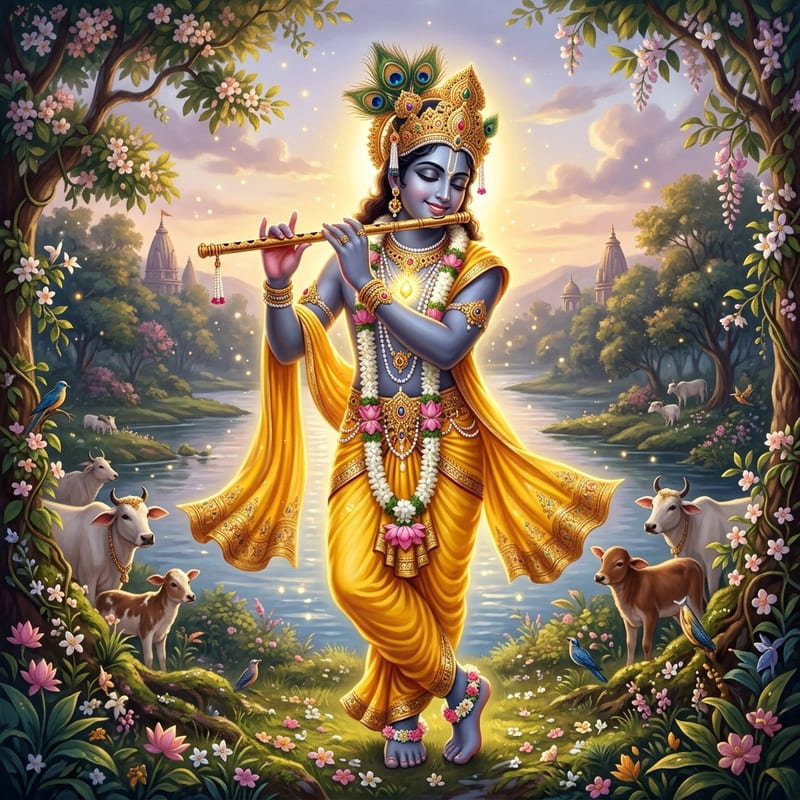
भज गोविन्दं भज गोविन्दं
गोविन्दं भज मूढमते ।
सम्प्राप्ते सन्निहिते काले
नहि नहि रक्षति डुकृङ्करणे ॥ 1 ॥
गोविन्दं भज मूढमते ।
सम्प्राप्ते सन्निहिते काले
नहि नहि रक्षति डुकृङ्करणे ॥ 1 ॥
- भज गोविन्दं (bhaja govindaṃ)worship Govinda (bhaja:worship | govindaṃ:Govinda, the Lord)
- मूढमते (mūḍhamate)O foolish-minded one (mūḍha:foolish | mate:O mind/intellect)
- सम्प्राप्ते सन्निहिते काले (samprāpte sannihite kāle)when the time has arrived and drawn near (samprāpte:arrived | sannihite:drawn near, imminent | kāle:the time of death)
- नहि नहि रक्षति (nahi nahi rakṣati)it surely does not protect (nahi nahi:surely not, by no means | rakṣati:protects)
- डुकृञ्करणे (ḍukṛñkaraṇe)the rules of grammar, the memorizing of grammatical formulas (ḍukṛñ:the grammatical root-marker for 'to do' | karaṇe:the doing/reciting)
भज गोविन्दं भज गोविन्दं ...
मूढ जहीहि धनागमतृष्णां
कुरु सद्बुद्धिं मनसि वितृष्णाम् ।
यल्लभसे निजकर्मोपात्तं
वित्तं तेन विनोदय चित्तम् ॥ 2 ॥
मूढ जहीहि धनागमतृष्णां
कुरु सद्बुद्धिं मनसि वितृष्णाम् ।
यल्लभसे निजकर्मोपात्तं
वित्तं तेन विनोदय चित्तम् ॥ 2 ॥
- मूढ (mūḍha)O deluded one
- जहीहि (jahīhi)abandon
- धनागमतृष्णाम् (dhanāgamatṛṣṇām)the thirst for the acquisition of wealth (dhana:wealth | āgama:acquisition | tṛṣṇām:thirst, craving)
- कुरु (kuru)cultivate, make
- सद्बुद्धिम् (sadbuddhim)right understanding (sat:good, true | buddhim:intellect)
- मनसि (manasi)in the mind
- वितृष्णाम् (vitṛṣṇām)free from craving (vi:without | tṛṣṇām:craving)
- यल्लभसे (yallabhase)whatever you obtain (yat:whatever | labhase:you obtain)
- निज कर्मोपात्तम् (nija karmopāttam)acquired through your own actions (nija:one's own | karma:action | upāttam:obtained)
- वित्तम् (vittam)wealth
- तेन (tena)with that
- विनोदय (vinodaya)gladden, delight
- चित्तम् (cittam)the heart, mind
भज गोविन्दं भज गोविन्दं ...
नारीस्तनभर-नाभीदेशं
दृष्ट्वा मा गा मोहावेशम् ।
एतन्मांसवसादिविकारं
मनसि विचिन्तय वारं वारम् ॥ 3 ॥
नारीस्तनभर-नाभीदेशं
दृष्ट्वा मा गा मोहावेशम् ।
एतन्मांसवसादिविकारं
मनसि विचिन्तय वारं वारम् ॥ 3 ॥
- नारी-स्तनभर-नाभीदेशम् (nārī-stanabhara-nābhīdeśam)a woman's heavy breasts and navel region (nārī:woman | stana-bhara:weight of the breasts | nābhī-deśam:region of the navel)
- दृष्ट्वा (dṛṣṭvā)having seen
- मा गा मोहावेशम् (mā gā mohāveśam)do not fall into infatuation (mā gā:do not go/fall into | moha-āveśam:the grip of delusion)
- एतन्मांस-वसादि-विकारम् (etat-māṃsa-vasādi-vikāram)this is a modification of flesh, fat and the like (etat:this | māṃsa:flesh | vasā-ādi:fat and so on | vikāram:transformation/modification)
- मनसि (manasi)in the mind
- विचिन्तय (vicintaya)reflect, ponder
- वारं वारम् (vāraṃ vāram)again and again
भज गोविन्दं भज गोविन्दं ...
नलिनीदल-गतजलमतितरलं
तद्वज्जीवितमतिशय-चपलम् ।
विद्धि व्याध्यभिमानग्रस्तं
लोकं शोकहतं च समस्तम् ॥ 4 ॥
नलिनीदल-गतजलमतितरलं
तद्वज्जीवितमतिशय-चपलम् ।
विद्धि व्याध्यभिमानग्रस्तं
लोकं शोकहतं च समस्तम् ॥ 4 ॥
- भज गोविन्दं (bhaja govindaṃ)worship Govinda
- नलिनीदलगतजलम् (nalinīdalagatajalam)water resting on a lotus petal
- अतितरलम् (atitaralam)exceedingly unsteady
- तद्वत् (tadvat)even so
- जीवितम् (jīvitam)life
- अतिशयचपलम् (atiśayacapalam)supremely fickle
- विद्धि (viddhi)know
- व्याध्यभिमानग्रस्तम् (vyādhyabhimānagrastam)seized by disease and pride
- लोकम् (lokam)the world
- शोकहतम् (śokahatam)struck by grief
- समस्तम् (samastam)entire
भज गोविन्दं भज गोविन्दं ...
यावद्वित्तोपार्जनसक्तः
तावन्निजपरिवारो रक्तः ।
पश्चाज्जीवति जर्जरदेहे
वार्तां कोऽपि न पृच्छति गेहे ॥ 5 ॥
यावद्वित्तोपार्जनसक्तः
तावन्निजपरिवारो रक्तः ।
पश्चाज्जीवति जर्जरदेहे
वार्तां कोऽपि न पृच्छति गेहे ॥ 5 ॥
- यावत् (yāvat)as long as
- वित्त-उपार्जन-सक्तः (vitta-upārjana-saktaḥ)capable of earning wealth (vitta:wealth | upārjana:earning | saktaḥ:able, engaged)
- तावत् (tāvat)so long
- निज-परिवारः (nija-parivāraḥ)one's own family (nija:one's own | parivāraḥ:family)
- रक्तः (raktaḥ)attached, devoted
- पश्चात् (paścāt)afterward
- जीवति (jīvati)lives on
- जर्जर-देहे (jarjara-dehe)in the frail, decrepit body (jarjara:worn out, decrepit | dehe:in the body)
- वार्ताम् (vārtām)news, tidings of welfare
- कः अपि न (ko'pi na)no one (kaḥ:who | api:even | na:not)
- पृच्छति (pṛcchati)asks
- गेहे (gehe)in the house
भज गोविन्दं भज गोविन्दं ...
यावत्पवनो निवसति देहे
तावत्पृच्छति कुशलं गेहे ।
गतवति वायौ देहापाये
भार्या बिभ्यति तस्मिन्काये ॥ 6 ॥
यावत्पवनो निवसति देहे
तावत्पृच्छति कुशलं गेहे ।
गतवति वायौ देहापाये
भार्या बिभ्यति तस्मिन्काये ॥ 6 ॥
- यावत् (yāvat)as long as
- पवनः (pavanaḥ)the breath, vital air
- निवसति देहे (nivasati dehe)dwells in the body (nivasati:dwells | dehe:in the body)
- तावत् (tāvat)so long
- पृच्छति कुशलम् (pṛcchati kuśalam)inquire after welfare (pṛcchati:asks | kuśalam:well-being)
- गेहे (gehe)in the household
- गतवति वायौ (gatavati vāyau)when the breath has departed (gatavati:having gone | vāyau:the vital air)
- देहापाये (dehāpāye)at the destruction of the body (deha:body | apāye:departure, perishing)
- भार्या बिभ्यति (bhāryā bibhyati)the wife shrinks in fear (bhāryā:wife | bibhyati:fears)
- तस्मिन् काये (tasmin kāye)from that body/corpse (tasmin:that | kāye:body)
भज गोविन्दं भज गोविन्दं ...
बालस्तावत्क्रीडासक्तः
तरुणस्तावत्तरुणीसक्तः ।
वृद्धस्तावच्चिन्तासक्तः
परमे ब्रह्मणि कोऽपि न सक्तः ॥ 7 ॥
बालस्तावत्क्रीडासक्तः
तरुणस्तावत्तरुणीसक्तः ।
वृद्धस्तावच्चिन्तासक्तः
परमे ब्रह्मणि कोऽपि न सक्तः ॥ 7 ॥
- भज गोविन्दं (bhaja govindaṃ)worship Govinda
- बालः (bālaḥ)the boy
- तावत् (tāvat)so long, meanwhile
- क्रीडासक्तः (krīḍāsaktaḥ)attached to play
- तरुणः (taruṇaḥ)the young man
- तरुणीसक्तः (taruṇīsaktaḥ)attached to a young woman
- वृद्धः (vṛddhaḥ)the old man
- चिन्तासक्तः (cintāsaktaḥ)attached to anxiety
- परमे ब्रह्मणि (parame brahmaṇi)in the supreme Brahman
- कः अपि न सक्तः (kaḥ api na saktaḥ)no one is attached
भज गोविन्दं भज गोविन्दं ...
का ते कान्ता कस्ते पुत्रः
संसारोऽयमतीव विचित्रः ।
कस्य त्वं कः कुत आयातः
तत्त्वं चिन्तय तदिह भ्रातः ॥ 8 ॥
का ते कान्ता कस्ते पुत्रः
संसारोऽयमतीव विचित्रः ।
कस्य त्वं कः कुत आयातः
तत्त्वं चिन्तय तदिह भ्रातः ॥ 8 ॥
- का ते कान्ता (kā te kāntā)who is your wife (kā:who | te:your | kāntā:wife)
- कः ते पुत्रः (kaste putraḥ)who is your son (kaḥ:who | te:your | putraḥ:son)
- संसारः अयम् (saṃsāro'yam)this worldly existence (saṃsāraḥ:cycle of existence | ayam:this)
- अतीव विचित्रः (atīva vicitraḥ)exceedingly strange (atīva:exceedingly | vicitraḥ:wondrous, strange)
- कस्य त्वम् (kasya tvaṃ)whose are you (kasya:whose | tvam:you)
- वा कुतः आयातः (vā kuta āyātaḥ)or from where have you come (vā:or | kutaḥ:from where | āyātaḥ:come)
- तत्त्वं चिन्तय (tattvaṃ cintaya)reflect upon the truth (tattvam:the truth, essence | cintaya:reflect, contemplate)
- तत् इह भ्रातः (tadiha bhrātaḥ)that, here, O brother (tat:that | iha:here | bhrātaḥ:O brother)
भज गोविन्दं भज गोविन्दं ...
सत्सङ्गत्वे निस्सङ्गत्वं
निस्सङ्गत्वे निर्मोहत्वम् ।
निर्मोहत्वे निश्चलतत्त्वं
निश्चलतत्त्वे जीवन्मुक्तिः ॥ 9 ॥
सत्सङ्गत्वे निस्सङ्गत्वं
निस्सङ्गत्वे निर्मोहत्वम् ।
निर्मोहत्वे निश्चलतत्त्वं
निश्चलतत्त्वे जीवन्मुक्तिः ॥ 9 ॥
- सत्सङ्गत्वे (satsaṅgatve)in the company of the good (sat:the good/truth | saṅgatve:in association)
- निस्सङ्गत्वम् (nissaṅgatvam)non-attachment (nis:free from | saṅgatvam:attachment)
- निस्सङ्गत्वे (nissaṅgatve)in non-attachment
- निर्मोहत्वम् (nirmohatvam)freedom from delusion (nir:free from | mohatvam:delusion)
- निर्मोहत्वे (nirmohatve)in freedom from delusion
- निश्चलतत्त्वम् (niścalatattvam)the unwavering Reality (niścala:unmoving/steady | tattvam:essential Reality)
- निश्चलतत्त्वे (niścalatattve)in the unwavering Reality
- जीवन्मुक्तिः (jīvanmuktiḥ)liberation while living (jīvan:while alive | muktiḥ:liberation)
भज गोविन्दं भज गोविन्दं ...
वयसि गते कः कामविकारः
शुष्के नीरे कः कासारः ।
क्षीणे वित्ते कः परिवारः
ज्ञाते तत्त्वे कः संसारः ॥ 10 ॥
वयसि गते कः कामविकारः
शुष्के नीरे कः कासारः ।
क्षीणे वित्ते कः परिवारः
ज्ञाते तत्त्वे कः संसारः ॥ 10 ॥
- वयसि गते (vayasi gate)when youth/age has passed (vayasi:in age/youth | gate:gone)
- कः कामविकारः (kaḥ kāmavikāraḥ)what use is the excitement of desire (kaḥ:what/where | kāma:desire | vikāraḥ:agitation/passion)
- शुष्के नीरे (śuṣke nīre)when the water is dried up (śuṣke:dried | nīre:water)
- कः कासारः (kaḥ kāsāraḥ)where is the lake
- क्षीणे वित्ते (kṣīṇe vitte)when wealth is diminished (kṣīṇe:diminished | vitte:wealth)
- कः परिवारः (kaḥ parivāraḥ)where is the retinue/family
- ज्ञाते तत्त्वे (jñāte tattve)when the Truth is known (jñāte:known | tattve:the essential reality)
- कः संसारः (kaḥ saṃsāraḥ)where is worldly existence
भज गोविन्दं भज गोविन्दं ...
मा कुरु धन-जन-यौवन-गर्वं
हरति निमेषात्कालः सर्वम् ।
मायामयमिदमखिलं हित्वा
ब्रह्मपदं त्वं प्रविश विदित्वा ॥ 11 ॥
मा कुरु धन-जन-यौवन-गर्वं
हरति निमेषात्कालः सर्वम् ।
मायामयमिदमखिलं हित्वा
ब्रह्मपदं त्वं प्रविश विदित्वा ॥ 11 ॥
- भज गोविन्दं (bhaja govindaṃ)worship Govinda
- मा कुरु (mā kuru)do not make
- धनजनयौवनगर्वम् (dhanajanayauvanagarvam)pride in wealth, kin and youth
- हरति (harati)carries off
- निमेषात् (nimeṣāt)in a blink
- कालः (kālaḥ)Time
- सर्वम् (sarvam)everything
- मायामयम् (māyāmayam)made of illusion
- इदम् अखिलम् (idam akhilam)all this
- हित्वा (hitvā)having abandoned
- ब्रह्मपदम् (brahmapadam)the state of Brahman
- प्रविश (praviśa)enter
- विदित्वा (viditvā)having known
भज गोविन्दं भज गोविन्दं ...
दिनयामिन्यौ सायं प्रातः
शिशिरवसन्तौ पुनरायातः ।
कालः क्रीडति गच्छत्यायुः
तदपि न मुञ्चत्याशावायुः ॥ 12 ॥
दिनयामिन्यौ सायं प्रातः
शिशिरवसन्तौ पुनरायातः ।
कालः क्रीडति गच्छत्यायुः
तदपि न मुञ्चत्याशावायुः ॥ 12 ॥
- दिन-यामिन्यौ (dina-yāminyau)day and night (dina:day | yāminyau:the two nights)
- सायं प्रातः (sāyaṃ prātaḥ)evening and morning (sāyam:evening | prātaḥ:morning)
- शिशिर-वसन्तौ (śiśira-vasantau)winter and spring (śiśira:winter | vasantau:spring)
- पुनः आयातः (punaḥ āyātaḥ)come again (punaḥ:again | āyātaḥ:they come)
- कालः क्रीडति (kālaḥ krīḍati)time plays on (kālaḥ:time | krīḍati:plays)
- गच्छति आयुः (gacchati āyuḥ)life goes away (gacchati:goes | āyuḥ:lifespan)
- तदपि (tadapi)yet even so (tat:that | api:even)
- न मुञ्चति (na muñcati)does not release (na:not | muñcati:releases)
- आशा-वायुः (āśā-vāyuḥ)the wind of desire (āśā:desire, hope | vāyuḥ:wind, gust)
भज गोविन्दं भज गोविन्दं ...
का ते कान्ता धनगतचिन्ता
वातुल किं तव नास्ति नियन्ता ।
त्रिजगति सज्जनसङ्गतिरेका
भवति भवार्णवतरणे नौका ॥ 13 ॥
का ते कान्ता धनगतचिन्ता
वातुल किं तव नास्ति नियन्ता ।
त्रिजगति सज्जनसङ्गतिरेका
भवति भवार्णवतरणे नौका ॥ 13 ॥
- का ते कान्ता (kā te kāntā)who is your wife (kā:who | te:your | kāntā:wife)
- धन गत चिन्ता (dhana gata cintā)anxiety over wealth (dhana:wealth | gata:concerning | cintā:worry)
- वातुल (vātula)O deluded/mad one
- किं तव नास्ति नियन्ता (kiṃ tava nāsti niyantā)is there not a ruler for you (kiṃ:whether | tava:for you | nāsti:is not | niyantā:controller, ruler)
- त्रिजगति (trijagati)in the three worlds (tri:three | jagati:worlds)
- सज्जन सङ्गतिः एका (sajjana saṅgatiḥ ekā)the company of the good alone (sajjana:good people | saṅgatiḥ:company | ekā:alone)
- भवति (bhavati)becomes
- भवार्णव तरणे नौका (bhavārṇava taraṇe naukā)the boat for crossing the ocean of existence (bhava:worldly existence | arṇava:ocean | taraṇe:in crossing | naukā:boat)
भज गोविन्दं भज गोविन्दं ...
द्वादश-मञ्जरिकाभिरशेषः
कथितो वैयाकरणस्यैषः ।
उपदेशोऽभूद्विद्या-निपुणैः
श्रीमच्छङ्कर-भगवच्छरणैः ॥ 14 ॥
द्वादश-मञ्जरिकाभिरशेषः
कथितो वैयाकरणस्यैषः ।
उपदेशोऽभूद्विद्या-निपुणैः
श्रीमच्छङ्कर-भगवच्छरणैः ॥ 14 ॥
- द्वादश-मञ्जरिकाभिः (dvādaśa-mañjarikābhiḥ)with twelve flower-clusters of verse (dvādaśa:twelve | mañjarikābhiḥ:with little blossoms/verse-bunches)
- अशेषः (aśeṣaḥ)complete, without remainder
- कथितः (kathitaḥ)has been told
- वैयाकरणस्य (vaiyākaraṇasya)for the grammarian
- एषः (eṣaḥ)this
- उपदेशः (upadeśaḥ)instruction, teaching
- अभूत् (abhūt)was, came to be
- विद्या-निपुणैः (vidyā-nipuṇaiḥ)by one skilled in knowledge (vidyā:knowledge | nipuṇaiḥ:by the adept)
- श्रीमत्-शङ्कर-भगवत्-शरणैः (śrīmat-śaṅkara-bhagavat-śaraṇaiḥ)by the venerable Śaṅkara Bhagavatpāda, the refuge (śrīmat:venerable/glorious | śaṅkara:Śaṅkara | bhagavat:the divine lord | śaraṇaiḥ:by the refuge-giver)
भज गोविन्दं भज गोविन्दं ...
जटिलो मुण्डी लुञ्छितकेशः
काषायाम्बर-बहुकृतवेषः ।
पश्यन्नपि च न पश्यति मूढः
उदरनिमित्तं बहुकृतवेषः ॥ 15 ॥
जटिलो मुण्डी लुञ्छितकेशः
काषायाम्बर-बहुकृतवेषः ।
पश्यन्नपि च न पश्यति मूढः
उदरनिमित्तं बहुकृतवेषः ॥ 15 ॥
- भज गोविन्दं (bhaja govindaṃ)worship Govinda
- जटिलः (jaṭilaḥ)wearing matted hair
- मुण्डी (muṇḍī)shaven-headed
- लुञ्छितकेशः (luñchitakeśaḥ)with hair plucked out
- काषायाम्बरबहुकृतवेषः (kāṣāyāmbarabahukṛtaveṣaḥ)making many guises with ochre cloth
- पश्यन् अपि (paśyan api)though seeing
- न पश्यति (na paśyati)does not see
- मूढः (mūḍhaḥ)the fool
- उदरनिमित्तम् (udaranimittam)for the sake of the belly
भज गोविन्दं भज गोविन्दं ...
अङ्गं गलितं पलितं मुण्डं
दशनविहीनं जातं तुण्डम् ।
वृद्धो याति गृहीत्वा दण्डं
तदपि न मुञ्चत्याशापिण्डम् ॥ 16 ॥
अङ्गं गलितं पलितं मुण्डं
दशनविहीनं जातं तुण्डम् ।
वृद्धो याति गृहीत्वा दण्डं
तदपि न मुञ्चत्याशापिण्डम् ॥ 16 ॥
- अङ्गं गलितं (aṅgaṃ galitaṃ)the body has decayed/grown feeble (aṅgam:body | galitam:worn away)
- पलितं मुण्डं (palitaṃ muṇḍaṃ)the head has turned gray (palitam:gray-haired | muṇḍam:head)
- दशन विहीनं जातं तुण्डम् (daśana vihīnaṃ jātaṃ tuṇḍam)the mouth has become devoid of teeth (daśana:teeth | vihīnam:bereft of | jātam:has become | tuṇḍam:mouth)
- वृद्धो याति (vṛddho yāti)the old man walks/goes about (vṛddhaḥ:old man | yāti:goes)
- गृहीत्वा दण्डं (gṛhītvā daṇḍaṃ)having grasped a staff (gṛhītvā:having taken | daṇḍam:staff)
- तदपि (tadapi)even then (tat:that | api:even)
- न मुञ्चति (na muñcati)does not release (na:not | muñcati:lets go)
- आशा पिण्डम् (āśā piṇḍam)the lump/mass of desire (āśā:hope/desire | piṇḍam:lump)
भज गोविन्दं भज गोविन्दं ...
अग्रे वह्निः पृष्ठे भानुः
रात्रौ चुबुक-समर्पित-जानुः ।
करतल-भिक्षस्तरुतलवासः
तदपि न मुञ्चत्याशापाशः ॥ 17 ॥
अग्रे वह्निः पृष्ठे भानुः
रात्रौ चुबुक-समर्पित-जानुः ।
करतल-भिक्षस्तरुतलवासः
तदपि न मुञ्चत्याशापाशः ॥ 17 ॥
- अग्रे वह्निः (agre vahniḥ)fire in front (agre:in front | vahniḥ:fire)
- पृष्ठे भानुः (pṛṣṭhe bhānuḥ)the sun at the back (pṛṣṭhe:behind, at the back | bhānuḥ:the sun)
- रात्रौ (rātrau)at night
- चुबुक-समर्पित-जानुः (cubuka-samarpita-jānuḥ)with knees drawn up to the chin (cubuka:chin | samarpita:offered, placed against | jānuḥ:knees)
- करतल-भिक्षः (karatala-bhikṣaḥ)alms received in the palm of the hand (karatala:palm of the hand | bhikṣaḥ:begged food, alms)
- तरुतल-वासः (tarutala-vāsaḥ)dwelling at the foot of a tree (taru:tree | tala:base, foot | vāsaḥ:dwelling)
- तदपि (tadapi)even then, in spite of that (tat:that | api:even)
- न मुञ्चति (na muñcati)does not release (na:not | muñcati:releases)
- आशा-पाशः (āśā-pāśaḥ)the noose of desire (āśā:desire, hope | pāśaḥ:noose, bond)
भज गोविन्दं भज गोविन्दं ...
कुरुते गङ्गासागरगमनं
व्रत-परिपालनमथवा दानम् ।
ज्ञानविहीनः सर्वमतेन
भजति न मुक्तिं जन्मशतेन ॥ 18 ॥
कुरुते गङ्गासागरगमनं
व्रत-परिपालनमथवा दानम् ।
ज्ञानविहीनः सर्वमतेन
भजति न मुक्तिं जन्मशतेन ॥ 18 ॥
- भज गोविन्दं (bhaja govindaṃ)worship Govinda
- कुरुते (kurute)performs
- गङ्गासागरगमनम् (gaṅgāsāgaragamanam)the journey to the confluence of Gaṅgā and the sea
- व्रतपरिपालनम् (vrataparipālanam)the keeping of vows
- अथवा (athavā)or else
- दानम् (dānam)charity
- ज्ञानविहीनः (jñānavihīnaḥ)devoid of knowledge
- सर्वमतेन (sarvamatena)by the reckoning of every school
- भजति न मुक्तिम् (bhajati na muktim)does not attain liberation
- जन्मशतेन (janmaśatena)in a hundred births
भज गोविन्दं भज गोविन्दं ...
सुरमन्दिर-तरु-मूल-निवासः
शय्या भूतलमजिनं वासः ।
सर्व-परिग्रह-भोगत्यागः
कस्य सुखं न करोति विरागः ॥ 19 ॥
सुरमन्दिर-तरु-मूल-निवासः
शय्या भूतलमजिनं वासः ।
सर्व-परिग्रह-भोगत्यागः
कस्य सुखं न करोति विरागः ॥ 19 ॥
- भज गोविन्दं (bhaja govindaṃ)worship Govinda
- सुरमन्दिरतरुमूलनिवासः (suramandirataramūlanivāsaḥ)dwelling at a tree-root by a temple
- शय्या भूतलम् (śayyā bhūtalam)the ground for a bed
- अजिनम् वासः (ajinam vāsaḥ)a hide for clothing
- सर्वपरिग्रहभोगत्यागः (sarvaparigrahabhogatyāgaḥ)renunciation of all possession and enjoyment
- कस्य (kasya)whose
- सुखम् (sukham)happiness
- न करोति (na karoti)does it not make
- विरागः (virāgaḥ)dispassion
भज गोविन्दं भज गोविन्दं ...
योगरतो वा भोगरतो वा
सङ्गरतो वा सङ्गविहीनः ।
यस्य ब्रह्मणि रमते चित्तं
नन्दति नन्दति नन्दत्येव ॥ 20 ॥
योगरतो वा भोगरतो वा
सङ्गरतो वा सङ्गविहीनः ।
यस्य ब्रह्मणि रमते चित्तं
नन्दति नन्दति नन्दत्येव ॥ 20 ॥
- योगरतः (yogarataḥ)devoted to yoga (yoga:yoga | rataḥ:devoted)
- वा (vā)or
- भोगरतः (bhogarataḥ)devoted to enjoyment (bhoga:enjoyment | rataḥ:devoted)
- वा (vā)or
- सङ्गरतः (saṅgarataḥ)delighting in company/attachment (saṅga:company | rataḥ:delighting)
- वा (vā)or
- सङ्गविहीनः (saṅgavihīnaḥ)free of attachment (saṅga:attachment | vihīnaḥ:devoid of)
- यस्य (yasya)whose
- ब्रह्मणि (brahmaṇi)in Brahman
- रमते चित्तम् (ramate cittam)the mind delights (ramate:delights | cittam:the mind)
- नन्दति नन्दति नन्दति एव (nandati nandati nandati eva)he rejoices, rejoices, truly rejoices indeed (nandati:he rejoices | eva:indeed)
भज गोविन्दं भज गोविन्दं ...
भगवद्गीता किञ्चिदधीता
गङ्गाजल-लवकणिका पीता ।
सकृदपि येन मुरारिसमर्चा
क्रियते तस्य यमेन न चर्चा ॥ 21 ॥
भगवद्गीता किञ्चिदधीता
गङ्गाजल-लवकणिका पीता ।
सकृदपि येन मुरारिसमर्चा
क्रियते तस्य यमेन न चर्चा ॥ 21 ॥
- भगवद्गीता (bhagavadgītā)the Bhagavad Gita (bhagavat:the Lord | gītā:song)
- किञ्चित् अधीता (kiñcid adhītā)studied even a little (kiñcit:a little | adhītā:has been studied)
- गङ्गा-जललव-कणिका (gaṅgā-jalalava-kaṇikā)a droplet of the Ganga's water (gaṅgā:Ganga | jala-lava:a bit of water | kaṇikā:a tiny drop)
- पीता (pītā)has been drunk
- सकृत् अपि (sakṛd api)even once (sakṛt:once | api:even)
- येन (yena)by whom
- मुरारी समर्चा (murārī samarcā)Murari has been worshipped (murārī:slayer of Mura, Vishnu | samarcā:well worshipped)
- क्रियते (kriyate)is done
- तस्य (tasya)with him
- यमेन न चर्चा (yamena na carcā)Yama holds no argument (yamena:by Yama, lord of death | na:not | carcā:discussion, dispute)
भज गोविन्दं भज गोविन्दं ...
पुनरपि जननं पुनरपि मरणं
पुनरपि जननीजठरे शयनम् ।
इह संसारे बहुदुस्तारे
कृपयाऽपारे पाहि मुरारे ॥ 22 ॥
पुनरपि जननं पुनरपि मरणं
पुनरपि जननीजठरे शयनम् ।
इह संसारे बहुदुस्तारे
कृपयाऽपारे पाहि मुरारे ॥ 22 ॥
- पुनरपि जननम् (punarapi jananam)birth again (punar-api:again | jananam:birth)
- पुनरपि मरणम् (punarapi maraṇam)death again (punar-api:again | maraṇam:death)
- पुनरपि जननी-जठरे शयनम् (punarapi jananī-jaṭhare śayanam)again lying in a mother's womb (punar-api:again | jananī:mother | jaṭhare:in the womb | śayanam:lying, resting)
- इह संसारे (iha saṃsāre)in this cycle of worldly existence (iha:here | saṃsāre:in the world of transmigration)
- बहु दुस्तारे (bahu dustāre)very hard to cross over (bahu:very | dustāre:difficult to traverse)
- कृपया अपारे (kṛpayā apāre)with boundless compassion (kṛpayā:by compassion | apāre:boundless)
- पाहि मुरारे (pāhi murāre)protect me, O Murāri (pāhi:protect | murāre:O slayer of Mura, Krishna)
भज गोविन्दं भज गोविन्दं ...
रथ्याचर्पट-विरचित-कन्थः
पुण्यापुण्य-विवर्जित-पन्थः ।
योगी योगनियोजित-चित्तः
रमते बालोन्मत्तवदेव ॥ 23 ॥
रथ्याचर्पट-विरचित-कन्थः
पुण्यापुण्य-विवर्जित-पन्थः ।
योगी योगनियोजित-चित्तः
रमते बालोन्मत्तवदेव ॥ 23 ॥
- रथ्या-चर्पट-विरचित-कन्थः (rathyā-carpaṭa-viracita-kanthaḥ)wearing a patched cloak stitched from rags gathered in the streets (rathyā:street | carpaṭa:rags/tatters | viracita:fashioned | kanthaḥ:patched garment)
- पुण्यापुण्य-विवर्जित-पन्थः (puṇyāpuṇya-vivarjita-panthaḥ)following a path free from merit and demerit (puṇya:merit | apuṇya:demerit | vivarjita:free from | panthaḥ:path)
- योगी (yogī)the yogi
- योग-नियोजित-चित्तः (yoga-niyojita-cittaḥ)with mind fixed in yoga (yoga:union | niyojita:engaged/fixed | cittaḥ:mind)
- रमते (ramate)delights, rejoices
- बाल-उन्मत्तवत् एव (bāla-unmattavat eva)just like a child or a madman (bāla:child | unmattavat:like one intoxicated/mad | eva:indeed)
भज गोविन्दं भज गोविन्दं ...
कस्त्वं कोऽहं कुत आयातः
का मे जननी को मे तातः ।
इति परिभावय सर्वमसारं
विश्वं त्यक्त्वा स्वप्नविचारम् ॥ 24 ॥
कस्त्वं कोऽहं कुत आयातः
का मे जननी को मे तातः ।
इति परिभावय सर्वमसारं
विश्वं त्यक्त्वा स्वप्नविचारम् ॥ 24 ॥
- भज गोविन्दं (bhaja govindaṃ)worship Govinda
- कः त्वम् (kaḥ tvam)who are you
- कः अहम् (kaḥ aham)who am I
- कुतः आयातः (kutaḥ āyātaḥ)whence come
- का मे जननी (kā me jananī)who is my mother
- कः मे तातः (kaḥ me tātaḥ)who my father
- इति परिभावय (iti paribhāvaya)reflect thus
- सर्वम् असारम् (sarvam asāram)all is without essence
- विश्वम् त्यक्त्वा (viśvam tyaktvā)abandoning the world
- स्वप्नविचारम् (svapnavicāram)as the consideration of a dream
भज गोविन्दं भज गोविन्दं ...
त्वयि मयि चान्यत्रैको विष्णुः
व्यर्थं कुप्यसि मय्यसहिष्णुः ।
भव समचित्तः सर्वत्र त्वं
वाञ्छस्यचिराद्यदि विष्णुत्वम् ॥ 25 ॥
त्वयि मयि चान्यत्रैको विष्णुः
व्यर्थं कुप्यसि मय्यसहिष्णुः ।
भव समचित्तः सर्वत्र त्वं
वाञ्छस्यचिराद्यदि विष्णुत्वम् ॥ 25 ॥
- भज गोविन्दं (bhaja govindaṃ)worship Govinda
- त्वयि मयि (tvayi mayi)in you and in me
- अन्यत्र (anyatra)elsewhere
- एकः विष्णुः (ekaḥ viṣṇuḥ)one Viṣṇu
- व्यर्थम् (vyartham)to no purpose
- कुप्यसि (kupyasi)you are angry
- असहिष्णुः (asahiṣṇuḥ)impatient
- भव समचित्तः (bhava samacittaḥ)be even-minded
- सर्वत्र (sarvatra)everywhere
- वाञ्छसि (vāñchasi)you wish
- अचिरात् (acirāt)before long
- विष्णुत्वम् (viṣṇutvam)the state of Viṣṇu
भज गोविन्दं भज गोविन्दं ...
शत्रौ मित्रे पुत्रे बन्धौ
मा कुरु यत्नं विग्रहसन्धौ ।
सर्वस्मिन्नपि पश्यात्मानं
सर्वत्रोत्सृज भेदाज्ञानम् ॥ 26 ॥
शत्रौ मित्रे पुत्रे बन्धौ
मा कुरु यत्नं विग्रहसन्धौ ।
सर्वस्मिन्नपि पश्यात्मानं
सर्वत्रोत्सृज भेदाज्ञानम् ॥ 26 ॥
- शत्रौ (śatrau)toward an enemy
- मित्रे (mitre)toward a friend
- पुत्रे (putre)toward a son
- बन्धौ (bandhau)toward a kinsman
- मा कुरु यत्नम् (mā kuru yatnaṃ)make no effort (mā:do not | kuru:make | yatnaṃ:effort)
- विग्रह-सन्धौ (vigraha-sandhau)in strife or alliance (vigraha:conflict | sandhau:peace/alliance)
- सर्वस्मिन् अपि (sarvasmin api)in all beings too (sarvasmin:in all | api:even)
- पश्य आत्मानम् (paśya ātmānaṃ)see the Self (paśya:see | ātmānaṃ:the Self)
- सर्वत्र (sarvatra)everywhere
- उत्सृज (utsṛja)cast off
- भेद-अज्ञानम् (bheda-ajñānam)the ignorance of separateness (bheda:difference | ajñānam:ignorance)
भज गोविन्दं भज गोविन्दं ...
कामं क्रोधं लोभं मोहं
त्यक्त्वाऽऽत्मानं पश्यति सोऽहम् ।
आत्मज्ञानविहीना मूढाः
ते पच्यन्ते नरकनिगूढाः ॥ 27 ॥
कामं क्रोधं लोभं मोहं
त्यक्त्वाऽऽत्मानं पश्यति सोऽहम् ।
आत्मज्ञानविहीना मूढाः
ते पच्यन्ते नरकनिगूढाः ॥ 27 ॥
- कामम् (kāmam)desire
- क्रोधम् (krodham)anger
- लोभम् (lobham)greed
- मोहम् (moham)delusion
- त्यक्त्वा (tyaktvā)having abandoned
- आत्मानं पश्यति (ātmānaṃ paśyati)one beholds the Self (ātmānaṃ:the Self | paśyati:sees)
- सोऽहम् (so'ham)'I am That' (saḥ:that | aham:I am)
- आत्मज्ञान-विहीनाः (ātmajñāna-vihīnāḥ)devoid of Self-knowledge (ātma:Self | jñāna:knowledge | vihīnāḥ:bereft of)
- मूढाः (mūḍhāḥ)the fools
- ते पच्यन्ते (te pacyante)they are cooked/tormented (te:they | pacyante:are cooked)
- नरक-निगूढाः (naraka-nigūḍhāḥ)hidden away in hell (naraka:hell | nigūḍhāḥ:concealed, buried)
भज गोविन्दं भज गोविन्दं ...
गेयं गीता-नामसहस्रं
ध्येयं श्रीपति-रूपमजस्रम् ।
नेयं सज्जन-सङ्गे चित्तं
देयं दीनजनाय च वित्तम् ॥ 28 ॥
गेयं गीता-नामसहस्रं
ध्येयं श्रीपति-रूपमजस्रम् ।
नेयं सज्जन-सङ्गे चित्तं
देयं दीनजनाय च वित्तम् ॥ 28 ॥
- भज गोविन्दं (bhaja govindaṃ)worship Govinda
- गेयम् (geyam)to be sung
- गीता (gītā)the Bhagavad-gītā
- नामसहस्रम् (nāmasahasram)the thousand names
- ध्येयम् (dhyeyam)to be meditated upon
- श्रीपतिरूपम् (śrīpatirūpam)the form of Śrī’s lord
- अजस्रम् (ajasram)unceasingly
- नेयम् (neyam)to be led
- सज्जनसङ्गे (sajjanasaṅge)into the company of the good
- चित्तम् (cittam)the mind
- देयम् (deyam)to be given
- दीनजनाय (dīnajanāya)to the poor
- वित्तम् (vittam)wealth
भज गोविन्दं भज गोविन्दं ...
सुखतः क्रियते कामाभोगः
पश्चाद्धन्त शरीरे रोगः ।
यद्यपि लोके मरणं शरणं
तदपि न मुञ्चति पापाचरणम् ॥ 29 ॥
सुखतः क्रियते कामाभोगः
पश्चाद्धन्त शरीरे रोगः ।
यद्यपि लोके मरणं शरणं
तदपि न मुञ्चति पापाचरणम् ॥ 29 ॥
- भज गोविन्दं (bhaja govindaṃ)worship Govinda
- सुखतः (sukhataḥ)with pleasure
- क्रियते (kriyate)is done
- कामाभोगः (kāmābhogaḥ)the enjoyment of desire
- पश्चात् (paścāt)afterwards
- हन्त (hanta)alas
- शरीरे रोगः (śarīre rogaḥ)disease in the body
- यद्यपि (yadyapi)although
- लोके (loke)in the world
- मरणम् शरणम् (maraṇam śaraṇam)death is the refuge
- तदपि (tadapi)even then
- न मुञ्चति (na muñcati)he does not release
- पापाचरणम् (pāpācaraṇam)sinful conduct
भज गोविन्दं भज गोविन्दं ...
अर्थमनर्थं भावय नित्यं
नास्तिततः सुखलेशः सत्यम् ।
पुत्रादपि धनभाजां भीतिः
सर्वत्रैषा विहिता रीतिः ॥ 30 ॥
अर्थमनर्थं भावय नित्यं
नास्तिततः सुखलेशः सत्यम् ।
पुत्रादपि धनभाजां भीतिः
सर्वत्रैषा विहिता रीतिः ॥ 30 ॥
- अर्थम् अनर्थम् (artham anartham)wealth as worthless / calamitous (artham:wealth | anartham:worthless, harmful)
- भावय नित्यम् (bhāvaya nityam)reflect constantly (bhāvaya:contemplate | nityam:always)
- नास्ति (nāsti)there is not
- ततः (tataḥ)from it
- सुख-लेशः (sukha-leśaḥ)the slightest happiness (sukha:happiness | leśaḥ:a trace, particle)
- सत्यम् (satyam)truly
- पुत्रात् अपि (putrāt api)even from one's own son (putrāt:from the son | api:even)
- धनभाजाम् (dhanabhājām)of those who possess wealth (dhana:wealth | bhājām:of the possessors)
- भीतिः (bhītiḥ)fear
- सर्वत्र (sarvatra)everywhere
- एषा (eṣā)this
- विहिता (vihitā)ordained, established
- रीतिः (rītiḥ)the way, custom
भज गोविन्दं भज गोविन्दं ...
प्राणायामं प्रत्याहारं
नित्यानित्य विवेकविचारम् ।
जाप्यसमेतसमाधिविधानं
कुर्ववधानं महदवधानम् ॥ 31 ॥
प्राणायामं प्रत्याहारं
नित्यानित्य विवेकविचारम् ।
जाप्यसमेतसमाधिविधानं
कुर्ववधानं महदवधानम् ॥ 31 ॥
- भज गोविन्दं (bhaja govindaṃ)worship Govinda
- प्राणायामम् (prāṇāyāmam)restraint of breath
- प्रत्याहारम् (pratyāhāram)withdrawal of the senses
- नित्यानित्यविवेकविचारम् (nityānityavivekavicāram)inquiry discerning eternal from transient
- जाप्यसमेतसमाधिविधानम् (jāpyasametasamādhividhānam)the practice of absorption together with recitation
- कुरु (kuru)do
- अवधानम् (avadhānam)with attention
- महत् अवधानम् (mahat avadhānam)with great attention
भज गोविन्दं भज गोविन्दं ...
गुरुचरणाम्बुज-निर्भरभक्तः
संसारादचिराद्भव मुक्तः ।
सेन्द्रियमानस-नियमादेवं
द्रक्ष्यसि निजहृदयस्थं देवम् ॥ 32 ॥
गुरुचरणाम्बुज-निर्भरभक्तः
संसारादचिराद्भव मुक्तः ।
सेन्द्रियमानस-नियमादेवं
द्रक्ष्यसि निजहृदयस्थं देवम् ॥ 32 ॥
- भज गोविन्दं (bhaja govindaṃ)worship Govinda
- गुरुचरणाम्बुजनिर्भरभक्तः (gurucaraṇāmbujanirbharabhaktaḥ)wholly devoted to the lotus feet of the teacher
- संसारात् (saṃsārāt)from worldly becoming
- अचिरात् (acirāt)before long
- भव मुक्तः (bhava muktaḥ)be freed
- सेन्द्रियमानसनियमात् (sendriyamānasaniyamāt)by restraint of senses and mind
- द्रक्ष्यसि (drakṣyasi)you will see
- निजहृदयस्थम् देवम् (nijahṛdayastham devam)the God seated in your own heart
भज गोविन्दं भज गोविन्दं ...
मूढः कश्चन वैयाकरणो
डुःकृङ्करणाध्ययनधुरीणः ।
श्रीमच्छङ्कर-भगवच्छिष्यैः
बोधित आसीच्छोधित-करणः ॥ 33 ॥
मूढः कश्चन वैयाकरणो
डुःकृङ्करणाध्ययनधुरीणः ।
श्रीमच्छङ्कर-भगवच्छिष्यैः
बोधित आसीच्छोधित-करणः ॥ 33 ॥
- भज गोविन्दं (bhaja govindaṃ)worship Govinda
- मूढः (mūḍhaḥ)foolish
- कश्चन (kaścana)a certain
- वैयाकरणः (vaiyākaraṇaḥ)grammarian
- डुकृञ्करणाध्ययनधुरीणः (ḍukṛñkaraṇādhyayanadhurīṇaḥ)foremost in the study of the root-rule ḍukṛñ-karaṇe
- श्रीमच्छङ्करभगवच्छिष्यैः (śrīmacchaṅkarabhagavacchiṣyaiḥ)by the disciples of the blessed lord Śaṅkara
- बोधितः (bodhitaḥ)awakened
- आसीत् (āsīt)was
- शोधितकरणः (śodhitakaraṇaḥ)whose faculties were purified
भज गोविन्दं भज गोविन्दं ...
भज गोविन्दं भज गोविन्दं
गोविन्दं भज मूढमते ।
नामस्मरणादन्यमुपायं
नहि पश्यामो भवतरणे ॥ 34 ॥
भज गोविन्दं भज गोविन्दं
गोविन्दं भज मूढमते ।
नामस्मरणादन्यमुपायं
नहि पश्यामो भवतरणे ॥ 34 ॥
- भज गोविन्दं (bhaja govindaṃ)worship Govinda
- नामस्मरणात् (nāmasmaraṇāt)than the remembrance of the Name
- अन्यम् उपायम् (anyam upāyam)another means
- न हि पश्यामः (na hi paśyāmaḥ)we do not see
- भवतरणे (bhavataraṇe)in crossing over becoming
भज गोविन्दं भज गोविन्दं ...
- भज (bhaja)worship
- गोविन्दम् (govindam)Govinda, the finder of cows and of the earth (the refrain continues मूढमते, “O foolish mind”, which this block abbreviates)