
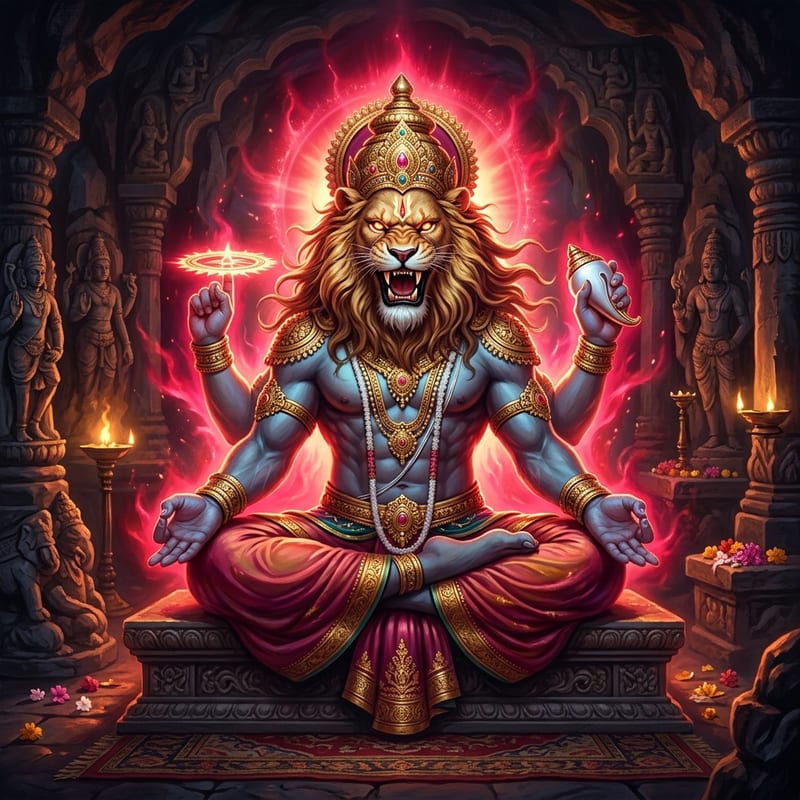
oṃ jaya narasiṃha hare, prabhu jaya narasiṃha hare|
stambha phāṛakara tuma prakaṭe, janakā dukha dūra kare||
oṃ jaya narasiṃha hare||
stambha phāṛakara tuma prakaṭe, janakā dukha dūra kare||
oṃ jaya narasiṃha hare||
hiraṇyakaśyapa pāpī, hari bhakta satāye|
prahalāda jī ko dukha dīne, khambhe se bandhāe||
oṃ jaya narasiṃha hare||
prahalāda jī ko dukha dīne, khambhe se bandhāe||
oṃ jaya narasiṃha hare||
devagaṇa bhī ḍare, pāpī prahalāda ko dhamakāye|
kṣaṇabhaṃgura kayā meṃ prabhu, narasiṃha rūpa meṃ āye||
oṃ jaya narasiṃha hare||
kṣaṇabhaṃgura kayā meṃ prabhu, narasiṃha rūpa meṃ āye||
oṃ jaya narasiṃha hare||
aṃgāroṃ se bhakta jale, pāpī prahalāda ko dukha dīne|
narasiṃha rūpa dharakara, hiraṇyakaśyapa ko māre||
oṃ jaya narasiṃha hare||
narasiṃha rūpa dharakara, hiraṇyakaśyapa ko māre||
oṃ jaya narasiṃha hare||
cakra gadā triśūla, kara meṃ astra dhāre|
narasiṃha jī kī āratī, jo nara prema se gāye||
oṃ jaya narasiṃha hare||
narasiṃha jī kī āratī, jo nara prema se gāye||
oṃ jaya narasiṃha hare||
sukha sampatti ghara āve, kaṣṭa miṭe tana kā|
prahalāda bhakta kī rakṣā, kīno mana se||
oṃ jaya narasiṃha hare||
prahalāda bhakta kī rakṣā, kīno mana se||
oṃ jaya narasiṃha hare||
prabhu narasiṃha kī āratī, jo nara prema se gāve|
manavāṃchita phala pāve, sukha saṃpatti pāve||
oṃ jaya narasiṃha hare||
manavāṃchita phala pāve, sukha saṃpatti pāve||
oṃ jaya narasiṃha hare||
|| iti saṃpūrṇaṃm ||