
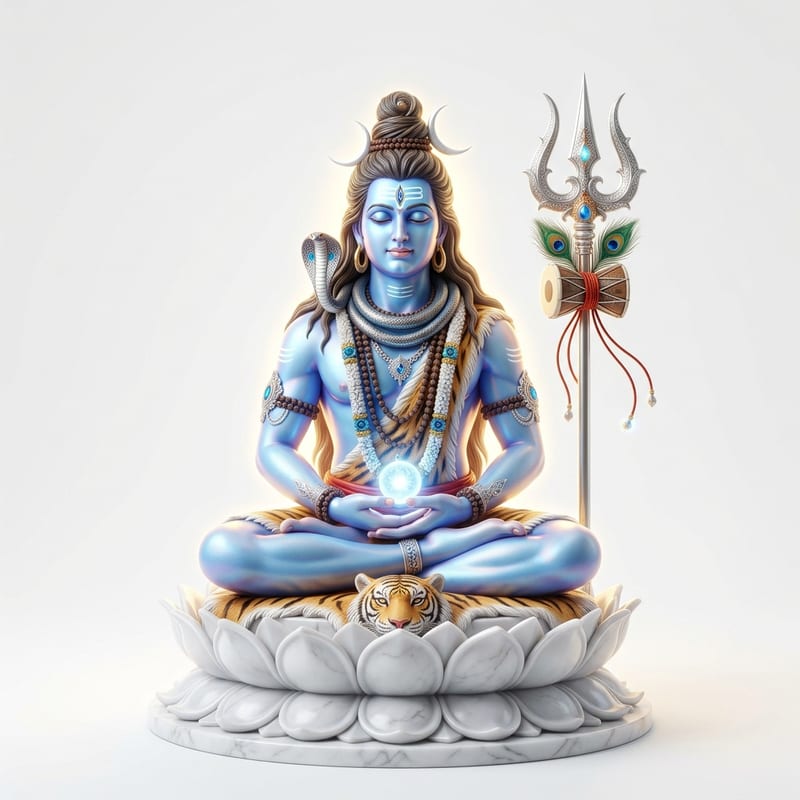
bhavadbhavya bhūteśvaraṃ bhūtanāthaṃ, śivaṃ śaṅkaraṃ śambhu mīśānamīḍe || 1 ||
- prabhumthe master
- prāṇanāthamlord of the life-breath
- vibhumpresent everywhere
- viśvanāthamlord of the world
- jagannāthanāthamlord even of the world's lords
- sadānandabhājāmof those who live in unbroken joy
- bhavadbhavyabhūteśvaramruler of what is, what will be and what has been
- bhūtanāthamlord of the hosts
- śivamShiva
- śaṅkaramShankara
- śambhumShambhu
- īśānamIshana
- īḍeI praise
anvaya prabhum prāṇanātham vibhum viśvanātham sadānandabhājām jagannāthanātham bhavadbhavyabhūteśvaram bhūtanātham śivam śaṅkaram śambhum īśānam īḍe
chandas Bhujaṅgaprayāta, 12 syllables in each of 4 pādas
īḍe I praise — From the old root īḍ, to praise, the same root the Rig Veda opens with in agnim īḷe. It is the one verb in the verse and it carries all eight.
bhavadbhavyabhūta what is, what will be, what has been — Three time words in one compound: present, future, past.
bhūtanātham lord of the hosts — The bhūtas are the attendants who go with Shiva. The word also means beings in general, and both senses are at work here.
note Every verse of the hymn ends on the same line, śivaṃ śaṅkaraṃ śambhumīśānamīḍe, four names of the one god and then the verb. The metre is Bhujaṅgaprayāta, whose name means the gliding of a snake, and the pace of the recitation comes from it.
jaṭājūṭa gaṅgottaraṅgairviśālaṃ, śivaṃ śaṅkaraṃ śambhu mīśānamīḍe || 2||
- galeat his throat
- ruṇḍamālamwearing a garland of severed heads
- tanauon his body
- sarpajālama mesh of snakes
- mahākālakālamdeath to death itself
- gaṇeśādipālamguardian of Ganesha and the rest
- jaṭājūṭagaṅgottaraṅgaiḥby the high waves of the Ganga in his coiled hair
- viśālammade vast
- śivamShiva
- śaṅkaramShankara
- śambhumShambhu
- īśānamIshana
- īḍeI praise
anvaya gale ruṇḍamālam tanau sarpajālam mahākālakālam gaṇeśādipālam jaṭājūṭagaṅgottaraṅgaiḥ viśālam śivam śaṅkaram śambhum īśānam īḍe
chandas Bhujaṅgaprayāta, 12 syllables in each of 4 pādas
mahākālakālam death to death itself — Kāla is time and also death. Mahākāla is death at its greatest, and Shiva is called the kāla of that.
ruṇḍamālam wearing a garland of severed heads — Ruṇḍa is a headless body or a head cut from one. The ornament belongs to the same Shiva who lives at the burning ground.
gaṅgottaraṅgaiḥ with the Ganga's rising waves — The river came down from the sky and was caught in his hair, which is what keeps her fall from breaking the earth.
note The verse keeps the fierce side of Shiva and the protecting side in one breath: heads and snakes in the first line, the guarding of Ganesha and the gods in the second.
anādiṃ hyapāraṃ mahā mohamāraṃ, śivaṃ śaṅkaraṃ śambhu mīśānamīḍe || 3 ||
- mudāmof gladness
- ākaramthe mine it is dug from
- maṇḍanamthe ornament itself
- maṇḍayantamwho adorns
- mahāmaṇḍalamthis great round world
- bhasmabhūṣādharamwearing ash for jewellery
- tamhim
- anādimwithout beginning
- hiindeed
- apāramwith no far shore
- mahāmohamāramwho kills the great confusion
- śivamShiva
- śaṅkaramShankara
- śambhumShambhu
- īśānamIshana
- īḍeI praise
anvaya mudām ākaram maṇḍanam mahāmaṇḍalam maṇḍayantam bhasmabhūṣādharam anādim hi apāram mahāmohamāram tam śivam śaṅkaram śambhum īśānam īḍe
chandas Bhujaṅgaprayāta, 12 syllables in each of 4 pādas
bhasmabhūṣādharam wearing ash for jewellery — The ash is from the burning ground, smeared on in place of ornaments. It is what is left when everything else has gone.
ākaram a mine — The place a metal or a gem is taken out of. Gladness is dug out of him as ore is dug out of a hill.
mahāmohamāram who kills the great confusion — Moha is the muddle in which a person takes one thing for another. Māra is the killing of it, from the same root as Kama's name Māra.
note The first line turns on one root: maṇḍana the ornament, maṇḍayantam adorning, mahāmaṇḍalam the great circle. Sanskrit poets prize that kind of play, and reading it aloud is where the effect is.
girīśaṃ gaṇeśaṃ sureśaṃ maheśaṃ, śivaṃ śaṅkaraṃ śambhu mīśānamīḍe || 4 ||
- vaṭādhonivāsamliving at the foot of the banyan
- mahāṭṭāṭṭahāsamwhose laughter rings out loud
- mahāpāpanāśamwho undoes the worst of wrongs
- sadāalways
- suprakāśamplain to see
- girīśamlord of the mountain
- gaṇeśamlord of the hosts
- sureśamlord of the gods
- maheśamthe great lord
- śivamShiva
- śaṅkaramShankara
- śambhumShambhu
- īśānamIshana
- īḍeI praise
anvaya vaṭādhonivāsam mahāṭṭāṭṭahāsam mahāpāpanāśam sadā suprakāśam girīśam gaṇeśam sureśam maheśam śivam śaṅkaram śambhum īśānam īḍe
chandas Bhujaṅgaprayāta, 12 syllables in each of 4 pādas
vaṭādhonivāsam living at the foot of the banyan — Shiva as Dakshinamurti sits under a banyan and teaches four elderly sages without speaking.
aṭṭāṭṭahāsam loud laughter — The word is made by doubling, and the sound of it is the laugh. His laughter is told of as shaking the worlds.
note The second line is four names built the same way, each ending in īśa, lord: of the mountain, of the hosts, of the gods, and then simply the great one.
parabrahma brahmādibhir-vandyamānaṃ, śivaṃ śaṅkaraṃ śambhu mīśānamīḍe || 5 ||
- girīndrātmajāsaṅgṛhītārdhadehamhalf of whose body the mountain king's daughter has taken
- girauon the hill
- saṃsthitamsettled
- sarvadāalways
- āpannagehama house for those in trouble
- parabrahmathe highest brahman
- brahmādibhiḥby Brahma and the rest
- vandyamānambeing bowed to
- śivamShiva
- śaṅkaramShankara
- śambhumShambhu
- īśānamIshana
- īḍeI praise
anvaya girīndrātmajāsaṅgṛhītārdhadeham girau saṃsthitam sarvadā āpannageham brahmādibhiḥ vandyamānam parabrahma śivam śaṅkaram śambhum īśānam īḍe
chandas Bhujaṅgaprayāta, 12 syllables in each of 4 pādas
girīndrātmajā the mountain king's daughter — Parvati, daughter of Himavat. Her name itself means of the mountain.
āpannageham a house for those in trouble — Āpanna is someone who has fallen into difficulty. The word for what he is to them is simply house.
note In the printed reading the third pāda sits a little loose against the metre. It is left as it stands.
balīvardhayānaṃ surāṇāṃ pradhānaṃ, śivaṃ śaṅkaraṃ śambhu mīśānamīḍe || 6 ||
- kapālama skull bowl
- triśūlama trident
- karābhyāmin his two hands
- dadhānamholding
- padāmbhojanamrāyato the one who bows at his lotus feet
- kāmamwhat was asked for
- dadānamgiving
- balīvardhayānamcarried by the bull
- surāṇāmamong the gods
- pradhānamthe first
- śivamShiva
- śaṅkaramShankara
- śambhumShambhu
- īśānamIshana
- īḍeI praise
anvaya karābhyām kapālam triśūlam dadhānam padāmbhojanamrāya kāmam dadānam balīvardhayānam surāṇām pradhānam śivam śaṅkaram śambhum īśānam īḍe
chandas Bhujaṅgaprayāta, 12 syllables in each of 4 pādas
kapālam a skull bowl — The begging bowl of a skull, one of the marks of Shiva as the ascetic who owns nothing.
balīvardhayānam whose mount is the bull — Balīvarda is a bull. The bull is Nandi, who carries him and waits at the door of every Shiva shrine.
note Two hands, two things held, and between them the whole of him: the skull of the ascetic and the trident of the one who rules.
aparṇā kalatraṃ sadā saccaritraṃ, śivaṃ śaṅkaraṃ śambhu mīśānamīḍe || 7 ||
- śaraccandragātramwhose body is the autumn moon
- gaṇānandapātramthe cup his hosts' gladness is poured into
- trinetramthree-eyed
- pavitramclean, and cleaning whoever comes near
- dhaneśasyaof the lord of wealth
- mitramthe friend
- aparṇākalatramwhose wife is Aparna
- sadāalways
- saccaritramof good conduct
- śivamShiva
- śaṅkaramShankara
- śambhumShambhu
- īśānamIshana
- īḍeI praise
anvaya śaraccandragātram gaṇānandapātram trinetram pavitram dhaneśasya mitram aparṇākalatram sadā saccaritram śivam śaṅkaram śambhum īśānam īḍe
chandas Bhujaṅgaprayāta, 12 syllables in each of 4 pādas
aparṇā Aparna, Parvati — Parṇa is a leaf, and a-parṇā is without one. The name comes from her long fast for Shiva, in which she gave up even leaves.
dhaneśasya mitram friend of the lord of wealth — Dhaneśa is Kubera, who keeps the wealth of the world. The god who owns nothing is his friend.
śaraccandra the autumn moon — After the rains the air is clear, so the autumn moon is the brightest of the year.
note Every pāda of this verse closes on the sound -tram, and the rhyme runs through all four.
śmaśāne vasantaṃ manojaṃ dahantaṃ, śivaṃ śaṅkaraṃ śambhu mīśānamīḍe || 8 ||
- haramwho takes everything away
- sarpahāramwearing a snake for a necklace
- citābhūvihāramwho walks where the pyres burn
- bhavamBhava, being itself
- vedasāramthe pith of the Veda
- sadāalways
- nirvikāramunchanging
- śmaśāneat the cremation ground
- vasantamliving
- manojamdesire, born in the mind
- dahantamburning
- śivamShiva
- śaṅkaramShankara
- śambhumShambhu
- īśānamIshana
- īḍeI praise
anvaya haram sarpahāram citābhūvihāram bhavam vedasāram sadā nirvikāram śmaśāne vasantam manojam dahantam śivam śaṅkaram śambhum īśānam īḍe
chandas Bhujaṅgaprayāta, 12 syllables in each of 4 pādas
manojam dahantam burning desire to ash — Manoja, born of the mind, is Kama. When he aimed at Shiva in meditation the third eye opened and burnt him where he stood.
haram who takes everything away — Hara is one of his commonest names. What he takes is read both as a person's wrongs and as everything that has an end.
nirvikāram unchanging — Vikāra is any change or alteration. The word puts the one who does all this outside change.
note The eighth and last verse of the set proper, and the one that stays longest at the burning ground. The verse after this one is the phalashruti and stands outside the eight.
suputraṃ sudhānyaṃ sumitraṃ kalatraṃ vicitraissamārādhya mokṣaṃ prayāti ||
- svayamhimself
- yaḥwhoever
- prabhāteat daybreak
- naraḥa person
- śūlapāṇeO you who hold the spear
- paṭhetshould recite
- stotraratnamthis jewel of a hymn
- tuindeed
- ihahere, in this life
- prāpyaratnamthe jewel worth getting
- suputrama good son
- sudhānyamgood grain
- sumitramgood friends
- kalatrama wife
- vicitraiḥwith all these
- samārādhyahaving worshipped well
- mokṣamrelease
- prayātigoes on to
anvaya śūlapāṇe yaḥ naraḥ prabhāte svayam iha prāpyaratnam stotraratnam tu paṭhet suputram sudhānyam sumitram kalatram vicitraiḥ samārādhya mokṣam prayāti
chandas Bhujaṅgaprayāta, 12 syllables in each of 4 pādas
stotraratnam jewel of a hymn — A hymn called a gem among hymns. The verse then plays on it: the jewel recited brings the jewel worth having.
śūlapāṇe O you who hold the spear — The one address in the hymn spoken straight to Shiva. Everywhere else he is spoken of.
note The closing verse, which says what comes of reciting: household good first, and release after it. Printed naraśśūla pāṇe, which is naraḥ and śūlapāṇe run together in the sandhi.