
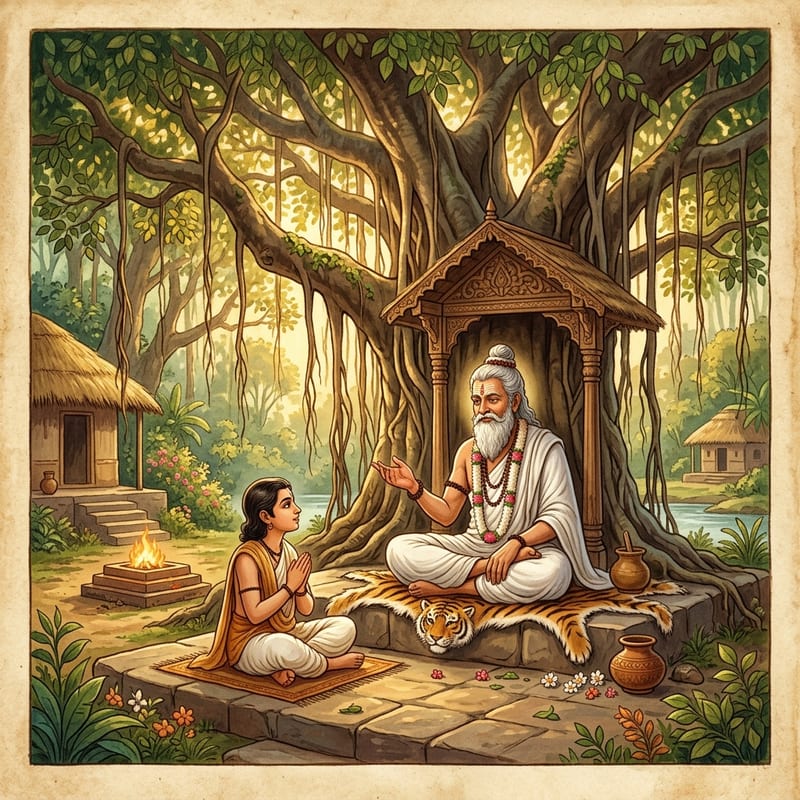
ॐ आप्यायन्तु ममाङ्गानि वाक्प्राणश्चक्षुः
श्रोत्रमथो बलमिन्द्रियाणि च सर्वाणि ।
सर्वं ब्रह्मौपनिषदं
माऽहं ब्रह्म निराकुर्यां मा मा ब्रह्म
निराकरोदनिराकरणमस्त्वनिराकरणं मेऽस्तु ।
तदात्मनि निरते य
उपनिषत्सु धर्मास्ते मयि सन्तु ते मयि सन्तु ।
ॐ शान्तिः शान्तिः शान्तिः ॥
- ॐ (oṃ)Om आप्यायन्तु (āpyāyantu) – may grow vigorous मम् (mam) – my अङ्गानि (aṅgāni) – limbs वाक् (vāk) – speech प्राणः (prāṇaḥ) – vital-air चक्षुः (cakṣuḥ) – eye श्रोत्रम (śrotrama) – ear अथो (atho) – then बलम् (balam) – strength इन्द्रियाणि (indriyāṇi) – senses च (ca) – and सर्वाणि (sarvāṇi) – all सर्वं (sarvaṃ) – all (are) ब्रह्म (brahma) – Brahman औपनिषदं (aupaniṣadaṃ) – of the Upaniṣads मा (mā) – never अहं (ahaṃ) – I ब्रह्म (brahma) – Brahman निराकुर्यां (nirākuryāṃ) – may reject मा मा (mā mā) – never never ब्रह्म (brahma) – Brahman निराकरोत् (nirākarot) – may spurn अनिराकरणम् (anirākaraṇam) – non-denial (of the Brahman) अस्तु (astu) – may there be अनिराकरणं (anirākaraṇaṃ) – non-denial (no spurning) मे (me) – in me (by me) अस्तु (astu) – let there be तत् आत्मनि (tat ātmani) – in the Ᾱtman निरते य (nirate ya) – delighting which उपनिषत्सु (upaniṣatsu) – in the Upaniṣads धर्माः (dharmāḥ) – virtues ते (te) – they all मयि (mayi) – in me सन्तु (santu) – are present ते (te) – they all मयि (mayi) – in me सन्तु (santu) – are present
केन प्राणः प्रथमः प्रैति युक्तः ।
केनेषितां वाचमिमां वदन्ति
चक्षुः श्रोत्रं क उ देवो युनक्ति ॥ १॥
- ॐ (oṃ)Om केन (kena) – by whom इषितं (iṣitaṃ) – willed पतति (patati) – falls प्रेषितं (preṣitaṃ) – directed (sent) मनः (manaḥ) – mind केन (kena) – by whom प्राणः (prāṇaḥ) – the vital -air प्रथमः (prathamaḥ) – at first प्रैति (praiti) – does proceed (to function) युक्तः (yuktaḥ) – well equipped केन (kena) – by whom इषितां (iṣitāṃ) – commanded वाचम् (vācam) – word (speech) इमां (imāṃ) – this वदन्ति (vadanti) – do (they, men) utter चक्षुः (cakṣuḥ) – eye श्रोत्रं (śrotraṃ) – ear कः (kaḥ) – who उ (u) – indeed देवः (devaḥ) – divine power युनक्ति (yunakti) – directs (towards their respective objects)
note English Translation Of Sri Shankaracharya's Commentary By Swami Gambirananda ।।1.1.1।। Kena, by what agent; being isitam, willed, directed; manah, the mind; patati, goes, goes towards its own object-this is the construction. Since the root is cannot be taken here to imply either repetition or going; ['Since the intention here is not to make the mind an object of the concept of either repeated occurrence or going, and since the desire is for knowing some special director of the mind.'-A.G.] it must be understood that the present form of the root is in its sense of desiring. The form in which the suffix it is used in the word isitam is a Vedic licence [The correct form should have been 'esitam.'-A.G.]. Presitam is a form of the same root, with pra prefixed to it, in the sense of directing. If the word presitam alone were used (without isitam) there would arise such an iniry about the particular kind of director and the direction as; 'By what particular director? And how is the direction?' But the attribute isitam being there, both the questions are set at rest, because thery is ascertained a special meaning, viz 'directed (presitam) through whose mere will ?' [' By mere presence that involves no effort.'-A.G.] Objection: If this be the meaning intended, the purpose is served by the expression willed by alone, and the expression directed need not be used. Moreover, since it is reasonable that an additional word should imply an additional meaning, it is proper to understand some special sense as: 'By what is it directed-by will, act, or speech?'
वाचो ह वाचं स उ प्राणस्य प्राणः ।
चक्षुषश्चक्षुरतिमुच्य धीराः
प्रेत्यास्माल्लोकादमृता भवन्ति ॥ २॥
- श्रोत्रस्य (śrotrasya)of the ear श्रोत्रं (śrotraṃ) – the ear मनसः (manasaḥ) – of the mind मनः (manaḥ) – the mind यद् वाचः (yad vācaḥ) – of that speech ह वाचं (ha vācaṃ) – this is the speech स उ (sa u) – the very same He is प्राणस्य (prāṇasya) – of the life प्राणः (prāṇaḥ) – the life चक्षुषः (cakṣuṣaḥ) – of the eye चक्षुः (cakṣuḥ) – the very eye अतिमुच्य (atimucya) – having abandoned (having transcended) धीराः (dhīrāḥ) – the bravely wise प्रेत्य (pretya) – having gone away अस्मान् लोकात् (asmān lokāt) – from this world (of senses) अमृता (amṛtā) – immortal भवन्ति (bhavanti) – become
note English Translation Of Sri Shankaracharya's Commentary By Swami Gambirananda ।।1.1.2।। Srotrasya srotram, the Ear of the ear. The srotram is that by which one hears, the instrument for the hearing of sound, the organ of hearing which reveals words. He about whom you put the question, 'Who is the effulgent being who directs the eyes and the ears?'-is the Ear of the ear. Objection: Is it not incongruous to answer, 'He is the Ear of the ear', when the reply should have been, 'So-and-so, with such and such attributes, directs the ears etc.'?
न विद्मो न विजानीमो यथैतदनुशिष्यात् ॥ ३॥
- न (na)never तत्र (tatra) – there चक्षुः (cakṣuḥ) – eye गच्छति (gacchati) – goes नः (naḥ) – nor वाक् (vāk) – speech गच्छति (gacchati) – goes न (na) – never मनो (mano) – the mind न (na) – never विद्मः (vidmaḥ) – do we know न (na) – never विजानीमः (vijānīmaḥ) – do we know perfectly यथा एतद् (yathā etad) – how it अनुशिष्यात् (anuśiṣyāt) – can be instructed
note English Translation Of Sri Shankaracharya's Commentary By S. Sitrama Sastry (This and next verse)
इति शुश्रुम पूर्वेषां ये नस्तद्व्याचचक्षिरे ॥ ४॥
- अन्यत् एव (anyat eva)very distinct तद् (tad) – that is विदितात् (viditāt) – from the known अथ (atha) – then अविदितात् (aviditāt) – from the unknown अधि (adhi) – extremely (distinct) इति (iti) – thus शुश्रुम (śuśruma) – we have heard पूर्वेषां (pūrveṣāṃ) – from the ancestors ये (ye) – who नः (naḥ) – to us तद् (tad) – that व्याचचक्षिरे (vyācacakṣire) – perfectly stated (taught us)
note English Translation Of Sri Shankaracharya's Commentary By Swami Gambirananda ।।1.1.5।। Anyat eva, different indeed; is tat, that which is the topic under discussion and which has been spoken of as the Ear etc., of the ear etc., and as beyond their reach. It is, indeed, different from the known. The known is very much within the grasp of the act of knowing, that which is the object of the verb, 'to known'. Inasmuch as everything is known somewhere by somody, all that is manifested is certainly known. The idea is that, It (Brahman) is different from that. Lest, in that case, It should be unknown, the text says, (It is,) atho, again; different aviditat, from the unknown, from what is opposed to the known, from that which consists of the unmanifested ignorance, which is the seed of the manifested. The word adhi, used in the sense of 'above', means 'different' by a figure of speech; for it is well-known that anything that exists above another is different from that other. Whatever is known is limited, mortal, and full of misery; and hence it is to be rejected. So when it is said that Brahman is different from the known it amounts to asserting that It is not to be rejected. Similarly, when it is affirmed that It is different from the unknown, it amounts to saying that It is not a thing to be obtained. It is for the sake of getting an effect, indeed, that somody different from it acires some other thing to serve as a cause. For this reason, too, nothing different (from the Self) need be acired to serve any purpose distinct from the knower (Self). Thus the statement, that Brahman is different from the known and the unknown, having amounted to Brahman being denied as an object to be acired or rejected, the desire of the disciple to know Brahman (objectively) comes to an end, for Brahman is nondifferent from the Self. (Or, according to a different reading-the desire of the disciple to know a Brahman different from the Self, comes to an end). [The expression concerned is svatmano' nanyatvat brahmavisaya jijnasa, or svatmano' nyabrahmavisaya jijnasa.] For nothing other than one's own Self can possibly be different from the known and the unknown. Thus it follows that the meaning of the sentence is that the Self is Brahman. And this also follows from such Vedic texts as: 'This Self is Brahman' (Ma. 2; Br. II. v. 19, IV. iv. 5), 'that Self which is untouched by sin' (Ch. VIII. vii. 1), 'the Brahman that is immediate and direct-the Self that is within all' (Br. III. iv. 1), etc. In this way, the text, 'Thus we heard' etc., states how through a succession of preceptors and disciples, was derived the purport of the sentence which establishes as Brahman that Self of all which is devoid of all distinguishing features, and is the light of pure consciousness. Moreover, Brahman is to be known only through such a traditional instruction of preceptors and not through argumentation, nor by study (or exposition), intelligence, great learning, austerity, sacrifices, etc. -iti, such (was what); susruma, we heard; purvesam, of the ancient teachers; the teachers ye, who; vyaccaksire, explained, taught clearly; nah to us; tat, that Brahman. The idea that the Self is Brahman having been established through the sentence, 'That is surely different from the known, and again, that is above the unknown', the hearer has this doubt: 'How can the Self the Brahman? For the Self is familarly known to be that which is entitled to undertake rites and meditation and which, being subject to birth and death, seeks to attain either the gods headed by Brahma (Creator ) or heaven by undertaking the practice of rites or meditation. Therefore some adorable being other that that (Self), e.g. Visnu, Isvara (Siva), Indra, or Prana (vital force or Hiranyagarbha) may well be Brahman, but not so the Self; for this is opposed to common sense. Just as other logicians say that the Self is different from the Lord, so also the ritualists worship other gods saying, 'Sacrifice to that one', 'Sacrifice to that one'. Therefore it is reasonable that, that should be Brahman which is known and adorable; and the worshipper should be one who is different from this.' Having noticed this doubt either from the looks or the words of the disciple, the teacher said, 'Don't be in doubt thus;'-
तदेव ब्रह्म त्वं विद्धि नेदं यदिदमुपासते ॥ ५॥
- यद् (yad)that which (was) वाचा (vācā) – by the speech अनभ्युदितं (anabhyuditaṃ) – not revealed येन (yena) – by which वाक् (vāk) – speech अभ्युद्यते (abhyudyate) – is revealed (itself) तद् एव (tad eva) – That alone ब्रह्म (brahma) – Brahman त्वं (tvaṃ) – thou विद्धि (viddhi) – know न इदं (na idaṃ) – not this यत् (yat) – that इदम् (idam) – this (there) उपासते (upāsate) – worships
note English Translation Of Sri Shankaracharya's Commentary By Swami Gambirananda Yat, that-whose essence consists of Consciousness alone-, which; (is not uttered) vaca, by speech-. Vak (speech) is the organ which, clinging to the eight localities, viz the root of the tongue etc. [Chest, throat, head, root of the tongue, teath, nose, lips, and palate.], and being presided over by (the god of) Fire, expresses the letters. The letters, too, as limited in their number and as subject to a certain seence, in conformity with the meaning intended to be conveyed, are also called vak. [The word gau (cow), for instance, consists of the letter g and au which are fixed as regards their seence so as to be able to express the meaning cow. This is the view of the Mimamsaka school.] Thus also the soud expressible by them, which is the pada (sphota), [This is the view of the Sphotavadi grammarians. 'Sphota is derived from the root sphut in the sense of that which is manifested by letters, i.e., that which imparts definite knowledge of word (pada), sentence, etc. Their idea is that this (pada-) sphota has to be admitted since a unified idea (conveyed by the word) cannot be contingent on a multiplicity of letters.'-A.G.] is called vak. this is in accordance with the Vedic text: 'The letter a, indeed, is all speech. ['That power of Consciousness is vak which is indicated by Om, in which a predominates. (Om is a combination of a, u, m), and this Om is called sphota,-A.G.] And that speech, being manifested as the sparsa letters, the antahstha letters (semi-vowels), and usma letters (aspirates), [Sparsa-25 consonants from ka to ma; antahstha-y, r, l, v; usma-s, s, s, h.] becomes many and multifarious' (Ai. A. II. iii. 7. 13). (Yat, that which) is anabhyuditam, not expressed, not uttered; vaca, by vak, by speech, which has these modifications, viz regulated (material, Rk), non-regulated (prose Yujuh), musical (Sama), true, and false-by that vak which becomes defined as words and to which the organ of speech is subordinate; ['The power of speech that human beings have, is established in sounds and letters, for it is expressed by these.'] yena, that by which-that Brahman, the light of Consciousness, by which-; vak, speech, together with its organs; abhyudyate, is uttered, is expressed, that is to say, is used in relations to the desired meaning-. That which has been spoken of here as 'the Speech of speech' (1.2), and as 'When It speaks, It is called the organ of speech' (Br. I. iv. 7), and 'He who controls the organ of speech from within' (Br. III. vii. 17), etc., in the Brhadaranyaka Upanisad, and about whom the question has been raised thus, 'The (power of) speech that is found in men, is established in sounds. Does any Brahmana know it?', and the answer has been given by saying, 'That by which one speaks is dream is speech,- that eternal power of speech which a speaker has is vak which is in essence, the light of Consciousness. And this follows from the Vedic text, 'For the speaker's power of speech can never be lost' (Br. IV. iii. 26). Tat eva, that indeed, that Self in its true nature; tvam, you; viddhi, know; as brahma, Brahman-(so called) because of its extensity (or unsurpassability)-that which is allsurpassing and is called Bhuma, great (Ch. VII. xxiii. 1). The significance of the word eva is this: Know the Self alone to be the unconditioned Brahman after eradicating all such adjuncts as speech because of which there occur such empirical expressions, with regard to the transcendental, unconditioned, unsurpassable, and eipoised Brahman, as 'It is the Speech of speech', 'the Eye of the eye', 'the Ear of the ear', 'the Mind of the mind', the agent, the enjoyer, the knower, the controller, governor. 'Consciousness, Bliss, Brahman' (Br. III. ix. 28.7), etc. Na idam, this is not; brahma, Brahman; Yat, which; people upasate, meditate on; as idam, this, (as a limited object) possessed of distinctions created by limiting adjuncts-as a non-Self, e.g. God, etc. Although in the sentence, 'Know that alone to be Brahman', it has already been stated that the non-Self is not Brahman, still with a view to enounciating as explicit rule (that leaves no scope for option) the idea is repeated in the sentence, 'This is not Brahman'; or this may be with a view to excluding the identification of Brahman with what is not Brahman. [In Mimamsa philosophy Niyama-vidhi pins one down to one thing only when alternatives are possible. Here the possibilities are, thinking of both Brahman and non-Brahman as Brahman. And the rule fixes us to the pursuit of Brahman only. Parisankhyavidhi merely excludes something-here the thought of non-Brahman as Brahman. So the text may be interpreted from either point of view.] English Commentary By Swami Sivananda
तदेव ब्रह्म त्वं विद्धि नेदं यदिदमुपासते ॥ ६॥
- यत् (yat)that which मनसा (manasā) – by the mind न (na) – never मनुते (manute) – (one) can never feel येन् (yen) – because of which आहुः (āhuḥ) – (they) say मनः मतम् (manaḥ matam) – mind is called by its name तद् एव (tad eva) – That alone ब्रह्म (brahma) – Brahman त्वं (tvaṃ) – thou विद्धि (viddhi) – know न इदं (na idaṃ) – not this यत् (yat) – that इदम् (idam) – this (here) उपासते (upāsate) – (man) worships
note English Translation Of Sri Shankaracharya's Commentary By Swami Gambirananda Manas means the internal organs, mind and intellect being taken as one entity. The word manas, derived from the root man in the sense of that by which one thinks, is common to all organs, since, it embraces all objects. In accordance with the Vedic text, 'Desire, deliberation, doubt, faith, want of faith, steadiness, unsteadiness, shame, intelligence, and fear-all these are but the mind' (Br. I. v. 3), mind is that which has desire etc. as its functions. Yat, that-the light of Consciousness illumining the mind-, which; one na manute, does not think nor determine, with that mind, because It rules the mind by virtue of being the enlightener of the mind-. Since the Self, indeed, constitutes the essence of everything, therefore the mind cannot act with regard to its own Self. The mind can think only when it is illumined by the light of Consciousness within. That Brahman, yena, by which;-they, the knowers of Brahman, ahuh, say-; manas, the mind, together with its modes; matam, is tought of, encompassed-. Therefore viddhi, know, tat eva, that very one, the Self of the mind, the internal illuminator, as Brahman. Na idam, etc. is to be understood as before. English Commentary By Swami Sivananda
तदेव ब्रह्म त्वं विद्धि नेदं यदिदमुपासते ॥ ७॥
- यत् (yat)that which चक्षुषा (cakṣuṣā) – through the eye न (na) – never पश्यति (paśyati) – (one) sees येन (yena) – by which चक्षूषि (cakṣūṣi) – the eyes पश्यति (paśyati) – (one) sees तत् एव (tat eva) – That alone ब्रह्म (brahma) – Brahman त्वं (tvaṃ) – thou विद्धि (viddhi) – know न इदं (na idaṃ) – not this यत् (yat) – that इदम् (idam) – (this) here उपासते (upāsate) – (man) worships
note English Translation Of Sri Shankaracharya's Commentary By Swami Gambirananda Yat, that which; caksusa, with the eye, associated with the functions of the internal organ; na pasyati, (a man) does not see, does not make an object of perception; yena, that by which; man pasyati; sees, perceives, encompasses, through the light of Consciousness; caksumsi, the activities of the eye-diversified in accordance with the modes of the internal organ-. Tat eva, etc., as before. English Commentary By Swami Sivananda
तदेव ब्रह्म त्वं विद्धि नेदं यदिदमुपासते ॥ ८॥
- यत् (yat)that which श्रोत्रेण (śrotreṇa) – through the ear न (na) – never श्रुणोति (śruṇoti) – (one) hears येन (yena) – that because of which श्रोत्रम् (śrotram) – ear इदम् (idam) – this श्रुतम् (śrutam) – is being heard तत् एव (tat eva) – That alone ब्रह्म (brahma) – Brahman त्वं (tvaṃ) – thou विद्धि (viddhi) – know न इदं (na idaṃ) – not this यत् (yat) – that इदम् (idam) – this (here) उपासते (upāsate) – (man) worships
note English Translation Of Sri Shankaracharya's Commentary By Swami Gambirananda ‘What cannot be heard with the ear’ means which the world does not perceive as an object with the organ of hearing, presided over by Digdevata, produced in Akas and connected with the activity of the mind. By which the ears are able to hear,’ it is well known that it is perceived as an object by the intelligence of the Atman. The rest has been already explained.English Commentary By Swami Sivananda Brahman directs the ear towards sound. Ear is a finite instrument. It carries the impressions of sound to the mind. The activity of the ear is connected with the activity of the mind. It derives its power of hearing from Brahman only, its source. The ear is made to move towards sound, music, etc., by the enlightening intelligence of Brahman. Brahman is the real unheard Hearer. He is the silent Witness of the activity of the ear.
तदेव ब्रह्म त्वं विद्धि नेदं यदिदमुपासते ॥ ९॥
॥ इति केनोपनिषदि प्रथमः खण्डः ॥
- यत् (yat)that which प्राणेन (prāṇena) – by the vital air न (na) – never प्राणिति (prāṇiti) – breaths येन (yena) – that because of which प्राण (prāṇa) – the very vital air प्रणीयते (praṇīyate) – is breathed तत् एव (tat eva) – That alone ब्रह्म (brahma) – Brahman त्वं (tvaṃ) – thou विद्धि (viddhi) – know न इदं (na idaṃ) – not this यत् (yat) – that इदम् (idam) – this (here) उपासते (upāsate) – (man) worships
note English Translation Of Sri Shankaracharya's Commentary By Swami Gambirananda ‘What none breathes with the breath’ means ‘what none perceives, like odour, with the earthly breath filling the nostrils and connected with the activity of the mind and life.’ ‘But by which, etc.,’ means ‘by the enlightening intelligence of the Atman, breath is made to move towards its objects.’ All the rest ‘tadeva, etc,’ has already been explained.English Commentary By Swami Sivananda Prana may also mean smell. Then the translation will be: “What smell does not perceive, but directs smell to its object, know That alone as Brahman and not this which people here worship.” He who is not enlivened by Prana but who gives Prana the power of enlivening all being-know That alone as Brahman, and not this which people here worship. The breath is made to move towards its objects by the enlightening intelligence of the Brahman. ‘That which one breaths not with the breath’ means, ‘That which one does not perceive like odour, with the air filling the nostrils, and connected with the activity of the mind and the life.’ Here ends the First Section.
नूनं त्वं वेत्थ ब्रह्मणो रूपम् ।
यदस्य त्वं यदस्य देवेष्वथ नु
मीमाँस्यमेव ते मन्ये विदितम् ॥ १॥
- यदि (yadi)if मन्यसे (manyase) – you think सुवेद (suveda) – very well I know इति (iti) – thus दहरमेवापि (daharamevāpi) – even a little too नूनम् (nūnam) – certainly त्वं (tvaṃ) – you वेत्थ (vettha) – understand ब्रह्मणः (brahmaṇaḥ) – of the Brahman रुपं (rupaṃ) – form यत् (yat) – that which is अस्य (asya) – of that त्वं (tvaṃ) – Thou यत् (yat) – That which अस्य (asya) – of that देवेषु (deveṣu) – in the devas अथ नु (atha nu) – now then मीमास्यम् एव (mīmāsyam eva) – is to be ascertained ते (te) – to you मन्ये (manye) – I think विदितम् (viditam) – that which is known (to you)
note English Translation Of Sri Shankaracharya's Commentary By S. Sitrama Sastry (This and next verse) The preceptor, fearing that, the disciple persuaded to believe that lie is the Atman, i.e., the Brahman not fit to be abandoned or acquired, might think ‘I certainly am the Brahman, I know myself well,’ says for the purpose of dispelling that notion of the disciple Yadi, etc. Then, is not an accurate conviction ‘I know (Brahman) well’ desirable? Certainly it is desirable. But an accurate conviction is not of the form ‘I know (Brahman) well.’ If what should be known becomes an object of sense-perception then it is possible to know it well, just as an inflammable substance can be consumed by the consuming fire. But the essence of fire cannot itself be so consumed. The well-ascertained drift of all Vedanta is that the Self (Atman) of every knower is the Brahman. The same has been here explained in the form of question and answer by the text ‘It is the ear of the ear, etc.’ The same has been still more clearly determined by the text: “What is not enlightened by speech, etc.” The traditional theory of those who know the Brahman has also been declared by tbe text: “It is something different from both the known and the unknown.” This Upanishad will also conclude by saying “It is unknown to those who know, and known to those who do not know.” It is, therefore, certainly proper that the notion of the disciple, ‘I know Brahman well’ should be dispelled. It is evident that the knower cannot be known by tbe knower, just as fire cannot be consumed by fire. There is no knower other than th e Brahman, to whom the Brahman can be a knowable, distinct from himself. By the Sruti: “There is no knower other than that,” the existence of another knower is denied. The belief, therefore, ‘I know Brahman well’ is an illusion. Therefore well did the preceptor say ‘Yadi, etc.’ ‘Vadi’ means ‘if perchance.’ ‘Suveda’ means ‘I know Brahman well.’ Because some one whose sins have been purged and who is really intelligent may properly understand what is taught and others not, the preceptor begins with a doubt ‘Yadi, etc.’ Such cases have also been found to occur. When he was informed ‘This purusha who is seen in the eye, this is the Atman; this is the immortal, fearless self,’ Virochana, the son of Prajapati and the lord of the Asuras, though intelligent, misinterpreted this instruction, on account of his natural defects and understood that the body was the Atman. Similarly, Indra, the lord of the Devas, not being able to comprehend the Brahman, at the first, second and third instructions, did, at the fourth, his natural faults having been removed, comprehend the very Brahman that he was first taught. It has been found in the world also, that, of disciples receiving instruction from the same preceptor, some understand him properly, some misinterpret his teaching, some interpret it into the exact contrary of the teacher’s view and some do not understand it at all. What more need we say of the knowledge of the Atman which is beyond the reach of the senses. On this point, all logicians, with their theories of Sat and Asat, are in conflict. The doubt, therefore, expressed in ‘Yadi manyase,’ etc., with which the preceptor begins his discourse is certainly appropriate, considering that the disciples, in spite of the instruction that the Brahman is unknowable, might have misunderstood him. ‘Dahara’ means ‘little’; ‘Vettha’ Means ‘knowest’; i.e., thou knowest surely little of Brahman’s form. Has Brahman then many forms, great and little, that it is said ‘daharam, etc.’? Quite so; many, indeed, are the forms of Brahman produced by conditions of name and form, but none in reality. By nature, as the Sruti says, it is without sound, touch, form, destruction; likewise, tasteless,odourless, and eternal. Thus with sound, etc., form is denied. But it may be said that, as that by which a thing is defined, is its rupa or form, the peculiar attribute of Brahman by which it is defined, may be said to be its form. We thus answer: Intelligence cannot be the quality of the earth, etc., either of one or all of them together, or under any modifications. Similarly, it cannot he the quality of the sensory organs, like the ear, etc., or of the mind. ‘Brahmano rûpam,’ Brahman is defined by its intelligence. Hence it is said: “Brahman is knowledge and bliss;’ ‘Brahman is dense with knowledge’; ‘Brahman is existence, knowledge and infinity’; thus the form of Brahman has been defined. Truly so; but even there, the Brahman is defined by the words ‘knowledge, etc.,’ only with reference to the limitations of mind, body and senses, because of its apparent adaptations to the exapansion, contraction, extinction, etc., of the body, etc., and not on account of its own essence. According to its essence it will be concluded in the subsequent portion of this Upanishad that it is unknown to those who know, and known to those who do not know. The expression ‘Yadasya brahmano rupam’ should be read along with what precedes it. Not only dost thou know little of the form of Brahman. when thou knowest it, as conditioned in man, but also when thou knowest it as conditioned in the Devas; so I think. Even the form of Brahman as it exists in the Devas is little, because it is limited by condition. The gist is that the Brahman limited by no conditions or attributes, passive, infinite, one without a second, known as Bhûma, eternal, cannot be known well. This being so, I think that you have yet to know Brahman by enquiry.’
यो नस्तद्वेद तद्वेद नो न वेदेति वेद च ॥ २॥
- न (na)never अहं (ahaṃ) – I मन्ये (manye) – think सुवेद (suveda) – (that) I know very well इति (iti) – thus नो न वेद (no na veda) – not that I do not know इति (iti) – thus वेद च (veda ca) – I know too यः (yaḥ) – (he) who नः (naḥ) – amongst us तत् (tat) – that वेद (veda) – know तद् वेद (tad veda) – knows that नो न वेद (no na veda) – not that I do not know इति (iti) – thus वेद च (veda ca) – (he) too understands
note English Translation Of Sri Shankaracharya's Commentary By S. Sitrama Sastry On being asked how, the disciple says: “Listen. I do not think I know Brahman well.” “Then is the Brahman not known by thee?” Thus questioned, the disciple says “Not that I do not know, I know too;” the word too in ‘I know too’ means ‘I do not know too.’ Is it not contradictory: ‘I think I know not Brahman well etc.?’ If thou dost not think thou knowest well, how then dost thou think thou knowest also? If again thou thinkest thou certainly knowest, then how dost thou think thou knowest not well? To say that a thing is not known well by the man who knows it is a contradiction, the cases of doubt and false knowledge being left out of consideration. Nor is it possible to lay down a restrictive rule that the knowledge of Brahman should be doubtful or false. It is well known that under any circumstances, doubtful or false knowledge works great evil. Though thus attempted to be shaken in his conviction by the preceptor the disciple was not shaken. From the tradition which his master had explained to him, i.e., that the Self is something other than both the known and the unknown, from the reasonableness of the doctrine and from the strength of his own experience, the disciple loudly exclaimed, showing the firmness of bis knowledge of the Brahman. How lie exclaimed is thus stated. ‘He of us,’ i.e., my co-disciple, who correctly understands what I have said, knows That (Brahman). The words he referred to are ‘not that I do not know. I know too.’ What was defined by the expression ‘that is something other than both the known and the unknown’, the disciple discussed and decided from inference and from experience; and in order to see whether the preceptor’s views agreed with his own and to counteract any false conclusion, which dull persons may have arrived at, he expressed the same in different words: ‘not that I do not know; I know too.’ The confident exclamation of the disciple ‘He of us. etc.,’ is accordingly appropriate.
अविज्ञातं विजानतां विज्ञातमविजानताम् ॥ ३॥
- यस्य (yasya)he to whom अमतं (amataṃ) – there is no comprehension (about the Brahman) तस्य मतं (tasya mataṃ) – his comprehension is real मतं (mataṃ) – (the real) comprehension यस्य (yasya) – to whom न (na) – is not वेद (veda) – knows सः (saḥ) – he अविज्ञातं (avijñātaṃ) – (it is) unknown विजानतां (vijānatāṃ) – to the real masters of true Knowledge (to those who know perfectly well) विज्ञातम् (vijñātam) – perfectly known अविजानताम् (avijānatām) – to those who know not
note English Translation Of Sri Shankaracharya's Commentary By S. Sitrama Sastry Turning from the concurring views of the preceptor and the disciple, the Sruti speaking for itself conveys in this text the view about which there is no disagreement. The purport is that to the knower of the Brahman whose firm conviction is that the Brahman is unknowable, the Brahman is well known. But he, whose conviction is that the Brahman is known by him, certainly knows not the Brahman. The latter half of the text only states those two distinct conclusions of the wise and ignorant man more emphatically. To those who know well, the Brahman is certainly (a thing) unknown; but to those w ho do not see well, i.e., who confound the Atman with the sensory organs, the mind and the conditioned intelligence [ Buddhi ], Brahman is certainly not known, but not to those who are extremely ignorant; for, in the case of these, the thought ‘Brahman is known by us’ never arises. In the case of those who find the Atman in the conditioned organs of sense, mind and intelligence, the false notion ‘I know Brahman’ is quite possible, because they cannot discriminate between Brahman and these conditions and because the conditions of intelligence, etc., are known to them. It is to show that such knowledge of the Brahman is fallacious that the latter half of the text is introduced. Or, the latter half ‘Avijnatam, etc..’ may be construed as furnishing a reason for the view propounded in the former.
आत्मना विन्दते वीर्यं विद्यया विन्दतेऽमृतम् ॥ ४॥
- प्रतिबोधविदितं (pratibodhaviditaṃ)that intuits It in and through every modification (of the mind) मतम् (matam) – the conviction अमृतत्वं हि (amṛtatvaṃ hi) – indeed immortality विन्दते (vindate) – attains आत्मना (ātmanā) – through the Ᾱtman विन्दते (vindate) – attains वीर्यं (vīryaṃ) – real strength (vigour) विद्यया (vidyayā) – through knowledge विन्दते (vindate) – attains अमृतम् (amṛtam) – immortality
note English Translation Of Sri Shankaracharya's Commentary By S. Sitrama Sastry It has been settled that it is unknown to those who know. If Brahman he not known at all, it will then come to this, that there is no difference between the worldly-minded and those who know the Brahman. To say that It is unknown to those who know is also a contradiction, flow then could that Brahman he well-known? This is explained in this text, ‘Pratibôdhaviditam’ means ‘known in respect of every state of consciousness.’ By the word ‘bôdha’ is meant ‘mental perception.’ That by which all states of consciousness are perceived like objects is the Atman. He knows and sees all states of consciousness, being by nature nothing hut intelligence and is indicated by these states of consciousness, as blended with every one of them. There is no other way by which the inner Atman could be known. Therefore when the Brahman is known as the witness of all states of consciousness, then it is known well. Being the witness of all states of consciousness, it will he clear that it is intelligence in its essence, subject to neither birth nor death, eternal, pure, unconditioned, and one in all things, because there is no difference in its essence, just as in the essence of the Akas, in a vessel or mountain cave, etc. The drift of the passage from the Agamas [traditions] is that the Brahman is other than both the known and the unknown. It is this pure Atman that will be described at the close of the Upanishad. Another Sruti says “He is the seer of the eye, the hearer of the ear, the thinker of thought, and the knower of knowledge.” But some explain the expression ‘Pratibôdhaviditam’ in the text as meaning ‘known by its defining attribute of knowledge,’ on the view that Brahman is the author of the act of knowing and that Brahman as such author is known by its activity in knowing,’ just as the wind is known as that which shakes the branches of the trees. In this view the Atman is an unintelligent substance having the power to know and not intelligence itself. Consciousness is produced and is destroyed. When consciousness is produced, then the Atman is associated with it; but when it is destroyed, the Atman, dissociated from consciousness, becomes a mere unintelligent substance. Such being the case, it is not possible to get over the objection that the Atman is rendered changeable in its nature, composed of parts, transient, impure, etc. Again according to the followers of Kanada consciousness is said to be produced by the combination of the Atman and the mind and to adhere to the Atman. Therefore, the Atman possesses the attribute of knowledge but is not subject to modifications. It simply becomes a substance just like a pot made red. Even on this theory the Brahman is reduced to an unintelligent substance and therefore, the Srutis ‘Brahman is knowledge and bliss, etc.,’ would be set at naught. Moreover the Atman having no parts and being omnipresent and, therefore, ever connected (with the mind), the impossibility of laying down a law regulating the origin of recollection is an insurmountable objection. Again that the Atman can be connected with any thing is itself repugnant to the Srutis, Smritis and logic. ‘The Atman is not connected with anything else; ‘The Atman unconnected with anything supports everything; so say both the Sruti and the Smriti. According to logic, too, a thing having attributes may be connected with another having attributes and not with one dissimilar in class. To say, therefore, that a thing having no attribute, undifferentiated and having nothing in common with anything else, combines with another unequal in class is illogical. Therefore, the meaning that the Atman is, by nature, knowledge and light, eternal and undecaying, can be arrived at, only if the Atman be the witness of all states of consciousness, and not otherwise. Hence the meaning of the expression ‘Pratibôdhaviditam matam’ is just what we explained it to be. Some, however, explain that the drift of this portion of the text is that the Atman is knowable by itself. There the Atman is thought of as conditioned and people talk of knowing the Atman by the Atman, distinguishing as it were, the unconditioned Atman from the Atman conditioned by intelligence, etc. Thus it has been said “He sees the Atman by the Atman” and “O Best of men! know the Atman by the Atman, thyself.” It is clear that the unconditioned Atman, being one, is not capable of being known either by itself or by others. Being itself the knowing principle, it cannot stand in need of another knowing principle; just as one light cannot possibly require another light. So here. On the theory of the followers of Buddha that the Atman is known by itself, knowledge becomes momentary and no Atman as its knower is possible. It is well known that the knowledge of the knower knows no destruction, being-indestructible. Again the Srutis: ‘Him who is eternal, omnipresent and all-pervading,’ ‘This is He, great, unborn, Atman, undecaying, deathless, immortal and fearless,’ etc., would be set at naught. Some, however, construe the word ‘Pratibodha’ to mean ‘causeless perception’ as that of one who sleeps. Others yet say that the word ‘Pratibôdha’ means ‘knowledge of the moment.’ (We answer) whether it has or has not a cause, whether it occurs once or is often repeated, it is still Pratibôdha itself or knowledge itself. The drift is that the Brahman known as the witness of all states of consciousness is well-known, because by such knowledge, one attains immortality, i.e., being centred in one’s self, i.e., emancipation. The knowledge that the Atman is the witness of all states of consciousness is the reason for immortality. Immortality cannot possibly be the fact of the Atman becoming something other than itself. The immortality of the Atman, consisting in being Atman, is causeless; thus the mortality of the Atman consists in the mistaken belief of no ‘Atman’ induced by ignorance. How again, it may be asked, does one attain immortality by the knowledge of the Atman as already explained? It is therefore, said as follows: ‘Atmana’ means ‘by one’s own nature;’ ‘Vindate’ means ‘attains;’ ‘Viryam’ means ‘strength or capacity.’ The strength gained by wealth, retinue, mantras, medicinal herbs, devotion and yoga cannot overcome mortality, because that is produced by things themselves mortal. The strength gained by the knowledge of the Atman can be acquired by the Atman alone and not by any other means. Because the strength produced by the knowledge of the Atman does not require any other aid, that strength alone can overcome death. And because one acquires by bis Atman alone the strength produced by the knowledge of the Atman, therefore he attains immortality by the knowledge of the Atman. The Atharvana Upanishad says “This Atman cannot be attained by one devoid of strength.”
न चेदिहावेदीन्महती विनष्टिः ।
भूतेषु भूतेषु विचित्य धीराः
प्रेत्यास्माल्लोकादमृता भवन्ति ॥ ५॥
॥ इति केनोपनिषदि द्वितीयः खण्डः ॥
- इह (iha)here चेद् अवेदीत् (ced avedīt) – if (one) knows (that Brahman) अथ (atha) – then सत्यम् (satyam) – the true fulfilment (the very essence of human aspiration) अस्ति (asti) – is (acquired) न चेत् (na cet) – if not इह (iha) – here अवेदीत् (avedīt) – knows महती (mahatī) – very great (is the) विनष्टिः (vinaṣṭiḥ) – destruction भूतेषु भूतेषु (bhūteṣu bhūteṣu) – in all beings विचित्य (vicitya) – seeing clearly (the Ᾱtman) धीराः (dhīrāḥ) – the subtle intellects (men) प्रेत्य (pretya) – having gone (risen) अस्मात् (asmāt) – from this लोकात् (lokāt) – world (of senses) अमृताः (amṛtāḥ) – immortals भवन्ति (bhavanti) – become
note English Translation Of Sri Shankaracharya's Sanskrit Commentary By S. Sitarama Sastry It is, indeed, hard to suffer birth, old age, death, sickness, etc., owing to ignorance, being one of the crowd of living beings, such as Devas, men, beasts. (pretas), etc., full of the miseries of Samsara. Therefore if a man, even in this world being authorised and competent, knows the Atman as defined, in the manner already explained, then there is truth; i.e., there is in this birth as a mortal, immortality, usefulness, real existence. But if one living here and authorised does not know the Brahman, then there is long and great misery for him, i.e., rotation in Samsara—one continuous stream of births and deaths. Therefore the Brahmins who know the advantages and the disadvantages as above pointed out, perceive in all things in the universe, immoveable and moveable, the one essence of the Atman, i.e., the Brahman, turn away with disgust from this world, the creature of ignorance consisting in the false notion of ‘I’ and ‘mine’ and having realised the principle of unity, the oneness of the Atman in all, become immortal, i.e., become Brahman itself; for, the Sruti says “He who knows that highest Brahman becomes Brahman itself.” English Commentary By Swami Sivananda
विजये देवा अमहीयन्त ॥ १॥
- ब्रह्म ह (brahma ha)Brahman देवेभ्यः (devebhyaḥ) – for the Gods विजिग्ये (vijigye) – won a victory तस्य ह ब्रह्मणः (tasya ha brahmaṇaḥ) – (though) due to the Brahman विजये (vijaye) – in the victory देवाः (devāḥ) – Gods अमहीयन्त (amahīyanta) – became elated
note English Translation Of Sri Shankaracharya's Sanskrit Commentary By S. Sitarama Sastry. This and next verse From the passage that ‘It is not known to those who know,’ some fools may argue that whatever is, can be known by proofs, and whatever is not cannot be so known and is, therefore, non-existent, as the horns of a hare, and Brahman, being unknown, does not exist. In order that they may not fall into that error this parable is introduced; for, the subsequent passages clearly show the folly of thinking that that Brahman who is controller of all in every way, Deva, even superior to all Devas, Lord over lords, not easily known, the cause of the victory of the Devas and of the defeat of the Asuras does not exist. Or (it is related) for eulogising the knowledge of Brahman. How? By showing that it was, indeed, by the knowledge of the Brahman that Fire, etc., attained pre-eminence among the Devas; and Indra specially more than the rest. Or. it shows how difficult it is to know Brahman, because even Fire, etc, with all their great powers, and even Indra. lord of the Devas knew the Brahman only with considerable difficulty. It may be that the whole Upanishad to follow is intended to lay down an injunction (to know the Brahman) or the story may have been intended to show the fallacious nature of the notion of doer, etc., found in all living beings, by contrasting it with the knowledge of the Brahman—fallacious like the notion of the Devas that the victory was theirs. The Brahman already defined won a victory for the benefit of the Devas; the Brahman in a battle between the Devas and the Asuras defeated the Asuras, the enemies of the world and the violators of the limitations imposed by the Lord and gave the benefit of the victory to the Devas for the preservation of the world. In this victory of Brahman the Devas, Fire, etc., attained glory, and not knowing that the victory and glory belonged to the Paramatman, seated in then own Atman, the witness of all perceptions, Lord of the universe, omniscient, the dispenser of the fruits of all Karma, omnipotent, and desirous of securing the safety of the world, looked upon the victory and the glory, as achieved by themselves—the Atman enclosed within the limitations of their own forms, Fire. etc.; that the glory—their being Fire, Air, Indra and the like, resulting from the victory—was theirs and that neither the victory nor the glory belonged to the Lord, over all the Atman within them. So they cherished this false notion. English Commentary By Swami Sivananda
तद्धैषां विजज्ञौ तेभ्यो ह प्रादुर्बभूव तन्न व्यजानत
किमिदं यक्षमिति ॥ २॥
- ते (te)they ऐक्षन्त (aikṣanta) – thought अस्माकम् एव (asmākam eva) – for us alone अयम् (ayam) – this विजयः (vijayaḥ) – victory अस्माकम् एव (asmākam eva) – only to us अयम् (ayam) – this महिमा (mahimā) – glory इति (iti) – thus तत् (tat) – that एषाम् (eṣām) – their (vanity) विजज्ञौ (vijajñau) – knowing well तेभ्यः ह (tebhyaḥ ha) – (before) them प्रादुर्बभूव (prādurbabhūva) – appeared तत् (tat) – that न व्यजानत (na vyajānata) – never understood किम् (kim) – which is इदम् (idam) – this यक्षम् (yakṣam) – adorable Spirit इति (iti) – thus
note English Translation Of Sri Shankaracharya's Commentary By Swami Gambirananda The Brahman evidently knew this false notion of theirs. Brahman being omniscient and director of the senses of all living beings knew of the false idea of the Devas and in order that the Devas might not be disgraced like the Asuras by this false notion, out of pity for them and intending to bless them hy dispelling their false notion, appeared before them for their benefit in a form assumed at will, in virtue of its power—a form unprecedentedly glorious and astonishing and capable of being perceived by the senses. The Devas did not at all know the Brahman that appeared before them. Who is this Yaksham, i.e., this venerable Great Spirit.
किमिदं यक्षमिति तथेति ॥ ३॥
- ते (te)they अग्निम् (agnim) – fire अब्रुवन् (abruvan) – said जातवेद (jātaveda) – all-knower एतद् (etad) – this विजानीहि (vijānīhi) – know well किम (kima) – what इदं (idaṃ) – this यक्षम् (yakṣam) – great Spirit (adorable creature) is इति (iti) – thus तथा (tathā) – as you say इति (iti) – thus (He agreed)
note English Translation Of Sri Shankaracharya's Sanskrit Commentary By S. Sitarama Sastry. Verses 3-3 to 3-6 The Devas not knowing what that Spirit was, being afraid of it, and desirous to know what it was, thus addressed Agni who went before them and who was little less than omniscient. “O Jataveda, learn well what this Great Spirit now in our view is. You are the brightest of us all.” “Be it so” said Agni and ran towards the Spirit. Seeing him approach near, with a desire to ask questions of it, but overawed into silence in its presence, the Spirit asked him: “who art thou?” Thus questioned by Brahman, Agni replied: “I am Agni well known also as Jataveda”; as if in self-complaisance at being so well known by two names, Brahman said to Agni who had thus replied: “what power is in thee who ownest such well-known and significant names.?” He replied: “I could reduce to ashes all this universe and all immoveables, etc., on this earth.” The word ‘earth’ is illustratively used; for, even what is in the air is burnt by Agni [Fire]. The Brahman placed a straw before Agni who was so vain-glorious, and said: “Burn but this straw in my presence. If thou art not able to burn this, give up thy vanity as the consumer of all.” Thus addressed, Agni approached the straw with all the speed of overweening confidence but was not able to burn it. So he Jataveda, being unable to burn it, covered with shame and bathed in bis resolution, returned in silence from the presence of the Spirit and told the Devas: “I was not able to learn more, concerning this Spirit.”
अहमस्मीत्यब्रवीज्जातवेदा वा अहमस्मीति ॥ ४॥
- तत् (tat)That अभ्यद्रवत् (abhyadravat) – hastened तम् (tam) – him अभ्यवदत् (abhyavadat) – asked कः (kaḥ) – who असि (asi) – are you इति (iti) – thus अग्निः वा (agniḥ vā) – either Agni अहम् (aham) – I अस्मि (asmi) – am इति (iti) – thus अब्रवीत् (abravīt) – replied जातवेदा (jātavedā) – omniscient वा (vā) – or अहम् (aham) – I अस्मि (asmi) – am इति (iti) – thus
note English Translation Of Sri Shankaracharya's Sanskrit Commentary By S. Sitarama Sastry. Verses 3-3 to 3-6 The Devas not knowing what that Spirit was, being afraid of it, and desirous to know what it was, thus addressed Agni who went before them and who was little less than omniscient. “O Jataveda, learn well what this Great Spirit now in our view is. You are the brightest of us all.” “Be it so” said Agni and ran towards the Spirit. Seeing him approach near, with a desire to ask questions of it, but overawed into silence in its presence, the Spirit asked him: “who art thou?” Thus questioned by Brahman, Agni replied: “I am Agni well known also as Jataveda”; as if in self-complaisance at being so well known by two names, Brahman said to Agni who had thus replied: “what power is in thee who ownest such well-known and significant names.?” He replied: “I could reduce to ashes all this universe and all immoveables, etc., on this earth.” The word ‘earth’ is illustratively used; for, even what is in the air is burnt by Agni [Fire]. The Brahman placed a straw before Agni who was so vain-glorious, and said: “Burn but this straw in my presence. If thou art not able to burn this, give up thy vanity as the consumer of all.” Thus addressed, Agni approached the straw with all the speed of overweening confidence but was not able to burn it. So he Jataveda, being unable to burn it, covered with shame and bathed in bis resolution, returned in silence from the presence of the Spirit and told the Devas: “I was not able to learn more, concerning this Spirit.”
दहेयं यदिदं पृथिव्यामिति ॥ ५॥
- तस्मिन् (tasmin)of such a nature त्वयि (tvayi) – in you किं (kiṃ) – what वीर्यम् (vīryam) – power (is there) इति (iti) – thus अपि (api) – even इदम् (idam) – this सर्वं (sarvaṃ) – all दहेयं (daheyaṃ) – I can burn यत् इदं (yat idaṃ) – whichever is पृथिव्याम् (pṛthivyām) – on the earth इति (iti) – thus
note English Translation Of Sri Shankaracharya's Sanskrit Commentary By S. Sitarama Sastry. Verses 3-3 to 3-6 The Devas not knowing what that Spirit was, being afraid of it, and desirous to know what it was, thus addressed Agni who went before them and who was little less than omniscient. “O Jataveda, learn well what this Great Spirit now in our view is. You are the brightest of us all.” “Be it so” said Agni and ran towards the Spirit. Seeing him approach near, with a desire to ask questions of it, but overawed into silence in its presence, the Spirit asked him: “who art thou?” Thus questioned by Brahman, Agni replied: “I am Agni well known also as Jataveda”; as if in self-complaisance at being so well known by two names, Brahman said to Agni who had thus replied: “what power is in thee who ownest such well-known and significant names.?” He replied: “I could reduce to ashes all this universe and all immoveables, etc., on this earth.” The word ‘earth’ is illustratively used; for, even what is in the air is burnt by Agni [Fire]. The Brahman placed a straw before Agni who was so vain-glorious, and said: “Burn but this straw in my presence. If thou art not able to burn this, give up thy vanity as the consumer of all.” Thus addressed, Agni approached the straw with all the speed of overweening confidence but was not able to burn it. So he Jataveda, being unable to burn it, covered with shame and bathed in bis resolution, returned in silence from the presence of the Spirit and told the Devas: “I was not able to learn more, concerning this Spirit.”
तदुपप्रेयाय सर्वजवेन तन्न शशाक दग्धुं स तत एव
निववृते नैतदशकं विज्ञातुं यदेतद्यक्षमिति ॥ ६॥
- तस्मै (tasmai)before him तृणं (tṛṇaṃ) – a blade of grass निदधौ (nidadhau) – placing एतद् (etad) – this दह (daha) – burn इति (iti) – thus तत् (tat) – that उपप्रेयाय (upapreyāya) – (Agni) dashed सर्वजवेन (sarvajavena) – with all his power तत् (tat) – that न शशाक (na śaśāka) – could not दग्धुं (dagdhuṃ) – to burn सः (saḥ) – He तत् एव (tat eva) – at once निववृते (nivavṛte) – returned न (na) – not एतत् (etat) – this अशकं (aśakaṃ) – could विज्ञातुं (vijñātuṃ) – to know यत् एतत् (yat etat) – that which is यक्षम् (yakṣam) – spirit इति (iti) – thus
note English Translation Of Sri Shankaracharya's Sanskrit Commentary By S. Sitarama Sastry. Verses 3-3 to 3-6 The Devas not knowing what that Spirit was, being afraid of it, and desirous to know what it was, thus addressed Agni who went before them and who was little less than omniscient. “O Jataveda, learn well what this Great Spirit now in our view is. You are the brightest of us all.” “Be it so” said Agni and ran towards the Spirit. Seeing him approach near, with a desire to ask questions of it, but overawed into silence in its presence, the Spirit asked him: “who art thou?” Thus questioned by Brahman, Agni replied: “I am Agni well known also as Jataveda”; as if in self-complaisance at being so well known by two names, Brahman said to Agni who had thus replied: “what power is in thee who ownest such well-known and significant names.?” He replied: “I could reduce to ashes all this universe and all immoveables, etc., on this earth.” The word ‘earth’ is illustratively used; for, even what is in the air is burnt by Agni [Fire]. The Brahman placed a straw before Agni who was so vain-glorious, and said: “Burn but this straw in my presence. If thou art not able to burn this, give up thy vanity as the consumer of all.” Thus addressed, Agni approached the straw with all the speed of overweening confidence but was not able to burn it. So he Jataveda, being unable to burn it, covered with shame and bathed in bis resolution, returned in silence from the presence of the Spirit and told the Devas: “I was not able to learn more, concerning this Spirit.”
किमेतद्यक्षमिति तथेति ॥ ७॥
- अथ (atha)then वायुम् (vāyum) – (to the) Wind अब्रुवन् (abruvan) – (the devas) said वायो (vāyo) – Oh (the Lord of) wind एतद् (etad) – this विजानीहि (vijānīhi) – know किम् (kim) – what एतद् (etad) – this यक्षम् (yakṣam) – Spirit इति (iti) – thus तथा (tathā) – as you say इति (iti) – thus (He agreed)
note English Translation Of Sri Shankaracharya's Sanskrit Commentary By S. Sitarama Sastry. Verses 3-7 to 3-10 They next addressed Vayu thus: ‘know this, etc.’ The vest bears the same meaning as in the last passage. Vayu [ Air ] is so named from the root which means ‘to go’or ‘to smell.’ Vayu is also called ‘Matarisva’ because it travels [ svayati ] in space [ matari ], ‘Adadiyam’ means ‘can take.’ The rest is explained as in the previous passage.
अहमस्मीत्यब्रवीन्मातरिश्वा वा अहमस्मीति ॥ ८॥
- तत् (tat)that अभ्यद्रवत् (abhyadravat) – hastened तत् (tat) – him अभ्यवदत् (abhyavadat) – replied कः (kaḥ) – who असि (asi) – are you इति (iti) – thus वायुः वा (vāyuḥ vā) – either Vāyu अहम् (aham) – I अस्मि (asmi) – am इति (iti) – thus अब्रवीत् (abravīt) – said मातरिश्वा वा (mātariśvā vā) – or the trodder of the skies अहम् (aham) – I अस्मि (asmi) – am इति (iti) – thus
note English Translation Of Sri Shankaracharya's Sanskrit Commentary By S. Sitarama Sastry. Verses 3-7 to 3-10 They next addressed Vayu thus: ‘know this, etc.’ The vest bears the same meaning as in the last passage. Vayu [ Air ] is so named from the root which means ‘to go’or ‘to smell.’ Vayu is also called ‘Matarisva’ because it travels [ svayati ] in space [ matari ], ‘Adadiyam’ means ‘can take.’ The rest is explained as in the previous passage.
सर्वमाददीय यदिदं पृथिव्यामिति ॥ ९॥
- तस्मिन् (tasmin)that त्वयि (tvayi) – in you किं (kiṃ) – what वीर्यम् (vīryam) – power इति (iti) – thus अपि (api) – even इदम् (idam) – this सर्वम् (sarvam) – all आददीय (ādadīya) – I can blow away यत् इदं (yat idaṃ) – in this पृथिव्याम् (pṛthivyām) – earth इति (iti) – thus
note English Translation Of Sri Shankaracharya's Sanskrit Commentary By S. Sitarama Sastry. Verses 3-7 to 3-10 They next addressed Vayu thus: ‘know this, etc.’ The vest bears the same meaning as in the last passage. Vayu [ Air ] is so named from the root which means ‘to go’or ‘to smell.’ Vayu is also called ‘Matarisva’ because it travels [ svayati ] in space [ matari ], ‘Adadiyam’ means ‘can take.’ The rest is explained as in the previous passage.
तदुपप्रेयाय सर्वजवेन तन्न शशाकादातुं स तत एव
निववृते नैतदशकं विज्ञातुं यदेतद्यक्षमिति ॥ १०॥
- तस्मै (tasmai)for him तृणं (tṛṇaṃ) – a blade of grass निदधौ (nidadhau) – placing एतद् (etad) – this आदत्स्व (ādatsva) – blow away इति (iti) – thus तत् (tat) – this उपप्रेयाय (upapreyāya) – having approached सर्वजवेन (sarvajavena) – with all his might तत् (tat) – this न शशाक (na śaśāka) – could not आदातुं (ādātuṃ) – to move सः (saḥ) – He तत्ः एव (tatḥ eva) – then only निववृते (nivavṛte) – returned न (na) – not एतत् (etat) – this अशकं (aśakaṃ) – could विज्ञातुं (vijñātuṃ) – to find यत् एतत् (yat etat) – that which is यक्षम् (yakṣam) – adorable Spirit इति (iti) – thus
note English Translation Of Sri Shankaracharya's Sanskrit Commentary By S. Sitarama Sastry. Verses 3-7 to 3-10 They next addressed Vayu thus: ‘know this, etc.’ The vest bears the same meaning as in the last passage. Vayu [ Air ] is so named from the root which means ‘to go’or ‘to smell.’ Vayu is also called ‘Matarisva’ because it travels [ svayati ] in space [ matari ], ‘Adadiyam’ means ‘can take.’ The rest is explained as in the previous passage.
तदभ्यद्रवत्तस्मात्तिरोदधे ॥ ११॥
- अथ (atha)then इन्द्रम् (indram) – to Indra अब्रुवन् (abruvan) – said मधवन् (madhavan) – the chief of Gods एतद् (etad) – this विजानीहि (vijānīhi) – know well किम् (kim) – which एतद् (etad) – this यक्षम् (yakṣam) – adorable Spirit इति (iti) – thus तथा (tathā) – as you say इति (iti) – this तद् (tad) – thus अभ्यद्रवत् (abhyadravat) – hastened तस्मात् (tasmāt) – towards it तिरोदधे (tirodadhe) – disappeared
note English Translation Of Sri Shankaracharya's Sanskrit Commentary By S. Sitarama Sastry. Verses 3-11, 3-12 Atha, etc., has already been explained. Indra, lord of the Devas, Maghavan, (being the most powerful of them) said yes, and ran to That. Hut That vanished from his sight, when he was near the Brahman and did not even talk to him, because it wished to crush altogether his pride at being Indra. In the very spot where the Spirit showed itself and from which it vanished and near the place where Indra was at the moment the Brahman vanished, Indra stood discussing within himself what that Spirit was, and did not return like Agni and Vayu. Seeing his attachment to that Spirit, knowledge in the form of a woman and of Umu appeared before him. Indra beheld knowledge. fairest of the fair,—this epithet is very appropriate in the particular context—as if adorned in gold. ‘Himavatim’ may mean ‘the daughter of Himalaya’ and being ever associated with the Lord (Siva) the omniscient, and having approached her, asked: “Who is this Spirit that showed itself and vanished?”
हैमवतीं ताँहोवाच किमेतद्यक्षमिति ॥ १२॥
॥ इति केनोपनिषदि तृतीयः खण्डः ॥
- सः (saḥ)He तस्मिन् एव (tasmin eva) – in the very same आकाशे (ākāśe) – spot (place) स्त्रियम् (striyam) – woman आजगाम (ājagāma) – came to know बहुशोभमानाम् (bahuśobhamānām) – extremely charming उमाम् (umām) – Umā हैमवतीं (haimavatīṃ) – the daughter of the Himavān ताम् (tām) – (to) her ह उवाच (ha uvāca) – said (he) किम् (kim) – which एतद् (etad) – this यक्षम् (yakṣam) – adorable Spirit इति (iti) – thus
note English Translation Of Sri Shankaracharya's Sanskrit Commentary By S. Sitarama Sastry. Verses 3-11, 3-12 Atha, etc., has already been explained. Indra, lord of the Devas, Maghavan, (being the most powerful of them) said yes, and ran to That. Hut That vanished from his sight, when he was near the Brahman and did not even talk to him, because it wished to crush altogether his pride at being Indra. In the very spot where the Spirit showed itself and from which it vanished and near the place where Indra was at the moment the Brahman vanished, Indra stood discussing within himself what that Spirit was, and did not return like Agni and Vayu. Seeing his attachment to that Spirit, knowledge in the form of a woman and of Umu appeared before him. Indra beheld knowledge. fairest of the fair,—this epithet is very appropriate in the particular context—as if adorned in gold. ‘Himavatim’ may mean ‘the daughter of Himalaya’ and being ever associated with the Lord (Siva) the omniscient, and having approached her, asked: “Who is this Spirit that showed itself and vanished?”
ततो हैव विदाञ्चकार ब्रह्मेति ॥ १॥
- सा (sā)she ब्रह्म (brahma) – Brahman इति (iti) – thus उवाच ह (uvāca ha) – answered ब्रह्मणः वा (brahmaṇaḥ vā) – Brahman’s एतद् (etad) – this विजये (vijaye) – in the victory महीयध्वम् (mahīyadhvam) – you gained greatness इति (iti) – thus ततः (tataḥ) – then ह एव (ha eva) – only विदाञ्चकार (vidāñcakāra) – knew (he) ब्रह्म (brahma) – Brahman इति (iti) – as
note English Translation Of Sri Shankaracharya's Sanskrit Commentary By S. Sitarama Sastry The particle ‘Ha’ means ‘verily.’ Glory in the victory of the omnipotent Lord (for the Asuras were defeated only by Brahman). Etat modifies the predicate. Your notion that the victory and the glory are yours is false. From her words alone Indra learned that it was Brahman. The force of ‘only’ is that Indra did not know of himself. English Commentary By Swami Sivananda
ह्येनन्नेदिष्ठं पस्पर्शुस्ते ह्येनत्प्रथमो विदाञ्चकार ब्रह्मेति ॥ २॥
- तस्मात् वा (tasmāt vā)therefore एते (ete) – these देवा (devā) – Gods अतितराम् (atitarām) – excel इव (iva) – as it were अन्यान् (anyān) – the other देवान् (devān) – Gods यत् (yat) – which अग्निः (agniḥ) – Agni वायुः (vāyuḥ) – Wind इन्द्रः (indraḥ) – Indra वे हि (ve hi) – they alone एनत् (enat) – this नेदिष्ठं (nediṣṭhaṃ) – nearing (it) पस्पृशुस्तः (paspṛśustaḥ) – perceived ते हि (te hi) – they were एनत् (enat) – this प्रथमः (prathamaḥ) – the first (who) विदाञ्चकार (vidāñcakāra) – knew ब्रह्म (brahma) – Brahman इति (iti) – thus
note English Translation Of Sri Shankaracharya's Sanskrit Commentary By S. Sitarama Sastry Because these Devas, Agni, Vayu and Indra approached the Brahman nearest by conversing with and seeing That, they surpass the others considerably in the matter of power, quality and affluence. The particle ‘Iva’ either has no meaning or has the force of ‘certainly.’ Because these Devas, Agni, Vayu and Indra approached nearest the most desirable Brahman, by such means as the conversation aforesaid, and because they were the first who knew the Brahman, they are foremost. English Commentary By Swami Sivananda ।।4.1.2।। The Devas, Agni, Vayu and Indra approached the Brahman nearest by conversing with Brahman and seeing Him also and so they excel the other gods in the matter of power, qaulify and prosperity. They were the first who knew Brahman and so they are pre-eminent.
ह्येनन्नेदिष्ठं पस्पर्श स ह्येनत्प्रथमो विदाञ्चकार ब्रह्मेति ॥ ३॥
- तस्मात् वा (tasmāt vā)therefore इन्द्रः (indraḥ) – Indra अतितराम् (atitarām) – excels इव (iva) – as it were अन्यान् (anyān) – the rest of the देवान् (devān) – Gods सः हि (saḥ hi) – he alone एनत् (enat) – that नेदिष्ठं (nediṣṭhaṃ) – nearing (It) पस्पर्श (pasparśa) – touched (perceived) सः हि (saḥ hi) – he alone एनत् (enat) – this प्रथमः (prathamaḥ) – first विदाञ्चकार (vidāñcakāra) – knew ब्रह्म (brahma) – Brahman इति (iti) – thus
note English Translation Of Sri Shankaracharya's Sanskrit Commentary By S. Sitarama Sastry Because even Agni and Vayu knew Brahman from the words of Indra and because Indra first heard of the Brahman from the words of Uma, therefore does Indra so excel the other Devas. He approached Brahman nearest because he was first who knew the Brahman. English Commentary By Swami Sivananda ।।4.1.3।। Agni and Vayu knew Brahman from the words of Indra. Indra first heard of Brahman from the words of Uma. Therefore he excels the other gods. He approached Brahman nearest, because he was the first who knew Brahman.
इतीन् न्यमीमिषदा३ इत्यधिदैवतम् ॥ ४॥
- तस्य (tasya)its एषः (eṣaḥ) – this आदेशः (ādeśaḥ) – illustration (description) यतेतद् (yatetad) – this is विद्युतः (vidyutaḥ) – lighting व्यद्युतदा (vyadyutadā) – shining like lightning इतिः (itiḥ) – thus अन्यमीमिषदा (anyamīmiṣadā) – It is appeared within the twinkling of the eye इति (iti) – thus (is the) अधिदैवतम् (adhidaivatam) – of cosmic powers
note English Translation Of Sri Shankaracharya's Sanskrit Commentary By S. Sitarama Sastry Of the Brahman the subject discussed, this is the Adesa. Adesa is instruction by means of illustrations. The illustration by which the Brahman, the like of which does not exist, is explained is said to-be its Adesa. What is It? That which is well-known in the world as the flash of lightning. To add ‘kritavat’ is inconsistent. Therefore we understand it to mean ‘the flash of lightning’. The particle ‘A’ means ‘like.’ The meaning is ‘like the flash of lightning.’ We find another Sruti saying ‘As if a lightning flashed.’ It just showed itself to the Devas like lightning and vanished from their view—or the word ‘Tejas’ [bright] should be supplied after ‘Vidyutah’ [of lightning]. The meaning then is that It shone for a moment like a dazzling flash of lightning. The word ‘iti’ shows that it is an illustration. The word ‘ith’ is used in the sense of ‘and’ or ‘else’. This is another illustration of it. What is it? It winked as the eye winks. The nich suffix has no distinct meaning from the meaning of the root. The particle ‘a’ means ‘like’. The meaning is that it was like the eye opening and closing to see and to turn from its objects. This illustration of the Brahman is taken from the activity of the deities. English Commentary By Swami Sivananda ।।4.1.4।। Sri Sankara says: ‘Of the Brahman the subject discussed, this is the Adesa.’ Adesa is instruction by means of illustrations. The illustrations by which Brahman is explained is said to be its Adesa. Brahman showed Himself to the Devas and disappeared from their sight like the flash of lighting. He shone for a moment like a dazzling flash of lighting. He appeared and disappeared as the eye winks. His appearance was like the eye opening and closing to see and turn away from its objects. Brahman suddenly appeared and vanished like lighting and winking. Thus is the teaching concerning the gods.
चैतदुपस्मरत्यभीक्ष्णँ सङ्कल्पः ॥ ५॥
- अथ (atha)now then अध्यात्मं (adhyātmaṃ) – (an illustration) from the microcosm यत् एतद् (yat etad) – this which गच्छति इव (gacchati iva) – goes as it were च (ca) – and मनः (manaḥ) – the mind अनेन च (anena ca) – by this एतद् (etad) – this उपस्मरति (upasmarati) – one thinks अभीक्ष्ण (abhīkṣṇa) – off and on संकल्पः (saṃkalpaḥ) – (speedy) willing of the mind
note English Translation Of Sri Shankaracharya's Sanskrit Commentary By S. Sitarama Sastry Atha means‘next’. We offer illustrations from the Atman within the body. ‘Goes to’ means ‘perceives as an object’. As speedily as one (worshipper) thinks of the Brahman as near. ‘Abhikshnam’ means ‘very much’. ‘Wills’, i. e., about the Brahman. By the volition, recollection of the mind, the Brahman as hounded by the mind is perceived as an object. Therefore this is an illustration of the Brahman taken from within the body, as lightning and winking from the activity of the powers. And as those illustrations show that Brahman flashes instantaneously, so these illustrations show that Brahman’s appearance and disappearance are as quick as the perceptions of the mind. These illustrations of the Brahman are given because it can be understood by dull persons only if so illustrated. It is well-known that the unconditioned Brahman can be known by persons of inferior intellect. English Commentary By Swami Sivananda ।।4.1.5।। Next there is the illustration of Brahman from the Self within the body. Atha-next, after describing the Adhidaivic aspect; Adhyatmam-psychological, the teaching through illustration of Brahman from within the Self; Gacchati-goes to, perceives in an object; Abhikshnam-very much, constantly, again and again.
हैनꣳ सर्वाणि भूतानि संवाञ्छन्ति ॥ ६॥
- तत् ह (tat ha)this is (well-known as) तद्वनं (tadvanaṃ) – the one who is to be meditated upon नाम (nāma) – in the name of तद्वनम् (tadvanam) – tadvana इति (iti) – thus as उपासितव्यं (upāsitavyaṃ) – is to be worshipped सः (saḥ) – he यः (yaḥ) – who एतद् (etad) – this एवं (evaṃ) – in this way वेदाभि (vedābhi) – knows ह एनम् (ha enam) – him सर्वा णि (sarvā ṇi) – all भूतानि (bhūtāni) – living beings संवाञ्छन्ति (saṃvāñchanti) – love him extremely
note English Translation Of Sri Shankaracharya's Sanskrit Commentary By S. Sitarama Sastry Tat means ‘Brahman’. ‘Ha’ means ‘as is well-known’. ‘Tadvanam’ is a compound of tat and vanam. It means ‘which deserves to be worshipped as the one Atman of all living things’. The Brahman is well-known as Tadvanam and should, therefore, be worshipped as Tadvana, a word denoting its virtue. ‘Worshipped’ means ‘contemplated.’ The Sruti next declares the fruit attained by one who contemplates the Brahman by this name. He who contemplates the Brahman already defined as possessed of this virtue, him (this worshipper) all living things love, i.e., pray to him as they would to Brahman. Thus instructed, the disciple addressed the preceptor in the following manner. English Commentary By Swami Sivananda
उपनिषदमब्रूमेति ॥ ७॥
- उपनिषदं (upaniṣadaṃ)(the saving knowledge of) Upaniṣad भोः (bhoḥ) – Sir ब्रूहि (brūhi) – tell (me) (teach me) इति (iti) – thus उक्ताः (uktāḥ) – has been said ते (te) – to you उपनिषद् ब्राह्मीम् (upaniṣad brāhmīm) – the saving knowledge of Brahman वाव ते (vāva te) – to you उपनिषदम् (upaniṣadam) – that knowledge अब्रूम (abrūma) – we have imparted इति (iti) – thus
note English Translation Of Sri Shankaracharya's Sanskrit Commentary By S. Sitarama Sastry When the disciple said “O holy one! Teach me the secret that should he thought of,” the preceptor replied “the Upanishad has been taught thee.” “What is that Upanishad?” The preceptor replied “The Upanishad treating of Brahman, the supreme Self, has been taught thee who excel in knowledge”. The latter half is introduced for decisively asserting that the knowledge of the supreme Pramatman, the Brahman already explained, is the Upanishad. Now what is the real significance of the disciple, who has already heard, explained to him, the knowledge of the Brahman, asking the preceptor to tell him the Upanishad? If the question was about what was already explained, then the question itself becomes redundant and meaningless like Pishtapeshana. If, however, the Upanishad had been only partially explained, then the concluding it by reciting its fruits: “Having turned away from this world they become immortal,” is not reasonable. Therefore, the question, if asked about the unexplained portion of the Upanishad is also unsound, because there was no portion yet to be explained. What then is the meaning of the questioner. We answer thus: The disciple meant to say: “Does the Upanishad already explained stand in need of anything else which should combine with it to secure the desired end, or does it not stand in need of any such thing? If it does, teach me the Upanishad about what is so required. If it does not, assert emphatically like Pippalada in the words—There is nothing beyond this—.”
सत्यमायतनम् ॥ ८॥
- तस्यै (tasyai)of it तपः (tapaḥ) – austerity दमः (damaḥ) – restraint कर्म (karma) – (dedicated) work इति (iti) – thus प्रतिष्ठा (pratiṣṭhā) – (are the) foundation वेदाः (vedāḥ) – the Vedas सर्वाङ्गानि (sarvāṅgāni) – are the limbs (of It) सत्यम् (satyam) – Truth is आयतनम् (āyatanam) – (its) abode
note English Translation Of Sri Shankaracharya's Sanskrit Commentary By S. Sitarama Sastry Of the Upanishad about Brahman which has been already taught, devotion, etc., are helps to the acquisition. ‘Tapas’ means, ‘control of the body, the sensory organs and the mind.’ ‘Dama’ means ‘freedom from passions.’ ‘Karma’ is Agnihotra, etc. It has been seen that knowledge of the Brahman arises indirectly through the purification of the mind in the person, who has been refined by these. Even when Brahman is explained, those who have not been purged of their faults, either disbelieve or misbelieve in it, as in the cases of Indra, Virochana, etc. Therefore, knowledge as inculcated arises only in him who has, by tapas, etc., performed either in this birth or in many previous ones, purified his mind. The Sruti says: “To that high-souled man whose devotion to the Lord is great and whose devotion to his preceptor is as great as that to the Lord, these secrets explained become illuminated.” The Smriti says: “Knowledge arises in men by annihilation of sinful deeds.” The word ‘iti’ is used to show that the mention of tapas, etc., is only by way of illustration; for it will show that there are other aids than those mentioned to the acquisition of knowledge, as freedom from pride, hatred of pomp, etc. ‘Pratishta’ means ‘legs.’ For, when they exist, knowledge is firmly seated just as a person goes about with his legs, the four Vedas, all the six supplements, i.e., Siksha, etc. The Vedas being the enlighteners of the knowledge of karma and the supplementary scriptures being intended for their protection are called ‘legs’ of the knowledge of Brahman. Or the word ‘Pratishta’ having been construed as legs, the Vedas must be understood as all other parts of the body than the legs, such as the head, etc. In this case it should be understood that in the mention of Vedas, the Angas, siksha, etc., are in effect mentioned. When the trunk [ angi ] is mentioned, the limbs [ angas ] are included; because the limbs live in the trunk. The place where the Upanishad rests is Truth. ‘Satyam’ (Truth) means ‘freedom from deceit and fraud in speech, mind or deed’; for knowledge seeks those who are good-natured and free from deceit and not men of the nature of the A suras and the deceitful; for, the Sruti says: ‘Not in whom there is fraud, falsehood or deceit.’ Therefore, it is said that Truth is the resting place of knowledge. The mention again of Truth as the resting place of knowledge, notwithstanding its implied mention as ‘the leg on which knowledge stands’ along with devotion, etc., is to indicate that Truth excels others as a help to knowledge; for, the Smriti says: “If a thousand Asvamedha sacrifices and Truth were weighed in the balance, one Truth spoken will outweigh the thousand sacrifices.” English Commentary By Swami Sivananda ।।4.1.8।। Austerity, self-control and Karma are auxiliaries or aids to the acisition of the knowledge of Brahman.
लोके ज्येये प्रतितिष्ठति प्रतितिष्ठति ॥ ९॥
॥ इति केनोपनिषदि चतुर्थः खण्डः ॥
- यः वा (yaḥ vā)verily he who एताम (etāma) – this एवं (evaṃ) – thus वेद (veda) – knows अपहत्य (apahatya) – destroying पाप्मानम् (pāpmānam) – sin अनन्ते (anante) – limitless (boundless) सवर्गे (savarge) – heavenly लोके (loke) – realm (Bliss) ज्येये (jyeye) – in the Highest, Blissful प्रतितिष्ठति (pratitiṣṭhati) – (he) is established प्रतितिष्ठति (pratitiṣṭhati) – is established (certainly) इति (iti) – thus
note English Translation Of Sri Shankaracharya's Sanskrit Commentary By S. Sitarama Sastry ‘This’ means ‘the knowledge of Brahman as explained in ‘keneshitam’, etc., and highly eulogised in the text ‘Brahmaha Devebhyo,’ etc., and the source of all knowledge. Although it has been already said that by such knowledge one attains immortality, the fruit of the knowledge of Brahman is again stated at the end. ‘Sin’ means ‘the seed of Samsara whose nature is ignorance, desire and karma’ ‘Anante’ means ‘boundless.’ ‘Svarye loke’ means ‘in the Brahman who is all bliss’ and not ‘in heaven because of the adjunct ‘boundless.’ It may be said that the word ‘boundless’ is used in its secondary sense. Therefore the Sruti adds: ‘Jyeye,’ ‘highest of all.’ The purport is that he is firmly seated in the unconditioned Brahman, i.e., does not again revert to Samsara [worldly existence]. English Commentary By Swami Sivananda ।।4.1.9।। Etam-this, the knowledge of Brahman as explained in Keneshitam etc. Although it has already been said in the verse 5, Section II, that one attains immortality by knowledge of Brahman, the fruit of Knowledge of Brahman is again started at the end.
श्रोत्रमथो बलमिन्द्रियाणि च सर्वाणि ।
सर्वं ब्रह्मौपनिषदं
माऽहं ब्रह्म निराकुर्यां मा मा ब्रह्म
निराकरोदनिराकरणमस्त्वनिराकरणं मेऽस्तु ।
तदात्मनि निरते य
उपनिषत्सु धर्मास्ते मयि सन्तु ते मयि सन्तु ।
ॐ शान्तिः शान्तिः शान्तिः ॥
- ॐ (oṃ)Om आप्यायन्तु (āpyāyantu) – may grow vigorous मम् (mam) – my अङ्गानि (aṅgāni) – limbs वाक् (vāk) – speech प्राणः (prāṇaḥ) – vital-air चक्षुः (cakṣuḥ) – eye श्रोत्रम (śrotrama) – ear अथो (atho) – then बलम् (balam) – strength इन्द्रियाणि (indriyāṇi) – senses च (ca) – and सर्वाणि (sarvāṇi) – all सर्वं (sarvaṃ) – all (are) ब्रह्म (brahma) – Brahman औपनिषदं (aupaniṣadaṃ) – of the Upaniṣads मा (mā) – never अहं (ahaṃ) – I ब्रह्म (brahma) – Brahman निराकुर्यां (nirākuryāṃ) – may reject मा मा (mā mā) – never never ब्रह्म (brahma) – Brahman निराकरोत् (nirākarot) – may spurn अनिराकरणम् (anirākaraṇam) – non-denial (of the Brahman) अस्तु (astu) – may there be अनिराकरणं (anirākaraṇaṃ) – non-denial (no spurning) मे (me) – in me (by me) अस्तु (astu) – let there be तत् आत्मनि (tat ātmani) – in the Ᾱtman निरते य (nirate ya) – delighting which उपनिषत्सु (upaniṣatsu) – in the Upaniṣads धर्माः (dharmāḥ) – virtues ते (te) – they all मयि (mayi) – in me सन्तु (santu) – are present ते (te) – they all मयि (mayi) – in me सन्तु (santu) – are present ॐ शान्ति: (oṃ śānti:) – Peace be with us from heavenly wraths शान्ति: (śānti:) – Peace be with us from phenomenal cruelties शान्ति: (śānti:) – Peace be with us from bodily obstacles