
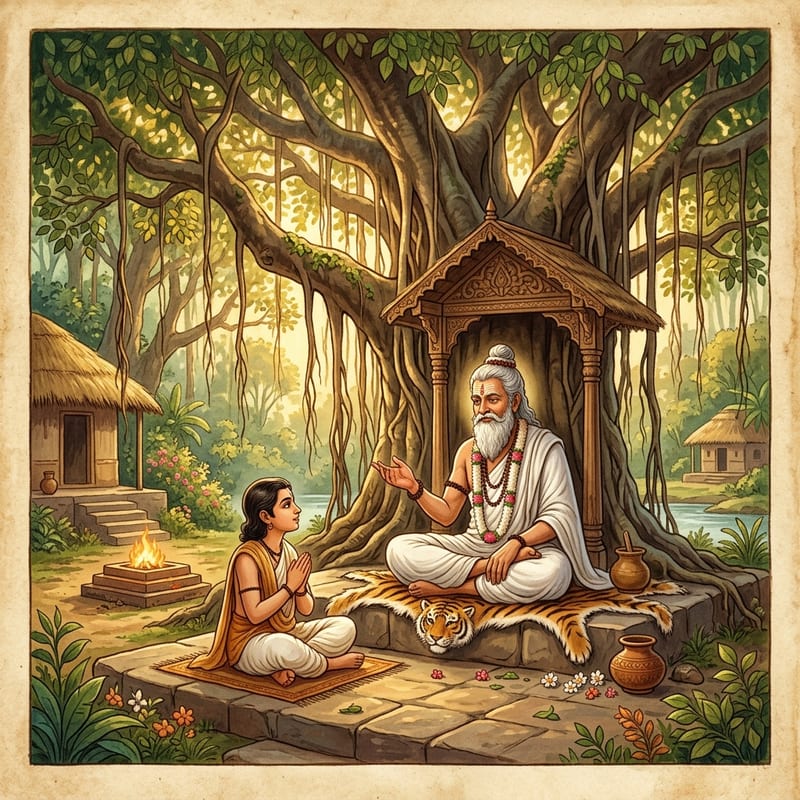
sarvavedāntasiddhāntagocaraṃ tamagocaram |
govindaṃ paramānandaṃ sadguruṃ praṇato'smyaham || 1||
govindaṃ paramānandaṃ sadguruṃ praṇato'smyaham || 1||
- sarva-vedānta-siddhānta-sarva-vedānta-siddhānta-gocaramknowable through the import of all Vedanta (sarva:all | vedānta:Vedanta, essence of the Vedas | siddhānta:established conclusion | gocaram:within range of)
- tam agocaramhim who is beyond the reach of speech and mind (tam:him | a:beyond | gocaram:range of perception)
- govindaṃGovinda, the Lord
- paramānandaṃSupreme Bliss (parama:supreme | ānanda:bliss)
- sadguruṃthe true Guru (sat:true, perfect | guru:spiritual teacher)
- praṇataḥ asmi ahamI bow in prostration (praṇataḥ:bowed, prostrated | asmi:am | aham:I)
jantūnāṃ narajanma durlabhamataḥ puṃstvaṃ tato vipratā
tasmādvaidikadharmamārgaparatā vidvattvamasmātparam |
ātmānātmavivecanaṃ svanubhavo brahmātmanā saṃsthitiḥ
muktirno śatajanmakoṭisukṛtaiḥ puṇyairvinā labhyate || 2||
tasmādvaidikadharmamārgaparatā vidvattvamasmātparam |
ātmānātmavivecanaṃ svanubhavo brahmātmanā saṃsthitiḥ
muktirno śatajanmakoṭisukṛtaiḥ puṇyairvinā labhyate || 2||
- jantūnāṃof all living beings
- narajanmahuman birth (nara:human | janma:birth)
- durlabhamdifficult to obtain (dur:with difficulty | labha:attainment)
- ataḥmore so, beyond that
- puṃstvaṃmanhood
- tataḥbeyond that
- vipratāBrahminhood
- vaidikadharmamārgaparatādevotion to the Vedic path of righteousness (vaidika:Vedic | dharma:righteousness | mārga:path | paratā:devotion to)
- vidvattvamerudition, scriptural learning
- ātmānātmavivecanamdiscrimination between Self and not-Self (ātmā:the Self | anātma:the not-Self | vivecanam:discrimination)
- svanubhavaḥdirect personal experience of the Self (sva:one's own | anubhavaḥ:experience)
- brahmātmanā saṃsthitiḥabiding in identity with Brahman (brahma:Brahman | ātmanā:as the Self | saṃsthitiḥ:established abiding)
- muktiḥLiberation
- śatajanmakoṭisukṛtaiḥby meritorious deeds of a hundred crore births (śata:hundred | janma:births | koṭi:crore | sukṛtaiḥ:by meritorious deeds)
- puṇyair vinā na labhyatecannot be obtained without merit (puṇyaiḥ:by merit | vinā:without | na labhyate:cannot be obtained)
(pāṭhabhedaḥ - śatakoṭijanmasu kṛtaiḥ)
durlabhaṃ trayamevaitaddevānugrahahetukam |
manuṣyatvaṃ mumukṣutvaṃ mahāpuruṣasaṃśrayaḥ || 3||
durlabhaṃ trayamevaitaddevānugrahahetukam |
manuṣyatvaṃ mumukṣutvaṃ mahāpuruṣasaṃśrayaḥ || 3||
- durlabhaṃdifficult to attain
- trayam evathese three alone (trayam:three | eva:indeed)
- etatthese
- devānugraha-devānugraha-hetukamcaused by the grace of God (deva:God | anugraha:grace | hetukam:caused by)
- manuṣyatvaṃhuman birth, humanity
- mumukṣutvaṃlonging for Liberation (mumukṣu:one who desires liberation | tvam:state of being)
- mahāpuruṣa-mahāpuruṣa-saṃśrayaḥthe protecting care of a great soul or perfected sage (mahā:great | puruṣa:person, sage | saṃśrayaḥ:refuge, protective care)
labdhvā kathañcinnarajanma durlabhaṃ (pāṭhabhedaḥ - kathañcin)
tatrāpi puṃstvaṃ śrutipāradarśanam |
yastvātmamuktau na yateta mūḍhadhīḥ
sa hyātmahā svaṃ vinihantyasadgrahāt || 4||
tatrāpi puṃstvaṃ śrutipāradarśanam |
yastvātmamuktau na yateta mūḍhadhīḥ
sa hyātmahā svaṃ vinihantyasadgrahāt || 4||
- labdhvāhaving obtained
- kathaṃcitby some means, somehow
- narajanmahuman birth (nara:human | janma:birth)
- durlabhaṃrare, hard to obtain
- tatrāpiand there too
- puṃstvaṃmanhood
- śrutipāradarśanammastery of the Vedas (śruti:Vedas | pāra:the other shore, full extent | darśanam:seeing, mastery)
- yaḥ tubut he who
- ātmamuktaufor the liberation of the Self (ātma:Self | muktau:for liberation)
- na yatetadoes not strive
- mūḍhadhīḥthe fool, the dull-witted one (mūḍha:deluded, foolish | dhīḥ:intellect)
- saḥ hi ātmahāhe indeed is a slayer of the Self
- svaṃ vinihantykills himself
- asadgrahātby clinging to the unreal (asat:unreal | grahāt:from clinging to)
(pāṭhabhedaḥ - ātmahā svaṃ)
itaḥ ko nvasti mūḍhātmā yastu svārthe pramādyati |
durlabhaṃ mānuṣaṃ dehaṃ prāpya tatrāpi pauruṣam || 5||
itaḥ ko nvasti mūḍhātmā yastu svārthe pramādyati |
durlabhaṃ mānuṣaṃ dehaṃ prāpya tatrāpi pauruṣam || 5||
- itaḥthan this, greater than this
- kaḥ nu astiwho indeed is there
- mūḍhātmāthe foolish one (mūḍha:deluded, foolish | ātmā:self)
- yaḥ tubut he who
- svārthein his own highest interest, in the real purpose of life (sva:one's own | arthe:in the purpose, goal)
- pramādyatiis negligent, neglects
- durlabhaṃrare, hard to obtain
- mānuṣaṃ dehama human body (mānuṣam:human | deham:body)
- prāpyahaving obtained
- pauruṣammanliness, the masculine capacity for spiritual striving
vadantu śāstrāṇi yajantu devān (pāṭhabhedaḥ - paṭhantu)
kurvantu karmāṇi bhajantu devatāḥ |
ātmaikyabodhena vināpi mukti- (pāṭhabhedaḥ - vinā vimuktiḥ na)
rna sidhyati brahmaśatāntare'pi || 6||
kurvantu karmāṇi bhajantu devatāḥ |
ātmaikyabodhena vināpi mukti- (pāṭhabhedaḥ - vinā vimuktiḥ na)
rna sidhyati brahmaśatāntare'pi || 6||
- vadantu śāstrāṇilet them quote the scriptures (vadantu:let them recite | śāstrāṇi:scriptures)
- yajantu devānlet them sacrifice to the gods (yajantu:let them worship | devān:gods)
- kurvantu karmāṇilet them perform rituals (kurvantu:let them do | karmāṇi:rituals, actions)
- bhajantu devatāḥlet them worship the deities (bhajantu:let them worship | devatāḥ:deities)
- ātmaikyabodhena vināwithout the realisation of one's identity with the Ātman (ātma:Self | aikya:oneness, identity | bodhena:by knowledge | vinā:without)
- api muktiḥeven Liberation
- na sidhyatidoes not succeed
- brahmaśatāntare apieven within a hundred Brahma-lifetimes (brahma:the creator Brahmā | śata:hundred | antare:within the span of | api:even)
amṛtattvasya nāśāsti vittenetyeva hi śrutiḥ |
bravīti karmaṇo mukterahetutvaṃ sphuṭaṃ yataḥ || 7||
bravīti karmaṇo mukterahetutvaṃ sphuṭaṃ yataḥ || 7||
- amṛtatvasyaof immortality (amṛta:immortal | tvasya:of the state/nature)
- na āśā astithere is no hope (na:not | āśā:hope | asti:is)
- vittenaby means of wealth
- iti eva hithus indeed
- śrutiḥthe Vedas, shruti
- bravītideclares
- karmaṇaḥof action, ritual works
- mukteḥfor Liberation
- ahetutvaṃbeing not the cause (a:not | hetu:cause | tvam:state of being)
- sphuṭaṃclearly
- yataḥsince, because
ato vimuktyai prayateta vidvān
sannyastabāhyārthasukhaspṛhaḥ san |
santaṃ mahāntaṃ samupetya deśikaṃ
tenopadiṣṭārthasamāhitātmā || 8||
sannyastabāhyārthasukhaspṛhaḥ san |
santaṃ mahāntaṃ samupetya deśikaṃ
tenopadiṣṭārthasamāhitātmā || 8||
- ataḥtherefore
- vimuktyaifor Liberation (vi:fully | mukti:liberation)
- prayatetashould strive
- vidvānthe wise, learned man
- saṃnyasta-bāhyārtha-sukha-saṃnyasta-bāhyārtha-sukha-spṛhaḥhaving renounced desire for pleasures from external objects (saṃnyasta:renounced | bāhya:external | artha:objects | sukha:pleasure | spṛhaḥ:desire for)
- sanbeing
- santaṃ mahāntaṃa good, magnanimous Guru (santam:good, holy | mahāntam:great, magnanimous)
- samupetyahaving duly approached
- deśikaṃthe preceptor, Guru
- tena upadiṣṭa-artha-samāhita-tena upadiṣṭa-artha-samāhita-ātmāwith mind concentrated on the truth taught by him (tena:by him | upadiṣṭa:instructed | artha:truth, meaning | samāhita:concentrated | ātmā:mind, self)
uddharedātmanā''tmānaṃ magnaṃ saṃsāravāridhau |
yogārūḍhatvamāsādya samyagdarśananiṣṭhayā || 9||
yogārūḍhatvamāsādya samyagdarśananiṣṭhayā || 9||
- uddharetshould lift up, rescue
- ātmanāby oneself, by the Self
- ātmānaṃoneself
- magnaṃimmersed, drowning
- saṃsāra-saṃsāra-vāridhauin the ocean of worldly existence (saṃsāra:the cycle of birth and death | vāridhau:in the ocean)
- yogārūḍhatvamthe state of being established in Yoga (yoga:meditative union | ārūḍha:ascended to | tvam:state of being)
- āsādyahaving attained
- samyag-darśana-samyag-darśana-niṣṭhayāthrough steadfast devotion to right discrimination (samyag:right, correct | darśana:vision, discrimination | niṣṭhayā:by steadfast devotion)
sannyasya sarvakarmāṇi bhavabandhavimuktaye |
yatyatāṃ paṇḍitairdhīrairātmābhyāsa upasthitaiḥ || 10||
yatyatāṃ paṇḍitairdhīrairātmābhyāsa upasthitaiḥ || 10||
- saṃnyasyahaving renounced
- sarvakarmāṇiall actions, works (sarva:all | karmāṇi:actions)
- bhava-bandha-bhava-bandha-vimuktayefor liberation from the bondage of worldly existence (bhava:worldly existence | bandha:bondage | vimuktaye:for liberation)
- yatyatāṃlet them strive
- paṇḍitaiḥby the learned
- dhīraiḥby the firm, the erudite
- ātmābhyāsein the practice of realising the Self (ātma:Self | abhyāse:in practice)
- upasthitaiḥby those who have commenced, who are engaged
cittasya śuddhaye karma na tu vastūpalabdhaye |
vastusiddhirvicāreṇa na kiñcitkarmakoṭibhiḥ || 11||
vastusiddhirvicāreṇa na kiñcitkarmakoṭibhiḥ || 11||
- cittasyaof the mind
- śuddhayefor purification
- karmaaction, ritual work
- na tubut not
- vastu-vastu-upalabdhayefor the perception of Reality (vastu:Reality, the real thing | upalabdhaye:for perception, attainment)
- vastu-vastu-siddhiḥthe realisation of Truth (vastu:Reality | siddhiḥ:accomplishment, realisation)
- vicāreṇaby discrimination, reasoning
- na kiṃcitnot in the least
- karmakoṭibhiḥby ten million acts (karma:action | koṭibhiḥ:by crores, tens of millions)
samyagvicārataḥ siddhā rajjutattvāvadhāraṇā |
bhrāntoditamahāsarpabhayaduḥkhavināśinī || 12||
bhrāntoditamahāsarpabhayaduḥkhavināśinī || 12||
- samyag-samyag-vicārataḥthrough right, thorough reasoning (samyag:right, proper | vicārataḥ:from reasoning)
- siddhāaccomplished, gained
- rajju-tattva-rajju-tattva-avadhāraṇāthe conviction about the true nature of the rope (rajju:rope | tattva:true nature | avadhāraṇā:conviction, firm understanding)
- bhrānta-bhrānta-uditaarising from delusion (bhrānta:deluded | udita:arisen)
- mahāsarpagreat serpent (mahā:great | sarpa:serpent)
- bhaya-duḥkha-bhaya-duḥkha-vināśinīthat which destroys the fear and suffering (bhaya:fear | duḥkha:suffering | vināśinī:destroyer of)
(pāṭhabhedaḥ - bhrāntyo)
arthasya niścayo dṛṣṭo vicāreṇa hitoktitaḥ |
na snānena na dānena prāṇāyāmaśatena vā || 13||
arthasya niścayo dṛṣṭo vicāreṇa hitoktitaḥ |
na snānena na dānena prāṇāyāmaśatena vā || 13||
- arthasyaof the Truth, Reality
- niścayaḥconviction, certainty
- dṛṣṭaḥis seen, is established
- vicāreṇaby reasoning, discrimination
- hita-hita-uktitaḥfrom the salutary counsel of the wise (hita:beneficial, salutary | uktitaḥ:from speech, counsel)
- na snānenanot by bathing in sacred waters
- na dānenanot by gift-giving
- prāṇāyāma-prāṇāyāma-śatenaby hundreds of prāṇāyāmas (prāṇāyāma:breath control | śatena:by hundreds)
- vāor
adhikāriṇamāśāste phalasiddhirviśeṣataḥ |
upāyā deśakālādyāḥ santyasminsahakāriṇaḥ || 14||
upāyā deśakālādyāḥ santyasminsahakāriṇaḥ || 14||
- adhikāriṇamthe qualified aspirant
- āśāsteexpects, awaits
- phala-phala-siddhiḥthe accomplishment of the fruit (phala:fruit, result | siddhiḥ:accomplishment)
- viśeṣataḥessentially, primarily
- upāyāḥmeans, auxiliaries
- deśa-kāla-deśa-kāla-ādyāḥplace, time and other such factors (deśa:place | kāla:time | ādyāḥ:and others)
- santiare
- asminin this matter
- sahakāriṇaḥauxiliaries, supporting conditions (saha:together | kāriṇaḥ:causes)
(pāṭhabhedaḥ - santyasyāṃ)
ato vicāraḥ kartavyo jijñāsorātmavastunaḥ ||
samāsādya dayāsindhuṃ guruṃ brahmaviduttamam || 15||
ato vicāraḥ kartavyo jijñāsorātmavastunaḥ ||
samāsādya dayāsindhuṃ guruṃ brahmaviduttamam || 15||
- ataḥtherefore
- vicāraḥreasoning, inquiry
- kartavyaḥshould be undertaken
- jijñāsoḥof the seeker, the inquirer
- ātma-ātma-vastunaḥof the Reality of the Self (ātma:Self | vastunaḥ:of the Reality)
- samāsādyahaving duly approached
- dayā-dayā-sindhuṃan ocean of compassion (dayā:compassion | sindhuṃ:ocean)
- guruṃthe Guru
- brahmavid-brahmaviduttamamthe foremost among knowers of Brahman (brahma:Brahman | vid:knower | uttamam:the best, foremost)
medhāvī puruṣo vidvānūhāpohavicakṣaṇaḥ |
adhikāryātmavidyāyāmuktalakṣaṇalakṣitaḥ || 16||
adhikāryātmavidyāyāmuktalakṣaṇalakṣitaḥ || 16||
- medhāvīintelligent, sharp-minded
- puruṣaḥperson
- vidvānlearned, erudite
- ūhāpoha-ūhāpoha-vicakṣaṇaḥskilled in arguing for and refuting counter-arguments (ūha:hypothesis, reasoning in favour | apoha:refutation, reasoning against | vicakṣaṇaḥ:skilled in)
- adhikārīthe qualified one, the fit recipient
- ātma-ātma-vidyāyāmfor the knowledge of the Self (ātma:Self | vidyāyām:for knowledge)
- ukta-lakṣaṇa-ukta-lakṣaṇa-lakṣitaḥcharacterised by the above-mentioned qualities (ukta:stated | lakṣaṇa:characteristic | lakṣitaḥ:marked by, endowed with)
vivekino viraktasya śamādiguṇaśālinaḥ |
mumukṣoreva hi brahmajijñāsāyogyatā matā || 17||
mumukṣoreva hi brahmajijñāsāyogyatā matā || 17||
- vivekinaḥof the one who discriminates
- viraktasyaof the dispassionate
- śama-ādi-guṇa-śama-ādi-guṇa-śālinaḥpossessing calmness and the allied virtues (śama:calmness | ādi:and the rest | guṇa:virtue | śālinaḥ:possessing)
- mumukṣoḥ evaof the one yearning for liberation alone (mumukṣoḥ:of the one desiring liberation | eva:alone, only)
- hiindeed
- brahma-jijñāsā-brahma-jijñāsā-yogyatāthe qualification for inquiry into Brahman (brahma:Brahman | jijñāsā:inquiry | yogyatā:fitness, qualification)
- matāis considered, is acknowledged
sādhanānyatra catvāri kathitāni manīṣibhiḥ |
yeṣu satsveva sanniṣṭhā yadabhāve na sidhyati || 18||
yeṣu satsveva sanniṣṭhā yadabhāve na sidhyati || 18||
- sādhanānithe means, qualifications
- atrahere, regarding this
- catvārifour
- kathitānihave been spoken of
- manīṣibhiḥby the sages, the wise
- yeṣu satsu evaonly when these are present (yeṣu:in which | satsu:being present | eva:only)
- sanniṣṭhāfirm establishment, devotion to Brahman
- yad abhāvein the absence of which
- na sidhyatidoes not succeed
ādau nityānityavastuvivekaḥ parigaṇyate |
ihāmutraphalabhogavirāgastadanantaram |
śamādiṣaṭkasampattirmumukṣutvamiti sphuṭam || 19||
ihāmutraphalabhogavirāgastadanantaram |
śamādiṣaṭkasampattirmumukṣutvamiti sphuṭam || 19||
- ādaufirst
- nityānitya-vastu-nityānitya-vastu-vivekaḥdiscrimination between the eternal and the transient (nitya:eternal | anitya:transient | vastu:things | vivekaḥ:discrimination)
- parigamyateis enumerated, comes first
- iha amutrahere and hereafter (iha:here, in this world | amutra:hereafter, in the other world)
- phala-bhoga-phala-bhoga-virāgaḥdispassion toward the enjoyment of fruits (phala:fruit, result | bhoga:enjoyment | virāgaḥ:dispassion)
- tad anantaramafter that, next
- śama-ādi-ṣaṭka-śama-ādi-ṣaṭka-sampattiḥthe possession of the group of six virtues beginning with calmness (śama:calmness | ādi:beginning with | ṣaṭka:group of six | sampattiḥ:wealth, possession)
- mumukṣutvamyearning for Liberation
- iti sphuṭamthus clearly (iti:thus | sphuṭam:clearly)
brahma satyaṃ jaganmithyetyevaṃrūpo viniścayaḥ |
so'yaṃ nityānityavastuvivekaḥ samudāhṛtaḥ || 20||
so'yaṃ nityānityavastuvivekaḥ samudāhṛtaḥ || 20||
- brahma satyaṃBrahman is real (brahma:Brahman | satyam:real, true)
- jagat mithyāthe world is unreal (jagat:world | mithyā:unreal, illusory)
- iti evaṃrūpaḥof this very nature (iti:thus | evaṃrūpaḥ:of such form)
- viniścayaḥfirm conviction, definitive determination
- saḥ ayamthis very
- nityānitya-vastu-nityānitya-vastu-vivekaḥdiscrimination between the eternal and the non-eternal (nitya:eternal | anitya:non-eternal | vastu:reality | vivekaḥ:discrimination)
- samudāhṛtaḥis designated, is called
tadvairāgyaṃ jihāsā yā darśanaśravaṇādibhiḥ | (pāṭhabhedaḥ - jugupsā yā)
dehādibrahmaparyante hyanitye bhogavastuni || 21||
dehādibrahmaparyante hyanitye bhogavastuni || 21||
- tad vairāgyamthat Vairāgya, renunciation
- jihāsāthe desire to give up, aversion
- yāwhich
- darśana-śravaṇa-darśana-śravaṇa-ādibhiḥthrough observation, instruction and so forth (darśana:seeing, observation | śravaṇa:hearing, instruction | ādibhiḥ:and so forth)
- deha-ādi-brahma-deha-ādi-brahma-paryantefrom the body up to Brahmāhood (deha:body | ādi:beginning | brahma:the state of Brahmā | paryante:up to the limit of)
- hi anityetoward what is indeed transient
- bhoga-bhoga-vastuniin the objects of enjoyment (bhoga:enjoyment | vastuni:in things, objects)
(pāṭhabhedaḥ - bhogyavastuni)
virajya viṣayavrātāddoṣadṛṣṭyā muhurmuhuḥ |
svalakṣye niyatāvasthā manasaḥ śama ucyate || 22||
virajya viṣayavrātāddoṣadṛṣṭyā muhurmuhuḥ |
svalakṣye niyatāvasthā manasaḥ śama ucyate || 22||
- virajyahaving detached from
- viṣaya-viṣaya-vrātātfrom the multitude of sense-objects (viṣaya:sense objects | vrātāt:from the multitude, host)
- doṣa-doṣa-dṛṣṭyāby continually observing their defects (doṣa:defect, fault | dṛṣṭyā:by seeing)
- muhurmuhuḥagain and again, repeatedly
- sva-sva-lakṣyeon its own goal, Brahman (sva:its own | lakṣye:on the goal)
- niyata-niyata-avasthāsteadfast resting (niyata:fixed, steady | avasthā:state, resting)
- manasaḥof the mind
- śamaḥŚama, calmness
- ucyateis called
viṣayebhyaḥ parāvartya sthāpanaṃ svasvagolake |
ubhayeṣāmindriyāṇāṃ sa damaḥ parikīrtitaḥ |
bāhyānālambanaṃ vṛttereṣoparatiruttamā || 23||
ubhayeṣāmindriyāṇāṃ sa damaḥ parikīrtitaḥ |
bāhyānālambanaṃ vṛttereṣoparatiruttamā || 23||
- viṣayebhyaḥfrom sense-objects
- parāvartyaturning back
- sthāpanaṃplacing, establishing
- sva-sva-svasva-golakein their respective centres or spheres (sva-sva:each one's own | golake:in the sphere, centre)
- ubhayeṣām indriyāṇāmof both kinds of sense-organs, the five of knowledge and five of action (ubhayeṣām:of both kinds | indriyāṇām:of the sense-organs)
- saḥ damaḥthat is Dama, self-control
- parikīrtitaḥis declared
- bāhya-bāhya-anālambanaṃnon-support in external objects, withdrawal from them (bāhya:external | anālambanaṃ:non-reliance, withdrawal)
- vṛtteḥof the mind-function
- eṣā uparatiḥthis Uparati, self-withdrawal
- uttamāthe best
sahanaṃ sarvaduḥkhānāmapratīkārapūrvakam |
cintāvilāparahitaṃ sā titikṣā nigadyate || 24||
cintāvilāparahitaṃ sā titikṣā nigadyate || 24||
- sahanaṃbearing, endurance
- sarva-sarva-duḥkhānāmof all afflictions and sufferings (sarva:all | duḥkhānām:of sufferings)
- apratīkāra-apratīkāra-pūrvakamwithout seeking to redress them (apratīkāra:without remedy | pūrvakam:accompanied by)
- cintā-vilāpa-cintā-vilāpa-rahitamfree from anxiety and lamentation (cintā:anxiety | vilāpa:lamentation | rahitam:free from)
- sāthat
- titikṣāTitikṣā, forbearance
- nigadyateis called
śāstrasya guruvākyasya satyabuddhyavadhāraṇam | (pāṭhabhedaḥ - satyabuddhyāvadhāraṇā)
sā śraddhā kathitā sadbhiryayā vastūpalabhyate || 25||
sā śraddhā kathitā sadbhiryayā vastūpalabhyate || 25||
- śāstrasyaof the scripture
- guru-guru-vākyasyaof the Guru's words (guru:teacher | vākyasya:of the words)
- satya-satya-buddhyāwith a conviction of their truth (satya:truth | buddhyā:by the intellect, conviction)
- avadhāraṇamfirm acceptance
- sāthat
- śraddhāŚraddhā, faith
- kathitāis called
- sadbhiḥby the sages, the wise
- yayāby which
- vastu upalabhyatethe Reality is perceived and attained (vastu:Reality | upalabhyate:is perceived, attained)
sarvadā sthāpanaṃ buddheḥ śuddhe brahmaṇi sarvadā | (pāṭhabhedaḥ - samyagāsthāpanaṃ)
tatsamādhānamityuktaṃ na tu cittasya lālanam || 26||
tatsamādhānamityuktaṃ na tu cittasya lālanam || 26||
- sarvadāalways, ever
- sthāpanaṃplacing, fixing
- buddheḥof the intellect, the affirming faculty
- śuddhe brahmaṇion the ever-pure Brahman (śuddhe:pure | brahmaṇi:on Brahman)
- tatthat
- samādhānamSamādhāna, self-settledness
- iti uktamis so called
- na tubut not
- cittasyaof the mind
- lālanamindulgence, mere pampering of thought in curiosity (lit. fondling)
ahaṅkārādidehāntān bandhānajñānakalpitān |
svasvarūpāvabodhena moktumicchā mumukṣutā || 27||
svasvarūpāvabodhena moktumicchā mumukṣutā || 27||
- ahaṃkāra-ādi-deha-ahaṃkāra-ādi-deha-antānfrom egoism to the body and all bondages in between (ahaṃkāra:egoism | ādi:beginning | deha:body | antān:up to, extending to)
- bandhānbondages
- ajñāna-ajñāna-kalpitānsuperimposed by Ignorance (ajñāna:ignorance | kalpitān:imagined, superimposed)
- sva-svarūpa-sva-svarūpa-avabodhenathrough the realisation of one's own true nature (sva:one's own | svarūpa:true nature | avabodhena:by knowledge, realisation)
- moktum icchāthe desire to be freed (moktum:to be freed | icchā:desire)
- mumukṣutāMumukṣutā, yearning for Liberation
mandamadhyamarūpāpi vairāgyeṇa śamādinā |
prasādena guroḥ seyaṃ pravṛddhā sūyate phalam || 28||
prasādena guroḥ seyaṃ pravṛddhā sūyate phalam || 28||
- manda-madhyama-manda-madhyama-rūpā apieven when torpid or mediocre in degree (manda:sluggish, dull | madhyama:mediocre | rūpā:in the form of | api:even)
- vairāgyeṇaby means of renunciation
- śama-śama-ādināby calmness and the rest (śama:calmness | ādinā:by the rest)
- prasādenaby the grace
- guroḥof the Guru
- sā iyamthis very yearning for liberation
- pravṛddhāgrown, fully developed
- sūyatebears, produces
- phalamfruit, result
vairāgyaṃ ca mumukṣutvaṃ tīvraṃ yasya tu vidyate |
tasminnevārthavantaḥ syuḥ phalavantaḥ śamādayaḥ || 29||
tasminnevārthavantaḥ syuḥ phalavantaḥ śamādayaḥ || 29||
- vairāgyam carenunciation and
- mumukṣutvamyearning for liberation
- tīvramintense, keen
- yasya tuin whose case indeed
- vidyateexists, is present
- tasmin evain that person alone
- arthavantaḥmeaningful, purposeful
- syuḥare, become
- phalavantaḥfruitful, productive
- śama-śama-ādayaḥcalmness and the rest (śama:calmness | ādayaḥ:and others)
etayormandatā yatra viraktatvamumukṣayoḥ |
marau salilavattatra śamāderbhānamātratā || 30||
marau salilavattatra śamāderbhānamātratā || 30||
- etayoḥof these two
- mandatātorpidity, weakness
- yatrawhere
- viraktatva-viraktatva-mumukṣayoḥof renunciation and yearning for liberation (viraktatva:dispassion | mumukṣayoḥ:and yearning for liberation)
- marauin a desert
- salila-salila-vatlike water, i.e. a mirage (salila:water | vat:like)
- tatrathere
- śama-śama-ādeḥof calmness and the rest
- bhāna-bhāna-mātratatābeing mere appearance, a seeming only (bhāna:appearance | mātratatā:being only that, mere seeming)
mokṣakāraṇasāmagryāṃ bhaktireva garīyasī |
svasvarūpānusandhānaṃ bhaktirityabhidhīyate || 31||
svasvarūpānusandhānaṃ bhaktirityabhidhīyate || 31||
- mokṣa-kāraṇa-mokṣa-kāraṇa-sāmagryāmamong all the means and causes of Liberation (mokṣa:Liberation | kāraṇa:cause | sāmagryām:among the collection of means)
- bhaktiḥ evaBhakti alone
- garīyasīthe greatest, most important
- sva-svarūpa-sva-svarūpa-anusandhānamthe constant seeking after one's own real nature (sva:one's own | svarūpa:true nature | anusandhānam:constant inquiry, seeking)
- bhaktiḥis called Bhakti, devotion
- iti abhidhīyateis thus designated (iti:thus | abhidhīyate:is called)
svātmatattvānusandhānaṃ bhaktirityapare jaguḥ |
uktasādhanasampannastattvajijñāsurātmanaḥ |
upasīdedguruṃ prājñaṃ yasmādbandhavimokṣaṇam || 32||
uktasādhanasampannastattvajijñāsurātmanaḥ |
upasīdedguruṃ prājñaṃ yasmādbandhavimokṣaṇam || 32||
- sva-ātma-tattva-svātma-tattva-anusandhānaminquiry into the truth of one's own Self (sva:one's own | ātma:Self | tattva:truth | anusandhānam:inquiry, constant seeking)
- bhaktiḥis devotion
- itithus
- apareothers
- jaguḥhave said
- ukta-sādhana-ukta-sādhana-sampannaḥpossessed of the above-mentioned qualifications (ukta:stated | sādhana:qualifications | sampannaḥ:possessed of)
- tattva-tattva-jijñāsuḥthe seeker of Truth
- ātmanaḥof the Self
- upasīdetshould approach
- gurum prājñamthe wise Guru (gurum:teacher | prājñam:the wise, learned)
- yasmātfrom whom
- bandha-bandha-vimokṣaṇamliberation from bondage (bandha:bondage | vimokṣaṇam:complete liberation)
śrotriyo'vṛjino'kāmahato yo brahmavittamaḥ |
brahmaṇyuparataḥ śānto nirindhana ivānalaḥ |
ahetukadayāsindhurbandhurānamatāṃ satām || 33||
brahmaṇyuparataḥ śānto nirindhana ivānalaḥ |
ahetukadayāsindhurbandhurānamatāṃ satām || 33||
- śrotriyaḥversed in the Vedas, a Vedic scholar
- avṛjinaḥsinless (a:without | vṛjina:sin, transgression)
- akāmahataḥunsmitten by desire (a:without | kāma:desire | hataḥ:struck, afflicted by)
- yaḥwho
- brahmavid-brahmavit-tamaḥthe foremost knower of Brahman (brahma:Brahman | vit:knower | tamaḥ:superlative, foremost)
- brahmaṇi uparataḥwithdrawn into Brahman, resting in Brahman (brahmaṇi:in Brahman | uparataḥ:withdrawn, at rest)
- śāntaḥcalm, tranquil
- nirindhana iva analaḥlike a fire that has consumed its fuel (nirindhana:without fuel | iva:like | analaḥ:fire)
- ahetuka-dayā-ahetuka-dayā-sindhuḥan ocean of causeless, spontaneous compassion (ahetuka:without cause, spontaneous | dayā:compassion | sindhuḥ:ocean)
- bandhuḥfriend, kinsman
- ānamatāṃ satāmof the virtuous who bow to him (ānamatām:of those who bow | satām:of the virtuous)
tamārādhya guruṃ bhaktyā prahvapraśrayasevanaiḥ | (pāṭhabhedaḥ - prahvaḥ)
prasannaṃ tamanuprāpya pṛcchejjñātavyamātmanaḥ || 34||
prasannaṃ tamanuprāpya pṛcchejjñātavyamātmanaḥ || 34||
- tamthat Guru
- ārādhyaworshipping
- gurumthe Guru
- bhaktyāwith devotion
- prahva-praśraya-prahva-praśraya-sevanaihwith prostration, humility and service (prahva:prostration | praśraya:humility, courtesy | sevanaih:by service)
- prasannamwhen pleased
- tam anuprāpyahaving approached him
- pṛcchetshould ask
- jñātavyamwhat ought to be known
- ātmanaḥabout the Self
svāminnamaste natalokabandho
kāruṇyasindho patitaṃ bhavābdhau |
māmuddharātmīyakaṭākṣadṛṣṭyā
ṛjvyātikāruṇyasudhābhivṛṣṭyā || 35||
kāruṇyasindho patitaṃ bhavābdhau |
māmuddharātmīyakaṭākṣadṛṣṭyā
ṛjvyātikāruṇyasudhābhivṛṣṭyā || 35||
- svāminO Master
- namaḥ tesalutation to you, I bow to you
- nata-loka-nata-loka-bandhoO friend of those who bow to you (nata:bowed, prostrating | loka:people | bandho:O friend, relative)
- kāruṇya-kāruṇya-sindhoO ocean of compassion (kāruṇya:compassion | sindho:O ocean)
- patitamfallen
- bhava-bhava-abdhauinto the ocean of worldly existence (bhava:existence, birth-death cycle | abdhau:in the ocean)
- mām uddharsave me, lift me up (mām:me | uddhar:lift, rescue)
- ātmīya-kaṭākṣa-ātmīya-kaṭākṣa-dṛṣṭyāwith your own gracious glance (ātmīya:one's own, gracious | kaṭākṣa:sidelong glance | dṛṣṭyā:with the glance)
- ṛjvyāstraightforward, direct
- atikāruṇya-sudhā-ati-kāruṇya-sudhā-abhivṛṣṭyāshowering the nectar of supreme compassion (ati:supreme | kāruṇya:compassion | sudhā:nectar | abhivṛṣṭyā:by showering)
durvārasaṃsāradavāgnitaptaṃ
dodhūyamānaṃ duradṛṣṭavātaiḥ |
bhītaṃ prapannaṃ paripāhi mṛtyoḥ
śaraṇyamanyadyadahaṃ na jāne || 36||
dodhūyamānaṃ duradṛṣṭavātaiḥ |
bhītaṃ prapannaṃ paripāhi mṛtyoḥ
śaraṇyamanyadyadahaṃ na jāne || 36||
- durvāra-saṃsāra-dava-agni-durvāra-saṃsāra-dava-agni-taptamscorched by the unquenchable forest-fire of worldly existence (durvāra:unquenchable | saṃsāra:worldly cycle | dava:forest fire | agni:fire | taptam:scorched)
- dodhūyamānamshaken violently, tossed about
- duradṛṣṭa-duradṛṣṭa-vātaiḥby the winds of ill fate (duradṛṣṭa:ill fate | vātaiḥ:by the winds)
- bhītamterrified
- prapannamone who has taken refuge, a surrendered seeker
- paripāhiprotect fully, save completely
- mṛtyoḥfrom death
- śaraṇyamrefuge, shelter
- anyad yadany other which
- aham na jāneI do not know (aham:I | na:not | jāne:know)
(pāṭhabhedaḥ - anyaṃ)
śāntā mahānto nivasanti santo
vasantavallokahitaṃ carantaḥ |
tīrṇāḥ svayaṃ bhīmabhavārṇavaṃ janā-
nahetunānyānapi tārayantaḥ || 37||
śāntā mahānto nivasanti santo
vasantavallokahitaṃ carantaḥ |
tīrṇāḥ svayaṃ bhīmabhavārṇavaṃ janā-
nahetunānyānapi tārayantaḥ || 37||
- śāntāḥtranquil
- mahāntaḥmagnanimous, great souls
- nivasantidwell, live
- santaḥthe good, holy ones
- vasanta-vasanta-vatlike the spring season (vasanta:spring | vat:like)
- loka-loka-hitamfor the welfare of the world (loka:world | hitam:good, welfare)
- carantaḥmoving about, acting
- tīrṇāḥhaving crossed
- svayamthemselves
- bhīma-bhava-bhīma-bhava-arṇavamthe terrible ocean of worldly existence (bhīma:terrible, dreadful | bhava:worldly existence | arṇavam:ocean)
- janānpeople
- ahetunāwithout any selfish motive (a:without | hetu:cause, motive)
- yān apiwhoever
- tārayantaḥhelping to cross, ferrying across
ayaṃ svabhāvaḥ svata eva yatpara-
śramāpanodapravaṇaṃ mahātmanām |
sudhāṃśureṣa svayamarkakarkaśa-
prabhābhitaptāmavati kṣitiṃ kila || 38||
śramāpanodapravaṇaṃ mahātmanām |
sudhāṃśureṣa svayamarkakarkaśa-
prabhābhitaptāmavati kṣitiṃ kila || 38||
- ayamthis
- svabhāvaḥthe very nature, inherent disposition
- svataḥ evaof its own accord, naturally
- yatthat
- para-śrama-apanoda-para-śrama-apanoda-pravaṇamthe inclination to remove others' troubles (para:others' | śrama:trouble, suffering | apanoda:removal | pravaṇam:inclined toward)
- mahātmanāmof the great souls
- sudhāṃśuḥthe moon (sudhā:nectar | aṃśuḥ:the rayed one)
- eṣaḥthis moon
- svayamof its own accord
- arka-karkaśa-prabhā-arka-karkaśa-prabhā-abhitaptāmthe earth scorched by the harsh rays of the sun (arka:sun | karkaśa:harsh, fierce | prabhā:rays | abhitaptām:scorched)
- avaticools, protects
- kṣitimthe earth
- kilaindeed, as is well known
brahmānandarasānubhūtikalitaiḥ pūtaiḥ suśītairyutai- (pāṭhabhedaḥ - suśītaiḥ sitaiḥ)
ryuṣmadvākkalaśojjhitaiḥ śrutisukhairvākyāmṛtaiḥ secaya |
santaptaṃ bhavatāpadāvadahanajvālābhirenaṃ prabho
dhanyāste bhavadīkṣaṇakṣaṇagateḥ pātrīkṛtāḥ svīkṛtāḥ || 39||
ryuṣmadvākkalaśojjhitaiḥ śrutisukhairvākyāmṛtaiḥ secaya |
santaptaṃ bhavatāpadāvadahanajvālābhirenaṃ prabho
dhanyāste bhavadīkṣaṇakṣaṇagateḥ pātrīkṛtāḥ svīkṛtāḥ || 39||
- brahmānanda-rasa-anubhūti-brahmānanda-rasa-anubhūti-kalitaiḥfilled with the relish of the experience of Brahmananda (brahma:Brahman | ānanda:bliss | rasa:relish, essence | anubhūti:experience | kalitaiḥ:filled with)
- pūrtaiḥ suśītaiḥfull and delightfully cool (pūrtaiḥ:full | suśītaiḥ:pleasantly cool)
- yuṣmad-vāk-kalaśa-yuṣmad-vāk-kalaśa-ujjhitaiḥpoured from the vessel of your speech (yuṣmad:your | vāk:speech | kalaśa:vessel, pitcher | ujjhitaiḥ:poured out from)
- śruti-śruti-sukhaiḥdelightful to the ears
- vākya-vākya-amṛtaiḥwith nectar-like words (vākya:words, speech | amṛtaiḥ:with nectar)
- secayasprinkle, shower
- saṃtaptamscorched, tormented
- bhavat-tāpa-dāva-dahana-bhavat-tāpa-dāva-dahana-jvālābhiḥby the flames of the forest-fire of worldly affliction (bhavat:worldly | tāpa:affliction | dāva:forest fire | dahana:burning | jvālābhiḥ:by flames)
- enamthis one, me
- prabhoO Lord
- dhanyāḥ teblessed are those (dhanyāḥ:blessed | te:those)
- bhavad-īkṣaṇa-kṣaṇa-bhavad-īkṣaṇa-kṣaṇa-gateḥupon whom your glance falls even for a moment (bhavad:your | īkṣaṇa:glance | kṣaṇa:moment | gateḥ:of the alighting)
- pātrī-kṛtāḥ svī-kṛtāḥmade worthy vessels and accepted as one's own (pātrī-kṛtāḥ:made into worthy recipients | svī-kṛtāḥ:accepted as one's own)
kathaṃ tareyaṃ bhavasindhumetaṃ
kā vā gatirme katamo'styupāyaḥ |
jāne na kiñcitkṛpayā'va māṃ prabho
saṃsāraduḥkhakṣatimātanuṣva || 40||
kā vā gatirme katamo'styupāyaḥ |
jāne na kiñcitkṛpayā'va māṃ prabho
saṃsāraduḥkhakṣatimātanuṣva || 40||
- kathamhow
- tareyamshall I cross
- bhava-bhava-sindhumthe ocean of worldly existence (bhava:existence, birth-death cycle | sindhum:ocean)
- etamthis
- kā vā gatiḥwhat is my way, what is my fate (kā:what | vā:or | gatiḥ:way, course)
- mefor me
- katamaḥwhich
- asti upāyaḥis the means (asti:is | upāyaḥ:means, method)
- jāne na kiñcitI know nothing at all (jāne:I know | na:not | kiñcit:anything)
- kṛpayā ava māmcondescend to protect me (kṛpayā:with compassion | ava:protect, descend to help | mām:me)
- prabhoO Lord
- saṃsāra-duḥkha-saṃsāra-duḥkha-kṣatimthe putting an end to the misery of worldly existence (saṃsāra:cycle of existence | duḥkha:misery | kṣatim:destruction, ending)
- ātanuṣvadescribe at length, narrate fully
tathā vadantaṃ śaraṇāgataṃ svaṃ
saṃsāradāvānalatāpataptam |
nirīkṣya kāruṇyarasārdradṛṣṭyā
dadyādabhītiṃ sahasā mahātmā || 41||
saṃsāradāvānalatāpataptam |
nirīkṣya kāruṇyarasārdradṛṣṭyā
dadyādabhītiṃ sahasā mahātmā || 41||
- tathāthus, in this manner
- vadantamspeaking
- śaraṇa-śaraṇa-āgatamwho has sought refuge (śaraṇa:refuge | āgatam:come to)
- svamhis own disciple
- saṃsāra-dāva-anala-tāpa-saṃsāra-dāva-anala-tāpa-taptamscorched by the heat of the forest-fire of worldly existence (saṃsāra:worldly cycle | dāva:forest fire | anala:fire | tāpa:heat | taptam:scorched)
- nirīkṣyalooking at
- kāruṇya-rasa-ārdra-kāruṇya-rasa-ārdra-dṛṣṭyāwith a glance softened with the essence of compassion (kāruṇya:compassion | rasa:essence | ārdra:softened | dṛṣṭyā:with the glance)
- dadyātbestows
- abhītimfearlessness
- sahasāspontaneously, at once
- mahātmāthe great soul, the saint
vidvān sa tasmā upasattimīyuṣe
mumukṣave sādhu yathoktakāriṇe |
praśāntacittāya śamānvitāya
tattvopadeśaṃ kṛpayaiva kuryāt || 42||
mumukṣave sādhu yathoktakāriṇe |
praśāntacittāya śamānvitāya
tattvopadeśaṃ kṛpayaiva kuryāt || 42||
- vidvānthe wise one, the sage
- saḥhe
- tasmaito him
- upasattim īyuṣewho has sought his protection (upasattim:approach for protection | īyuṣe:who has gone to)
- mumukṣaveto the one thirsting for Liberation
- sādhuduly, properly
- yathokta-yathoktakāriṇewho obeys the instructions as prescribed (yathā:as | ukta:said | kāriṇe:one who does)
- praśānta-praśānta-cittāyato one of serene mind (praśānta:serene | cittāya:of mind)
- śama-śama-anvitāyaendowed with calmness (śama:calmness | anvitāya:endowed with)
- tattva-tattva-upadeśamthe teaching of Truth (tattva:Truth | upadeśam:teaching)
- kṛpayā evaout of sheer grace
- kuryātshould impart
mā bhaiṣṭa vidvaṃstava nāstyapāyaḥ
saṃsārasindhostaraṇe'styupāyaḥ |
yenaiva yātā yatayo'sya pāraṃ
tameva mārgaṃ tava nirdiśāmi || 43||
saṃsārasindhostaraṇe'styupāyaḥ |
yenaiva yātā yatayo'sya pāraṃ
tameva mārgaṃ tava nirdiśāmi || 43||
- mā bhaiṣṭafear not (mā:do not | bhaiṣṭa:fear)
- vidvanO learned one
- tavafor you
- na asti apāyaḥthere is no death, no danger (na:not | asti:is | apāyaḥ:danger, death)
- saṃsāra-saṃsāra-sindhoḥof the ocean of worldly existence (saṃsāra:cycle of birth and death | sindhoḥ:of the ocean)
- taraṇefor the crossing
- asti upāyaḥthere is a means
- yena evaby which very means
- yātāḥ yatayaḥsages have gone (yātāḥ:gone | yatayaḥ:sages, ascetics)
- asya pāramto the other shore of this ocean
- tam eva mārgamthat very path
- tava nirdiśāmiI shall point out to you
astyupāyo mahānkaścitsaṃsārabhayanāśanaḥ |
tena tīrtvā bhavāmbhodhiṃ paramānandamāpsyasi || 44||
tena tīrtvā bhavāmbhodhiṃ paramānandamāpsyasi || 44||
- astithere is
- upāyaḥa means
- mahānsovereign, great
- kaścita certain
- saṃsāra-bhaya-saṃsāra-bhaya-nāśanaḥthat destroys the fear of relative existence (saṃsāra:relative existence | bhaya:fear | nāśanaḥ:destroyer)
- tenaby that
- tīrtvāhaving crossed
- bhava-bhava-ambhodhimthe ocean of Samsāra (bhava:worldly existence | ambhodhim:the ocean)
- paramānandaṃsupreme bliss (parama:supreme | ānanda:bliss)
- āpsyasiyou will attain
vedāntārthavicāreṇa jāyate jñānamuttamam |
tenātyantikasaṃsāraduḥkhanāśo bhavatyanu || 45||
tenātyantikasaṃsāraduḥkhanāśo bhavatyanu || 45||
- vedānta-artha-vedānta-artha-vicāreṇaby reasoning on the meaning of the Vedanta (vedānta:Vedanta | artha:meaning | vicāreṇa:by reasoning)
- jāyateis born, arises
- jñānam uttamamthe highest knowledge (jñānam:knowledge | uttamam:highest)
- tenaby that
- ātyantikacomplete, total
- saṃsāra-duḥkha-saṃsāra-duḥkha-nāśaḥthe annihilation of the misery of worldly existence (saṃsāra:worldly cycle | duḥkha:misery | nāśaḥ:destruction)
- bhavatioccurs
- anuimmediately after
śraddhābhaktidhyānayogānmumukṣoḥ
mukterhetūnvakti sākṣācchrutergīḥ |
yo vā eteṣveva tiṣṭhatyamuṣya
mokṣo'vidyākalpitāddehabandhāt || 46||
mukterhetūnvakti sākṣācchrutergīḥ |
yo vā eteṣveva tiṣṭhatyamuṣya
mokṣo'vidyākalpitāddehabandhāt || 46||
- śraddhā-bhakti-dhyāna-śraddhā-bhakti-dhyāna-yogānfaith, devotion and the Yoga of meditation (śraddhā:faith | bhakti:devotion | dhyāna:meditation | yogān:the yoga)
- mumukṣoḥof the seeker after Liberation
- mukteḥ hetūnas the direct causes of Liberation (mukteḥ:of Liberation | hetūn:causes)
- vaktideclares
- sākṣāt śruteḥ gīḥthe direct voice of the Vedas (sākṣāt:directly | śruteḥ:of the Shruti | gīḥ:voice, speech)
- yaḥ vāwhoever
- eteṣu evain these alone
- tiṣṭhatiabides
- amuṣyahis
- mokṣaḥLiberation
- avidyā-kalpitāt deha-avidyā-kalpitāt deha-bandhātfrom the bondage of the body conjured by Ignorance (avidyā:ignorance | kalpitāt:from the conjured | deha:body | bandhāt:from bondage)
ajñānayogātparamātmanastava
hyanātmabandhastata eva saṃsṛtiḥ |
tayorvivekoditabodhavahniḥ
ajñānakāryaṃ pradahetsamūlam || 47||
hyanātmabandhastata eva saṃsṛtiḥ |
tayorvivekoditabodhavahniḥ
ajñānakāryaṃ pradahetsamūlam || 47||
- ajñāna-ajñāna-yogātthrough contact with Ignorance (ajñāna:ignorance | yogāt:from the union, contact)
- paramātmanaḥof the Supreme Self
- tavafor you
- hiindeed
- anātma-anātma-bandhaḥthe bondage to the non-Self (anātma:non-Self | bandhaḥ:bondage)
- tataḥ evafrom that alone
- saṃsṛtiḥthe cycle of births and deaths
- tayoḥof these two, the Self and non-Self
- viveka-udita-bodha-viveka-udita-bodha-vanhiḥthe fire of knowledge kindled by discrimination (viveka:discrimination | udita:kindled | bodha:knowledge | vanhiḥ:fire)
- ajñāna-ajñāna-kāryamthe effects of Ignorance
- pradahetburns up completely
- samūlamtogether with the root
śiṣya uvāca|
kṛpayā śrūyatāṃ svāminpraśno'yaṃ kriyate mayā |
yaduttaramahaṃ śrutvā kṛtārthaḥ syāṃ bhavanmukhāt || 48||
kṛpayā śrūyatāṃ svāminpraśno'yaṃ kriyate mayā |
yaduttaramahaṃ śrutvā kṛtārthaḥ syāṃ bhavanmukhāt || 48||
- śiṣyaḥ uvācathe disciple said
- kṛpayākindly, condescend to
- śrūyatāṃmay it be listened to
- svāminO Master
- praśnaḥ ayamthis question
- kriyateis put
- mayāby me
- yat uttaramthe reply to which
- ahamI
- śrutvāhaving heard
- kṛtārthaḥwith my life's purpose fulfilled (kṛta:done | arthaḥ:purpose)
- syāmshall be
- bhavat mukhātfrom your lips (bhavat:your | mukhāt:from the mouth)
ko nāma bandhaḥ kathameṣa āgataḥ
kathaṃ pratiṣṭhāsya kathaṃ vimokṣaḥ |
ko'sāvanātmā paramaḥ ka ātmā
tayorvivekaḥ kathametaducyatām || 49||
kathaṃ pratiṣṭhāsya kathaṃ vimokṣaḥ |
ko'sāvanātmā paramaḥ ka ātmā
tayorvivekaḥ kathametaducyatām || 49||
- kaḥ nāma bandhaḥwhat indeed is bondage (kaḥ:what | nāma:indeed, forsooth | bandhaḥ:bondage)
- katham eṣaḥ āgataḥhow has it come about (katham:how | eṣaḥ:this | āgataḥ:come)
- katham pratiṣṭhāhow does it persist
- asyaof this
- katham vimokṣaḥhow is one freed from it
- kaḥ asau anātmāwhat is this non-Self (kaḥ:what | asau:that | anātmā:non-Self)
- paramaḥ kaḥ ātmāwho is the Supreme Self
- tayoḥ vivekaḥthe discrimination between the two
- katham etad ucyatāmlet all this be stated (katham:how | etad:all this | ucyatām:let it be said)
śrīguruvāca |
dhanyo'si kṛtakṛtyo'si pāvitaṃ te kulaṃ tvayā | (pāṭhabhedaḥ - pāvitaṃ)
yadavidyābandhamuktyā brahmībhavitumicchasi || 50||
dhanyo'si kṛtakṛtyo'si pāvitaṃ te kulaṃ tvayā | (pāṭhabhedaḥ - pāvitaṃ)
yadavidyābandhamuktyā brahmībhavitumicchasi || 50||
- śrīguruḥ uvācathe revered Guru said
- dhanyaḥ asiblessed art thou (dhanyaḥ:blessed | asi:art)
- kṛtakṛtyaḥ asithou hast achieved thy life's purpose (kṛta:done | kṛtyaḥ:what ought to be done | asi:art)
- pāvitamsanctified
- te kulamyour family
- tvayāby you
- yadin that
- avidyā-bandha-avidyā-bandha-muktyāby freeing oneself from the bondage of Ignorance (avidyā:ignorance | bandha:bondage | muktyā:by liberation from)
- brahmībhavitumto become Brahman, to attain Brahmanhood (brahmī:relating to Brahman | bhavitum:to become)
- icchasiyou wish
ṛṇamocanakartāraḥ pituḥ santi sutādayaḥ |
bandhamocanakartā tu svasmādanyo na kaścana || 51||
bandhamocanakartā tu svasmādanyo na kaścana || 51||
- ṛṇa-mocana-ṛṇa-mocana-kartāraḥthose who can free one from debt (ṛṇa:debt | mocana:freeing | kartāraḥ:those who do)
- pituḥfor the father
- santiare, exist
- suta-suta-ādayaḥsons and others (suta:son | ādayaḥ:and others)
- bandha-mocana-bandha-mocana-kartāone who can free from bondage (bandha:bondage | mocana:freeing | kartā:the doer)
- tubut
- svasmāt anyaḥother than oneself (svasmāt:than oneself | anyaḥ:other)
- na kaścananone whatsoever
mastakanyastabhārāderduḥkhamanyairnivāryate |
kṣudhādikṛtaduḥkhaṃ tu vinā svena na kenacit || 52||
kṣudhādikṛtaduḥkhaṃ tu vinā svena na kenacit || 52||
- mastaka-nyasta-bhāra-mastaka-nyasta-bhāra-ādeḥcaused by a load placed on the head and so on (mastaka:head | nyasta:placed | bhāra:load | ādeḥ:and such)
- duḥkhamtrouble, pain
- anyaiḥby others
- nivāryatecan be removed
- kṣudhā-ādi-kṛta-kṣudhā-ādi-kṛta-duḥkhamthe pain caused by hunger and the like (kṣudhā:hunger | ādi:and the like | kṛta:caused | duḥkham:pain)
- tubut
- vinā svenaexcept by oneself
- na kenacitby none whatsoever
pathyamauṣadhasevā ca kriyate yena rogiṇā |
ārogyasiddhirdṛṣṭā'sya nānyānuṣṭhitakarmaṇā || 53||
ārogyasiddhirdṛṣṭā'sya nānyānuṣṭhitakarmaṇā || 53||
- pathyamthe proper diet
- auṣadha-auṣadha-sevātaking the medicine (auṣadha:medicine | sevā:taking, using)
- caand
- kriyateis done
- yena rogiṇāby which patient
- ārogya-ārogya-siddhiḥrecovery of health (ārogya:health | siddhiḥ:accomplishment)
- dṛṣṭāis seen
- asyaof that person
- na anya-anuṣṭhita-na anya-anuṣṭhita-karmaṇānot through work done by another (na:not | anya:other | anuṣṭhita:performed | karmaṇā:by action)
vastusvarūpaṃ sphuṭabodhacakṣuṣā
svenaiva vedyaṃ na tu paṇḍitena |
candrasvarūpaṃ nijacakṣuṣaiva
jñātavyamanyairavagamyate kim || 54||
svenaiva vedyaṃ na tu paṇḍitena |
candrasvarūpaṃ nijacakṣuṣaiva
jñātavyamanyairavagamyate kim || 54||
- vastu-vastu-svarūpamthe true nature of Reality (vastu:Reality | svarūpam:true nature)
- sphuṭa-bodha-sphuṭa-bodha-cakṣuṣāthrough the eye of clear illumination (sphuṭa:clear | bodha:illumination | cakṣuṣā:through the eye)
- svena evaby oneself alone
- vedyamto be known
- na tu paṇḍitenanot through a sage
- candra-candra-svarūpamwhat the moon exactly is
- nija-nija-cakṣuṣā evaby one's own eyes alone
- jñātavyamto be known
- anyaiḥ avagamyate kimcan others make him know it? (anyaiḥ:by others | avagamyate:can be conveyed | kim:what, implying impossible)
avidyākāmakarmādipāśabandhaṃ vimocitum |
kaḥ śaknuyādvinā''tmānaṃ kalpakoṭiśatairapi || 55||
kaḥ śaknuyādvinā''tmānaṃ kalpakoṭiśatairapi || 55||
- avidyā-kāma-karma-ādi-pāśa-avidyā-kāma-karma-ādi-pāśa-bandhamthe bondage of the fetters of Ignorance, desire, action and the like (avidyā:ignorance | kāma:desire | karma:action | ādi:and others | pāśa:fetter | bandham:bondage)
- vimocitumto free oneself from
- kaḥ śaknuyātwho can (kaḥ:who | śaknuyāt:is able to)
- vinā ātmānamexcept one's own self
- kalpa-koṭi-kalpa-koṭi-śataiḥ apieven in a hundred crore of cycles (kalpa:cosmic cycle | koṭi:crore | śataiḥ:hundreds | api:even)
na yogena na sāṅkhyena karmaṇā no na vidyayā |
brahmātmaikatvabodhena mokṣaḥ sidhyati nānyathā || 56||
brahmātmaikatvabodhena mokṣaḥ sidhyati nānyathā || 56||
- na yogenanot by Yoga
- na sāṃkhyenanot by Sānkhya
- karmaṇā nonot by action
- na vidyayānot by learning
- brahma-ātma-aikatva-brahma-ātma-aikatva-bodhenaby the realisation of one's identity with Brahman (brahma:Brahman | ātma:Self | aikatva:oneness | bodhena:by realisation)
- mokṣaḥLiberation
- sidhyatiis accomplished
- na anyathānot otherwise
vīṇāyā rūpasaundaryaṃ tantrīvādanasauṣṭhavam |
prajārañjanamātraṃ tanna sāmrājyāya kalpate || 57||
prajārañjanamātraṃ tanna sāmrājyāya kalpate || 57||
- vīṇāyāḥof a guitar
- rūpa-rūpa-saundaryamthe beauty of form (rūpa:form | saundaryam:beauty)
- tantrī-vādana-tantrī-vādana-sauṣṭhavamthe skill of playing on its strings (tantrī:string | vādana:playing | sauṣṭhavam:skill)
- prajā-rañjana-prajā-rañjana-mātrammerely serving to please some people (prajā:people | rañjana:delighting | mātram:merely)
- tatthat
- na sāmrājyāyanot for sovereignty
- kalpatesuffices
vāgvaikharī śabdajharī śāstravyākhyānakauśalam |
vaiduṣyaṃ viduṣāṃ tadvadbhuktaye na tu muktaye || 58||
vaiduṣyaṃ viduṣāṃ tadvadbhuktaye na tu muktaye || 58||
- vāk-vāk-vaikharīloud, articulate speech (vāk:speech | vaikharī:the articulate vocal form)
- śabda-śabda-jharīa shower of words (śabda:word | jharī:stream)
- śāstra-vyākhyāna-śāstra-vyākhyāna-kauśalamskill in expounding the Scriptures (śāstra:scripture | vyākhyāna:exposition | kauśalam:skill)
- vaiduṣyamerudition
- viduṣāṃof the learned
- tadvatlikewise
- bhuktayefor personal enjoyment
- na tu muktayenot for Liberation
avijñāte pare tattve śāstrādhītistu niṣphalā |
vijñāte'pi pare tattve śāstrādhītistu niṣphalā || 59||
vijñāte'pi pare tattve śāstrādhītistu niṣphalā || 59||
- avijñātewhen not realised, when unknown
- pare tattvethe highest Truth (pare:highest | tattve:in the Truth)
- śāstra-śāstra-adhītiḥstudy of scriptures
- tu niṣphalāis indeed fruitless
- vijñāte apieven when known, after realisation
- pare tattveof the highest Truth
- śāstra-śāstra-adhītiḥscriptural study
- tu niṣphalāis equally useless
śabdajālaṃ mahāraṇyaṃ cittabhramaṇakāraṇam |
ataḥ prayatnājjñātavyaṃ tattvajñaistattvamātmanaḥ || 60||
ataḥ prayatnājjñātavyaṃ tattvajñaistattvamātmanaḥ || 60||
- śabda-śabda-jālamthe thicket of words (śabda:word | jālam:network, snare)
- mahā-mahā-araṇyama dense forest (mahā:great | araṇyam:forest)
- citta-bhramaṇa-citta-bhramaṇa-kāraṇamthe cause of the mind's wandering (citta:mind | bhramaṇa:wandering | kāraṇam:cause)
- ataḥtherefore
- prayatnātwith earnest effort
- jñātavyamshould be known
- tattva-tattva-jñaiḥby men of wisdom (tattva:truth | jñaiḥ:by knowers)
- tattvam ātmanaḥthe true nature of the Self
tattvajñāttattva
ajñānasarpadaṣṭasya brahmajñānauṣadhaṃ vinā |
kimu vedaiśca śāstraiśca kimu mantraiḥ kimauṣadhaiḥ || 61||
ajñānasarpadaṣṭasya brahmajñānauṣadhaṃ vinā |
kimu vedaiśca śāstraiśca kimu mantraiḥ kimauṣadhaiḥ || 61||
- ajñāna-sarpa-ajñāna-sarpa-daṣṭasyaof one bitten by the serpent of Ignorance (ajñāna:ignorance | sarpa:serpent | daṣṭasya:of the bitten)
- brahma-jñāna-brahma-jñāna-auṣadhamthe medicine of the knowledge of Brahman (brahma:Brahman | jñāna:knowledge | auṣadham:medicine)
- vināwithout
- kimuof what avail
- vedaiḥ ca śāstraiḥ cathe Vedas and Scriptures
- mantraiḥby mantras
- auṣadhaiḥby medicines
na gacchati vinā pānaṃ vyādhirauṣadhaśabdataḥ |
vinā'parokṣānubhavaṃ brahmaśabdairna mucyate || 62||
vinā'parokṣānubhavaṃ brahmaśabdairna mucyate || 62||
- na gacchatidoes not go away
- vinā pānamwithout actually taking it (vinā:without | pānam:drinking, taking)
- vyādhiḥa disease
- auṣadha-auṣadha-śabdataḥby the mere utterance of the word medicine (auṣadha:medicine | śabdataḥ:by mere utterance)
- vinā aparokṣa-vinā aparokṣa-anubhavamwithout direct, immediate experience (vinā:without | aparokṣa:direct, non-mediate | anubhavam:experience)
- brahma-brahma-śabdaiḥby the mere utterance of the word Brahman
- na mucyateone is not liberated
akṛtvā dṛśyavilayamajñātvā tattvamātmanaḥ |
brahmaśabdaiḥ kuto muktiruktimātraphalairnṛṇām || 63||
brahmaśabdaiḥ kuto muktiruktimātraphalairnṛṇām || 63||
- akṛtvāwithout causing to vanish
- dṛśya-dṛśya-vilayamthe dissolution of the objective world (dṛśya:the visible universe | vilayam:dissolution)
- ajñātvāwithout knowing
- tattvam ātmanaḥthe truth of the Self
- brahma-brahma-śabdaiḥby the mere utterance of the word Brahman
- kutaḥ muktiḥhow can there be Liberation
- ukti-mātra-ukti-mātra-phalaihthe result being a mere verbal exercise (ukti:utterance | mātra:merely | phalaih:by result)
- nṛṇāmfor men
(pāṭhabhedaḥ - bāhyaśabdaiḥ)
akṛtvā śatrusaṃhāramagatvākhilabhūśriyam |
rājāhamiti śabdānno rājā bhavitumarhati || 64||
akṛtvā śatrusaṃhāramagatvākhilabhūśriyam |
rājāhamiti śabdānno rājā bhavitumarhati || 64||
- akṛtvāwithout accomplishing
- śatru-śatru-saṃhāramthe destruction of enemies (śatru:enemies | saṃhāram:destruction)
- agatvāwithout possessing
- akhila-bhū-akhila-bhū-śriyamthe splendour of the entire earth (akhila:entire | bhū:earth | śriyam:splendour)
- rājā aham itiI am a king, thus
- śabdātby the mere utterance
- nonot
- rājā bhavitumto become a king
- arhatione deserves, one can claim
āptoktiṃ khananaṃ tathopariśilādyutkarṣaṇaṃ svīkṛtiṃ (pāṭhabhedaḥ - pariśilāpākarṣaṇaṃ)
nikṣepaḥ samapekṣate na hi bahiḥśabdaistu nirgacchati |
tadvadbrahmavidopadeśamananadhyānādibhirlabhyate
māyākāryatirohitaṃ svamamalaṃ tattvaṃ na duryuktibhiḥ || 65||
nikṣepaḥ samapekṣate na hi bahiḥśabdaistu nirgacchati |
tadvadbrahmavidopadeśamananadhyānādibhirlabhyate
māyākāryatirohitaṃ svamamalaṃ tattvaṃ na duryuktibhiḥ || 65||
- āpta-āpta-uktimtrustworthy instruction from a competent person (āpta:trustworthy | uktim:instruction)
- khananamexcavation
- upari-śilā-ādi-upari-śilā-ādi-utkarṣaṇamremoval of stones and other things lying above (upari:above | śilā:stone | ādi:and such | utkarṣaṇam:removal)
- svīkṛtimgrasping, taking possession
- nikṣepaḥa hidden treasure
- samapekṣaterequires
- na hi bahiḥ śabdaiḥnever by being called out by name
- nirgacchaticomes out
- tadvatlikewise
- brahmavid-upadeśa-manana-dhyāna-brahma-vid-upadeśa-manana-dhyāna-ādibhiḥthrough the instructions of a knower of Brahman, reflection, meditation and so forth
- labhyateis attained
- māyā-kārya-māyā-kārya-tirohitamhidden by the effects of Maya (māyā:illusion | kārya:effects | tirohitam:concealed)
- sva-sva-amalam tattvamone's own pure Truth, the stainless Self (sva:one's own | amalam:stainless | tattvam:Truth)
- na duryuktibhiḥnot by perverted arguments
tasmātsarvaprayatnena bhavabandhavimuktaye |
svaireva yatnaḥ kartavyo rogādāviva paṇḍitaiḥ || 66||
svaireva yatnaḥ kartavyo rogādāviva paṇḍitaiḥ || 66||
- tasmāttherefore
- sarva-sarva-prayatnenaby all means, with every effort (sarva:all | prayatnena:with effort)
- bhava-bandha-bhava-bandha-vimuktayefor liberation from the bondage of worldly existence (bhava:worldly existence | bandha:bondage | vimuktaye:for liberation)
- svaiḥ evapersonally, by oneself
- yatnaḥeffort
- kartavyaḥshould be made
- roga-roga-ādau ivajust as in the case of disease (roga:disease | ādau:and such | iva:just as)
- paṇḍitaiḥby the wise
(pāṭhabhedaḥ - rogāderiva)
yastvayādya kṛtaḥ praśno varīyāñchāstravinmataḥ | (pāṭhabhedaḥ - sammataḥ)
sūtraprāyo nigūḍhārtho jñātavyaśca mumukṣubhiḥ || 67||
yastvayādya kṛtaḥ praśno varīyāñchāstravinmataḥ | (pāṭhabhedaḥ - sammataḥ)
sūtraprāyo nigūḍhārtho jñātavyaśca mumukṣubhiḥ || 67||
- yaḥwhich
- tvayāby you
- adyatoday
- kṛtaḥasked
- praśnaḥquestion
- varīyānexcellent, the best
- śāstra-vin-śāstra-vin-mataḥapproved by those versed in the Śāstras (śāstra:scripture | vin:knower | mataḥ:approved by)
- sūtra-sūtra-prāyaḥaphoristic in character (sūtra:aphorism | prāyaḥ:resembling)
- nigūḍha-nigūḍha-arthaḥpregnant with deep meaning (nigūḍha:deep, hidden | arthaḥ:meaning)
- jñātavyaḥ caand fit to be known
- mumukṣubhiḥby seekers after Liberation
śaṛṇuṣvāvahito vidvanyanmayā samudīryate |
tadetacchravaṇātsadyo bhavabandhādvimokṣyase || 68||
tadetacchravaṇātsadyo bhavabandhādvimokṣyase || 68||
- śṛṇuṣvalisten
- avahitaḥattentively, with care
- vidvanO learned one
- yatwhat
- mayāby me
- samudīryateis being said
- tad etatthis
- śravaṇātby listening to
- sadyaḥimmediately, at once
- bhava-bhava-bandhātfrom the bondage of worldly existence (bhava:existence | bandhāt:from bondage)
- vimokṣyaseyou shall be completely freed
mokṣasya hetuḥ prathamo nigadyate
vairāgyamatyantamanityavastuṣu |
tataḥ śamaścāpi damastitikṣā
nyāsaḥ prasaktākhilakarmaṇāṃ bhṛśam || 69||
vairāgyamatyantamanityavastuṣu |
tataḥ śamaścāpi damastitikṣā
nyāsaḥ prasaktākhilakarmaṇāṃ bhṛśam || 69||
- mokṣasyaof Liberation
- hetuḥthe cause, the step
- prathamaḥthe first
- nigadyateis declared
- vairāgyamdispassion, renunciation
- atyantamextreme, intense
- anitya-anitya-vastuṣutoward all perishable things (anitya:perishable | vastuṣu:toward things)
- tataḥthen, next
- śamaḥ ca apicalmness also
- damaḥself-control
- titikṣāforbearance
- nyāsaḥrelinquishment of works
- prasakta-akhila-prasakta-akhila-karmaṇāmof all works enjoined by the Scriptures (prasakta:enjoined | akhila:all | karmaṇām:of works)
- bhṛśamutterly, completely
tataḥ śrutistanmananaṃ satattva-
dhyānaṃ ciraṃ nityanirantaraṃ muneḥ |
tato'vikalpaṃ parametya vidvān
ihaiva nirvāṇasukhaṃ samṛcchati || 70||
dhyānaṃ ciraṃ nityanirantaraṃ muneḥ |
tato'vikalpaṃ parametya vidvān
ihaiva nirvāṇasukhaṃ samṛcchati || 70||
- tataḥthen, next
- śrutiḥhearing of the Truth from the Guru
- tan-tan-mananamreflection on that (tan:that | mananam:reflection)
- sa-tattva-sa-tattva-dhyānammeditation on that Truth (sa:on that | tattva:Truth | dhyānam:meditation)
- ciramfor long
- nitya-nitya-nirantaramconstant and unbroken (nitya:constant | nirantaram:without interruption)
- muneḥof the sage, the contemplative
- tataḥafter that
- avikalpamthe Nirvikalpa state, beyond all mental modifications (a:without | vikalpa:modification, distinction)
- param etyahaving reached the supreme state
- vidvānthe learned seeker
- iha evahere in this very life
- nirvāṇa-nirvāṇa-sukhaṃthe bliss of Nirvana (nirvāṇa:liberation | sukham:bliss)
- samṛcchatiattains
yadboddhavyaṃ tavedānīmātmānātmavivecanam |
taducyate mayā samyak śrutvātmanyavadhāraya || 71||
taducyate mayā samyak śrutvātmanyavadhāraya || 71||
- yad boddhavyamwhat ought to be known (yad:what | boddhavyam:ought to be known)
- tavaby you
- idānīmnow
- ātmānātma-ātmānātma-vivecanamthe discrimination between the Self and the non-Self (ātmā:Self | anātma:non-Self | vivecanam:discrimination)
- tadthat
- ucyateis being said
- mayāby me
- samyakfully, properly
- śrutvāhaving listened
- ātmaniwithin yourself
- avadhārayadecide, realise firmly
majjāsthimedaḥpalaraktacarma-
tvagāhvayairdhātubhirebhiranvitam |
pādoruvakṣobhujapṛṣṭhamastakaiḥ
aṅgairupāṅgairupayuktametat || 72||
tvagāhvayairdhātubhirebhiranvitam |
pādoruvakṣobhujapṛṣṭhamastakaiḥ
aṅgairupāṅgairupayuktametat || 72||
- majjāmarrow
- asthibone
- medaḥfat
- palaflesh
- raktablood
- carmaskin
- tvak-tvak-āhvayaiḥcalled the cuticle (tvak:cuticle | āhvayaiḥ:named)
- dhātubhiḥ ebhiḥby these seven bodily constituents
- anvitamcomposed of
- pāda-ūru-vakṣa-bhuja-pṛṣṭha-pāda-ūru-vakṣa-bhuja-pṛṣṭha-mastakaiḥlegs, thighs, chest, arms, back and head
- aṅgaiḥ upāṅgaiḥwith limbs and their sub-parts
- upayuktamconstituted, fitted
- etatthis body
ahammameti prathitaṃ śarīraṃ
mohāspadaṃ sthūlamitīryate budhaiḥ |
nabhonabhasvaddahanāmbubhūmayaḥ
sūkṣmāṇi bhūtāni bhavanti tāni || 73||
mohāspadaṃ sthūlamitīryate budhaiḥ |
nabhonabhasvaddahanāmbubhūmayaḥ
sūkṣmāṇi bhūtāni bhavanti tāni || 73||
- aham-mama-iti-aham-mama-iti-prathitamreputed as the seat of "I and mine" (aham:I | mama:mine | iti:thus | prathitam:reputed)
- śarīramthe body
- moha-moha-āspadamthe abode of delusion (moha:delusion | āspadam:abode)
- sthūlamthe gross body
- iti īryateis thus called
- budhaiḥby the wise
- nabhaḥspace, sky
- nabhasvatair
- dahanafire
- ambuwater
- bhūmayaḥearth
- sūkṣmāṇisubtle
- bhūtānielements
- bhavantiare
- tānithey
parasparāṃśairmilitāni bhūtvā
sthūlāni ca sthūlaśarīrahetavaḥ |
mātrāstadīyā viṣayā bhavanti
śabdādayaḥ pañca sukhāya bhoktuḥ || 74||
sthūlāni ca sthūlaśarīrahetavaḥ |
mātrāstadīyā viṣayā bhavanti
śabdādayaḥ pañca sukhāya bhoktuḥ || 74||
- paraspara-paraspara-aṃśaiḥwith parts of one another (paraspara:mutually | aṃśaiḥ:with parts)
- militāniunited, combined
- bhūtvāhaving become
- sthūlānigross
- sthūla-śarīra-sthūla-śarīra-hetavaḥcauses of the gross body (sthūla:gross | śarīra:body | hetavaḥ:causes)
- mātrāḥsubtle essences, tanmātras
- tadīyāḥtheir (the elements')
- viṣayāḥsense-objects
- bhavantibecome
- śabda-śabda-ādayaḥsound and the rest
- pañcafive
- sukhāyafor happiness
- bhoktuḥof the experiencer, the individual soul
ya eṣu mūḍhā viṣayeṣu baddhā
rāgorupāśena sudurdamena |
āyānti niryāntyadha ūrdhvamuccaiḥ
svakarmadūtena javena nītāḥ || 75||
rāgorupāśena sudurdamena |
āyānti niryāntyadha ūrdhvamuccaiḥ
svakarmadūtena javena nītāḥ || 75||
- yethose who
- eṣuto these
- mūḍhāḥfools
- viṣayeṣuin sense-objects
- baddhāḥtied, bound
- rāga-uru-rāga-uru-pāśenaby the stout cord of attachment (rāga:attachment | uru:stout, great | pāśena:by the cord)
- sudurdamenavery difficult to snap (su:very | dur:with difficulty | damena:by control)
- āyānti niryānticome and go
- adhaḥ ūrdhvamdownward and upward
- uccaiḥforcefully
- sva-karma-sva-karma-dūtenaby the emissary of their own past actions (sva:one's own | karma:action | dūtena:by the messenger)
- javenaswiftly
- nītāḥcarried, led
śabdādibhiḥ pañcabhireva pañca
pañcatvamāpuḥ svaguṇena baddhāḥ |
kuraṅgamātaṅgapataṅgamīna-
bhṛṅgā naraḥ pañcabhirañcitaḥ kim || 76||
pañcatvamāpuḥ svaguṇena baddhāḥ |
kuraṅgamātaṅgapataṅgamīna-
bhṛṅgā naraḥ pañcabhirañcitaḥ kim || 76||
- śabda-śabda-ādibhiḥby sound and the rest
- pañcabhiḥ evaby these five alone
- pañcathese five creatures
- pañcatvam āpuḥmet their death (pañcatvam:dissolution into five elements, death | āpuḥ:attained)
- sva-sva-guṇena baddhāḥbound by their own attachment to one quality
- kuraṅgaḥthe deer (drawn by sound)
- mātaṅgaḥthe elephant (drawn by touch)
- pataṅgaḥthe moth (drawn by form/fire)
- mīnaḥthe fish (drawn by taste)
- bhṛṅgāḥthe black bee (drawn by smell)
- naraḥman
- pañcabhiḥ añcitaḥattached to all five senses (pañcabhiḥ:by five | añcitaḥ:drawn toward)
- kimwhat fate then awaits him?
doṣeṇa tīvro viṣayaḥ kṛṣṇasarpaviṣādapi |
viṣaṃ nihanti bhoktāraṃ draṣṭāraṃ cakṣuṣāpyayam || 77||
viṣaṃ nihanti bhoktāraṃ draṣṭāraṃ cakṣuṣāpyayam || 77||
- doṣeṇain its evil effect
- tīvraḥmore virulent
- viṣayaḥsense-object
- kṛṣṇa-sarpa-kṛṣṇa-sarpa-viṣāt apieven than the poison of a black cobra (kṛṣṇa:black | sarpa:serpent | viṣāt:than the poison | api:even)
- viṣampoison
- nihantikills
- bhoktāramone who consumes it
- draṣṭāramone who merely looks at the sense-objects
- cakṣuṣā apieven through the eyes
- ayamthis sense-object
viṣayāśāmahāpāśādyo vimuktaḥ sudustyajāt |
sa eva kalpate muktyai nānyaḥ ṣaṭśāstravedyapi || 78||
sa eva kalpate muktyai nānyaḥ ṣaṭśāstravedyapi || 78||
- viṣaya-āśā-mahā-viṣaya-āśā-mahā-pāśātfrom the great fetter of hankering for sense-objects (viṣaya:sense-objects | āśā:hankering | mahā:great | pāśāt:from the fetter)
- yaḥwho
- vimuktaḥis free
- sudustyajātso very difficult to give up
- saḥ evathat person alone
- kalpateis fit
- muktyaifor Liberation
- na anyaḥnone other
- ṣaṭ-śāstra-ṣaṭ-śāstra-vedyaḥ apieven though versed in all six Śāstras (ṣaṭ:six | śāstra:scripture | vedyaḥ:one who knows | api:even though)
āpātavairāgyavato mumukṣūn
bhavābdhipāraṃ pratiyātumudyatān |
āśāgraho majjayate'ntarāle
nigṛhya kaṇṭhe vinivartya vegāt || 79||
bhavābdhipāraṃ pratiyātumudyatān |
āśāgraho majjayate'ntarāle
nigṛhya kaṇṭhe vinivartya vegāt || 79||
- āpāta-vairāgya-āpāta-vairāgya-vataḥthose with only apparent or surface dispassion (āpāta:apparent, sudden | vairāgya:dispassion | vataḥ:possessing)
- mumukṣūnseekers after Liberation
- bhava-abdhi-bhava-abdhi-pāramthe other shore of the ocean of worldly existence
- prati yātum udyatānendeavouring to cross toward (prati:toward | yātum:to go | udyatān:endeavouring)
- āśā-āśā-grahaḥthe shark of hankering (āśā:hankering | grahaḥ:shark, seizer)
- majjayatedrowns
- antarālehalfway, midway
- nigṛhyacatching
- kaṇṭheby the throat
- vinivartyapulling violently back
- vegātwith force
viṣayākhyagraho yena suviraktyasinā hataḥ |
sa gacchati bhavāmbhodheḥ pāraṃ pratyūhavarjitaḥ || 80||
sa gacchati bhavāmbhodheḥ pāraṃ pratyūhavarjitaḥ || 80||
- viṣaya-ākhya-viṣaya-ākhya-grahaḥthe shark known as sense-objects (viṣaya:sense-objects | ākhya:named | grahaḥ:shark, seizer)
- yenaby whom
- su-virakti-su-virakti-asināwith the sword of mature dispassion (su:mature | virakti:dispassion | asinā:with the sword)
- hataḥkilled, cut down
- saḥthat person
- gacchaticrosses
- bhava-bhava-ambhodheḥthe ocean of worldly existence
- pāramthe other shore
- pratyūha-pratyūha-varjitaḥfree from all obstacles (pratyūha:obstacle | varjitaḥ:free from)
viṣamaviṣayamārgairgacchato'nacchabuddheḥ (pāṭhabhedaḥ - viṣayamārge gacchato)
pratipadamabhiyāto mṛtyurapyeṣa viddhi | (pāṭhabhedaḥ - pratipadamabhighāto mṛtyurapyeṣa siddhaḥ)
hitasujanagurūktyā gacchataḥ svasya yuktyā
prabhavati phalasiddhiḥ satyamityeva viddhi || 81||
pratipadamabhiyāto mṛtyurapyeṣa viddhi | (pāṭhabhedaḥ - pratipadamabhighāto mṛtyurapyeṣa siddhaḥ)
hitasujanagurūktyā gacchataḥ svasya yuktyā
prabhavati phalasiddhiḥ satyamityeva viddhi || 81||
- viṣama-viṣaya-viṣama-viṣaya-mārgaiḥalong the dreadful ways of sense-pleasure (viṣama:dreadful | viṣaya:sense-pleasure | mārgaiḥ:by the ways)
- gacchataḥof one who walks
- anaccha-anachha-buddheḥof the dull-witted (anachha:turbid, unclear | buddheḥ:of the intellect)
- pratipadamat every step
- abhiyātaḥ mṛtyuḥdeath approaches rapidly
- viddhiknow
- hita-sujana-guru-hita-sujana-guru-uktyāin accordance with the instructions of a well-wishing Guru (hita:well-wishing | sujana:good person | guru:teacher | uktyā:by the instructions)
- svasya yuktyāwith one's own reasoning (svasya:one's own | yuktyā:by reasoning)
- prabhavati phala-prabhavati phala-siddhiḥthe accomplishment of the goal prevails (prabhavati:achieves | phala:fruit | siddhiḥ:accomplishment)
- satyam iti eva viddhiknow this to be true
mokṣasya kāṅkṣā yadi vai tavāsti
tyajātidūrādviṣayānviṣaṃ yathā |
pīyūṣavattoṣadayākṣamārjava-
praśāntidāntīrbhaja nityamādarāt || 82||
tyajātidūrādviṣayānviṣaṃ yathā |
pīyūṣavattoṣadayākṣamārjava-
praśāntidāntīrbhaja nityamādarāt || 82||
- mokṣasya kāṃkṣāyearning for Liberation (mokṣasya:of Liberation | kāṃkṣā:craving)
- yadiif
- vaiindeed
- tava astiyou have
- tyajashun, abandon
- ati-ati-dūrātfrom a great distance
- viṣayānsense-objects
- viṣam yathāas you would poison
- pīyūṣa-pīyūṣa-vatlike nectar
- toṣa-dayā-kṣamā-toṣa-dayā-kṣamā-ārjavacontentment, compassion, forgiveness, straight-forwardness (toṣa:contentment | dayā:compassion | kṣamā:forgiveness | ārjava:straight-forwardness)
- praśānti-praśānti-dāntīḥcalmness and self-control (praśānti:calmness | dāntīḥ:self-control)
- bhajacultivate
- nityam ādarātalways and carefully (nityam:always | ādarāt:with care, devotion)
anukṣaṇaṃ yatparihṛtya kṛtyaṃ
anādyavidyākṛtabandhamokṣaṇam |
dehaḥ parārtho'yamamuṣya poṣaṇe
yaḥ sajjate sa svamanena hanti || 83||
anādyavidyākṛtabandhamokṣaṇam |
dehaḥ parārtho'yamamuṣya poṣaṇe
yaḥ sajjate sa svamanena hanti || 83||
- anukṣaṇamalways, at every moment
- yat parihṛtyaleaving aside what
- kṛtyamshould be done
- anādi-avidyā-kṛta-bandha-anādi-avidyā-kṛta-bandha-mokṣaṇamemancipation from the bondage created by beginningless Ignorance (anādi:without beginning | avidyā:ignorance | kṛta:created | bandha:bondage | mokṣaṇam:emancipation)
- dehaḥthe body
- para-para-arthaḥan object for others, not one's own (para:others | arthaḥ:object)
- ayamthis
- amuṣya poṣaṇein nourishing this body
- yaḥwhoever
- sajjateis passionately devoted
- saḥ svam anena hanticommits suicide thereby (saḥ:he | svam:himself | anena:by this | hanti:kills)
śarīrapoṣaṇārthī san ya ātmānaṃ didṛkṣati | (pāṭhabhedaḥ - didṛkṣate)
grāhaṃ dārudhiyā dhṛtvā nadīṃ tartuṃ sa gacchati || 84||
grāhaṃ dārudhiyā dhṛtvā nadīṃ tartuṃ sa gacchati || 84||
- śarīra-poṣaṇa-śarīra-poṣaṇa-arthīone devoted to nourishing the body (śarīra:body | poṣaṇa:nourishment | arthī:seeker of)
- sanbeing
- yaḥwhoever
- ātmānamthe Self
- didṛkṣatidesires to realise
- grāhama crocodile
- dāru-dāru-dhiyāmistaking it for a log of wood (dāru:wood, log | dhiyā:by thinking, mistaking)
- dhṛtvācatching hold of
- nadīm tartumto cross a river
- saḥ gacchatiproceeds
(pāṭhabhedaḥ - sa icchati)
moha eva mahāmṛtyurmumukṣorvapurādiṣu |
moho vinirjito yena sa muktipadamarhati || 85||
moha eva mahāmṛtyurmumukṣorvapurādiṣu |
moho vinirjito yena sa muktipadamarhati || 85||
- mohaḥ evainfatuation indeed
- mahāmṛtyuḥthe dire death (mahā:great, dire | mṛtyuḥ:death)
- mumukṣoḥfor the seeker after Liberation
- vapuḥ-vapuḥ-ādiṣuover the body and such things
- mohaḥthis infatuation
- vinirjitaḥthoroughly conquered
- yenaby whom
- saḥthat person
- mukti-mukti-padamthe state of Liberation
- arhatideserves
mohaṃ jahi mahāmṛtyuṃ dehadārasutādiṣu |
yaṃ jitvā munayo yānti tadviṣṇoḥ paramaṃ padam || 86||
yaṃ jitvā munayo yānti tadviṣṇoḥ paramaṃ padam || 86||
- mohaminfatuation
- jahiconquer, give up
- mahāmṛtyumthe dire death
- deha-dāra-suta-deha-dāra-suta-ādiṣuover body, wife, children and so on (deha:body | dāra:wife | suta:children | ādiṣu:etc.)
- yamwhich
- jitvāhaving conquered
- munayaḥthe sages
- yāntiattain
- tad viṣṇoḥ paramam padamthat Supreme State of Vishnu (viṣṇoḥ:of Vishnu | paramam:supreme | padam:state, abode)
tvaṅmāṃsarudhirasnāyumedomajjāsthisaṅkulam |
pūrṇaṃ mūtrapurīṣābhyāṃ sthūlaṃ nindyamidaṃ vapuḥ || 87||
pūrṇaṃ mūtrapurīṣābhyāṃ sthūlaṃ nindyamidaṃ vapuḥ || 87||
- tvakskin
- māṃsaflesh
- rudhirablood
- snāyuarteries and veins
- medaḥfat
- majjāmarrow
- asthibones
- saṃkulamcomposed of, full of
- pūrṇamfull
- mūtra-mūtra-purīṣābhyāmof urine and excrement (mūtra:urine | purīṣābhyām:and excrement)
- sthūlamgross
- nindyamto be deprecated, censured
- idam vapuḥthis body
pañcīkṛtebhyo bhūtebhyaḥ sthūlebhyaḥ pūrvakarmaṇā |
samutpannamidaṃ sthūlaṃ bhogāyatanamātmanaḥ |
avasthā jāgarastasya sthūlārthānubhavo yataḥ || 88||
samutpannamidaṃ sthūlaṃ bhogāyatanamātmanaḥ |
avasthā jāgarastasya sthūlārthānubhavo yataḥ || 88||
- pañcīkṛta-pañcīkṛta-bhūtebhyaḥfrom the gross elements formed by the union of the subtle elements (pañcīkṛta:combined through the quintuplication process | bhūtebhyaḥ:from the elements)
- sthūlebhyaḥfrom the gross
- pūrva-pūrva-karmaṇāby one's past actions
- samutpannamproduced
- idam sthūlamthis gross body
- bhoga-bhoga-āyatanamthe medium of experience (bhoga:experience | āyatanam:abode, medium)
- ātmanaḥof the soul
- avasthā jāgaraḥthe waking state
- tasyaits
- sthūla-artha-sthūla-artha-anubhavaḥexperience of gross objects (sthūla:gross | artha:objects | anubhavaḥ:experience)
- yataḥsince
bāhyendriyaiḥ sthūlapadārthasevāṃ
srakcandanastryādivicitrarūpām |
karoti jīvaḥ svayametadātmanā
tasmātpraśastirvapuṣo'sya jāgare || 89||
srakcandanastryādivicitrarūpām |
karoti jīvaḥ svayametadātmanā
tasmātpraśastirvapuṣo'sya jāgare || 89||
- bāhya-bāhya-indriyaiḥby means of the external organs
- sthūla-padārtha-sthūla-padārtha-sevāmenjoyment of gross objects
- srak-candana-strī-ādi-vicitra-srak-candana-strī-ādi-vicitra-rūpāmof varied forms like garlands, sandal-paste, women and so on (srak:garland | candana:sandal | strī:woman | ādi:etc. | vicitra:varied)
- karotiperforms
- jīvaḥthe individual soul
- svayam etad-svayam etad-ātmanāidentifying itself with this body (svayam:itself | etad:this | ātmanā:as the self)
- tasmāt praśastiḥhence its fullest play
- vapuṣaḥof this body
- jāgarein the waking state
sarvo'pi bāhyasaṃsāraḥ puruṣasya yadāśrayaḥ |
viddhi dehamidaṃ sthūlaṃ gṛhavadgṛhamedhinaḥ || 90||
viddhi dehamidaṃ sthūlaṃ gṛhavadgṛhamedhinaḥ || 90||
- sarvaḥ apithe entire
- bāhya-bāhya-saṃsāraḥexternal worldly dealings
- puruṣasyaof man
- yat āśrayaḥwhich rests upon (yat:which | āśrayaḥ:depending on)
- viddhiknow
- deham idam sthūlamthis gross body
- gṛha-gṛha-vatlike a house
- gṛhamedhinaḥof the householder
sthūlasya sambhavajarāmaraṇāni dharmāḥ
sthaulyādayo bahuvidhāḥ śiśutādyavasthāḥ |
varṇāśramādiniyamā bahudhā''mayāḥ syuḥ
pūjāvamānabahumānamukhā viśeṣāḥ || 91||
sthaulyādayo bahuvidhāḥ śiśutādyavasthāḥ |
varṇāśramādiniyamā bahudhā''mayāḥ syuḥ
pūjāvamānabahumānamukhā viśeṣāḥ || 91||
- sthūlasyaof the gross body
- saṃbhava-jarā-saṃbhava-jarā-maraṇānibirth, decay and death (saṃbhava:birth | jarā:decay | maraṇāni:death)
- dharmāḥcharacteristics
- sthaulya-sthaulya-ādayaḥstoutness and the like
- bahu-bahu-vidhāḥof many kinds
- śiśutā-ādya-śiśutā-ādy-avasthāḥconditions such as childhood and so on
- varṇa-āśrama-ādi-varṇa-āśrama-ādi-niyamāḥrestrictions of caste, order of life, etc.
- bahudhā-bahudhā-amayāḥvarious diseases
- syuḥare
- pūjā-avamāna-bahumāna-pūjā-avamāna-bahumāna-mukhāḥsuch as worship, insult and high honour (pūjā:worship | avamāna:insult | bahumāna:high honour)
- viśeṣāḥdifferent kinds of treatment
buddhīndriyāṇi śravaṇaṃ tvagakṣi
ghrāṇaṃ ca jihvā viṣayāvabodhanāt |
vākpāṇipādā gudamapyupasthaḥ (pāṭhabhedaḥ - upasthaṃ)
karmendriyāṇi pravaṇena karmasu || 92||
ghrāṇaṃ ca jihvā viṣayāvabodhanāt |
vākpāṇipādā gudamapyupasthaḥ (pāṭhabhedaḥ - upasthaṃ)
karmendriyāṇi pravaṇena karmasu || 92||
- buddhi-buddhi-indriyāṇithe organs of knowledge
- śravaṇamear
- tvakskin
- akṣieye
- ghrāṇamnose
- jivhātongue
- viṣaya-viṣaya-avabodhanātfrom their cognising objects (viṣaya:objects | avabodhanāt:from cognising)
- vākspeech
- pāṇihands
- pādālegs
- gudamrectum
- upasthaḥgenitals
- karma-karma-indriyāṇiorgans of action
- pravaṇenaowing to their tendency
- karmasuin action
(pāṭhabhedaḥ - pravaṇāni)
nigadyate'ntaḥkaraṇaṃ manodhīḥ
ahaṅkṛtiścittamiti svavṛttibhiḥ |
manastu saṅkalpavikalpanādibhiḥ
buddhiḥ padārthādhyavasāyadharmataḥ || 93||
nigadyate'ntaḥkaraṇaṃ manodhīḥ
ahaṅkṛtiścittamiti svavṛttibhiḥ |
manastu saṅkalpavikalpanādibhiḥ
buddhiḥ padārthādhyavasāyadharmataḥ || 93||
- nigadyateis called
- antaḥkaraṇamthe inner organ
- manaḥ-dhīḥ-ahaṃkṛtiḥ-manaḥ-dhīḥ-ahaṃkṛtiḥ-cittamas Manas, Buddhi, Ego and Chitta
- sva-sva-vṛttibhiḥaccording to their respective functions
- manaḥ tuManas indeed
- saṃkalpa-vikalpana-saṃkalpa-vikalpana-ādibhiḥfrom considering the pros and cons (saṃkalpa:will, resolve | vikalpana:doubt, alternative)
- buddhiḥBuddhi
- padārtha-adhyavasāya-padārtha-adhyavasāya-dharmataḥfrom its property of determining the truth of objects (padārtha:objects | adhyavasāya:determination | dharmataḥ:from the property)
atrābhimānādahamityahaṅkṛtiḥ |
svārthānusandhānaguṇena cittam || 94||
svārthānusandhānaguṇena cittam || 94||
- atra abhimānātfrom identification here
- aham iti ahaṃkṛtiḥthe ego, from the sense of "I"
- sva-artha-anusandhāna-sva-artha-anusandhāna-guṇenafrom its function of seeking pleasurable objects (sva:one's own | artha:object | anusandhāna:seeking)
- cittamChitta
prāṇāpānavyānodānasamānā bhavatyasau prāṇaḥ |
svayameva vṛttibhedādvikṛtibhedātsuvarṇasalilādivat || 95||
svayameva vṛttibhedādvikṛtibhedātsuvarṇasalilādivat || 95||
- prāṇa-apāna-vyāna-udāna-prāṇa-apāna-vyāna-udāna-samānāḥPrāṇa, Apāna, Vyāna, Udāna and Samāna
- bhavatibecomes
- asau prāṇaḥthat one Prāṇa, the vital force
- svayam evaby itself
- vṛtti-vṛtti-bhedātdue to diversity of functions (vṛtti:function | bhedāt:from diversity)
- vikṛti-vikṛti-bhedātdue to diversity of modifications
- suvarṇa-salila-suvarṇa-salila-ādivatlike gold and water and so on (suvarṇa:gold | salila:water | ādivat:and so on)
(pāṭhabhedaḥ - vikṛterbhedātsuvarṇasalilamiva)
vāgādi pañca śravaṇādi pañca
prāṇādi pañcābhramukhāni pañca |
buddhyādyavidyāpi ca kāmakarmaṇī
puryaṣṭakaṃ sūkṣmaśarīramāhuḥ || 96||
vāgādi pañca śravaṇādi pañca
prāṇādi pañcābhramukhāni pañca |
buddhyādyavidyāpi ca kāmakarmaṇī
puryaṣṭakaṃ sūkṣmaśarīramāhuḥ || 96||
- vāk-vāk-ādi pañcathe five organs of action beginning with speech
- śravaṇa-śravaṇa-ādi pañcathe five organs of knowledge beginning with the ear
- prāṇa-prāṇa-ādi pañcathe five vital forces beginning with Prāṇa
- abhra-abhra-mukhāni pañcathe five subtle elements beginning with ether
- buddhi-ādya-buddhi-ādy-avidyāBuddhi and the rest, together with Nescience
- kāma-kāma-karmaṇīdesire and action
- purya-pury-aṣṭakamthe group of eight cities, eight constituents (puri:city, constituent | aṣṭakam:group of eight)
- sūkṣma-sūkṣma-śarīramthe subtle body
- āhuḥis called by the wise
idaṃ śarīraṃ śaṛṇu sūkṣmasañjñitaṃ
liṅgaṃ tvapañcīkṛtabhūtasambhavam |
savāsanaṃ karmaphalānubhāvakaṃ
svājñānato'nādirupādhirātmanaḥ || 97||
liṅgaṃ tvapañcīkṛtabhūtasambhavam |
savāsanaṃ karmaphalānubhāvakaṃ
svājñānato'nādirupādhirātmanaḥ || 97||
- idam śarīramthis body
- śṛṇulisten
- sūkṣma-sūkṣma-saṃjñitamcalled the subtle body
- liṅgamthe Liṅga body
- apañcīkṛta-apañcīkṛta-saṃbhavamproduced before the quintuplication of the subtle elements
- sa-sa-vāsanampossessed of latent desires (sa:with | vāsanam:desires, impressions)
- karma-phala-karma-phala-anubhāvakamthe experiencer of the fruits of actions
- sva-sva-ajñānataḥdue to its own ignorance
- anādi-anādi-upādhiḥa beginningless superimposition
- ātmanaḥon the soul
svapno bhavatyasya vibhaktyavasthā
svamātraśeṣeṇa vibhāti yatra |
svapne tu buddhiḥ svayameva jāgrat
kālīnanānāvidhavāsanābhiḥ || 98||
svamātraśeṣeṇa vibhāti yatra |
svapne tu buddhiḥ svayameva jāgrat
kālīnanānāvidhavāsanābhiḥ || 98||
- svapnahdream
- bhavatibecomes
- asyaof this
- vibhakti-vibhakti avasthaathe state of separation (vibhakti:separation | avasthaa:state)
- sva-mātra-sva maatra sheshenawith only the self remaining (sva:self | maatra:only | sheshena:remaining)
- vibhaatishines
- yatrawhere
- svapnein dream
- tuindeed
- buddhihthe intellect
- svayam-svayam evaby itself alone (svayam:itself | eva:alone)
- jāgrat-jaagrat kaaliinabelonging to waking time (jaagrat:waking | kaaliina:belonging to time)
- nānā-vidha-naanaa vidha vaasanaabhihby various kinds of impressions (naanaa:various | vidha:kinds | vaasanaabhih:by impressions)
kartrādibhāvaṃ pratipadya rājate
yatra svayaṃ bhāti hyayaṃ parātmā | (pāṭhabhedaḥ - svayañjyotirayaṃ)
dhīmātrakopādhiraśeṣasākṣī
na lipyate tatkṛtakarmaleśaiḥ | karmalepaiḥ
yasmādasaṅgastata eva karmabhiḥ
na lipyate kiñcidupādhinā kṛtaiḥ || 99||
yatra svayaṃ bhāti hyayaṃ parātmā | (pāṭhabhedaḥ - svayañjyotirayaṃ)
dhīmātrakopādhiraśeṣasākṣī
na lipyate tatkṛtakarmaleśaiḥ | karmalepaiḥ
yasmādasaṅgastata eva karmabhiḥ
na lipyate kiñcidupādhinā kṛtaiḥ || 99||
- kartṛ-ādi-kartri aadi bhaavamthe state of doer and so on (kartri:doer | aadi:and so on | bhaavam:state)
- pratipadyahaving assumed
- raajateshines
- svayaṃ-svayam bhaatiself-luminous (svayam:self | bhaati:shines)
- hiindeed
- ayamthis
- para-para aatmaathe Supreme Self (para:supreme | aatmaa:Self)
- dhī-mātraka-dhii maatra ka upaadhihhaving intellect alone as limiting adjunct (dhii:intellect | maatra:alone | upaadhih:limiting adjunct)
- aśeṣa-ashesha saakshiiwitness of all (ashesha:all | saakshii:witness)
- na-na lipyateis not tainted (na:not | lipyate:is tainted)
- tat-kṛta-karma-tat krita karma leshaihby traces of actions done by that (tat:that | krita:done | karma:action | leshaih:by traces)
- yasmaatbecause
- asangahunattached
- tataḥ-tatah evatherefore alone (tatah:therefore | eva:alone)
- karmabhihby actions
- kinchitanything
- upādhinā-upaadhina kritaihdone by the limiting adjunct (upaadhina:by limiting adjunct | kritaih:done)
sarvavyāpṛtikaraṇaṃ liṅgamidaṃ syāccidātmanaḥ puṃsaḥ |
vāsyādikamiva takṣṇastenaivātmā bhavatyasaṅgo'yam || 100||
vāsyādikamiva takṣṇastenaivātmā bhavatyasaṅgo'yam || 100||
- sarva-vyāpṛti-sarva-vyāpṛti-karaṇamthe instrument for all activities (sarva:all | vyāpṛti:activities | karaṇam:instrument)
- liṅgamthe subtle (Liṅga) body
- idamthis
- syātis
- cid-cid-ātmanaḥof the Ātman who is Knowledge Absolute (cit:consciousness, knowledge | ātmanaḥ:of the Self)
- puṃsaḥof the person
- vāsya-vāsya-ādikaṃ ivalike an adze and other tools (vāsya:adze | ādikaṃ:and such | iva:like)
- takṣṇaḥof the carpenter
- tena evatherefore
- ātmāthe Ātman
- bhavatiis
- asaṅgaḥperfectly unattached
- ayamthis
andhatvamandatvapaṭutvadharmāḥ
sauguṇyavaiguṇyavaśāddhi cakṣuṣaḥ |
bādhiryamūkatvamukhāstathaiva
śrotrādidharmā na tu vetturātmanaḥ || 101||
sauguṇyavaiguṇyavaśāddhi cakṣuṣaḥ |
bādhiryamūkatvamukhāstathaiva
śrotrādidharmā na tu vetturātmanaḥ || 101||
- andhatvablindness
- mandatvaweakness of vision
- paṭutvasharpness
- dharmāḥare conditions
- sauguṇya-vaiguṇya-sauguṇya-vaiguṇya-vaśātdue to the fitness or defectiveness of the eye (sauguṇya:fitness, good quality | vaiguṇya:defectiveness | vaśāt:due to)
- hiindeed
- cakṣuṣaḥof the eye
- bādhiryadeafness
- mūkatvadumbness
- mukhāḥand such
- tathaivalikewise
- śrotra-ādi-śrotra-ādi-dharmāḥconditions of the ear and so forth
- na tubut never
- vettuḥ ātmanaḥof the Ātman the Knower (vettuḥ:of the knower | ātmanaḥ:of the Self)
ucchvāsaniḥśvāsavijṛmbhaṇakṣu-
tprasyandanādyutkramaṇādikāḥ kriyāḥ | (pāṭhabhedaḥ - praspandanādy)
prāṇādikarmāṇi vadanti tajñāḥ (pāṭhabhedaḥ - tajjñāḥ)
prāṇasya dharmāvaśanāpipāse || 102||
tprasyandanādyutkramaṇādikāḥ kriyāḥ | (pāṭhabhedaḥ - praspandanādy)
prāṇādikarmāṇi vadanti tajñāḥ (pāṭhabhedaḥ - tajjñāḥ)
prāṇasya dharmāvaśanāpipāse || 102||
- ucchvāsa-ucchvāsa-niḥśvāsainhalation and exhalation
- vijṛmbhaṇayawning
- kṣutsneezing
- prasyandanasecretion
- utkramaṇa-utkramaṇa-ādikāḥleaving the body and so on
- kriyāḥfunctions
- prāṇa-ādi-prāṇa-ādi-karmāṇifunctions of Prāṇa and the rest
- vadantideclare
- tajñāḥexperts
- prāṇasyaof Prāṇa proper
- dharmauthe two characteristics
- aśanā-aśanā-apipāsehunger and thirst (aśanā:hunger | apipāse:and thirst)
antaḥkaraṇameteṣu cakṣurādiṣu varṣmaṇi |
ahamityabhimānena tiṣṭhatyābhāsatejasā || 103||
ahamityabhimānena tiṣṭhatyābhāsatejasā || 103||
- antaḥkaraṇamthe inner organ (mind)
- eteṣuin these
- cakṣuḥ-cakṣuḥ-ādiṣuin the organs such as the eye
- varṣmaṇiin the body
- aham itiwith the sense of "I"
- abhimānenaby identification
- tiṣṭhatiremains, operates
- ābhāsa-ābhāsa-tejasāendued with a reflected light of the Ātman (ābhāsa:reflection | tejasā:by the light, consciousness)
ahaṅkāraḥ sa vijñeyaḥ kartā bhoktābhimānyayam |
sattvādiguṇayogena cāvasthātrayamaśnute || 104||
sattvādiguṇayogena cāvasthātrayamaśnute || 104||
- ahaṃkāraḥegoism
- saḥthat
- vijñeyaḥshould be known
- kartāthe doer
- bhoktāthe experiencer
- abhimānīthe one who identifies
- ayamthis
- sattva-ādi-guṇa-sattva-ādi-guṇa-yogenain conjunction with the Guṇas such as Sattva (sattva:purity | ādi:and others | guṇa:quality | yogena:through conjunction)
- caand
- avasthā-avasthā-trayamthe three states (waking, dream, deep sleep)
- aśnuteassumes, experiences
(pāṭhabhedaḥ - yogenāvasthātritayamśnute)
viṣayāṇāmānukūlye sukhī duḥkhī viparyaye |
sukhaṃ duḥkhaṃ ca taddharmaḥ sadānandasya nātmanaḥ || 105||
viṣayāṇāmānukūlye sukhī duḥkhī viparyaye |
sukhaṃ duḥkhaṃ ca taddharmaḥ sadānandasya nātmanaḥ || 105||
- viṣayāṇāmof sense-objects
- ānukūlyewhen favourable
- sukhībecomes happy
- duḥkhībecomes miserable
- viparyayewhen contrary
- sukham duḥkham cahappiness and misery
- tad dharmāḥare characteristics of that (the ego)
- sadā-sadā-ānandasyaof the ever-blissful (sadā:ever | ānandasya:of the blissful)
- na ātmanaḥnot of the Ātman
ātmārthatvena hi preyānviṣayo na svataḥ priyaḥ |
svata eva hi sarveṣāmātmā priyatamo yataḥ |
tata ātmā sadānando nāsya duḥkhaṃ kadācana || 106||
svata eva hi sarveṣāmātmā priyatamo yataḥ |
tata ātmā sadānando nāsya duḥkhaṃ kadācana || 106||
- ātma-ātma-arthatvenaas dependent on the Ātman (ātma:Self | arthatvena:as the object, as depending on)
- hiindeed
- preyānmore beloved
- viṣayaḥsense-object
- na svataḥnot independently
- priyaḥdear
- svataḥ eva hiby its very nature indeed
- sarveṣāmof all
- ātmāthe Self
- priyatamaḥthe most beloved
- yataḥtherefore
- tataḥhence
- ātmāthe Ātman
- sadā-sadā-ānandaḥever blissful (sadā:ever | ānandaḥ:blissful)
- na asya duḥkhamit never suffers misery
- kadācanaever, at any time
yatsuṣuptau nirviṣaya ātmānando'nubhūyate |
śrutiḥ pratyakṣamaitihyamanumānaṃ ca jāgrati || 107||
śrutiḥ pratyakṣamaitihyamanumānaṃ ca jāgrati || 107||
- yatthat
- suṣuptauin profound sleep
- nirviṣayaindependent of sense-objects (nir:without | viṣaya:sense-objects)
- ātmānandaḥthe bliss of the Ātman (ātmā:Self | ānandaḥ:bliss)
- anubhūyateis experienced
- śrutiḥthe Vedas
- pratyakṣamdirect perception
- aitihyamtradition
- anumānam caand inference
- jāgratiattest clearly
avyaktanāmnī parameśaśaktiḥ
anādyavidyā triguṇātmikā parā |
kāryānumeyā sudhiyaiva māyā
yayā jagatsarvamidaṃ prasūyate || 108||
anādyavidyā triguṇātmikā parā |
kāryānumeyā sudhiyaiva māyā
yayā jagatsarvamidaṃ prasūyate || 108||
- avyakta-avyakta-nāmnīcalled the Undifferentiated (avyakta:unmanifest | nāmnī:named)
- parameśa-parameśa-śaktiḥthe power of the Lord (parameśa:the Supreme Lord | śaktiḥ:power)
- anādi-anādi-avidyābeginningless Nescience
- tri-guṇa-tri-guṇa-ātmikāmade up of the three Guṇas (tri:three | guṇa:quality | ātmikā:consisting of)
- parāsuperior to effects, as their cause
- kārya-kārya-anumeyāto be inferred from her effects (kārya:effects | anumeyā:inferrable)
- sudhiyā evaby one of clear intellect alone
- māyāMāyā
- yayāby whom
- jagat sarvam idamthis entire universe
- prasūyateis brought forth
sannāpyasannāpyubhayātmikā no
bhinnāpyabhinnāpyubhayātmikā no |
sāṅgāpyanaṅgā hyubhayātmikā no (pāṭhabhedaḥ - anaṅgāpyubhayātmikā)
mahādbhutā'nirvacanīyarūpā || 109||
bhinnāpyabhinnāpyubhayātmikā no |
sāṅgāpyanaṅgā hyubhayātmikā no (pāṭhabhedaḥ - anaṅgāpyubhayātmikā)
mahādbhutā'nirvacanīyarūpā || 109||
- san apineither existent
- asan apinor non-existent
- ubhayātmikā nonor partaking of both characters
- bhinna apineither the same
- abhinna apinor different
- ubhayātmikā nonor both
- sāṅga apineither composed of parts
- anaṅga apinor indivisible
- ubhayātmikā nonor both
- mahādbhutāmost wonderful
- anirvacanīya-anirvacanīya-rūpāof indescribable nature (anirvacanīya:beyond description | rūpā:of the nature)
śuddhādvayabrahmavibodhanāśyā
sarpabhramo rajjuvivekato yathā |
rajastamaḥsattvamiti prasiddhā
guṇāstadīyāḥ prathitaiḥ svakāryaiḥ || 110||
sarpabhramo rajjuvivekato yathā |
rajastamaḥsattvamiti prasiddhā
guṇāstadīyāḥ prathitaiḥ svakāryaiḥ || 110||
- śuddha-advaya-brahma-vibodhana-śuddha-advaya-brahma-vibhodhana-āśyādestroyed by the realisation of the pure, non-dual Brahman (śuddha:pure | advaya:non-dual | brahma:Brahman | vibhodhana:realisation | āśyā:by the destruction through)
- sarpa-sarpa-bhramaḥthe mistaken idea of a serpent
- rajju-rajju-vivekataḥby discrimination of the rope (rajju:rope | vivekataḥ:by discrimination)
- yathājust as
- rajaḥ-tamaḥ-rajaḥ-tamaḥ-sattvamRajas, Tamas and Sattva
- itithus
- prasiddhāḥwell-known
- guṇāḥthe three Guṇas
- tadīyāḥher, Māyā's
- prathitaiḥknown through
- sva-sva-kāryaiḥtheir own respective functions
vikṣepaśaktī rajasaḥ kriyātmikā
yataḥ pravṛttiḥ prasṛtā purāṇī |
rāgādayo'syāḥ prabhavanti nityaṃ
duḥkhādayo ye manaso vikārāḥ || 111||
yataḥ pravṛttiḥ prasṛtā purāṇī |
rāgādayo'syāḥ prabhavanti nityaṃ
duḥkhādayo ye manaso vikārāḥ || 111||
- vikṣepa-vikṣepa-śaktiḥthe projecting power (vikṣepa:projection, distraction | śaktiḥ:power)
- rajasaḥof Rajas
- kriyā-kriyā-ātmikāof the nature of activity (kriyā:activity | ātmikā:consisting of)
- yataḥfrom which
- pravṛttiḥworldly activity
- prasṛtāhas emanated
- purāṇīprimeval
- rāga-rāga-ādayaḥattachment and the like
- asyāḥfrom this
- prabhavantiare produced
- nityamcontinually
- duḥkha-duḥkha-ādayaḥgrief and such
- yewhich
- manasaḥ vikārāḥmodifications of the mind
kāmaḥ krodho lobhadambhādyasūyā (pāṭhabhedaḥ - lobhadambhābhyasūyā)
ahaṅkārerṣyāmatsarādyāstu ghorāḥ |
dharmā ete rājasāḥ pumpravṛtti-
ryasmādeṣā tadrajo bandhahetuḥ || 112||
ahaṅkārerṣyāmatsarādyāstu ghorāḥ |
dharmā ete rājasāḥ pumpravṛtti-
ryasmādeṣā tadrajo bandhahetuḥ || 112||
- kāmaḥlust
- krodhaḥanger
- lobhaḥavarice
- dambhaarrogance
- asūyāspite
- ahaṃkāraegoism
- īrṣyāenvy
- matsarajealousy
- ādyāḥ tu ghorāḥand other dire attributes
- dharmāḥ ete rājasāḥthese are the attributes of Rajas
- pum-pum-pravṛttiḥthe worldly tendency of man (pum:man | pravṛttiḥ:tendency)
- yasmāt eṣāfrom which this arises
- tad rajaḥthat Rajas
- bandha-bandha-hetuḥa cause of bondage
(pāṭhabhedaḥ - yasmādetattadrajo)
eṣā''vṛtirnāma tamoguṇasya
śaktirmayā vastvavabhāsate'nyathā | śaktiryayā
saiṣā nidānaṃ puruṣasya saṃsṛteḥ
vikṣepaśakteḥ pravaṇasya hetuḥ || 113||
eṣā''vṛtirnāma tamoguṇasya
śaktirmayā vastvavabhāsate'nyathā | śaktiryayā
saiṣā nidānaṃ puruṣasya saṃsṛteḥ
vikṣepaśakteḥ pravaṇasya hetuḥ || 113||
- eṣāthis
- āvṛtiḥthe veiling power
- nāmacalled
- tamoguṇasyaof Tamas
- śaktiḥthe power
- māyāby Māyā
- vastuthings, Reality
- avabhāsate anyathāappears other than what they are (avabhāsate:appears | anyathā:otherwise, differently)
- sā eṣāthis very
- nidānamthe root cause
- puruṣasyaof man's
- saṃsṛteḥrepeated transmigration
- vikṣepa-vikṣepa-śakteḥof the projecting power
- pravaṇasyawhich is inclined
- hetuḥthe cause
(pāṭhabhedaḥ - prasarasya)
prajñāvānapi paṇḍito'pi caturo'pyatyantasūkṣmātmadṛg- (pāṭhabhedaḥ - sūkṣmārthadṛg)
vyālīḍhastamasā na vetti bahudhā sambodhito'pi sphuṭam |
bhrāntyāropitameva sādhu kalayatyālambate tadguṇān
hantāsau prabalā durantatamasaḥ śaktirmahatyāvṛtiḥ || 114||
prajñāvānapi paṇḍito'pi caturo'pyatyantasūkṣmātmadṛg- (pāṭhabhedaḥ - sūkṣmārthadṛg)
vyālīḍhastamasā na vetti bahudhā sambodhito'pi sphuṭam |
bhrāntyāropitameva sādhu kalayatyālambate tadguṇān
hantāsau prabalā durantatamasaḥ śaktirmahatyāvṛtiḥ || 114||
- prajñāvān apieven the wise
- paṇḍitaḥ apieven the learned
- caturaḥ apieven the clever
- atyanta-sūkṣma-ātma-atyanta-sūkṣma-ātma-dṛkadept in the vision of the exceedingly subtle Ātman (atyanta:exceedingly | sūkṣma:subtle | ātma:Self | dṛk:seer)
- vyālīḍhaḥoverpowered
- tamasāby Tamas
- na vettidoes not understand
- bahudhā saṃbodhitaḥ apieven though clearly explained in many ways
- bhrāntyā āropitam evawhat is simply superimposed by delusion (bhrāntyā:by delusion | āropitam:superimposed)
- sādhu kalayaticonsiders as real
- ālambateattaches to
- tad-tad-guṇānits qualities
- hantaalas
- prabalāpowerful
- duranta-dur-anta-tamasaḥof dreadful Tamas (dur:dreadful | anta:extreme | tamasaḥ:of Tamas)
- mahatī āvṛtiḥthe great veiling power
abhāvanā vā viparītabhāvanā'- (pāṭhabhedaḥ - viparītabhāvanā)
sambhāvanā vipratipattirasyāḥ |
saṃsargayuktaṃ na vimuñcati dhruvaṃ
vikṣepaśaktiḥ kṣapayatyajasram || 115||
sambhāvanā vipratipattirasyāḥ |
saṃsargayuktaṃ na vimuñcati dhruvaṃ
vikṣepaśaktiḥ kṣapayatyajasram || 115||
- abhāvanāabsence of right judgment
- vāor
- viparīta-viparīta-bhāvanācontrary or wrong judgment (viparīta:contrary | bhāvanā:judgment, conception)
- asaṃbhāvanāwant of definite belief, doubt about the Self
- vipratiprattiḥperverse understanding
- asyāḥof this veiling power
- saṃsarga-saṃsarga-yuktamone who has connection with it
- na vimuñcatidoes not leave
- dhruvamcertainly
- vikṣepa-vikṣepa-śaktiḥthe projecting power
- kṣapayatigives trouble, torments
- ajasramceaselessly
ajñānamālasyajaḍatvanidrā-
pramādamūḍhatvamukhāstamoguṇāḥ |
etaiḥ prayukto na hi vetti kiñcit
nidrāluvatstambhavadeva tiṣṭhati || 116||
pramādamūḍhatvamukhāstamoguṇāḥ |
etaiḥ prayukto na hi vetti kiñcit
nidrāluvatstambhavadeva tiṣṭhati || 116||
- ajñānamignorance
- ālasyalassitude
- jaḍatvadullness, inertia
- nidrāsleep
- pramādainadvertence
- mūḍhatvastupidity
- mukhāḥand such
- tamo-tamo-guṇāḥattributes of Tamas
- etaiḥ prayuktaḥone tied to these (etaiḥ:by these | prayuktaḥ:impelled, tied)
- na hi vetti kiñcitdoes not comprehend anything
- nidrāluvatlike one asleep
- stambhavat evalike a stock or stone
- tiṣṭhatiremains
sattvaṃ viśuddhaṃ jalavattathāpi
tābhyāṃ militvā saraṇāya kalpate |
yatrātmabimbaḥ pratibimbitaḥ san
prakāśayatyarka ivākhilaṃ jaḍam || 117||
tābhyāṃ militvā saraṇāya kalpate |
yatrātmabimbaḥ pratibimbitaḥ san
prakāśayatyarka ivākhilaṃ jaḍam || 117||
- sattvamSattva
- viśuddhampure
- jala-jala-vatlike water
- tathāpiyet
- tābhyām militvāin conjunction with those two (Rajas and Tamas)
- saraṇāyafor transmigration, for worldly flow
- kalpatemakes
- yatrawhere
- ātma-ātma-bimbaḥthe reflection of the Ātman
- pratibimbitaḥreflected
- sanbeing
- prakāśayatireveals
- arkaḥ ivalike the sun
- akhilamthe entire
- jaḍamworld of matter
miśrasya sattvasya bhavanti dharmāḥ
tvamānitādyā niyamā yamādyāḥ |
śraddhā ca bhaktiśca mumukṣutā ca
daivī ca sampattirasannivṛttiḥ || 118||
tvamānitādyā niyamā yamādyāḥ |
śraddhā ca bhaktiśca mumukṣutā ca
daivī ca sampattirasannivṛttiḥ || 118||
- miśrasya sattvasyaof mixed Sattva (combined with Rajas and Tamas)
- bhavanti dharmāḥare the traits
- tuand
- amānitā-amānitā-ādyāḥan utter absence of pride and the like
- niyamāḥthe Niyamas (observances)
- yama-yama-ādyāḥthe Yamas and such
- śraddhā cafaith and
- bhaktiḥ cadevotion and
- mumukṣatā cayearning for Liberation and
- daivī sampattiḥthe divine tendencies (daivī:divine | sampattiḥ:qualities, wealth)
- asat-asat-nivṛttiḥturning away from the unreal (asat:unreal | nivṛttiḥ:turning away)
viśuddhasattvasya guṇāḥ prasādaḥ
svātmānubhūtiḥ paramā praśāntiḥ |
tṛptiḥ praharṣaḥ paramātmaniṣṭhā
yayā sadānandarasaṃ samṛcchati || 119||
svātmānubhūtiḥ paramā praśāntiḥ |
tṛptiḥ praharṣaḥ paramātmaniṣṭhā
yayā sadānandarasaṃ samṛcchati || 119||
- viśuddha-viśuddha-sattvasyaof pure Sattva
- guṇāḥthe traits
- prasādaḥcheerfulness, serenity
- sva-ātma-sva-ātma-anubhūtiḥrealisation of one's own Self (sva:one's own | ātma:Self | anubhūtiḥ:realisation)
- paramā praśāntiḥsupreme peace (paramā:supreme | praśāntiḥ:peace)
- tṛptiḥcontentment
- praharṣaḥbliss, joy
- paramātma-paramātma-niṣṭhāsteady devotion to the Ātman (paramātma:Supreme Self | niṣṭhā:steady devotion)
- yayāby which
- sadā-ānanda-sadā-ānanda-rasamthe relish of eternal bliss
- samṛcchatienjoys, attains
avyaktametattriguṇairniruktaṃ
tatkāraṇaṃ nāma śarīramātmanaḥ |
suṣuptiretasya vibhaktyavasthā
pralīnasarvendriyabuddhivṛttiḥ || 120||
tatkāraṇaṃ nāma śarīramātmanaḥ |
suṣuptiretasya vibhaktyavasthā
pralīnasarvendriyabuddhivṛttiḥ || 120||
- avyaktam etatthis Undifferentiated
- tri-tri-guṇaiḥspoken of in terms of the three Guṇas
- niruktamdefined, spoken of
- tatthat
- kāraṇam nāmacalled the causal body (kāraṇam:causal | nāma:called)
- śarīrambody
- ātmanaḥof the soul
- suṣuptiḥprofound sleep
- etasyaits
- vibhakti-vibhakti-avasthāthe special, distinct state (vibhakti:distinct | avasthā:state)
- pralīna-sarva-indriya-buddhi-pralīna-sarva-indriya-buddhi-vṛttiḥin which the functions of all senses and mind are suspended (pralīna:dissolved | sarva:all | indriya:senses | buddhi:intellect | vṛttiḥ:functions)
sarvaprakārapramitipraśāntiḥ
bījātmanāvasthitireva buddheḥ |
suṣuptiretasya kila pratītiḥ (pāṭhabhedaḥ - suṣuptiratrāsya)
kiñcinna vedmīti jagatprasiddheḥ || 121||
bījātmanāvasthitireva buddheḥ |
suṣuptiretasya kila pratītiḥ (pāṭhabhedaḥ - suṣuptiratrāsya)
kiñcinna vedmīti jagatprasiddheḥ || 121||
- sarva-prakāra-pramiti-sarva prakaara pramiti prashaantihcomplete cessation of all kinds of perception (sarva:all | prakaara:kinds | pramiti:perception | prashaantih:cessation)
- bīja-ātmanā-biija aatmanaa avasthitihremaining in a seed-like state (biija:seed | aatmanaa:in the form of | avasthitih:remaining)
- eva buddhealone, of the mind/intellect (eva:alone | buddhe:of the intellect)
- sushuptihprofound sleep
- etasyaits
- kila pratiitihis known/recognized (kila:verily | pratiitih:recognition)
- kimcin na vedmiiti"I did not know anything" (kimcit:anything | na:not | vedmi:I know | iti:thus)
- jagat-jagat prasiddhehfrom the world-renowned verdict (jagat:world | prasiddheh:well-known)
dehendriyaprāṇamano'hamādayaḥ
sarve vikārā viṣayāḥ sukhādayaḥ |
vyomādibhūtānyakhilaṃ ca viśvaṃ
avyaktaparyantamidaṃ hyanātmā || 122||
sarve vikārā viṣayāḥ sukhādayaḥ |
vyomādibhūtānyakhilaṃ ca viśvaṃ
avyaktaparyantamidaṃ hyanātmā || 122||
- deha-indriya-prāṇa-manaḥ-aham-deha indriya praana mano aham aadayahbody, organs, vital breaths, mind, egoism and the rest (deha:body | indriya:organs | praana:vital breath | manas:mind | aham:ego | aadayah:and others)
- sarve vikaaraaall modifications (sarve:all | vikaaraa:modifications)
- vishaayaahsense-objects
- sukha-sukha aadayahpleasure and the rest (sukha:pleasure | aadayah:etc.)
- vyoma-ādi-vyoma aadi bhuutaanielements beginning with ether (vyoma:ether/space | aadi:beginning with | bhuutaani:elements)
- akhilam vishvamthe entire universe (akhilam:entire | vishvam:universe)
- avyakta-avyakta paryantamup to the Unmanifested (avyakta:unmanifested | paryantam:up to)
- idam hi anaatmaaall this is verily the non-Self (idam:this | hi:verily | anaatmaa:non-Self)
māyā māyākāryaṃ sarvaṃ mahadādidehaparyantam |
asadidamanātmatattvaṃ viddhi tvaṃ marumarīcikākalpam || 123||
asadidamanātmatattvaṃ viddhi tvaṃ marumarīcikākalpam || 123||
- maayaaMaya, the cosmic illusion
- māyā-maayaa kaaryamthe effects/products of Maya (maayaa:illusion | kaaryam:effect)
- sarvamall
- mahad-ādi-deha-mahad aadi deha paryantamfrom Mahat down to the gross body (mahad:Mahat, the great principle | aadi:beginning | deha:body | paryantam:up to)
- asad idamthis is unreal (asat:unreal | idam:this)
- anātma-anaatma tattvamof the nature of non-Self (anaatma:non-Self | tattvam:nature)
- viddhi tvamknow thou (viddhi:know | tvam:you)
- maru-marīcikā-maru mariicikaa kalpamlike a mirage in a desert (maru:desert | mariicikaa:mirage | kalpam:like)
atha te sampravakṣyāmi svarūpaṃ paramātmanaḥ |
yadvijñāya naro bandhānmuktaḥ kaivalyamaśnute || 124||
yadvijñāya naro bandhānmuktaḥ kaivalyamaśnute || 124||
- athanow
- teto you
- sampravakshaamiI will fully reveal (sam:fully | pra:forth | vakshaami:I will speak)
- svaruupamthe true nature
- param aatmanahof the Supreme Self (param:supreme | aatmanah:of the Self)
- yad vijnaayahaving directly known which (yad:which | vijnaaya:having known)
- naraha person
- bandhaan muktahfreed from bondage (bandhaan:from bondage | muktah:freed)
- kaivalyam ashnuteattains liberation (kaivalyam:aloneness, liberation | ashnute:attains)
asti kaścitsvayaṃ nityamahampratyayalambanaḥ |
avasthātrayasākṣī sanpañcakośavilakṣaṇaḥ || 125||
avasthātrayasākṣī sanpañcakośavilakṣaṇaḥ || 125||
- astithere is, exists
- kashcitsome (absolute) entity
- svayamself-luminous, by itself
- nityameternal
- aham-pratyaya-aham pratyaya lambhanahthe substratum of the notion of I (aham:I | pratyaya:cognition, notion | lambhanah:substratum, support)
- avasthā-traya-avasthaa traya saakshiithe witness of the three states (avasthaa:state | traya:three | saakshii:witness)
- sanbeing
- pañca-kośa-panca kosha vilakshanahdistinct from the five sheaths (panca:five | kosha:sheath | vilakshanah:distinct from)
yo vijānāti sakalaṃ jāgratsvapnasuṣuptiṣu |
buddhitadvṛttisadbhāvamabhāvamahamityayam || 126||
buddhitadvṛttisadbhāvamabhāvamahamityayam || 126||
- yo vijaanaatiwhich knows (yo:which | vijaanaati:knows completely)
- sakalameverything, all
- jāgrat-svapna-jaagrat svapna sushuptishuin waking, dream and deep-sleep states (jaagrat:waking | svapna:dream | sushuptishu:in deep sleep)
- buddhi-tad-buddhi tad vrittithe intellect and its functions (buddhi:intellect | tad:its | vritti:functions/modifications)
- sad bhaavamthe presence, existence (sat:being | bhaavam:state of being)
- abhaavamabsence, non-existence
- aham iti ayamthis "I", background of egoism (aham:I | iti:thus | ayam:this one)
yaḥ paśyati svayaṃ sarvaṃ yaṃ na paśyati kaścana | (pāṭhabhedaḥ - kiñcana)
yaścetayati buddhyādi na tadyaṃ cetayatyayam || 127||
yaścetayati buddhyādi na tadyaṃ cetayatyayam || 127||
- yah pashyati svayam sarvamwhich itself sees everything (yah:which | pashyati:sees | svayam:itself | sarvam:all)
- yam na pashyati kashcanawhich no one can see (yam:which | na:not | pashyati:see | kashcana:anyone)
- yash cetayatiwhich illumines/animates (yah:which | cetayati:makes conscious, illumines)
- buddhi-buddhi aadiintellect and the rest (buddhi:intellect | aadi:etc.)
- na tad yam cetayatiwhich they cannot illumine in return (na:not | tad:that | yam:which | cetayati:illumines)
- ayamThis – that is That
yena viśvamidaṃ vyāptaṃ yaṃ na vyāpnoti kiñcana |
ābhārūpamidaṃ sarvaṃ yaṃ bhāntamanubhātyayam || 128||
ābhārūpamidaṃ sarvaṃ yaṃ bhāntamanubhātyayam || 128||
- yenaby whom
- viśvam idamall this universe
- vyāptamis pervaded
- yamwhom
- na vyāpnotidoes not pervade
- kiñcanaanything whatsoever
- ābhā-ābhā-rūpamhaving the nature of mere appearance
- idam sarvamall this
- yam bhāntamwhom, as he shines
- anubhātishines after
- ayamthis world
yasya sannidhimātreṇa dehendriyamanodhiyaḥ |
viṣayeṣu svakīyeṣu vartante preritā iva || 129||
viṣayeṣu svakīyeṣu vartante preritā iva || 129||
- yasya sannidhi-yasya sannidhi maatrenaaby the mere presence/proximity of which (yasya:whose | sannidhi:proximity, presence | maatrenaa:by mere)
- deha-indriya-manaḥ-deha indriya mano dhiyahbody, organs, mind and intellect (deha:body | indriya:organs | manas:mind | dhiyah:intellects)
- vishaayeshu svaakiiyeshuin their respective spheres of objects (vishaayeshu:in objects | svaakiiyeshu:in their own)
- vartantefunction, operate
- preritaa ivaas if impelled, like servants (preritaa:impelled, driven | iva:as if, like)
ahaṅkārādidehāntā viṣayāśca sukhādayaḥ |
vedyante ghaṭavadyena nityabodhasvarūpiṇā || 130||
vedyante ghaṭavadyena nityabodhasvarūpiṇā || 130||
- ahaṅkāra-ādi-deha-ahamkaara aadi deha antaafrom egoism down to the body (ahamkaara:egoism | aadi:beginning from | deha:body | antaa:ending in)
- vishaayaash caand sense-objects
- sukha-sukha aadayahpleasure and the rest (sukha:pleasure | aadayah:etc.)
- vedyanteare known, cognized
- ghaṭa-ghata vadlike a jar (ghata:jar | vad:like)
- yenaby which
- nitya-bodha-nitya bodha svaruupinaaby It whose essence is Eternal Knowledge (nitya:eternal | bodha:consciousness/knowledge | svaruupinaa:by the one whose nature is)
eṣo'ntarātmā puruṣaḥ purāṇo
nirantarākhaṇḍasukhānubhūtiḥ |
sadaikarūpaḥ pratibodhamātro
yeneṣitā vāgasavaścaranti || 131||
nirantarākhaṇḍasukhānubhūtiḥ |
sadaikarūpaḥ pratibodhamātro
yeneṣitā vāgasavaścaranti || 131||
- esho antar aatmaathis is the inner Self (esho:this | antar:inner | aatmaa:Self)
- purushah puraanahthe primeval Being (purushah:person, Being | puraanah:ancient, primeval)
- nirantara-akhaṇḍa-sukha-nirantara akhanda sukha anubhuutihwhose experience is unceasing undivided bliss (nirantara:unceasing | akhanda:undivided | sukha:bliss | anubhuutih:experience)
- sadā eka-sadaa eka ruupahever the same, ever one form (sadaa:always | eka:one | ruupah:form)
- prati-bodha-prati bodha maatrahpure consciousness alone (prati:towards, reflected | bodha:consciousness | maatrah:alone)
- yena ishitaacommanded by which (yena:by which | ishitaa:commanded)
- vaag asavash carantispeech and vital forces function (vaak:speech | asavah:vital forces | caranti:move, function)
atraiva sattvātmani dhīguhāyāṃ
avyākṛtākāśa uśatprakāśaḥ | (pāṭhabhedaḥ - uruprakāśaḥ)
ākāśa uccai ravivatprakāśate
svatejasā viśvamidaṃ prakāśayan || 132||
avyākṛtākāśa uśatprakāśaḥ | (pāṭhabhedaḥ - uruprakāśaḥ)
ākāśa uccai ravivatprakāśate
svatejasā viśvamidaṃ prakāśayan || 132||
- atra evaright here, in this very body
- sattva-sattva aatmaniin the mind full of Sattva (sattva:purity, clarity | aatmani:in the self/mind)
- dhī-dhii guhaayaamin the cave of the intellect (dhii:intellect | guhaayaam:in the cave)
- avyākṛta-avyaakrita aakaashein the akasha of the Unmanifested (avyaakrita:unmanifested | aakaashe:in space)
- uśat-ushat prakashahof charming, brilliant splendour (ushat:shining, charming | prakashah:splendour)
- aakaashe uccaiin space, aloft (aakaashe:in space | uccai:on high)
- ravi-ravi vat prakaashateshines like the sun (ravi:sun | vat:like | prakaashate:shines)
- sva-sva tejasaaby Its own effulgence (sva:own | tejasaa:effulgence)
- vishvam idam prakaashayanilluminating this universe (vishvam:universe | idam:this | prakaashayan:illuminating)
jñātā mano'haṅkṛtivikriyāṇāṃ
dehendriyaprāṇakṛtakriyāṇām |
ayo'gnivattānanuvartamāno
na ceṣṭate no vikaroti kiñcana || 133||
dehendriyaprāṇakṛtakriyāṇām |
ayo'gnivattānanuvartamāno
na ceṣṭate no vikaroti kiñcana || 133||
- jnaataathe Knower
- manaḥ-ahaṅkṛti-mano aham kriti vikriyaanaamof the modifications of mind and egoism (manas:mind | ahamkrti:egoism | vikriyaanaam:of modifications)
- deha-indriya-prāṇa-kṛta-deha indriya praana krita kriyaanaamof the activities performed by body, organs, and vital forces (deha:body | indriya:organs | praana:vital forces | krita:done | kriyaanaam:of activities)
- ayaḥ-agni-ayo agni vatlike iron heated by fire (ayah:iron | agni:fire | vat:like)
- taan anuvartamaanahapparently following/taking their forms (taan:them | anuvartamaanah:following along)
- na ceshtatedoes not act
- no vikarotinor undergoes change
- kimcanain the least, whatsoever
na jāyate no mriyate na vardhate
na kṣīyate no vikaroti nityaḥ |
vilīyamāne'pi vapuṣyamuṣmi-
nna līyate kumbha ivāmbaraṃ svayam || 134||
na kṣīyate no vikaroti nityaḥ |
vilīyamāne'pi vapuṣyamuṣmi-
nna līyate kumbha ivāmbaraṃ svayam || 134||
- na jaayateis not born
- no mriyatenor does It die
- na vardhatedoes not grow
- na kshiiyatedoes not decay
- no vikarotidoes not undergo change
- nityaheternal
- viliiyamaane apieven when destroyed/dissolved (viliiyamaane:being dissolved | api:even)
- vapushiin the body
- amusminin that (body)
- na liiyatedoes not cease to exist
- kumbha ivalike a jar (kumbha:pot/jar | iva:like)
- ambaram svayamspace itself, being independent (ambaram:space, sky | svayam:independently)
prakṛtivikṛtibhinnaḥ śuddhabodhasvabhāvaḥ
sadasadidamaśeṣaṃ bhāsayannirviśeṣaḥ |
vilasati paramātmā jāgradādiṣvavasthā-
svahamahamiti sākṣātsākṣirūpeṇa buddheḥ || 135||
sadasadidamaśeṣaṃ bhāsayannirviśeṣaḥ |
vilasati paramātmā jāgradādiṣvavasthā-
svahamahamiti sākṣātsākṣirūpeṇa buddheḥ || 135||
- prakṛti-vikṛti-prakriti vikrti bhinnahdistinct from Prakriti and its modifications (prakriti:primal nature | vikrti:modifications | bhinnah:distinct)
- śuddha-bodha-shuddha bodha svabhaavahwhose nature is Pure Consciousness (shuddha:pure | bodha:consciousness | svabhaavah:nature)
- sad-asad-idam-sad asad idam asheshamthis entire (universe) of real and unreal (sat:real | asat:unreal | idam:this | ashesham:entire, without remainder)
- bhaasayanilluminating, manifesting
- nirvisheshuhwithout distinctions, Absolute
- vilasati param aatmaathe Supreme Self shines forth (vilasati:shines, plays | param:supreme | aatmaa:Self)
- jāgrat-ādiṣu-jaagrat aadishu avasthaain states beginning with waking (jaagrat:waking | aadishu:in etc. | avasthaa:states)
- sva-aham-sva aham aham itias the persistent sense of I (sva:own | aham:I)
- sākṣāt sākṣi-saakshaat saakshi ruupenadirectly as the Witness (saakshaat:directly | saakshi:witness | ruupena:in the form)
- buddheof the intellect
niyamitamanasāmuṃ tvaṃ svamātmānamātma-
nyayamahamiti sākṣādviddhi buddhiprasādāt |
janimaraṇataraṅgāpārasaṃsārasindhuṃ
pratara bhava kṛtārtho brahmarūpeṇa saṃsthaḥ || 136||
nyayamahamiti sākṣādviddhi buddhiprasādāt |
janimaraṇataraṅgāpārasaṃsārasindhuṃ
pratara bhava kṛtārtho brahmarūpeṇa saṃsthaḥ || 136||
- niyamita-niyamita manasaaby means of a regulated mind (niyamita:regulated, controlled | manasaa:by the mind)
- amum tvam svam aatmaanamthis, your own Self (amum:this one | tvam:you | svam:own | aatmaanam:Self)
- aatmaniin the Self
- ayam aham itias "I am this" (ayam:this | aham:I | iti:thus)
- saakshaad viddhiknow directly (saakshaat:directly | viddhi:know)
- buddhi-buddhi prasaadaatthrough the grace/clarity of the purified intellect (buddhi:intellect | prasaadaat:through grace/clarity)
- jani-maraṇa-jani marana tarangawaves of birth and death (jani:birth | marana:death | taranga:waves)
- apāra-saṃsāra-apaara samsaara sindhumthe shoreless ocean of Samsara (apaara:boundless | samsaara:cycle of existence | sindhum:ocean)
- prataracross over
- bhavabecome
- kṛta-krita arthahone who has achieved the goal (krita:accomplished | arthah:purpose)
- brahma-brahma ruupena samsthahestablished in the form of Brahman (brahma:Brahman | ruupena:in the form | samsthah:established)
atrānātmanyahamiti matirbandha eṣo'sya puṃsaḥ
prāpto'jñānājjananamaraṇakleśasampātahetuḥ |
yenaivāyaṃ vapuridamasatsatyamityātmabuddhyā
puṣyatyukṣatyavati viṣayaistantubhiḥ kośakṛdvat || 137||
prāpto'jñānājjananamaraṇakleśasampātahetuḥ |
yenaivāyaṃ vapuridamasatsatyamityātmabuddhyā
puṣyatyukṣatyavati viṣayaistantubhiḥ kośakṛdvat || 137||
- atra anaatmani aham iti matihthe notion of I in this non-Self (atra:here | anaatmani:in the non-Self | aham:I | iti:thus | matih:notion)
- bandha eshothis is bondage
- asya pumsahof this person
- praapto ajnaanaatbrought about by ignorance (praapto:obtained | ajnaanaat:from ignorance)
- janana-maraṇa-kleśa-saṃpāta-janana marana klesha sampaata hetuhthe cause of falling into the miseries of birth and death (janana:birth | marana:death | klesha:misery | sampaata:falling | hetuh:cause)
- yena evaby which alone
- ayam vapuh idam asat satyam itithis body, though unreal, is taken as real (vapuh:body | asat:unreal | satyam:as real)
- ātma-aatma buddhyaathrough the idea of being the Self
- pushyatinourishes
- ukshatibathes
- avatipreserves
- vishaayais tantubhihby sense-objects as threads (vishaayaih:sense-objects | tantubhih:threads)
- kośa-kṛt-kosha krit vatlike a cocoon-maker (silkworm) (kosha:cocoon | krit:maker | vat:like)
atasmiṃstadbuddhiḥ prabhavati vimūḍhasya tamasā
vivekābhāvādvai sphurati bhujage rajjudhiṣaṇā |
tato'narthavrāto nipatati samādāturadhikaḥ
tato yo'sadgrāhaḥ sa hi bhavati bandhaḥ śaṛṇu sakhe || 138||
vivekābhāvādvai sphurati bhujage rajjudhiṣaṇā |
tato'narthavrāto nipatati samādāturadhikaḥ
tato yo'sadgrāhaḥ sa hi bhavati bandhaḥ śaṛṇu sakhe || 138||
- atasmin tad-atasmin tad buddhihthe notion of that thing in this (which is not it) – mistaking one for another (atasmin:in the other | tad:that | buddhih:notion)
- prabhavatiarises
- vimuudasyain the one overpowered by delusion
- tamasaaby ignorance/darkness
- viveka-viveka abhaavaatdue to absence of discrimination (viveka:discrimination | abhaavaat:from absence)
- vai sphurativerily appears
- bhujage rajju-bhujage rajju dhishanaathe cognition of a rope in a snake – mistaking the snake for a rope (bhujage:in a snake | rajju:rope | dhishanaa:cognition/notion)
- tataḥ anartha-tato anarthavraato nipatatithen a host of calamities befalls (tato:then | anarthah:misfortune | vraat:multitude | nipatati:falls upon)
- sam aadaatuh adhikahgreater for the one who seizes it (sam:together | aadaatuh:of the one who seizes | adhikah:greater)
- tatāḥ yaḥ asat-tato yo asad graahahtherefore this grasping of the unreal (tato:therefore | yo:which | asat:unreal | graahah:grasping)
- sa hi bhavati bandhahthat verily is bondage
- shrinu sakhelisten, O friend (shrinu:listen | sakhe:O friend)
akhaṇḍanityādvayabodhaśaktyā
sphurantamātmānamanantavaibhavam |
samāvṛṇotyāvṛtiśaktireṣā
tamomayī rāhurivārkabimbam || 139||
sphurantamātmānamanantavaibhavam |
samāvṛṇotyāvṛtiśaktireṣā
tamomayī rāhurivārkabimbam || 139||
- akhaṇḍa-nitya-advaya-bodha-akhanda nitya advaya bodha shaktyaawith the power of indivisible, eternal, non-dual Consciousness (akhanda:indivisible | nitya:eternal | advaya:non-dual | bodha:consciousness | shaktyaa:by the power)
- sphurantamshining, manifesting
- aatmaanamthe Self
- ananta-ananta vaibhavamof infinite glory (ananta:infinite | vaibhavam:glory, majesty)
- sam aavrinoticompletely covers
- āvṛti-aavrti shaktir eshaathis veiling power (aavrti:veiling | shaktih:power | eshaa:this)
- tamaḥ-tamo mayiicomposed of darkness/tamas (tamas:darkness | mayii:made of)
- raahu ivalike Rahu, the eclipse demon (raahu:Rahu | iva:like)
- arka-arka bimbamthe orb of the sun (arka:sun | bimbam:orb, disk)
tirobhūte svātmanyamalataratejovati pumān
anātmānaṃ mohādahamiti śarīraṃ kalayati |
tataḥ kāmakrodhaprabhṛtibhiramuṃ bandhanaguṇaiḥ (pāṭhabhedaḥ - bandhakaguṇaiḥ)
paraṃ vikṣepākhyā rajasa uruśaktirvyathayati || 140||
anātmānaṃ mohādahamiti śarīraṃ kalayati |
tataḥ kāmakrodhaprabhṛtibhiramuṃ bandhanaguṇaiḥ (pāṭhabhedaḥ - bandhakaguṇaiḥ)
paraṃ vikṣepākhyā rajasa uruśaktirvyathayati || 140||
- tiro bhuutewhen hidden, concealed
- sva-sva aatmanione's own Self
- amala-tara-tejo-amala tara tejo vatiendowed with the purest splendour (amala:pure | tara:more, purest | tejah:splendour | vati:endowed with)
- pumaana person
- anaatmaanamthe non-Self
- mohaad aham itithrough delusion, as I (mohat:from delusion | aham:I | iti:thus)
- shariram kalayatiidentifies with the body (shariram:body | kalayati:considers, identifies)
- tatahthen
- kāma-krodha-kaama krodha prabhritibhihby desire, anger and the rest (kaama:desire | krodha:anger | prabhritibhih:and such others)
- amum bandhana-amum bandhana gunaihhim through these binding qualities (amum:him | bandhana:binding | gunaih:qualities)
- paramgreatly
- vikṣepa-vikshepa aakhyaacalled the projecting power/Vikshepashakti (vikshepa:projecting | aakhyaa:called)
- rajasaḥ uru-rajasa uru shaktirthe great power of Rajas (rajasa:of rajas | uru:great | shaktih:power)
- vyathayatitorments, afflicts
mahāmohagrāhagrasanagalitātmāvagamano
dhiyo nānāvasthāṃ svayamabhinayaṃstadguṇatayā | (pāṭhabhedaḥ - nānāvasthāḥ)
apāre saṃsāre viṣayaviṣapūre jalanidhau
nimajyonmajyāyaṃ bhramati kumatiḥ kutsitagatiḥ || 141||
dhiyo nānāvasthāṃ svayamabhinayaṃstadguṇatayā | (pāṭhabhedaḥ - nānāvasthāḥ)
apāre saṃsāre viṣayaviṣapūre jalanidhau
nimajyonmajyāyaṃ bhramati kumatiḥ kutsitagatiḥ || 141||
- mahā-moha-grāha-mahaa moha graaha grasanaswallowed by the shark of great delusion (mahaa:great | moha:delusion | graaha:shark/crocodile | grasana:swallowing)
- galita-ātma-galita aatma avagamanahwhose self-knowledge has slipped away (galita:dissolved | aatma:Self | avagamanah:knowledge)
- dhiyaḥ nānā-dhiyo naanaa avasthaamthe various states of intellect (dhiyah:of the intellect | naanaa:various | avasthaam:states)
- svayam abhinayanhimself imitating (svayam:himself | abhinayan:playing the role, imitating)
- tad-tad gunatayaathrough the superimposed qualities (tad:its | gunatayaa:through the quality)
- apaare samsaarein the boundless Samsara (apaare:boundless | samsaare:in the ocean of existence)
- viṣaya-viṣa-vishaya visha puurefull of the poison of sense-objects (vishaya:sense-objects | visha:poison | puure:full of)
- jala-jala nidhauin the ocean (jala:water | nidhau:in the ocean/receptacle)
- nimajya unmajyasinking and rising (nimajya:having submerged | unmajya:having risen)
- ayam bhramatithis one wanders
- kumatihof perverted intellect
- kutsita-kutsita gatihof wretched fate (kutsita:wretched, contemptible | gatih:movement, fate)
bhānuprabhāsañjanitābhrapaṅktiḥ
bhānuṃ tirodhāya vijṛmbhate yathā |
ātmoditāhaṅkṛtirātmatattvaṃ
tathā tirodhāya vijṛmbhate svayam || 142||
bhānuṃ tirodhāya vijṛmbhate yathā |
ātmoditāhaṅkṛtirātmatattvaṃ
tathā tirodhāya vijṛmbhate svayam || 142||
- bhānu-prabhā-bhaanu prabhaa sam janitagenerated by the sun's own rays (bhaanu:sun | prabhaa:rays/light | sam janita:generated from)
- abhra-abhra panktihrows/layers of clouds (abhra:cloud | panktih:row)
- bhaanum tiro dhaayahaving hidden the sun (bhaanum:the sun | tirodhaya:having veiled)
- vijrimbhate yathaajust as they spread and appear
- ātma-aatma uditaaborn/generated from the Self (aatma:Self | uditaa:arisen)
- ahaṅ-aham kritihegoism, the sense of I-maker (aham:I | kritih:making)
- ātma-aatma tattvamthe reality of the Self (aatma:Self | tattvam:truth/reality)
- tathaa tiro dhaayasimilarly having hidden (tathaa:similarly | tirodhaya:having veiled)
- vijrimbhate svayamappears by itself (vijrimbhate:expands, appears | svayam:by itself alone)
kavalitadinanāthe durdine sāndrameghaiḥ
vyathayati himajhañjhāvāyurugro yathaitān |
aviratatamasā''tmanyāvṛte mūḍhabuddhiṃ
kṣapayati bahuduḥkhaistīvravikṣepaśaktiḥ || 143||
vyathayati himajhañjhāvāyurugro yathaitān |
aviratatamasā''tmanyāvṛte mūḍhabuddhiṃ
kṣapayati bahuduḥkhaistīvravikṣepaśaktiḥ || 143||
- kavalita-dina-kavalita dina aarthewhen the day is swallowed up (kavalita:swallowed | dina:day | aarthe:in respect of)
- dur dineon a cloudy/bad day
- sāndra-saandra meghaisby dense clouds (saandra:dense, thick | meghais:by clouds)
- vyathayatitorments
- hima-jhañjhā-hima jhanjhaa vaayuhthe cold blizzard wind (hima:cold | jhanjhaa:blizzard, storm | vaayuh:wind)
- ugro yathaa etaanjust as this fierce (wind) torments them (ugrah:fierce | yathaa:just as | etaan:these)
- avirata-avirata tamasaaby unceasing darkness/ignorance (avirata:unceasing | tamasaa:by ignorance)
- aatmani aavritewhen the Self is veiled (aatmani:the Self | aavrite:having been covered)
- mūḍha-muudha buddhimthe foolish intellect (muudha:foolish | buddhim:intellect)
- kshapayatidestroys, wears down, afflicts
- bahu-bahu duhkhaisby many griefs (bahu:many | duhkhais:by griefs)
- tīvra-vikṣepa-tiivra vikshepa shaktihthe powerful projecting power (tiivra:intense | vikshepa:projecting | shaktih:power)
etābhyāmeva śaktibhyāṃ bandhaḥ puṃsaḥ samāgataḥ |
yābhyāṃ vimohito dehaṃ matvā''tmānaṃ bhramatyayam || 144||
yābhyāṃ vimohito dehaṃ matvā''tmānaṃ bhramatyayam || 144||
- etaabhyaam eva shaktibhyaamfrom these two powers alone (etaabhyaam:from these two | eva:alone | shaktibhyaam:from the powers)
- bandhah pumsah samaagataahman's bondage has come about (bandhah:bondage | pumsah:of man | samaagata:has arrived)
- yaabhyaam vimohitahbeguiled by which two (yaabhyaam:by which two | vimohitah:deluded)
- deham matvaa aatmaanammistaking the body for the Self (deham:body | matvaa:having considered | aatmaanam:as Self)
- bhramaty ayamthis one wanders (bhramati:wanders | ayam:this one)
bījaṃ saṃsṛtibhūmijasya tu tamo dehātmadhīraṅkuro
rāgaḥ pallavamambu karma tu vapuḥ skandho'savaḥ śākhikāḥ |
agrāṇīndriyasaṃhatiśca viṣayāḥ puṣpāṇi duḥkhaṃ phalaṃ
nānākarmasamudbhavaṃ bahuvidhaṃ bhoktātra jīvaḥ khagaḥ || 145||
rāgaḥ pallavamambu karma tu vapuḥ skandho'savaḥ śākhikāḥ |
agrāṇīndriyasaṃhatiśca viṣayāḥ puṣpāṇi duḥkhaṃ phalaṃ
nānākarmasamudbhavaṃ bahuvidhaṃ bhoktātra jīvaḥ khagaḥ || 145||
- bījam saṃsṛti-biijam samsriti bhuumijasyathe seed of the tree of Samsara (biijam:seed | samsriti:cycle of births | bhuumijasya:of the earth-grown tree)
- tu tamoverily is ignorance/darkness (tu:verily | tamas:darkness/ignorance)
- deha-ātma-deha aatma dhiithe notion of body as Self (deha:body | aatma:Self | dhii:notion)
- ankurothe sprout
- raagah pallavamattachment is the tender leaf (raagah:attachment | pallavam:tender shoot)
- ambu karmaaction is the water nourishing it (ambu:water | karma:action)
- tu vapuh skandhahthe body is the trunk (vapuh:body | skandhah:trunk)
- asavah shaakhikaavital forces are the branches (asavah:vital forces | shaakhikaah:branches)
- agra-indriya-agra indriya samhatihthe cluster of sense organs at the tips (agra:tip | indriya:senses | samhatih:cluster)
- ca vishaayaah pushpaaniand sense-objects are the flowers (vishaayaah:sense-objects | pushpaani:flowers)
- duhkham phalamsuffering is the fruit
- nānā-karma-sam-naanaa karma sam udbhavam bahu vidhamarising from various actions, manifold (naanaa:various | karma:action | udbhavam:arising | bahu vidham:manifold)
- bhoktaa atra jiivah khagahthe Jiva (individual soul) is the bird sitting on it (bhoktaa:enjoyer | atra:here | jiivah:individual soul | khagah:bird)
ajñānamūlo'yamanātmabandho
naisargiko'nādirananta īritaḥ |
janmāpyayavyādhijarādiduḥkha-
pravāhapātaṃ janayatyamuṣya || 146||
naisargiko'nādirananta īritaḥ |
janmāpyayavyādhijarādiduḥkha-
pravāhapātaṃ janayatyamuṣya || 146||
- ajñāna-ajnaana muulahrooted in ignorance (ajnaana:ignorance | muulah:root)
- ayam anātma-ayam anaatma bandhahthis bondage of the non-Self (ayam:this | anaatma:non-Self | bandhah:bondage)
- naisargikahnatural, inherent
- anaadirwithout beginning
- anantawithout end
- iiritahdeclared, spoken of
- janma-janma apyayabirth and dissolution/death (janma:birth | apyaya:dissolution, death)
- vyādhi-jarā-vyaadhi jaraa aadidisease, old age and the rest (vyaadhi:disease | jaraa:old age | aadi:etc.)
- duḥkha-pravāha-duhkha pravaaha paatama continuous stream of miseries (duhkha:misery | pravaaha:stream | paatam:falling into)
- janayatiproduces, brings about
- amusyafor him, for that one
nāstrairna śastrairanilena vahninā
chettuṃ na śakyo na ca karmakoṭibhiḥ |
vivekavijñānamahāsinā vinā
dhātuḥ prasādena śitena mañjunā || 147||
chettuṃ na śakyo na ca karmakoṭibhiḥ |
vivekavijñānamahāsinā vinā
dhātuḥ prasādena śitena mañjunā || 147||
- na astrair na shastrairneither by missiles nor by weapons (na:not | astrair:by missiles | shastrair:by weapons)
- anilenaby wind
- vanhinaaby fire
- chettum na shakyahcannot be cut (chettum:to cut | na:not | shakyah:possible)
- na ca karma-na ca karma kotibhihnor by millions of actions (na:not | ca:nor | karma:action | kotibhih:by millions)
- viveka-vijñāna-mahā-viveka vijnaana mahaa asinaaexcept by the great sword of discriminative knowledge (viveka:discrimination | vijnaana:knowledge | mahaa:great | asinaa:by sword)
- vinaawithout, except
- dhaatuh prasaadenaby the grace of the Lord/Creator (dhaatuh:of the Lord | prasaadena:by grace)
- shitenasharpened
- manjunaawonderful, beautiful
śrutipramāṇaikamateḥ svadharma
niṣṭhā tayaivātmaviśuddhirasya |
viśuddhabuddheḥ paramātmavedanaṃ
tenaiva saṃsārasamūlanāśaḥ || 148||
niṣṭhā tayaivātmaviśuddhirasya |
viśuddhabuddheḥ paramātmavedanaṃ
tenaiva saṃsārasamūlanāśaḥ || 148||
- śruti-pramāṇa-eka-shruti pramaana eka matehof one who regards Shruti alone as the authority (shruti:scriptures | pramaana:authority/proof | eka:sole | mateh:of one who holds)
- sva-dharma-sva dharma nishthaasteadiness in one's own Svadharma (sva:own | dharma:duty | nishthaa:steadfastness)
- tayaa evaby that alone
- ātma-aatma vishuddhihself-purification (aatma:self | vishuddhih:purification)
- asyahis
- viśuddha-vishuddha buddheof the one with a purified intellect (vishuddha:purified | buddhe:intellect)
- paramātma-param aatma vedanamthe direct knowledge of the Supreme Self (param:supreme | aatma:Self | vedanam:knowing)
- tena evaby that alone
- saṃsāra-samūla-samsaara samuula naashahathe complete destruction of Samsara with its root (samsaara:cycle of births | samuula:with the root | naashaha:destruction)
kośairannamayādyaiḥ pañcabhirātmā na saṃvṛto bhāti |
nijaśaktisamutpannaiḥ śaivālapaṭalairivāmbu vāpīstham || 149||
nijaśaktisamutpannaiḥ śaivālapaṭalairivāmbu vāpīstham || 149||
- koshaihby the sheaths
- annamaya-anna mayaa aadyaihbeginning with the food-sheath (anna:food | mayaa:made of | aadyaih:beginning with)
- pancabhihby the five
- aatmaa na samvrto bhaatithe Self does not appear, being covered (aatmaa:Self | na:not | samvrtah:covered | bhaati:appears/shines)
- nija-śakti-sam-nija shakti sam utpannaihgenerated by its own power (nija:own | shakti:power | sam utpannaih:generated)
- śaivāla-shaivaalaa patalai ivalike layers of moss (shaivaalaa:moss | patalai:layers | iva:like)
- ambu vāpī-ambu vaapii sthamthe water in a pond/tank (ambu:water | vaapii:pond, tank | stham:situated in)
tacchaivālāpanaye samyak salilaṃ pratīyate śuddham |
tṛṣṇāsantāpaharaṃ sadyaḥ saukhyapradaṃ paraṃ puṃsaḥ || 150||
tṛṣṇāsantāpaharaṃ sadyaḥ saukhyapradaṃ paraṃ puṃsaḥ || 150||
- tac-śaivāla-tac chaivaalaa apanayeon the removal of that moss (tad:that | chaivaalaa:moss | apanaye:on removal)
- samyakproperly, perfectly
- saliilam pratiiyatethe water appears/shines forth (saliilam:water | pratiiyate:appears)
- shuddhampure
- tṛṣṇā-santāpa-trishnaa santaapa haramremoving the burning of thirst (trishnaa:thirst | santaapa:burning torment | haram:remover)
- sadyahimmediately
- saukhya-saukhya pradambestower of happiness (saukhya:happiness | pradam:bestower)
- param pumsahthe supreme (joy) for man (param:supreme | pumsah:for man)
pañcānāmapi kośānāmapavāde vibhātyayaṃ śuddhaḥ |
nityānandaikarasaḥ pratyagrūpaḥ paraḥ svayañjyotiḥ || 151||
nityānandaikarasaḥ pratyagrūpaḥ paraḥ svayañjyotiḥ || 151||
- pancaanaam api koshaanaamof all five sheaths (pancaanaam:of five | api:even | koshaanaam:of sheaths)
- apavaadeon negation, elimination
- vibhaaty ayamthis one shines forth (vibhaati:shines | ayam:this)
- shuddhahpure
- nitya-ānanda-eka-nitya ananda eka rasahof the single essence of eternal bliss (nitya:eternal | ananda:bliss | eka:one | rasah:essence/taste)
- pratyag-pratyag ruupahof the nature of the indwelling inner Self (pratyak:indwelling, inner | ruupah:form)
- parahsupreme, the Highest
- svayañ-svayam jyotihself-luminous (svayam:self | jyotih:light)
ātmānātmavivekaḥ kartavyo bandhamuktaye viduṣā |
tenaivānandī bhavati svaṃ vijñāya saccidānandam || 152||
tenaivānandī bhavati svaṃ vijñāya saccidānandam || 152||
- ātmā-anātma-aatmaa anaatma vivekahdiscrimination between Self and non-Self (aatmaa:Self | anaatma:non-Self | vivekah:discrimination)
- kartavyahshould be practiced
- bandha-bandha muktayefor freedom from bondage (bandha:bondage | muktaye:for liberation)
- vidushaaby the wise person
- tena evaby that alone
- aanandii bhavatibecomes blissful (aanandii:blissful | bhavati:becomes)
- svam vijnaayahaving known one's own Self (svam:own | vijnaaya:having known directly)
- sac-cid-sac cid aanandamas Existence-Knowledge-Bliss (sat:existence | cit:consciousness | aananda:bliss)
muñjādiṣīkāmiva dṛśyavargāt
pratyañcamātmānamasaṅgamakriyam |
vivicya tatra pravilāpya sarvaṃ
tadātmanā tiṣṭhati yaḥ sa muktaḥ || 153||
pratyañcamātmānamasaṅgamakriyam |
vivicya tatra pravilāpya sarvaṃ
tadātmanā tiṣṭhati yaḥ sa muktaḥ || 153||
- muñja-ādi-munja aadi shiikaam ivalike (drawing out) the inner stalk from its munja-grass sheath (munja:a type of grass | aadi:etc. | shiikaa:inner fiber/stalk | iva:like)
- dṛśya-drishya vargaatfrom the group of perceived/visible objects (drishya:visible | vargaat:from the group)
- pratyancam aatmaanamthe indwelling inner Self (pratyak:inner, indwelling | aatmaanam:the Self)
- asangam akriyamunattached and actionless (asangam:unattached | akriyam:without action)
- vivicyahaving discriminated/separated
- tatrain That (the Self)
- pravilaapya sarvamhaving merged everything into It (pravilaapya:having dissolved | sarvam:everything)
- tad-tad aatmanaaidentified with That, as That Self (tad:that | aatmanaa:as the Self)
- tishtati yahwho abides (tishtati:abides | yah:who)
- sa muktahhe is liberated
deho'yamannabhavano'nnamayastu kośa- (pāṭhabhedaḥ - kośo)
ścānnena jīvati vinaśyati tadvihīnaḥ | (pāṭhabhedaḥ - hyannena)
tvakcarmamāṃsarudhirāsthipurīṣarāśi-
rnāyaṃ svayaṃ bhavitumarhati nityaśuddhaḥ || 154||
ścānnena jīvati vinaśyati tadvihīnaḥ | (pāṭhabhedaḥ - hyannena)
tvakcarmamāṃsarudhirāsthipurīṣarāśi-
rnāyaṃ svayaṃ bhavitumarhati nityaśuddhaḥ || 154||
- dehaḥ ayam anna-deho ayam anna bhavanahthis body is born from food (deha:body | ayam:this | anna:food | bhavanah:born of)
- anna maayaas tu koshahand is indeed the food-sheath (anna:food | maayaa:composed of | tu:and | koshah:sheath)
- ca annena jiivatiand lives by food (ca:and | annena:by food | jiivati:lives)
- vinaśyati tad-vinashyati tad viihinahperishes without it (vinashyati:perishes | tad:it | viihinah:bereft of)
- tvak-carma-māṃsa-rudhira-asthi-purīṣa-tvak carma maamsaa rudhira asthi puriisha raashiha mass of skin, hide, flesh, blood, bones, and excrement (tvak:skin | carma:hide | maamsaa:flesh | rudhira:blood | asthi:bone | puriisha:excrement | raashih:mass)
- na ayam svayam bhavitum arhatithis itself is not fit to be (na:not | ayam:this | svayam:itself | bhavitum:to become | arhati:is worthy)
- nitya-nitya shuddhaheternally pure (nitya:eternal | shuddha:pure)
pūrvaṃ janeradhimṛterapi nāyamasti (pāṭhabhedaḥ - janerapimṛteratha)
jātakṣaṇaḥ kṣaṇaguṇo'niyatasvabhāvaḥ |
naiko jaḍaśca ghaṭavatparidṛśyamānaḥ
svātmā kathaṃ bhavati bhāvavikāravettā || 155||
jātakṣaṇaḥ kṣaṇaguṇo'niyatasvabhāvaḥ |
naiko jaḍaśca ghaṭavatparidṛśyamānaḥ
svātmā kathaṃ bhavati bhāvavikāravettā || 155||
- puurvam janer adhi mriter apineither before birth nor after death (puurvam:before | janeh:of birth | adhi:beyond, over | mrteh:of death | api:even)
- na ayam astithis does not exist
- jāta-jaata kshanahexisting only at the moment of birth (jaata:born | kshanah:moment)
- kṣaṇa-kshana gunahof transient qualities (kshana:moment | gunah:qualities)
- aniyata-aniyata svabhaavahof changeful uncertain nature (aniyata:irregular, not fixed | svabhaavah:nature)
- na ekahnot one, not unitary
- jadash caand inert
- ghaṭa-ghata vadlike a jar
- pari-pari drishyamaanahbeing a sense-object, observable (pari:fully | drishyamaanah:being seen)
- sva-sva aatmaaone's own Self
- katham bhavatihow can it be
- bhāva-vikāra-bhaava vikaara vettaathe Knower of changes in all states (bhaava:states | vikaara:changes | vettaa:knower)
pāṇipādādimāndeho nātmā vyaṅge'pi jīvanāt |
tattacchakteranāśācca na niyamyo niyāmakaḥ || 156||
tattacchakteranāśācca na niyamyo niyāmakaḥ || 156||
- pāṇi-pāda-ādi-paani paada aadi maan dehothe body possessing hands, feet and the rest (paani:hand | paada:foot | aadi:etc. | maan:possessing | deha:body)
- na aatmaais not the Self
- vyange api jiivanaahbecause one continues to live even with limbs amputated (vyange:in the absence of a limb | api:even | jiivanaah:because of living)
- tat-tac-śakteḥ anāśāc-tat tac shakter anaashaash caand because the respective powers/functions are not destroyed (tat tat:respective | shakteh:of power/function | anaashaash:of non-destruction | ca:and)
- na niyamyahnot the governed/controlled
- niyaamakaahthe Ruler, Controller
dehataddharmatatkarmatadavasthādisākṣiṇaḥ |
sata eva svataḥsiddhaṃ tadvailakṣaṇyamātmanaḥ || 157||
sata eva svataḥsiddhaṃ tadvailakṣaṇyamātmanaḥ || 157||
- deha-tad-dharma-tat-karma-tad-avasthā-ādi-deha tad dharma tat karma tad avasthaa aadi saakshinahthe witness of the body, its attributes, activities, states and the rest (deha:body | tad dharma:its attributes | tat karma:its actions | tad avasthaa:its states | aadi:etc. | saakshinah:of the witness)
- sata evabeing real/existent
- svataḥ-svatah siddhamself-evident (svatah:by itself | siddham:established)
- tad-tad vailaksanyam aatmanahthe distinctness of the Self from all that (tad:that | vailaksanyam:distinction, difference in character | aatmanah:of the Self)
śalyarāśirmāṃsalipto malapūrṇo'tikaśmalaḥ |
kathaṃ bhavedayaṃ vettā svayametadvilakṣaṇaḥ || 158||
kathaṃ bhavedayaṃ vettā svayametadvilakṣaṇaḥ || 158||
- śalya-shalya raashiha heap of bones (shalya:bones, splinters | raashih:heap)
- māṃsa-maamsaa liptosmeared with flesh (maamsaa:flesh | lipto:smeared)
- mala-mala puurnofilled with filth (mala:filth, impurity | puurno:filled)
- ati-ati kashmalaextremely impure (ati:extremely | kashmala:vile, impure)
- katham bhavedhow can it be
- ayam vettaathis Knower (ayam:this | vettaa:knower)
- svayam etad-svayam etad vilakshanahitself distinct from all this (svayam:itself | etad:this | vilakshanah:distinct from)
tvaṅmāṃsamedo'sthipurīṣarāśā-
vahammatiṃ mūḍhajanaḥ karoti |
vilakṣaṇaṃ vetti vicāraśīlo
nijasvarūpaṃ paramārthabhūtam || 159||
vahammatiṃ mūḍhajanaḥ karoti |
vilakṣaṇaṃ vetti vicāraśīlo
nijasvarūpaṃ paramārthabhūtam || 159||
- tvaṅ-māṃsa-med-asthi-purīṣa-tvang maamsaa medo asthi puriisha raashaain this mass of skin, flesh, fat, bones and excrement (tvak:skin | maamsaa:flesh | medas:fat | asthi:bone | puriisha:excrement | raashaa:in the mass)
- aham-vaham matimthe I-notion, ego-identification (aham:I | matim:notion)
- mūḍha-muudha janah karotithe foolish person creates (muudha:foolish | janah:person | karoti:creates/makes)
- vilakshanam vettiknows the distinct (Self) (vilakshanam:distinct | vetti:knows)
- vicāra-vicaara shiiloone of a reflective, discriminating nature (vicaara:reflection | shiilo:given to)
- nija-nija svaruupamone's own true nature (nija:own | svaruupam:true nature)
- paramārtha-param artha bhuutamwhich is the highest Reality (param:highest | artha:reality/purpose | bhuutam:which is)
deho'hamityeva jaḍasya buddhiḥ
dehe ca jīve viduṣastvahandhīḥ |
vivekavijñānavato mahātmano
brahmāhamityeva matiḥ sadātmani || 160||
dehe ca jīve viduṣastvahandhīḥ |
vivekavijñānavato mahātmano
brahmāhamityeva matiḥ sadātmani || 160||
- deho aham ity evaonly the notion "I am the body" (deha:body | aham:I | iti:thus | eva:only)
- jadhasya buddhihis the cognition of the stupid/inert one (jadhasya:of the inert | buddhih:cognition/intellect)
- dehe ca jiivein both the body and the soul (dehe:in body | ca:and | jiive:in the individual soul)
- viduṣaḥ tu aham-vidushah tv aham dhiithe book-learned man's I-notion rests (vidushah:of the learned | tu:but | aham dhii:I-notion)
- viveka-vijñāna-viveka vijnaana vatahof the one possessed of discriminative realisation (viveka:discrimination | vijnaana:direct knowledge | vatah:possessing)
- mahā-mahaa aatmanahof the great soul/sage (mahaa:great | aatmanah:of the Self)
- brahma aham ity eva matihonly the cognition "I am Brahman" (brahma:Brahman | aham:I | iti:thus | eva:only | matih:cognition)
- sadaa aatmaniever in the Self (sadaa:always | aatmani:in the Self)
atrātmabuddhiṃ tyaja mūḍhabuddhe
tvaṅmāṃsamedo'sthipurīṣarāśau |
sarvātmani brahmaṇi nirvikalpe
kuruṣva śāntiṃ paramāṃ bhajasva || 161||
tvaṅmāṃsamedo'sthipurīṣarāśau |
sarvātmani brahmaṇi nirvikalpe
kuruṣva śāntiṃ paramāṃ bhajasva || 161||
- atra ātma-atra aatma buddhim tyajagive up here the self-notion (atra:here | aatma:Self | buddhim:notion/identification | tyaja:give up)
- mūḍha-muudha buddheO foolish one (muudha:foolish | buddhe:O intellect)
- tvaṅ-māṃsa-med-asthi-purīṣa-tvang maamsaa medo asthi puriisha raashauin this mass of skin, flesh, fat, bones and filth (tvak:skin | maamsaa:flesh | medas:fat | asthi:bone | puriisha:filth | raashau:in the mass)
- sarva-sarva aatmani brahmaniin Brahman, the Self of all (sarva:all | aatmani:in the Self | brahmani:in Brahman)
- nirvikalpethe Absolute, free of modifications
- kurushaestablish
- shaantim paramaamsupreme Peace (shaantim:peace | paramaam:supreme)
- bhajasvaworship, resort to
dehendriyādāvasati bhramoditāṃ
vidvānahantāṃ na jahāti yāvat |
tāvanna tasyāsti vimuktivārtā-
pyastveṣa vedāntanayāntadarśī || 162||
vidvānahantāṃ na jahāti yāvat |
tāvanna tasyāsti vimuktivārtā-
pyastveṣa vedāntanayāntadarśī || 162||
- deha-indriya-deha indriya aadauin the body, organs and the rest (deha:body | indriya:organs | aadau:and so on)
- asatiwhich are unreal
- bhrama-bhrama uditaamarising from delusion (bhrama:delusion | uditaam:arisen)
- vidvaanthe learned man
- aham taam na jahaatidoes not give up the I-notion in them (aham:I | taam:that | na:not | jahaati:gives up)
- yaavatas long as
- taavannat tasya astitill then there is no (taavannat:until then | tasya:his | asti:there is)
- vimukti-vimukti vaartaatalk of Liberation (vimukti:liberation | vaartaa:talk, discourse)
- apy astueven though
- eṣaḥ vedānta-naya-anta-esha vedaanta naya anta darshiihe may be a knower of the final import of Vedanta (esha:this one | vedaanta:Vedanta | naya:import | anta:final | darshii:seer)
chāyāśarīre pratibimbagātre
yatsvapnadehe hṛdi kalpitāṅge |
yathātmabuddhistava nāsti kāci-
jjīvaccharīre ca tathaiva mā'stu || 163||
yatsvapnadehe hṛdi kalpitāṅge |
yathātmabuddhistava nāsti kāci-
jjīvaccharīre ca tathaiva mā'stu || 163||
- chāyā-chaayaa shariirein the shadow-body (chaayaa:shadow | shariire:in the body)
- pratibimba-pratibimba gaatrein the image/reflection-body (pratibimba:reflection | gaatre:in the limbs)
- yat svapna-yat svapna dehein the dream-body (yat:in which | svapna:dream | dehe:in the body)
- hṛdi kalpita-hridi kalpita angein the imagined body of the heart/mind (hridi:in the heart | kalpita:imagined | ange:in the body)
- yathā ātma-yathaa aatma buddhihjust as the Self-notion (yathaa:just as | aatma:Self | buddhih:notion)
- tava naasti kaacijyou have none whatsoever (tava:your | naasti:there is not | kaacit:any)
- jīvac-jiivac chariire cain the living body too (jiivat:living | shariire:in the body | ca:too)
- tathaa eva maastuso too let it not be (tathaa:so | eva:indeed | maastu:let it not be)
dehātmadhīreva nṛṇāmasaddhiyāṃ
janmādiduḥkhaprabhavasya bījam |
yatastatastvaṃ jahi tāṃ prayatnāt
tyakte tu citte na punarbhavāśā || 164||
janmādiduḥkhaprabhavasya bījam |
yatastatastvaṃ jahi tāṃ prayatnāt
tyakte tu citte na punarbhavāśā || 164||
- deha-ātma-deha aatma dhiih evaidentification with the body alone (deha:body | aatma:Self | dhiih:notion | eva:alone)
- nṛṇām asad-nrinaaam asad dhiyaamfor people attached to unreality (nrinaaam:of men | asad:unreal | dhiyaam:of those whose minds are on)
- janma-ādi-duḥkha-prabhāva-janma aadi duhkha prabhaavasya biijamthe seed that produces miseries beginning with birth (janma:birth | aadi:beginning | duhkha:misery | prabhaavasya:of arising | biijam:seed)
- yatas tatas tvam jahi taamtherefore do thou by all means destroy it (yatah tatah:therefore | tvam:you | jahi:destroy | taam:that)
- prayatnaatwith utmost care and effort
- tyakte tu cittewhen the mind gives up (tyakte:on abandonment | tu:but | citte:in the mind)
- na punarbhava-na punar bhava aashaano more chance for rebirth (na:not | punah:again | bhava:becoming | aashaa:hope/possibility)
karmendriyaiḥ pañcabhirañcito'yaṃ
prāṇo bhavetprāṇamayastu kośaḥ ||
yenātmavānannamayo'nupūrṇaḥ
pravartate'sau sakalakriyāsu || 165||
prāṇo bhavetprāṇamayastu kośaḥ ||
yenātmavānannamayo'nupūrṇaḥ
pravartate'sau sakalakriyāsu || 165||
- karma-karma indriyaih pancabhihby the five organs of action (karma:action | indriyaih:by organs | pancabhih:by five)
- ancitah ayamcombined with this
- praanahthe vital breath/Prana
- bhavet praana maayaas tu koshahforms indeed the vital sheath (bhavet:becomes | praana:vital breath | maayaa:composed of | tu:indeed | koshah:sheath)
- yena aatma vaanpermeated by which as if alive (yena:by which | aatmavaan:possessing life)
- anna mayo anupuurnothe food-sheath fully filled (annamayah:food-sheath | anupuurno:completely filled)
- pravartate asauengages itself (pravartate:engages | asau:that)
- sakala-sakala kriyaashuin all activities (sakala:all | kriyaashu:in activities)
naivātmāpi prāṇamayo vāyuvikāro (pāṭhabhedaḥ - naivātmāyaṃ)
gantā''gantā vāyuvadantarbahireṣaḥ |
yasmātkiñcitkvāpi na vettīṣṭamaniṣṭaṃ
svaṃ vānyaṃ vā kiñcana nityaṃ paratantraḥ || 166||
gantā''gantā vāyuvadantarbahireṣaḥ |
yasmātkiñcitkvāpi na vettīṣṭamaniṣṭaṃ
svaṃ vānyaṃ vā kiñcana nityaṃ paratantraḥ || 166||
- na eva aatmaa apinor is the Self even (na:not | eva:indeed | aatmaa:Self | api:even)
- praana mayahthe vital sheath
- vāyu-vaayu vikaaraha modification of Vayu/air (vaayu:air | vikaarah:modification)
- gantā-gantaa agantaagoing in and coming out (gantaa:one who goes | agantaa:one who comes)
- vaayuvadlike the air (vaayu:air | vat:like)
- antar bahih eshahthis (breath) inside and outside (antar:inside | bahih:outside | eshah:this)
- yasmaat kimcitbecause it does not know anything (yasmaat:because | kimcit:anything)
- kvaapi na vettianywhere at all (kvaapi:anywhere | na:not | vetti:knows)
- ishtam anishtamwhat is desirable or undesirable
- svam vaa anyam vaaof itself or others
- nityam para-nityam para tantraheternally dependent on another (nityam:eternally | para:another | tantrah:dependent on)
jñānendriyāṇi ca manaśca manomayaḥ syāt
kośo mamāhamiti vastuvikalpahetuḥ |
sañjñādibhedakalanākalito balīyāṃ-
statpūrvakośamabhipūrya vijṛmbhate yaḥ || 167||
kośo mamāhamiti vastuvikalpahetuḥ |
sañjñādibhedakalanākalito balīyāṃ-
statpūrvakośamabhipūrya vijṛmbhate yaḥ || 167||
- jñāna-jnaana indriyaani ca manash cathe organs of knowledge together with the mind (jnaana:knowledge | indriyaani:organs | ca:and | manas:mind)
- mano maayaah syaat koshahform the mental sheath (mano:mental | maayaah:composed of | syaat:is | koshah:sheath)
- mama aham itithe notions of mine and I (mama:mine | aham:I | iti:thus)
- vastu-vikalpa-vastu vikalpa hetuhthe cause of the diversity of all objects (vastu:thing | vikalpa:diversity | hetuh:cause)
- sañjñā-ādi-bheda-kalanā-samjnaa aadi bheda kalanaa kalitahendowed with faculty of creating differences of name etc. (samjnaa:name | aadi:etc. | bheda:differences | kalanaa:faculty | kalitah:endowed with)
- baliiyaanpowerful
- tat-pūrva-kośam abhi-tat puurva kosham abhi puuryapermeating the preceding sheath, i.e. the vital sheath (tat:that | puurva:preceding | kosham:sheath | abhipuurya:permeating fully)
- vijrimbhate yahthis one manifests (vijrimbhate:expands, manifests | yah:which)
(pāṭhabhedaḥ - anupūrya)
pañcendriyaiḥ pañcabhireva hotṛbhiḥ
pracīyamāno viṣayājyadhārayā |
jājvalyamāno bahuvāsanendhanaiḥ
manomayāgnirdahati prapañcam || 168||
pañcendriyaiḥ pañcabhireva hotṛbhiḥ
pracīyamāno viṣayājyadhārayā |
jājvalyamāno bahuvāsanendhanaiḥ
manomayāgnirdahati prapañcam || 168||
- pañca-panca indriyaih pancabhihby the five sense organs (panca:five | indriyaih:by senses | pancabhih:by five)
- eva hotribhihacting as priests/offerers (eva:indeed | hotribhih:by the officiating priests)
- praciiyamaanahbeing fed, increased
- viṣaya-ājya-vishaya aajya dhaarayaaby the stream of sense-objects as oblations (vishaya:sense-objects | aajya:ghee/oblation | dhaarayaa:by the stream)
- jaajvalyamaanahblazing, set ablaze
- bahu-vāsanā-bahu vaasana indhanaiwith numerous desires as fuel (bahu:many | vaasana:desires | indhanai:with fuel)
- manomaya-mano maya agnihthe fire that is the mental sheath (mano:mental | maya:composed of | agnih:fire)
- dahati prapancamburns up the phenomenal universe (dahati:burns | prapancam:the world of appearances)
(pāṭhabhedaḥ - manomayo'gnirdahati)
na hyastyavidyā manaso'tiriktā
mano hyavidyā bhavabandhahetuḥ |
tasminvinaṣṭe sakalaṃ vinaṣṭaṃ
vijṛmbhite'sminsakalaṃ vijṛmbhate || 169||
na hyastyavidyā manaso'tiriktā
mano hyavidyā bhavabandhahetuḥ |
tasminvinaṣṭe sakalaṃ vinaṣṭaṃ
vijṛmbhite'sminsakalaṃ vijṛmbhate || 169||
- na hi asty avidyaathere is no Ignorance (na:not | hi:indeed | asti:exists | avidyaa:ignorance)
- manasah atiriktaaoutside/beyond the mind (manasah:of the mind | atiriktaa:beyond, apart from)
- mano hi avidyaathe mind alone is Ignorance (manas:mind | hi:indeed | avidyaa:ignorance)
- bhava-bandha-bhava bandha hetuhthe cause of the bondage of transmigration (bhava:becoming | bandha:bondage | hetuh:cause)
- tasmin vinashtewhen that (mind) is destroyed (tasmin:in that | vinashte:on destruction)
- sakalam vinastameverything is destroyed (sakalam:everything | vinastam:destroyed)
- vijrimbhite asminwhen this expands/manifests (vijrimbhite:on manifesting | asmin:in this)
- sakalam vijrimbhateeverything manifests (sakalam:everything | vijrimbhate:manifests)
svapne'rthaśūnye sṛjati svaśaktyā
bhoktrādiviśvaṃ mana eva sarvam |
tathaiva jāgratyapi no viśeṣaḥ
tatsarvametanmanaso vijṛmbhaṇam || 170||
bhoktrādiviśvaṃ mana eva sarvam |
tathaiva jāgratyapi no viśeṣaḥ
tatsarvametanmanaso vijṛmbhaṇam || 170||
- svapnein dream
- artha-artha shuunyewhere there are no actual objects (artha:object | shuunye:in the void/absence)
- srijaticreates
- sva-sva shaktyaaby its own power (sva:own | shaktyaa:by power)
- bhoktṛ-ādi-bhoktri aadi vishvamthe universe consisting of experiencer etc. (bhoktri:experiencer | aadi:etc. | vishvam:universe)
- mana eva sarvamthe mind alone, everything (manas:mind | eva:alone | sarvam:all)
- tathaa evasimilarly
- jaagraty apiin the waking state too (jaagrati:in waking | api:too)
- no visheshahthere is no difference
- tat sarvam etatall this therefore
- manaso vijrimbhanamis the projection/manifestation of the mind (manasah:of the mind | vijrimbhanam:projection, expansion)
suṣuptikāle manasi pralīne
naivāsti kiñcitsakalaprasiddheḥ |
ato manaḥkalpita eva puṃsaḥ
saṃsāra etasya na vastuto'sti || 171||
naivāsti kiñcitsakalaprasiddheḥ |
ato manaḥkalpita eva puṃsaḥ
saṃsāra etasya na vastuto'sti || 171||
- suṣupti-sushupti kaalein the time of deep sleep (sushupti:deep sleep | kaale:at the time)
- manasi praliinewhen the mind is dissolved/reduced (manasi:the mind | praliine:on dissolution)
- na eva asti kimcitthere is nothing whatsoever (na:not | eva:indeed | asti:exists | kimcit:anything)
- sakala-sakala prasiddhehas is universally known (sakala:universal | prasiddheh:from being well-known)
- atahtherefore
- manaḥ-manah kalpita evatruly imagined by the mind alone (manah:mind | kalpita:imagined | eva:alone)
- pumsah samsaarathe relative existence of man (pumsah:of man | samsaara:relative existence)
- etasyahis
- na vastu to astihas no objective reality (na:not | vastutah:in reality | asti:exists)
vāyunā''nīyate meghaḥ punastenaiva nīyate | (pāṭhabhedaḥ - vāyunā nīyate meghaḥ punastenaiva līyate)
manasā kalpyate bandho mokṣastenaiva kalpyate || 172||
manasā kalpyate bandho mokṣastenaiva kalpyate || 172||
- vaayunaa niiyateclouds are brought by the wind (vaayunaa:by the wind | niiyate:are brought)
- medhahclouds
- punas tena evaand again by that same (punah:again | tena:by that | eva:same)
- niiyateare driven away
- manasaaby the mind
- kalpyate bandhahbondage is created (kalpyate:is fashioned | bandhah:bondage)
- mokshahLiberation
- tena eva kalpyateis also fashioned by that same (mind) (tena:by that | eva:alone | kalpyate:is caused)
dehādisarvaviṣaye parikalpya rāgaṃ
badhnāti tena puruṣaṃ paśuvadguṇena |
vairasyamatra viṣavat suvidhāya paścād
enaṃ vimocayati tanmana eva bandhāt || 173||
badhnāti tena puruṣaṃ paśuvadguṇena |
vairasyamatra viṣavat suvidhāya paścād
enaṃ vimocayati tanmana eva bandhāt || 173||
- deha-ādi-sarva-deha aadi sarva vishayetowards all objects beginning with the body (deha:body | aadi:beginning | sarva:all | vishaye:in objects)
- parikalpya raagamhaving created attachment (parikalpya:having fashioned | raagam:attachment)
- badhnati tenabinds by means of that (badhnati:binds | tena:by that)
- purushamthe person
- paśu-pashu vad gunenalike an animal by a rope (pashu:animal | vad:like | gunena:by a rope/quality)
- vairasyam atraa total distaste for these (vairasyam:utter distaste | atra:here)
- viṣa-visha vatlike poison (visha:poison | vat:like)
- suvudhayagenerating in (the person)
- pashcaad enamthereafter him
- vimocayatifrees, liberates
- tan mana evathat very same mind (tad:that | manas:mind | eva:alone)
- bandhaatfrom bondage
tasmānmanaḥ kāraṇamasya jantoḥ
bandhasya mokṣasya ca vā vidhāne |
bandhasya heturmalinaṃ rajoguṇaiḥ
mokṣasya śuddhaṃ virajastamaskam || 174||
bandhasya mokṣasya ca vā vidhāne |
bandhasya heturmalinaṃ rajoguṇaiḥ
mokṣasya śuddhaṃ virajastamaskam || 174||
- tasmaantherefore
- manah kaaranamthe mind is the cause (manas:mind | kaaranam:cause)
- asya jantohfor this creature/man (asya:of this | jantoh:of the creature)
- bandhasyaof bondage
- mokshasya ca vaa vidhaaneor of Liberation (mokshasya:of liberation | ca:and | vaa:or | vidhaane:in bringing about)
- bandhasya hetuhcause of bondage
- malinamimpure, tainted
- rajo-rajo gunaihby the qualities of Rajas (rajah:Rajas | gunaih:by qualities)
- mokshasya shuddham(the cause) of Liberation (is the mind) pure (mokshasya:of liberation | shuddham:pure)
- virajaḥ-virajas tamaskamfree of Rajas and Tamas (virajas:free of rajas | tamaskam:free of tamas)
vivekavairāgyaguṇātirekā-
cchuddhatvamāsādya mano vimuktyai |
bhavatyato buddhimato mumukṣo-
stābhyāṃ dṛḍhābhyāṃ bhavitavyamagre || 175||
cchuddhatvamāsādya mano vimuktyai |
bhavatyato buddhimato mumukṣo-
stābhyāṃ dṛḍhābhyāṃ bhavitavyamagre || 175||
- viveka-vairāgya-guṇa-viveka vairaagya guna atirekaacthrough a preponderance of the qualities of discrimination and renunciation (viveka:discrimination | vairaagya:detachment | guna:qualities | atirekaac:through preponderance)
- chuddhatvam aasaadyaattaining purity (shuddhatvam:purity | aasaadya:having attained)
- mano vimuktyaithe mind (works) for Liberation (manas:mind | vimuktyai:for liberation)
- bhavatibecomes
- atahtherefore
- buddhi mato mumukshohfor the intelligent seeker of Liberation (buddhimatah:of the intelligent one | mumukshoh:of the seeker of liberation)
- taabhyaam dridhhaabhyaamthose two (discrimination and renunciation) firmly (taabhyaam:those two | drddhaabhyaam:firmly)
- bhavitavyam agremust be cultivated first (bhavitavyam:should be | agre:first, in front)
mano nāma mahāvyāghro viṣayāraṇyabhūmiṣu |
caratyatra na gacchantu sādhavo ye mumukṣavaḥ || 176||
caratyatra na gacchantu sādhavo ye mumukṣavaḥ || 176||
- mano naamawhat is called the mind
- mahā-mahaa vyaaghraha great tiger (mahaa:great | vyaaghrah:tiger)
- viṣaya-araṇya-vishaya aranya bhuumishuin the forest-tracts of sense-objects (vishaya:sense-objects | aranya:forest | bhuumishu:in the tracts)
- caratiprowls, roams
- atrathere
- na gacchantulet them not go
- saadhaavo yethose virtuous ones who (saadhu:good person | ye:who)
- mumukshavahhave a longing for Liberation
manaḥ prasūte viṣayānaśeṣān
sthūlātmanā sūkṣmatayā ca bhoktuḥ |
śarīravarṇāśramajātibhedān
guṇakriyāhetuphalāni nityam || 177||
sthūlātmanā sūkṣmatayā ca bhoktuḥ |
śarīravarṇāśramajātibhedān
guṇakriyāhetuphalāni nityam || 177||
- manah prasuutethe mind produces/creates (manas:mind | prasuute:produces)
- vishayaan asheshaanall sense-objects without exception (vishayaan:sense-objects | asheshaan:without remainder)
- sthūla-sthuula aatmanaain gross form (sthuula:gross | aatmanaa:in the form)
- suukshmatayaa caand in fine/subtle form (suukshmatayaa:in subtlety | ca:and)
- bhoktuhfor the experiencer
- śarīra-varṇa-āśrama-jāti-shariira varna aashrama jaati bhedaanthe differences of body, caste, order of life, and tribe (shariira:body | varna:caste | aashrama:order of life | jaati:tribe | bhedaan:differences)
- guṇa-kriyā-hetu-guna kriyaa hetu phalaanivarieties of qualification, action, means and results (guna:quality | kriyaa:action | hetu:means | phalaani:results)
- nityamconstantly, always
asaṅgacidrūpamamuṃ vimohya
dehendriyaprāṇaguṇairnibaddhya |
ahammameti bhramayatyajasraṃ
manaḥ svakṛtyeṣu phalopabhuktiṣu || 178||
dehendriyaprāṇaguṇairnibaddhya |
ahammameti bhramayatyajasraṃ
manaḥ svakṛtyeṣu phalopabhuktiṣu || 178||
- asaṅga-cid-asanga cid ruupamwhich is unattached Pure Consciousness (asanga:unattached | cit:consciousness | ruupam:form)
- amumthis (Jiva)
- vimohyahaving deluded
- deha-indriya-prāṇa-deha indriya praana gunaihby the attributes of body, organs and vital forces (deha:body | indriya:organs | praana:vital forces | gunaih:by attributes)
- nibaddhyahaving bound
- aham-mama-aham mama itiwith the ideas of I and mine (aham:I | mama:mine | iti:thus)
- bhramaatthrough delusion
- ajasramincessantly
- manahthe mind
- sva-sva krityeshuamidst its own doings (sva:own | krityeshu:in actions)
- phala-phala upabhuktiishuin the enjoyment of results (phala:result | upabhuktiishu:in enjoyments)
- causes it to wander
adhyāsadoṣātpuruṣasya saṃsṛtiḥ (pāṭhabhedaḥ - adhyāsayogāt)
adhyāsabandhastvamunaiva kalpitaḥ |
rajastamodoṣavato'vivekino
janmādiduḥkhasya nidānametat || 179||
adhyāsabandhastvamunaiva kalpitaḥ |
rajastamodoṣavato'vivekino
janmādiduḥkhasya nidānametat || 179||
- adhyāsa-adhyaasa doshaatdue to the evil of superimposition (adhyaasa:superimposition | doshaat:due to the fault)
- purushasya samsritihthe transmigration of man (purushasya:of man | samsritih:transmigration)
- adhyāsa-adhyaasa bandhash tuand the bondage of superimposition (adhyaasa:superimposition | bandhah:bondage | tu:and)
- amunaa evaby that (mind) alone
- kalpitahis created
- rajas-tamas-doṣa-rajas tamo dosha vatahtainted by Rajas and Tamas (rajah:rajas | tamas:tamas | dosha:taint | vatah:having)
- avivekinoof the man without discrimination
- janma-ādi-janma aadi duhkhasyaof the misery beginning with birth (janma:birth | aadi:beginning | duhkhasya:of misery)
- nidaanam etatthis is the root cause (nidaanam:root cause | etat:this)
ataḥ prāhurmano'vidyāṃ paṇḍitāstattvadarśinaḥ |
yenaiva bhrāmyate viśvaṃ vāyunevābhramaṇḍalam || 180||
yenaiva bhrāmyate viśvaṃ vāyunevābhramaṇḍalam || 180||
- atahtherefore
- praahuhdeclare
- mano avidyaamthe mind as Ignorance (manas:mind | avidyaam:ignorance)
- panditaahthe wise/learned
- tattva-tattva darshinahwho have seen the Truth (tattva:Truth | darshinah:seers of)
- yena eva bhraamyateby which alone is moved (yena:by which | eva:alone | bhraamyate:is moved)
- vishvamthe universe
- vaayunevalike by the wind (vaayunaa:by the wind | iva:like)
- abhra-abhra mandalammasses of clouds (abhra:cloud | mandalam:masses, circle)
tanmanaḥśodhanaṃ kāryaṃ prayatnena mumukṣuṇā |
viśuddhe sati caitasminmuktiḥ karaphalāyate || 181||
viśuddhe sati caitasminmuktiḥ karaphalāyate || 181||
- tat manaḥ-tan manah shodhanamtherefore purification of the mind (tat:therefore | manas:mind | shodhanam:purification)
- kaaryamshould be done
- prayatnenawith effort, carefully
- mumukshinaaby the seeker of Liberation
- vishuddhe satiwhen purified (vishuddhe:when pure | sati:being)
- ca etasminand when this (mind)
- muktihLiberation
- kara-kara phalaaayateis as easy as a fruit in the palm of the hand (kara:palm | phala:fruit | aayate:becomes)
mokṣaikasaktyā viṣayeṣu rāgaṃ
nirmūlya sannyasya ca sarvakarma |
sacchraddhayā yaḥ śravaṇādiniṣṭho
rajaḥsvabhāvaṃ sa dhunoti buddheḥ || 182||
nirmūlya sannyasya ca sarvakarma |
sacchraddhayā yaḥ śravaṇādiniṣṭho
rajaḥsvabhāvaṃ sa dhunoti buddheḥ || 182||
- mokṣa-eka-moksha eka saktyaaby one-pointed devotion to Liberation alone (moksha:liberation | eka:one | saktyaa:with attachment/devotion)
- vishayeshu raagamattachment to sense-objects (vishayeshu:in sense-objects | raagam:attachment)
- nirmuulyahaving rooted out
- saṃnyasya ca sarva-samnyasya ca sarva karmaand having renounced all actions (samnyasya:having renounced | ca:and | sarva:all | karma:actions)
- sac-sac chraddhayaawith genuine faith (sat:true, real | shraddhayaa:with faith)
- yaḥ śravaṇa-ādi-yah shravana aadi nishthahwho is devoted to hearing etc. (yah:who | shravana:hearing | aadi:etc. | nishthah:devoted to)
- rajaḥ-rajah svabhaavamthe Rajasika nature (rajah:rajas | svabhaavam:nature)
- sa dhunoti buddhehe shakes off from the intellect (sa:he | dhunoti:shakes off | buddhe:from intellect)
manomayo nāpi bhavetparātmā
hyādyantavattvātpariṇāmibhāvāt |
duḥkhātmakatvādviṣayatvahetoḥ
draṣṭā hi dṛśyātmatayā na dṛṣṭaḥ || 183||
hyādyantavattvātpariṇāmibhāvāt |
duḥkhātmakatvādviṣayatvahetoḥ
draṣṭā hi dṛśyātmatayā na dṛṣṭaḥ || 183||
- mano mayo na api bhavetthe mental sheath cannot be (mano:mental | mayah:composed of | na:not | api:even | bhavet:can be)
- param aatmaathe Supreme Self
- hi ādi-anta-hi aadi anta vat tvaatbecause it has a beginning and an end (hi:because | aadi:beginning | anta:end | vat:having | tvaat:because of)
- pariṇāmi-parinaami bhaavaatbeing subject to modifications (parinaami:changing | bhaavaat:due to the nature)
- duḥkha-duhkha aatmakatvaatbeing characterised by pain (duhkha:pain | aatmakatvaat:due to being of the nature of)
- viṣayatva-vishaya tvat hetohbecause it is an object (vishayatvat:being an object | hetoh:because of)
- drashthaathe subject/seer
- hi dṛśya-hi drishya aatmatayaaindeed by identifying with an object (hi:indeed | drishya:visible object | aatmatayaa:by identification with)
- na drishtahis not perceived/known
buddhirbuddhīndriyaiḥ sārdhaṃ savṛttiḥ kartṛlakṣaṇaḥ |
vijñānamayakośaḥ syātpuṃsaḥ saṃsārakāraṇam || 184||
vijñānamayakośaḥ syātpuṃsaḥ saṃsārakāraṇam || 184||
- buddhihthe intellect
- buddhi-buddhi indriyaih saardhamtogether with the organs of knowledge (buddhi:intellect | indriyaih:organs | saardham:together with)
- sa-sa vrittihwith its modifications (sa:with | vrittih:modifications/functions)
- kartṛ-kartri lakshanahcharacterised by agency/doership (kartri:agent/doer | lakshanah:characterised by)
- vijñānamaya-vijnaana maayaa koshahforms the intellectual sheath (vijnaana:knowledge | maayaa:composed of | koshah:sheath)
- syaatis
- pumsahof man
- saṃsāra-samsaara kaaranamthe cause of transmigration (samsaara:transmigration | kaaranam:cause)
anuvrajaccitpratibimbaśaktiḥ
vijñānasañjñaḥ prakṛtervikāraḥ |
jñānakriyāvānahamityajasraṃ
dehendriyādiṣvabhimanyate bhṛśam || 185||
vijñānasañjñaḥ prakṛtervikāraḥ |
jñānakriyāvānahamityajasraṃ
dehendriyādiṣvabhimanyate bhṛśam || 185||
- anu-anu vrajatfollowed by, reflected with
- cit-pratibimba-cit prati bimba shaktihthe power of the reflection of Consciousness (cit:consciousness | pratibimba:reflection | shaktih:power)
- vijñāna-vijnaana samjnahnamed the intellectual sheath (vijnaana:knowledge/intellect | samjnah:named)
- prakriter vikaaraha modification of Prakriti (prakriteh:of Prakriti | vikaarah:modification)
- jñāna-kriyā-jnaana kriyaa vaanendowed with the function of knowledge (jnaana:knowledge | kriyaa:action | vaan:endowed with)
- aham itias I
- ajasramalways, incessantly
- deha-indriya-deha indriya aadishuwith the body, organs and the rest (deha:body | indriya:organs | aadishu:etc.)
- abhimanyate bhrishamwholly identifies itself (abhimanyate:identifies with | bhrisham:completely, intensely)
anādikālo'yamahaṃsvabhāvo
jīvaḥ samastavyavahāravoḍhā |
karoti karmāṇyapi pūrvavāsanaḥ (pāṭhabhedaḥ - karmāṇyanu)
puṇyānyapuṇyāni ca tatphalāni || 186||
jīvaḥ samastavyavahāravoḍhā |
karoti karmāṇyapi pūrvavāsanaḥ (pāṭhabhedaḥ - karmāṇyanu)
puṇyānyapuṇyāni ca tatphalāni || 186||
- anādi-anaadi kaalahbeginningless in time (anaadi:beginningless | kaalah:time)
- ayamthis
- ahaṃ-aham svabhaavahwhose nature is I-ness (aham:I | svabhaavah:nature)
- jiivahthe individual soul
- samasta-vyavahāra-samasta vyavahaara vodhaathe bearer of all transactions (samasta:all | vyavahaara:transactions | vodhaa:bearer)
- karotiperforms
- karmaaniactions
- apialso
- pūrva-puurva vaasanahimpelled by past impressions (puurva:past | vaasanah:impressions)
- punyaanimeritorious
- apunyaanidemeritorious
- caand
- tat-tat phalaanitheir fruits (tat:their | phalaani:fruits)
bhuṅkte vicitrāsvapi yoniṣu vraja-
nnāyāti niryātyadha ūrdhvameṣaḥ |
asyaiva vijñānamayasya jāgrat-
svapnādyavasthāḥ sukhaduḥkhabhogaḥ || 187||
nnāyāti niryātyadha ūrdhvameṣaḥ |
asyaiva vijñānamayasya jāgrat-
svapnādyavasthāḥ sukhaduḥkhabhogaḥ || 187||
- bhunkteexperiences
- vicitraasuin various
- yonishuin wombs or births
- vrajangoing
- na aayaatidoes not come (na:not | aayaati:comes)
- niryaatigoes out
- athathen
- uurdhvamupward
- eshahthis one
- asya evaof this alone (asya:of this | eva:alone)
- vijnyaanamknowledge or consciousness
- aayaasyaof this being
- jaagratwaking
- svapna-ādi-svapna aadi avasthahstates beginning with dream (svapna:dream | aadi:beginning with | avasthah:states)
- sukha-duḥkha-sukha duhkha bhogahexperience of pleasure and pain (sukha:pleasure | duhkha:pain | bhogah:experience)
dehādiniṣṭhāśramadharmakarma-
guṇābhimānaḥ satataṃ mameti |
vijñānakośo'yamatiprakāśaḥ
prakṛṣṭasānnidhyavaśātparātmanaḥ |
ato bhavatyeṣa upādhirasya
yadātmadhīḥ saṃsarati bhrameṇa || 188||
guṇābhimānaḥ satataṃ mameti |
vijñānakośo'yamatiprakāśaḥ
prakṛṣṭasānnidhyavaśātparātmanaḥ |
ato bhavatyeṣa upādhirasya
yadātmadhīḥ saṃsarati bhrameṇa || 188||
- deha-ādi-niṣṭhā-āśrama-dharma-deha aadi nishthaa ashrama dharma karmathe duties, functions of the orders of life belonging to the body (deha:body | aadi:etc. | nishthaa:established | ashrama:order of life | dharma:duty | karma:action)
- guṇa-guna abhimaanahpride in these attributes (guna:qualities | abhimaanah:pride, self-identification)
- satatam mama itialways claiming these as mine (satatam:always | mama:mine | iti:thus)
- vijñāna-vijnaana kosha ayamthis intellectual sheath (vijnaana:knowledge | koshah:sheath | ayam:this)
- ati-ati prakaashahaexceedingly effulgent (ati:exceedingly | prakaashaha:luminous)
- prakṛṣṭa-sānnidhi-prakrishta saannidhi vashaadowing to close proximity (prakrishta:excellent, close | saannidhi:proximity | vashaad:owing to)
- param aatmanahof the Supreme Self
- ato bhavati esha upaadhi asyatherefore it becomes a superimposition on It (atah:therefore | bhavati:becomes | esha:this | upaadhi:superimposition | asya:its)
- yad ātma-yad aatma dhiihwhen the Self-notion (yad:when | aatma:Self | dhiih:cognition)
- samsarati bhramenawanders through delusion (samsarati:wanders | bhramena:through delusion)
yo'yaṃ vijñānamayaḥ prāṇeṣu hṛdi sphuratyayaṃ jyotiḥ | (pāṭhabhedaḥ - sphuratsvayañjyotiḥ)
kūṭasthaḥ sannātmā kartā bhoktā bhavatyupādhisthaḥ || 189||
kūṭasthaḥ sannātmā kartā bhoktā bhavatyupādhisthaḥ || 189||
- yo ayam vijnaana maayaahthis one who is the intellectual sheath (yo:who | ayam:this | vijnaana:knowledge | maayah:composed of)
- praanashu hridiin the Pranas, in the heart (praanashu:in vital forces | hridi:in the heart)
- sphuraty ayam jyotihthis self-effulgent Light shines (sphuraty:shines | ayam:this | jyotih:light)
- kuuta sthah sanbeing immutable (kuutasthah:immutable, unchanging | san:being)
- aatmaathe Atman
- kartaaagent/doer
- bhoktaaexperiencer
- bhavatibecomes
- upādhi-upaadhi sthahowing to being in the superimposition (upaadhi:superimposition | sthah:situated in)
svayaṃ paricchedamupetya buddheḥ
tādātmyadoṣeṇa paraṃ mṛṣātmanaḥ |
sarvātmakaḥ sannapi vīkṣate svayaṃ
svataḥ pṛthaktvena mṛdo ghaṭāniva || 190||
tādātmyadoṣeṇa paraṃ mṛṣātmanaḥ |
sarvātmakaḥ sannapi vīkṣate svayaṃ
svataḥ pṛthaktvena mṛdo ghaṭāniva || 190||
- svayam parichedam upetyaassuming limitations by itself (svayam:itself | parichedam:limitations | upetya:having assumed)
- buddheof the Buddhi
- tādātmya-taadaatmya doshenaathrough the error of identifying with it (taadaatmya:identification | doshenaa:through the fault)
- paramthe Supreme
- mṛṣā-mrishaa aatmanahof this totally unreal entity (mrishaa:false, unreal | aatmanah:of the entity)
- sarva-sarva aatmakah san apieven though being the Self of all (sarva:all | aatmakah:being the Self of | san:being | api:even though)
- viikshate svayamlooks upon itself
- svata prithaktvenaas different from itself (svatah:from itself | prithaktvena:by separateness)
- mrido ghataan ivalike earthen jars from clay (mridah:of clay/earth | ghataan:jars | iva:like)
upādhisambandhavaśātparātmā
hyupādhidharmānanubhāti tadguṇaḥ | (pāṭhabhedaḥ - 'pyupādhi)
ayovikārānavikārivahnivat
sadaikarūpo'pi paraḥ svabhāvāt || 191||
hyupādhidharmānanubhāti tadguṇaḥ | (pāṭhabhedaḥ - 'pyupādhi)
ayovikārānavikārivahnivat
sadaikarūpo'pi paraḥ svabhāvāt || 191||
- upādhi-sambandha-upaadhi sambandha vashaadowing to connection with the superimpositions (upaadhi:superimposition | sambandha:connection | vashaad:owing to)
- param aatmaathe Supreme Self
- hi upādhi-hi upaadhi dharmaanindeed the qualities of the superimpositions (hi:indeed | upaadhi:superimposition | dharmaan:qualities)
- anubhaatiappears to reflect
- tad-tad gunahtaking on their qualities
- ayaḥ-ayo vikaaraanthe modifications of iron (ayah:iron | vikaaraan:modifications)
- avikāri-avikaarivanhivatlike the fire which itself does not change (avikaaari:unchanging | vanhi:fire | vat:like)
- sadā eka-sadaa eka ruupah apieven though eternally of one form (sadaa:always | eka:one | ruupah:form | api:even though)
- parah svabhaavaattranscendent by nature (parah:transcendent | svabhaavaat:by nature)
śiṣya uvāca|
bhrameṇāpyanyathā vā'stu jīvabhāvaḥ parātmanaḥ |
tadupādheranāditvānnānādernāśa iṣyate || 192||
bhrameṇāpyanyathā vā'stu jīvabhāvaḥ parātmanaḥ |
tadupādheranāditvānnānādernāśa iṣyate || 192||
- shishya uvaacathe disciple said
- bhramena apieven through delusion
- anyathaa vaastuor otherwise, be that as it may
- jīva-jiiva bhaavahthe Jiva-hood (jiiva:individual soul | bhaavah:state of being)
- param aatmanahof the Supreme Self
- tad-tad upaadheits superimposition (tad:that | upaadhe:superimposition)
- anaaditvaatbecause of being without beginning (anaadi:beginningless | tvaat:because of)
- nanot
- anaadev naashahaan end of what has no beginning (anaadev:of the beginningless | naashaha:destruction)
- ishyatecan be supposed
ato'sya jīvabhāvo'pi nityā bhavati saṃsṛtiḥ |
na nivarteta tanmokṣaḥ kathaṃ me śrīguro vada || 193||
na nivarteta tanmokṣaḥ kathaṃ me śrīguro vada || 193||
- ato asyatherefore its
- jīva-jiiva bhaavah apiJiva-hood also (jiiva:individual soul | bhaavah:state | api:also)
- nityaa bhavatimust be eternal
- samsritihtransmigration
- na nivartetawould not cease
- tan mokshahthen Liberation
- kathamhow
- mefor me
- śrī-shri guroO revered Teacher (shri:venerable | guro:O teacher)
- vadakindly tell, enlighten
śrīgururuvāca |
samyakpṛṣṭaṃ tvayā vidvansāvadhānena tacchṛṇu |
prāmāṇikī na bhavati bhrāntyā mohitakalpanā || 194||
samyakpṛṣṭaṃ tvayā vidvansāvadhānena tacchṛṇu |
prāmāṇikī na bhavati bhrāntyā mohitakalpanā || 194||
- śrī-shri gurur uvaacathe venerable Teacher said
- samyak prishthamrightly, well questioned (samyak:rightly | prishtham:asked)
- tvayaa vidvanby you, O learned one (tvayaa:by you | vidvan:O learned)
- saavadhnaanenaattentively
- tac chhrinulisten to that (tat:that | shrinu:listen)
- praamaanakii na bhavaticannot be accepted as valid/real (praamaanakii:valid, authoritative | na:not | bhavati:becomes)
- bhraantyaa mohitadeluded by delusion (bhraantyaa:by delusion | mohita:deluded)
- kalpanaathe imagination/supposition
bhrāntiṃ vinā tvasaṅgasya niṣkriyasya nirākṛteḥ |
na ghaṭetārthasambandho nabhaso nīlatādivat || 195||
na ghaṭetārthasambandho nabhaso nīlatādivat || 195||
- bhraantim vinaawithout delusion (bhraantim:delusion | vinaa:without)
- tubut
- asangasyaof the unattached
- nishkriyasyaof the one beyond activity (nishkriya:actionless | sya:of)
- niraakritehof the formless
- na ghatetacannot take place
- artha-artha sambandhothe connection with objects (artha:object | sambandha:connection)
- nabhasoof the sky
- nīlatā-niila taa divatlike the appearance of blueness etc. (niila:blue | taa:quality | aadi:etc. | vat:like)
svasya draṣṭurnirguṇasyākriyasya
pratyagbodhānandarūpasya buddheḥ |
bhrāntyā prāpto jīvabhāvo na satyo
mohāpāye nāstyavastusvabhāvāt || 196||
pratyagbodhānandarūpasya buddheḥ |
bhrāntyā prāpto jīvabhāvo na satyo
mohāpāye nāstyavastusvabhāvāt || 196||
- svasya drashthuhof the Self as Witness (svasya:of itself | drashthuh:of the Witness/Seer)
- nirgunasyabeyond qualities
- akriyasyabeyond activity
- pratyag-bodha-ānanda-pratyag bodha aananda ruupasyawhose essence is inner Knowledge and Bliss (pratyak:inner | bodha:knowledge | aananda:bliss | ruupasya:of the nature of)
- buddheof the Buddhi
- bhraantyaa praaptosuperimposed by delusion (bhraantyaa:by delusion | praapto:obtained, superimposed)
- jīva-jiiva bhaavahthe Jiva-hood
- na satyahis not real
- moha-moha apaayewhen delusion is gone (moha:delusion | apaaye:on disappearance)
- naastiit does not exist
- avastu-avastu svabhaavaatbecause it is by nature an unreality (avastu:non-entity | svabhaavaat:by nature)
yāvadbhrāntistāvadevāsya sattā
mithyājñānojjṛmbhitasya pramādāt |
rajjvāṃ sarpo bhrāntikālīna eva
bhrānternāśe naiva sarpo'pi tadvat || 197||
mithyājñānojjṛmbhitasya pramādāt |
rajjvāṃ sarpo bhrāntikālīna eva
bhrānternāśe naiva sarpo'pi tadvat || 197||
- yaavad bhraantisso long as the delusion lasts (yaavad:as long as | bhraantih:delusion)
- taavad evaonly so long (taavad:that long | eva:only)
- asya sattaaits existence (asya:its | sattaa:existence)
- mithyā-jñāna-mithyaa jnaana ujjrimbhitasyacaused by false knowledge that has arisen (mithyaa:false | jnaana:knowledge | ujjrimbhitasya:that has expanded/arisen)
- pramaadaatthrough indiscrimination/negligence
- rajjvaam sarpothe snake on the rope (rajjvaam:on the rope | sarpo:snake)
- bhrānti-bhraanti kaaliina evaonly during the time of delusion (bhraanti:delusion | kaaliina:belonging to the time | eva:only)
- bhraantter naasheon the destruction of delusion (bhraanteh:of delusion | naashe:on destruction)
- na eva sarpo apithe snake no longer exists (na:not | eva:indeed | sarpo:snake | api:even)
- tad vatso too here (tad:that | vat:like)
(pāṭhabhedaḥ - sarpo'sti)
anāditvamavidyāyāḥ kāryasyāpi tatheṣyate |
utpannāyāṃ tu vidyāyāmāvidyakamanādyapi || 198||
anāditvamavidyāyāḥ kāryasyāpi tatheṣyate |
utpannāyāṃ tu vidyāyāmāvidyakamanādyapi || 198||
- anaaditvambeginninglessness
- avidyaayaahof ignorance
- kaaryasyaof the effect
- apialso
- tathaathus
- ishyateis accepted
- utpannaayaamwhen arisen
- tubut
- vidyaayaamin knowledge
- aavidyakamthat which is of ignorance
- anaadibeginningless
prabodhe svapnavatsarvaṃ sahamūlaṃ vinaśyati |
anādyapīdaṃ no nityaṃ prāgabhāva iva sphuṭam || 199||
anādyapīdaṃ no nityaṃ prāgabhāva iva sphuṭam || 199||
- prabodheupon awakening
- svapnavatlike a dream
- sarvamall
- saha-saha muulamalong with the root (saha:along with | muulam:root)
- vinashyatiis destroyed
- idamthis
- nonot
- nityameternal
- prāg-praag abhaavaprior non-existence (praag:prior | abhaava:non-existence)
- ivalike
- sphutamclearly
anāderapi vidhvaṃsaḥ prāgabhāvasya vīkṣitaḥ |
yadbuddhyupādhisambandhātparikalpitamātmani || 200||
yadbuddhyupādhisambandhātparikalpitamātmani || 200||
- anādeḥ-anaadeh apieven of the beginningless (anaadeh:of the beginningless | api:even)
- vidhvamsahdestruction
- prāg-praag abhavasyaof prior non-existence (praag:prior | abhavasya:of non-existence)
- viikshitahis observed
- yatwhich
- buddhi-upādhi-buddhi upaadhi sambandhaatdue to connection with the limiting adjunct of intellect (buddhi:intellect | upaadhi:limiting adjunct | sambandhaat:due to connection)
- parikalpitamsuperimposed
- aatmanion the Self
jīvatvaṃ na tato'nyastu svarūpeṇa vilakṣaṇaḥ | (pāṭhabhedaḥ - tato'nyattu)
sambandhastvātmano buddhyā mithyājñānapuraḥsaraḥ || 201||
sambandhastvātmano buddhyā mithyājñānapuraḥsaraḥ || 201||
- jiivatvamthe state of being a jiva
- nanot
- tatahfrom that
- anyahother
- tubut
- svaruupenaby nature
- vilakshanahdistinct
- sambandhahconnection
- tuindeed
- aatmanahof the Self
- buddhyaawith the intellect
- mithyā-jñāna-mithyaa jnaana purahsarahpreceded by false knowledge (mithyaa:false | jnaana:knowledge | purahsarah:preceded by)
(pāṭhabhedaḥ - sambandhaḥ svātmano)
vinivṛttirbhavettasya samyagjñānena nānyathā |
brahmātmaikatvavijñānaṃ samyagjñānaṃ śrutermatam || 202||
vinivṛttirbhavettasya samyagjñānena nānyathā |
brahmātmaikatvavijñānaṃ samyagjñānaṃ śrutermatam || 202||
- vinivrttih bhavetthe cessation will come about (vinivrttih:cessation | bhavet:will come)
- tasyaof that (superimposition)
- samyag-samyag jnaanenathrough perfect knowledge (samyak:perfect, complete | jnaanena:by knowledge)
- na anyathaanot otherwise
- brahma-ātma-ekatva-brahma aatma ekatva vijnaanmthe realisation of the identity of Brahman and Atman (brahma:Brahman | aatma:Self | ekatva:identity, oneness | vijnaanm:direct knowledge)
- samyag-samyag jnaanamis perfect knowledge
- shruter matamaccording to the Shrutis/scriptures (shruteh:of the scriptures | matam:opinion, teaching)
tadātmānātmanoḥ samyagvivekenaiva sidhyati |
tato vivekaḥ kartavyaḥ pratyagātmasadātmanoḥ || 203||
tato vivekaḥ kartavyaḥ pratyagātmasadātmanoḥ || 203||
- tatthat
- ātma-aatma anaatmanohof the Self and non-Self (aatma:Self | anaatmanoh:of the non-Self)
- samyak vivekena evaonly through proper discrimination (samyak:proper | vivekena:through discrimination | eva:only)
- sidhyatiis accomplished
- tatahtherefore
- vivekah kartavyahdiscrimination must be made (vivekah:discrimination | kartavyah:must be done)
- pratyak-ātma-sad-pratyag aatma sad aatmanohbetween the inner Self and the Absolute Self (pratyak:inner | aatma:Self | sat:existence/absolute | aatmanoh:of the Self)
(pāṭhabhedaḥ - pratyagātmāsadātmanoḥ)
jalaṃ paṅkavadatyantaṃ paṅkāpāye jalaṃ sphuṭam | (pāṭhabhedaḥ - paṅkavadaspaṣṭaṃ)
yathā bhāti tathātmāpi doṣābhāve sphuṭaprabhaḥ || 204||
jalaṃ paṅkavadatyantaṃ paṅkāpāye jalaṃ sphuṭam | (pāṭhabhedaḥ - paṅkavadaspaṣṭaṃ)
yathā bhāti tathātmāpi doṣābhāve sphuṭaprabhaḥ || 204||
- jalam paṅka-jalam panka vatwater like mud (jalam:water | panka:mud | vat:like)
- atyantamextremely
- paṅka-panka apaayewhen the mud is removed (panka:mud | apaaye:on removal)
- jalam sphutamwater becomes clear (jalam:water | sphutam:clear)
- yathaa bhaatijust as it shines (yathaa:just as | bhaati:shines)
- tathaa aatmaa apiso also the Self (tathaa:so also | aatmaa:Self | api:also)
- doṣa-dosha abhaavein the absence of defects (dosha:defects | abhaave:in the absence of)
- sphuṭa-sphuta prabhahof clear radiance (sphuta:clear | prabhah:radiance)
asannivṛttau tu sadātmanā sphuṭaṃ
pratītiretasya bhavetpratīcaḥ |
tato nirāsaḥ karaṇīya eva
sadātmanaḥ sādhvahamādivastunaḥ || 205||
pratītiretasya bhavetpratīcaḥ |
tato nirāsaḥ karaṇīya eva
sadātmanaḥ sādhvahamādivastunaḥ || 205||
- asat-asat nivri ttauupon the removal of the unreal (asat:unreal | nivri ttau:upon the removal)
- tu sad-tu sad aatmanaabut through the real Self (tu:but | sat:real | aatmanaa:through the Self)
- sphutam pratiitihclear experience (sphutam:clear | pratiitih:experience)
- etasya bhavetof this would arise (etasya:of this | bhavet:would arise)
- pratiicahof the inner Self
- tatah niraasahtherefore the negation (tatah:therefore | niraasah:negation)
- karaniiya evamust indeed be done (karaniiya:to be done | eva:indeed)
- sad-sad aatmanahof the real Self (sat:real | aatmanah:of the Self)
- sādhu aham-ādi-saadhu aham aadi vastunahthoroughly of the I and other objects (saadhu:thoroughly | aham:I | aadi:etc. | vastunah:of the object)
(pāṭhabhedaḥ - asadātmanaḥ)
ato nāyaṃ parātmā syādvijñānamayaśabdabhāk |
vikāritvājjaḍatvācca paricchinnatvahetutaḥ |
dṛśyatvādvyabhicāritvānnānityo nitya iṣyate || 206||
ato nāyaṃ parātmā syādvijñānamayaśabdabhāk |
vikāritvājjaḍatvācca paricchinnatvahetutaḥ |
dṛśyatvādvyabhicāritvānnānityo nitya iṣyate || 206||
- atahtherefore
- na ayam para aatmaa syaatthis is not the Supreme Self (na:not | ayam:this | para:supreme | aatmaa:Self | syaat:would be)
- vijñāna-māyā-śabda-vijnyaana maayaa shabda bhaakbearing the name of knowledge-sheath (vijnyaana:knowledge | maayaa:sheath | shabda:name | bhaak:bearing)
- vikaaritvaatbecause of being subject to change
- jadatvaat caand because of being insentient (jadatvaat:due to insentience | ca:and)
- paricchinnatva-paricchinna tva hetutahby reason of being limited (paricchinna:limited | tva:ness | hetutah:by reason of)
- drishyatvaatbecause of being an object of perception
- vyabhicaaritvaatbecause of being inconstant
- na anityah nitya ishyatethe non-eternal is not considered eternal (na:not | anityah:non-eternal | nitya:eternal | ishyate:is considered)
ānandapratibimbacumbitatanurvṛttistamojṛmbhitā
syādānandamayaḥ priyādiguṇakaḥ sveṣṭārthalābhodayaḥ |
puṇyasyānubhave vibhāti kṛtināmānandarūpaḥ svayaṃ
sarvo nandati yatra sādhu tanubhṛnmātraḥ prayatnaṃ vinā || 207||
syādānandamayaḥ priyādiguṇakaḥ sveṣṭārthalābhodayaḥ |
puṇyasyānubhave vibhāti kṛtināmānandarūpaḥ svayaṃ
sarvo nandati yatra sādhu tanubhṛnmātraḥ prayatnaṃ vinā || 207||
- ānanda-pratibimba-cumbita-ānanda-pratibimba-cumbita-tanuḥwhose form is touched by the reflection of Bliss (ānanda:bliss | pratibimba:reflection | cumbita:touched | tanuḥ:body/form)
- vṛttiḥ tamaḥ-vṛttiḥ tamaḥ-jṛmbhitāthe mental modification expanded by Tamas (vṛttiḥ:modification | tamaḥ:darkness/tamas | jṛmbhitā:expanded)
- syāt ānandamayāḥthis is the Anandamaya sheath (syāt:is | ānandamayāḥ:bliss-sheath)
- priya-ādi-priya-ādi-guṇakaḥhaving qualities like Priya etc. (priya:dear | ādi:etc. | guṇakaḥ:having qualities)
- sva-iṣṭa-artha-lābha-sva-iṣṭa-artha-lābha-udayaḥarising from obtaining one's desired object (sva:one's own | iṣṭa:desired | artha:object | lābha:obtaining | udayaḥ:arising)
- puṇyasya anubhavein the experience of merit (puṇyasya:of merit | anubhave:in experience)
- vibhāti kṛtināamshines for the meritorious (vibhāti:shines | kṛtinām:of the meritorious)
- ānanda-ānanda-rūpaḥ svayamitself of the nature of bliss (ānanda:bliss | rūpaḥ:nature | svayam:itself)
- sarvo nandati yatrawhere everyone rejoices (sarvaḥ:everyone | nandati:rejoices | yatra:where)
- sādhu tanubhṛt-sādhu tanubhṛt-mātraḥmerely an embodied being (sādhu:well | tanubhṛt:embodied being | mātraḥ:merely)
- prayatnaṃ vināwithout effort (prayatnam:effort | vinā:without)
(pāṭhabhedaḥ - bhūtvā nandati)
ānandamayakośasya suṣuptau sphūrtirutkaṭā |
svapnajāgarayorīṣadiṣṭasandarśanādinā || 208||
ānandamayakośasya suṣuptau sphūrtirutkaṭā |
svapnajāgarayorīṣadiṣṭasandarśanādinā || 208||
- ānanda-māya-ānanda-māya-kośasyaof the bliss sheath (ānanda:bliss | māya:made of | kośasya:of the sheath)
- suṣuptauin deep sleep
- sphūrtiḥ utkaṭāthe manifestation is intense (sphūrtiḥ:manifestation | utkaṭā:intense)
- svapna-svapna-jāgarayoḥin dream and waking states (svapna:dream | jāgarayoḥ:in waking)
- īṣatslightly
- iṣṭa-saṃdarśana-iṣṭa-saṃdarśana-avināwithout the sight of desired objects (iṣṭa:desired | saṃdarśana:sight | avinā:without)
naivāyamānandamayaḥ parātmā
sopādhikatvātprakṛtervikārāt |
kāryatvahetoḥ sukṛtakriyāyā
vikārasaṅghātasamāhitatvāt || 209||
sopādhikatvātprakṛtervikārāt |
kāryatvahetoḥ sukṛtakriyāyā
vikārasaṅghātasamāhitatvāt || 209||
- na eva ayamnot indeed this (na:not | eva:indeed | ayam:this)
- ānanda-ānanda-mayaḥthe bliss sheath (ānanda:bliss | mayaḥ:consisting of)
- para-para-ātmāthe Supreme Self (para:supreme | ātmā:Self)
- sa-sa-upādhikatvātbecause of having limiting adjuncts (sa:with | upādhikatvāt:due to having adjuncts)
- prakṛteḥ vikārātbeing a modification of Prakṛti (prakṛteḥ:of Prakṛti | vikārāt:due to being a modification)
- kāryatva-kāryatva-hetoḥbecause of being an effect (kāryatva:being an effect | hetoḥ:due to the reason)
- sukṛta-sukṛta-kriyāyāḥof meritorious deeds (sukṛta:meritorious | kriyāyāḥ:of action)
- vikāra-saṅghāta-vikāra-saṅghāta-samāhitatvātbecause of being comprised of a collection of modifications (vikāra:modification | saṅghāta:collection | samāhitatvāt:due to being comprised of)
pañcānāmapi kośānāṃ niṣedhe yuktitaḥ śruteḥ | (pāṭhabhedaḥ - yuktitaḥ kṛte)
tanniṣedhāvadhi sākṣī bodharūpo'vaśiṣyate || 210||
tanniṣedhāvadhi sākṣī bodharūpo'vaśiṣyate || 210||
- pañcānām api kośānāmof the five sheaths also (pañcānām:of five | api:also | kośānām:of sheaths)
- niṣedheupon negation
- yuktitaḥ śruteḥthrough reasoning and scripture (yuktitaḥ:through reasoning | śruteḥ:from scripture)
- tat-niṣedha-tat-niṣedha-avadhiup to the limit of that negation (tat:that | niṣedha:negation | avadhi:limit)
- sākṣīthe witness
- bodha-bodha-rūpaḥof the nature of consciousness (bodha:consciousness | rūpaḥ:of the nature)
- avaśiṣyateremains
(pāṭhabhedaḥ - tanniṣedhāvadhiḥ)
yo'yamātmā svayañjyotiḥ pañcakośavilakṣaṇaḥ |
avasthātrayasākṣī sannirvikāro nirañjanaḥ |
sadānandaḥ sa vijñeyaḥ svātmatvena vipaścitā || 211||
yo'yamātmā svayañjyotiḥ pañcakośavilakṣaṇaḥ |
avasthātrayasākṣī sannirvikāro nirañjanaḥ |
sadānandaḥ sa vijñeyaḥ svātmatvena vipaścitā || 211||
- yaḥ ayam ātmāthis Self which (yaḥ:which | ayam:this | ātmā:Self)
- svayaṃ-svayaṃ-jyotiḥself-luminous (svayam:self | jyotiḥ:light)
- pañca-kośa-pañca-kośa-vilakṣaṇaḥdistinct from the five sheaths (pañca:five | kośa:sheaths | vilakṣaṇaḥ:distinct)
- avasthā-traya-avasthā-traya-sākṣīwitness of the three states (avasthā:state | traya:three | sākṣī:witness)
- sanbeing
- nirvikāraḥchangeless
- nirañjanaḥuntainted
- sadā-sadā-ānandaḥever blissful (sadā:always | ānandaḥ:bliss)
- saḥ vijñeyaḥthat should be known (saḥ:that | vijñeyaḥ:to be known)
- sva-sva-ātmatvenaas one's own Self (sva:own | ātmatvena:as the Self)
- vipaścitāby the wise
śiṣya uvāca|
mithyātvena niṣiddheṣu kośeṣveteṣu pañcasu |
sarvābhāvaṃ vinā kiñcinna paśyāmyatra he guro |
vijñeyaṃ kimu vastvasti svātmanā''tmavipaścitā || 212||
mithyātvena niṣiddheṣu kośeṣveteṣu pañcasu |
sarvābhāvaṃ vinā kiñcinna paśyāmyatra he guro |
vijñeyaṃ kimu vastvasti svātmanā''tmavipaścitā || 212||
- śiṣya uvācathe disciple said (śiṣya:disciple | uvāca:said)
- mithyātvenaas unreal
- niṣiddheṣubeing negated
- kośeṣu eteṣu pañcasuin these five sheaths (kośeṣu:in the sheaths | eteṣu:in these | pañcasu:five)
- sarva-sarva-abhāvamcomplete absence (sarva:all | abhāvam:absence)
- vinā kiñcitexcept nothing (vinā:without | kiñcit:anything)
- na paśyāmi atraI do not see here (na:not | paśyāmi:I see | atra:here)
- he guroO Guru (he:O | guro:Guru)
- vijñeyam kim u vastu astiwhat reality is there to be known (vijñeyam:to be known | kim:what | u:indeed | vastu:reality | asti:is there)
- sva-ātmanā ātma-sva-ātmanā ātma-vipaścitāby oneself as a knower of the Self (sva:own | ātmanā:by the Self | ātma:Self | vipaścitā:by the wise one)
(pāṭhabhedaḥ - svātmanātra vipaścitā)
śrīgururuvāca |
satyamuktaṃ tvayā vidvannipuṇo'si vicāraṇe |
ahamādivikārāste tadabhāvo'yamapyanu || 213||
śrīgururuvāca |
satyamuktaṃ tvayā vidvannipuṇo'si vicāraṇe |
ahamādivikārāste tadabhāvo'yamapyanu || 213||
- shrii gurur uvaacathe blessed teacher said (shrii:blessed | guruh:teacher | uvaaca:said)
- satyamtruth
- uktamspoken
- tvayaaby you
- vidanknowing
- nipunah asiyou are skilled (nipunah:skilled | asi:you are)
- vicaaranein inquiry
- aham-ādi-aham aadi vikaaraahthe modifications beginning with ego (aham:ego | aadi:beginning with | vikaaraah:modifications)
- tethose
- tad-tad abhaavahthe absence of that (tad:that | abhaavah:absence)
- ayamthis
- api anualso follows (api:also | anu:follows)
(pāṭhabhedaḥ - 'yamapyatha)
sarve yenānubhūyante yaḥ svayaṃ nānubhūyate |
tamātmānaṃ veditāraṃ viddhi buddhyā susūkṣmayā || 214||
sarve yenānubhūyante yaḥ svayaṃ nānubhūyate |
tamātmānaṃ veditāraṃ viddhi buddhyā susūkṣmayā || 214||
- sarveall
- yenaby whom
- anubhuuyanteare experienced
- yahwho
- svayamhimself
- na anubhuuyateis not experienced (na:not | anubhuuyate:experienced)
- tam aatmaanamthat Self (tam:that | aatmaanam:Self)
- veditaaramthe knower
- viddhiknow
- buddhyaa susookshmayaawith a very subtle intellect (buddhyaa:with intellect | susookshmayaa:very subtle)
tatsākṣikaṃ bhavettattadyadyadyenānubhūyate |
kasyāpyananubhūtārthe sākṣitvaṃ nopayujyate || 215||
kasyāpyananubhūtārthe sākṣitvaṃ nopayujyate || 215||
- tat-tat-sākṣikamwitnessed by that (tat:that | sākṣikam:witnessed)
- bhavetbecomes
- tat tatthat and that (tat:that | tat:that)
- yat yatwhatever (yat:whatever | yat:whatever)
- yenaby which
- anubhūyateis experienced
- kasya apiof anyone (kasya:of whom | api:even)
- ananubhūta-ananubhūta-arthein a matter not experienced (ananubhūta:not experienced | arthe:in the matter)
- sākṣitvamwitnesshood
- na upayujyateis not applicable (na:not | upayujyate:is applicable)
(pāṭhabhedaḥ - nopapadyate)
asau svasākṣiko bhāvo yataḥ svenānubhūyate |
ataḥ paraṃ svayaṃ sākṣātpratyagātmā na cetaraḥ || 216||
asau svasākṣiko bhāvo yataḥ svenānubhūyate |
ataḥ paraṃ svayaṃ sākṣātpratyagātmā na cetaraḥ || 216||
- asau sva-asau sva-sākṣikaḥ bhāvaḥthis self-witnessing existence (asau:this | sva:self | sākṣikaḥ:witnessing | bhāvaḥ:existence)
- yataḥ svena anubhūyatebecause it is experienced by itself (yataḥ:because | svena:by itself | anubhūyate:is experienced)
- ataḥ paramtherefore the supreme (ataḥ:therefore | param:supreme)
- svayam sākṣātdirectly itself (svayam:itself | sākṣāt:directly)
- pratyag-pratyag-ātmāthe inner Self (pratyag:inner | ātmā:Self)
- na ca itaraḥand not another (na:not | ca:and | itaraḥ:another)
jāgratsvapnasuṣuptiṣu sphuṭataraṃ yo'sau samujjṛmbhate
pratyagrūpatayā sadāhamahamityantaḥ sphurannaikadhā | (pāṭhabhedaḥ - sphurannekadhā)
nānākāravikārabhāgina imān paśyannahandhīmukhān (pāṭhabhedaḥ - bhājina)
nityānandacidātmanā sphurati taṃ viddhi svametaṃ hṛdi || 217||
pratyagrūpatayā sadāhamahamityantaḥ sphurannaikadhā | (pāṭhabhedaḥ - sphurannekadhā)
nānākāravikārabhāgina imān paśyannahandhīmukhān (pāṭhabhedaḥ - bhājina)
nityānandacidātmanā sphurati taṃ viddhi svametaṃ hṛdi || 217||
- jāgrat-svapna-jāgrat-svapna-suṣuptiṣuin waking, dream and deep sleep (jāgrat:waking | svapna:dream | suṣuptiṣu:in deep sleep)
- sphuṭatarammore clearly
- yaḥ asau samujjṛmbhatethat which manifests (yaḥ:which | asau:that | samujjṛmbhate:manifests fully)
- pratyag-pratyag-rūpatayāas the innermost Self (pratyag:innermost | rūpatayā:in the form of)
- sadā aham aham itialways as I, I (sadā:always | aham:I | iti:thus)
- antaḥ sphuranshining within (antaḥ:within | sphuran:shining)
- na ekadhānot in one way alone (na:not | ekadhā:in one way)
- nānā-ākāra-vikāra-nānā-ākāra-vikāra-bhāginaḥpartaking of various forms and modifications (nānā:various | ākāra:forms | vikāra:modifications | bhāginaḥ:partaking of)
- imān paśyanseeing these (imān:these | paśyan:seeing)
- ahaṃ-dhī-ahaṃ-dhī-mukhānthe ego-intellect and the rest (aham:ego | dhī:intellect | mukhān:and others)
- nitya-ānanda-cit-nitya-ānanda-cit-ātmanāas eternal bliss and consciousness (nitya:eternal | ānanda:bliss | cit:consciousness | ātmanā:as the Self)
- sphuratishines
- tam viddhi svam etam hṛdiknow that as your own Self in the heart (tam:that | viddhi:know | svam:own | etam:this | hṛdi:in the heart)
ghaṭodake bimbitamarkabimba-
mālokya mūḍho ravimeva manyate |
tathā cidābhāsamupādhisaṃsthaṃ
bhrāntyāhamityeva jaḍo'bhimanyate || 218||
mālokya mūḍho ravimeva manyate |
tathā cidābhāsamupādhisaṃsthaṃ
bhrāntyāhamityeva jaḍo'bhimanyate || 218||
- ghaṭa-ghaṭa-udakein the water of a pot (ghaṭa:pot | udake:in water)
- bimbitam arka-bimbitam arka-bimbamthe reflected image of the sun (bimbitam:reflected | arka:sun | bimbam:image)
- ālokyahaving seen
- mūḍhaḥthe fool
- ravim eva manyatethinks it to be the sun itself (ravim:sun | eva:itself | manyate:thinks)
- tathāsimilarly
- cit-cit-ābhāsamthe reflection of consciousness (cit:consciousness | ābhāsam:reflection)
- upādhi-upādhi-saṃsthamsituated in the limiting adjunct (upādhi:limiting adjunct | saṃstham:situated)
- bhrāntyāthrough delusion
- aham iti evaas 'I' itself (aham:I | iti:thus | eva:itself)
- jaḍaḥ abhimanyatethe ignorant one identifies (jaḍaḥ:ignorant one | abhimanyate:identifies)
ghaṭaṃ jalaṃ tadgatamarkabimbaṃ
vihāya sarvaṃ vinirīkṣyate'rkaḥ | (pāṭhabhedaḥ - divi vīkṣyate'rkaḥ)
taṭastha etattritayāvabhāsakaḥ (pāṭhabhedaḥ - taṭasthitaḥ tattri)
svayamprakāśo viduṣā yathā tathā || 219||
vihāya sarvaṃ vinirīkṣyate'rkaḥ | (pāṭhabhedaḥ - divi vīkṣyate'rkaḥ)
taṭastha etattritayāvabhāsakaḥ (pāṭhabhedaḥ - taṭasthitaḥ tattri)
svayamprakāśo viduṣā yathā tathā || 219||
- ghaṭamthe pot
- jalamthe water
- tad-gatam arka-tad-gatam arka-bimbamthe reflection of the sun in it (tad:that | gatam:contained in | arka:sun | bimbam:reflection)
- vihāya sarvamleaving aside all (vihāya:leaving aside | sarvam:all)
- vinirīkṣyate arkaḥthe sun is perceived (vinirīkṣyate:is perceived | arkaḥ:the sun)
- taṭasthaḥstanding apart
- etat-tritaya-etat-tritaya-avabhāsakaḥilluminator of these three (etat:these | tritaya:triad | avabhāsakaḥ:illuminator)
- svayam-svayam-prakāśaḥself-luminous (svayam:self | prakāśaḥ:luminous)
- viduṣāby the wise one
- yathā tathāin the same manner (yathā:just as | tathā:so)
dehaṃ dhiyaṃ citpratibimbamevaṃ (pāṭhabhedaḥ - citpratibimbametaṃ)
visṛjya buddhau nihitaṃ guhāyām |
draṣṭāramātmānamakhaṇḍabodhaṃ
sarvaprakāśaṃ sadasadvilakṣaṇam || 220||
visṛjya buddhau nihitaṃ guhāyām |
draṣṭāramātmānamakhaṇḍabodhaṃ
sarvaprakāśaṃ sadasadvilakṣaṇam || 220||
- dehamthe body
- dhiyamthe intellect
- cit-cit pratibimbamthe reflection of consciousness (cit:consciousness | pratibimbam:reflection)
- evamthus
- visrijyahaving renounced
- buddhauin the intellect
- nihitamplaced
- guhaayaamin the cave of the heart
- drashtaaramthe witness
- aatmaanamthe Self
- akhaṇḍa-akhanda bodhamundivided consciousness (akhanda:undivided | bodham:consciousness)
- sarva-sarva prakaashamall-illumining (sarva:all | prakaasham:illumining)
- sad-asad-sad asad vilakshanamdistinct from existence and non-existence (sat:existence | asat:non-existence | vilakshanam:distinct from)
nityaṃ vibhuṃ sarvagataṃ susūkṣmaṃ
antarbahiḥśūnyamananyamātmanaḥ |
vijñāya samyaṅnijarūpametat
pumān vipāpmā virajo vimṛtyuḥ || 221||
antarbahiḥśūnyamananyamātmanaḥ |
vijñāya samyaṅnijarūpametat
pumān vipāpmā virajo vimṛtyuḥ || 221||
- nityameternal
- vibhumall-pervading
- sarvagatamomnipresent (sarva:all | gatam:present)
- susookshmamextremely subtle (su:very | sookshmam:subtle)
- antar-bahiḥ-antar bahih shoonyamdevoid of inside and outside (antar:inside | bahih:outside | shoonyam:devoid of)
- ananyamnon-different
- aatmanahfrom the Self
- vijnaayahaving known
- samyakcompletely
- nija-nija roopamone's own true nature (nija:own | roopam:nature)
- etatthis
- pumaana person
- vipaapamaafree from sin (vi:free from | paapamaa:sin)
- virajofree from impurity (vi:free from | rajah:impurity)
- vimrityuhfree from death (vi:free from | mrityuh:death)
viśoka ānandaghano vipaścit
svayaṃ kutaścinna bibheti kaścit |
nānyo'sti panthā bhavabandhamukteḥ
vinā svatattvāvagamaṃ mumukṣoḥ || 222||
svayaṃ kutaścinna bibheti kaścit |
nānyo'sti panthā bhavabandhamukteḥ
vinā svatattvāvagamaṃ mumukṣoḥ || 222||
- viśokaḥfree from sorrow
- ānandaghanaḥmass of bliss (आनन्द:bliss | घन:mass/dense)
- vipaścitthe wise one
- svayamhimself
- kutaścitfrom anything
- na bibhetidoes not fear
- kaścitanyone
- na anyaḥ astithere is no other
- panthāḥpath
- bhavabandhamukteḥfor liberation from the bondage of worldly existence (भव:worldly existence | बन्ध:bondage | मुक्ति:liberation)
- vināwithout
- svatattvāvagamamrealization of one's own true nature (स्व:own | तत्त्व:true nature | अवगम:understanding)
- mumukṣoḥfor the seeker of liberation
brahmābhinnatvavijñānaṃ bhavamokṣasya kāraṇam |
yenādvitīyamānandaṃ brahma sampadyate budhaiḥ || 223||
yenādvitīyamānandaṃ brahma sampadyate budhaiḥ || 223||
- brahma-abhinnatva-brahma-abhinnatva-vijñānamthe knowledge of non-difference from Brahman (brahma:Brahman | abhinnatva:non-difference | vijñānam:knowledge)
- bhava-bhava-mokṣasya kāraṇamthe cause of liberation from worldly existence (bhava:worldly existence | mokṣasya:of liberation | kāraṇam:cause)
- yenaby which
- advitīyam ānandamthe non-dual bliss (advitīyam:non-dual | ānandam:bliss)
- brahmaBrahman
- sampadyateis attained
- budhaiḥby the wise
(pāṭhabhedaḥ - sampadyate budhaḥ)
brahmabhūtastu saṃsṛtyai vidvānnāvartate punaḥ |
vijñātavyamataḥ samyagbrahmābhinnatvamātmanaḥ || 224||
brahmabhūtastu saṃsṛtyai vidvānnāvartate punaḥ |
vijñātavyamataḥ samyagbrahmābhinnatvamātmanaḥ || 224||
- brahma-brahma-bhūtaḥ tuone who has become Brahman indeed (brahma:Brahman | bhūtaḥ:become | tu:indeed)
- saṃsṛtyaifor transmigration
- vidvānthe wise one
- na āvartate punaḥdoes not return again (na:not | āvartate:returns | punaḥ:again)
- vijñātavyamshould be known
- ataḥtherefore
- samyakthoroughly
- brahma-brahma-abhinnatvam ātmanaḥthe non-difference of the Self from Brahman (brahma:Brahman | abhinnatvam:non-difference | ātmanaḥ:of the Self)
satyaṃ jñānamanantaṃ brahma viśuddhaṃ paraṃ svataḥsiddham |
nityānandaikarasaṃ pratyagabhinnaṃ nirantaraṃ jayati || 225||
nityānandaikarasaṃ pratyagabhinnaṃ nirantaraṃ jayati || 225||
- satyam jñānam anantam brahmaBrahman is truth, knowledge, infinite (satyam:truth | jñānam:knowledge | anantam:infinite | brahma:Brahman)
- viśuddham paramabsolutely pure, supreme (viśuddham:pure | param:supreme)
- svataḥ-svataḥ-siddhamself-established (svataḥ:by itself | siddham:established)
- nitya-ānanda-eka-nitya-ānanda-eka-rasamof the single essence of eternal bliss (nitya:eternal | ānanda:bliss | eka:one | rasam:essence)
- pratyak-pratyak-abhinnamnon-different from the inner Self (pratyak:inner Self | abhinnam:non-different)
- nirantaram jayatitriumphs eternally (nirantaram:without interruption | jayati:triumphs)
sadidaṃ paramādvaitaṃ svasmādanyasya vastuno'bhāvāt |
na hyanyadasti kiñcit samyak paramārthatattvabodhadaśāyām || 226||
na hyanyadasti kiñcit samyak paramārthatattvabodhadaśāyām || 226||
- sat idamthis is the Reality (sat:existence/truth | idam:this)
- parama-parama-advaitamsupreme non-duality (parama:supreme | advaitam:non-duality)
- svasmāt anyasya vastunaḥ abhāvātbecause of the absence of any other thing apart from oneself (svasmāt:from oneself | anyasya:of another | vastunaḥ:of a thing | abhāvāt:due to absence)
- na hi anyat asti kiñcitthere is indeed nothing else (na:not | hi:indeed | anyat:other | asti:exists | kiñcit:anything)
- samyak-parama-artha-tattva-bodha-samyak-parama-artha-tattva-bodha-daśāyāmin the state of correct knowledge of the ultimate reality (samyak:correct | parama:supreme | artha:meaning/reality | tattva:truth/principle | bodha:knowledge | daśāyām:in the state)
(pāṭhabhedaḥ - paratattvabodhasudaśāyām)
yadidaṃ sakalaṃ viśvaṃ nānārūpaṃ pratītamajñānāt |
tatsarvaṃ brahmaiva pratyastāśeṣabhāvanādoṣam || 227||
yadidaṃ sakalaṃ viśvaṃ nānārūpaṃ pratītamajñānāt |
tatsarvaṃ brahmaiva pratyastāśeṣabhāvanādoṣam || 227||
- yat idamthis which (yat:which | idam:this)
- sakalam viśvamthe entire universe (sakalam:entire | viśvam:universe)
- nānā-nānā-rūpamof manifold forms (nānā:various | rūpam:forms)
- pratītam ajñānātperceived due to ignorance (pratītam:perceived | ajñānāt:from ignorance)
- tat sarvamall that (tat:that | sarvam:all)
- brahma evais Brahman alone (brahma:Brahman | eva:alone)
- pratyasta-aśeṣa-bhāvanā-pratyasta-aśeṣa-bhāvanā-doṣamwhen all defects of false notions are removed (pratyasta:removed | aśeṣa:all | bhāvanā:notions | doṣam:defects)
mṛtkāryabhūto'pi mṛdo na bhinnaḥ
kumbho'sti sarvatra tu mṛtsvarūpāt |
na kumbharūpaṃ pṛthagasti kumbhaḥ
kuto mṛṣā kalpitanāmamātraḥ || 228||
kumbho'sti sarvatra tu mṛtsvarūpāt |
na kumbharūpaṃ pṛthagasti kumbhaḥ
kuto mṛṣā kalpitanāmamātraḥ || 228||
- mṛt-kārya-mṛt-kārya-bhūtaḥ apithough being an effect of clay (mṛt:clay | kārya:effect | bhūtaḥ:being | api:even/though)
- mṛdaḥ na bhinnaḥnot different from clay (mṛdaḥ:from clay | na:not | bhinnaḥ:different)
- kumbhaḥ astithe pot exists (kumbhaḥ:pot | asti:exists)
- sarvatra tu mṛt-sarvatra tu mṛt-svarūpāteverywhere as the nature of clay (sarvatra:everywhere | tu:indeed | mṛt:clay | svarūpāt:from the nature)
- na kumbha-na kumbha-rūpam pṛthak astithe pot-form does not exist separately (na:not | kumbha:pot | rūpam:form | pṛthak:separately | asti:exists)
- kumbhaḥ kutaḥwhence the pot (kumbhaḥ:pot | kutaḥ:whence/from where)
- mṛṣā kalpita-nāma-mṛṣā kalpita-nāma-mātraḥmerely a falsely imagined name (mṛṣā:falsely | kalpita:imagined | nāma:name | mātraḥ:merely)
kenāpi mṛdbhinnatayā svarūpaṃ
ghaṭasya sandarśayituṃ na śakyate |
ato ghaṭaḥ kalpita eva mohā-
nmṛdeva satyaṃ paramārthabhūtam || 229||
ghaṭasya sandarśayituṃ na śakyate |
ato ghaṭaḥ kalpita eva mohā-
nmṛdeva satyaṃ paramārthabhūtam || 229||
- kena apiby any means (kena:by what | api:even)
- mṛt-mṛt-bhinnatayāas different from clay (mṛt:clay | bhinnatayā:by being different)
- svarūpamthe essential nature
- ghaṭasyaof the pot
- saṃdarśayitumto show
- na śakyateis not possible (na:not | śakyate:is possible)
- ataḥtherefore
- ghaṭaḥ kalpitaḥ evathe pot is merely imagined (ghaṭaḥ:pot | kalpitaḥ:imagined | eva:only)
- mohātdue to delusion
- mṛt eva satyamclay alone is real (mṛt:clay | eva:alone | satyam:real)
- paramārtha-paramārtha-bhūtamthe ultimate reality (paramārtha:supreme truth | bhūtam:being)
sadbrahmakāryaṃ sakalaṃ sadevaṃ (pāṭhabhedaḥ - sadaiva)
tanmātrametanna tato'nyadasti | (pāṭhabhedaḥ - sanmātrametanna)
astīti yo vakti na tasya moho
vinirgato nidritavatprajalpaḥ || 230||
tanmātrametanna tato'nyadasti | (pāṭhabhedaḥ - sanmātrametanna)
astīti yo vakti na tasya moho
vinirgato nidritavatprajalpaḥ || 230||
- sat-brahma-sat-brahma-kāryamthe effect of Sat-Brahman (sat:existence | brahma:Brahman | kāryam:effect)
- sakalamall
- sa-sa-devamalong with the gods (sa:with | devam:gods)
- tat mātram etatthis is only That (tat:That | mātram:only | etat:this)
- na tataḥ anyat astinothing other than That exists (na:not | tataḥ:than That | anyat:other | asti:exists)
- asti iti yaḥ vaktione who says 'it exists' (asti:exists | iti:thus | yaḥ:who | vakti:says)
- na tasya mohaḥhis delusion has not (na:not | tasya:his | mohaḥ:delusion)
- vinirgataḥdeparted
- nidritavat prajalpaḥlike the babbling of one asleep (nidritavat:like one asleep | prajalpaḥ:babbling/prattle)
brahmaivedaṃ viśvamityeva vāṇī
śrautī brūte'tharvaniṣṭhā variṣṭhā |
tasmādetadbrahmamātraṃ hi viśvaṃ
nādhiṣṭhānādbhinnatā''ropitasya || 231||
śrautī brūte'tharvaniṣṭhā variṣṭhā |
tasmādetadbrahmamātraṃ hi viśvaṃ
nādhiṣṭhānādbhinnatā''ropitasya || 231||
- brahma eva idam viśvamBrahman alone is this universe (brahma:Brahman | eva:alone | idam:this | viśvam:universe)
- iti eva vāṇīthus indeed the word (iti:thus | eva:indeed | vāṇī:word/speech)
- śrautīthe Vedic
- brūtedeclares
- atharva-atharva-niṣṭhārooted in the Atharva Veda (atharva:Atharva Veda | niṣṭhā:rooted in)
- variṣṭhāmost excellent
- tasmāttherefore
- etad brahma-etad brahma-mātram hi viśvamthis universe is Brahman alone indeed (etad:this | brahma:Brahman | mātram:alone/only | hi:indeed | viśvam:universe)
- na adhiṣṭhānāt bhinna-na adhiṣṭhānāt bhinna-tā āropitasyathe superimposed has no separateness from the substratum (na:not | adhiṣṭhānāt:from the substratum | bhinna-tā:separateness | āropitasya:of the superimposed)
satyaṃ yadi syājjagadetadātmano'
nantattvahānirnigamāpramāṇatā |
asatyavāditvamapīśituḥ syā-
nnaitattrayaṃ sādhu hitaṃ mahātmanām || 232||
nantattvahānirnigamāpramāṇatā |
asatyavāditvamapīśituḥ syā-
nnaitattrayaṃ sādhu hitaṃ mahātmanām || 232||
- satyam yadi syātif it were real (satyam:real | yadi:if | syāt:were to be)
- jagat etat ātmanaḥthis world of the Self (jagat:world | etat:this | ātmanaḥ:of the Self)
- ananta-tattva-ananta-tattva-hāniḥloss of the infinite nature (ananta:infinite | tattva:nature/reality | hāniḥ:loss)
- nigama-nigama-apramāṇatāinvalidity of the scriptures (nigama:Vedas/scriptures | apramāṇatā:invalidity)
- asatya-asatya-vāditvam api īśituḥ syāteven the Lord would become a speaker of untruth (asatya:untruth | vāditvam:speaking | api:also | īśituḥ:of the Lord | syāt:would be)
- na etat trayamnot these three (na:not | etat:this | trayam:three)
- sādhu hitam mahātmanāmbeneficial for the noble souls (sādhu:good/proper | hitam:beneficial | mahātmanām:of great souls)
īśvaro vastutattvajño na cāhaṃ teṣvavasthitaḥ |
na ca matsthāni bhūtānītyevameva vyacīklṛpat || 233||
na ca matsthāni bhūtānītyevameva vyacīklṛpat || 233||
- īśvaraḥ vastu-tattva-īśvaraḥ vastu-tattva-jñaḥthe Lord, knower of the truth of reality (īśvaraḥ:the Lord | vastu:reality | tattva:truth | jñaḥ:knower)
- na ca aham teṣu avasthitaḥI am not situated in them (na:not | ca:and | aham:I | teṣu:in them | avasthitaḥ:situated)
- na ca mat-na ca mat-sthāni bhūtāninor do beings exist in Me (na:not | ca:and | mat:in Me | sthāni:existing | bhūtāni:beings)
- iti evam eva vyacīkḷpatthus He declared in this very way (iti:thus | evam:in this way | eva:indeed | vyacīkḷpat:declared)
(pāṭhabhedaḥ - vyacīkathat)
yadi satyaṃ bhavedviśvaṃ suṣuptāvupalabhyatām |
yannopalabhyate kiñcidato'satsvapnavanmṛṣā || 234||
yadi satyaṃ bhavedviśvaṃ suṣuptāvupalabhyatām |
yannopalabhyate kiñcidato'satsvapnavanmṛṣā || 234||
- yadi satyamif real (yadi:if | satyam:real)
- bhavet viśvamthe universe were (bhavet:were | viśvam:universe)
- suṣuptau upalabhyatāmit should be perceived in deep sleep (suṣuptau:in deep sleep | upalabhyatām:let it be perceived)
- yat na upalabhyatethat which is not perceived (yat:that which | na:not | upalabhyate:is perceived)
- kiñcitanything
- ataḥ asattherefore unreal (ataḥ:therefore | asat:unreal)
- svapnavat mṛṣāfalse like a dream (svapnavat:like a dream | mṛṣā:false)
ataḥ pṛthaṅnāsti jagatparātmanaḥ
pṛthakpratītistu mṛṣā guṇādivat | guṇāhivat
āropitasyāsti kimarthavattā'-
dhiṣṭhānamābhāti tathā bhrameṇa || 235||
pṛthakpratītistu mṛṣā guṇādivat | guṇāhivat
āropitasyāsti kimarthavattā'-
dhiṣṭhānamābhāti tathā bhrameṇa || 235||
- ataḥtherefore
- pṛthak na astidoes not exist separately (pṛthak:separately | na:not | asti:exists)
- jagat para-jagat para-ātmanaḥthe world from the Supreme Self (jagat:world | para:supreme | ātmanaḥ:from the Self)
- pṛthak-pṛthak-pratītiḥ tubut the perception of separateness (pṛthak:separate | pratītiḥ:perception | tu:but)
- mṛṣāis false
- guṇa-ādi-guṇa-ādi-vatlike the gunas etc. (guṇa:qualities | ādi:etc. | vat:like)
- āropitasyaof what is superimposed
- asti kim arthavattāwhat reality is there (asti:is there | kim:what | arthavattā:reality)
- adhiṣṭhānam ābhātithe substratum appears (adhiṣṭhānam:substratum | ābhāti:appears)
- tathā bhrameṇathus through delusion (tathā:thus | bhrameṇa:through delusion)
bhrāntasya yadyadbhramataḥ pratītaṃ
brahmaiva tattadrajataṃ hi śuktiḥ |
idantayā brahma sadaiva rūpyate (pāṭhabhedaḥ - sadeva)
tvāropitaṃ brahmaṇi nāmamātram || 236||
brahmaiva tattadrajataṃ hi śuktiḥ |
idantayā brahma sadaiva rūpyate (pāṭhabhedaḥ - sadeva)
tvāropitaṃ brahmaṇi nāmamātram || 236||
- bhrāntasyaof the deluded one
- yad-yad-yad bhramataḥ pratītamwhatever is perceived while wandering in delusion (yad-yad:whatever | bhramataḥ:of the wandering one | pratītam:perceived)
- bhrāmaḥ evais delusion alone (bhrāmaḥ:delusion | eva:alone)
- tat-tat-tad rajatamthat silver (tat-tad:that | rajatam:silver)
- hi śuktiḥis indeed the shell (hi:indeed | śuktiḥ:shell/nacre)
- idantayā brahmaBrahman as 'this' (idantayā:as this-ness | brahma:Brahman)
- sadā eva rūpyateis always perceived (sadā:always | eva:indeed | rūpyate:is perceived)
- tu āropitambut what is superimposed (tu:but | āropitam:superimposed)
- brahmaṇi nāma-brahmaṇi nāma-mātramupon Brahman is name only (brahmaṇi:upon Brahman | nāma:name | mātram:only)
ataḥ paraṃ brahma sadadvitīyaṃ
viśuddhavijñānaghanaṃ nirañjanam |
praśāntamādyantavihīnamakriyaṃ
nirantarānandarasasvarūpam || 237||
viśuddhavijñānaghanaṃ nirañjanam |
praśāntamādyantavihīnamakriyaṃ
nirantarānandarasasvarūpam || 237||
- atahtherefore
- param brahmathe Supreme Brahman (param:supreme | brahma:Brahman)
- sat-sat advatiiyamexistence without a second (sat:existence | advatiiyam:without a second)
- viśuddha-vijñāna-vishuddha vijnaana ghanammass of pure consciousness (vishuddha:pure | vijnaana:consciousness | ghanam:mass)
- niranjanamuntainted
- praashaantamsupremely peaceful
- ādi-anta-aadi anta vihiinamdevoid of beginning and end (aadi:beginning | anta:end | vihiinam:devoid of)
- akriyamactionless
- nirantara-ānanda-rasa-nirantara aananda rasa svaruupamof the nature of uninterrupted bliss essence (nirantara:uninterrupted | aananda:bliss | rasa:essence | svaruupam:of the nature of)
nirastamāyākṛtasarvabhedaṃ
nityaṃ sukhaṃ niṣkalamaprameyam | (pāṭhabhedaḥ - nityaṃ dhruvaṃ)
arūpamavyaktamanākhyamavyayaṃ
jyotiḥ svayaṃ kiñcididaṃ cakāsti || 238||
nityaṃ sukhaṃ niṣkalamaprameyam | (pāṭhabhedaḥ - nityaṃ dhruvaṃ)
arūpamavyaktamanākhyamavyayaṃ
jyotiḥ svayaṃ kiñcididaṃ cakāsti || 238||
- nirasta-māyā-kṛta-sarva-nirasta maayaa krita sarva bhedamin which all differences created by maya are negated (nirasta:negated | maayaa:maya | krita:created | sarva:all | bhedam:differences)
- nityameternal
- sukhamhappiness
- nishkalampartless
- aprameyamimmeasurable
- aruupamformless
- avyaktamunmanifest
- anaakhyamnameless
- avyayamimperishable
- jyotih svayamself-luminous light (jyotih:light | svayam:self)
- kimchit idamthis something (kimchit:something | idam:this)
- chakaastishines
jñātṛjñeyajñānaśūnyamanantaṃ nirvikalpakam |
kevalākhaṇḍacinmātraṃ paraṃ tattvaṃ vidurbudhāḥ || 239||
kevalākhaṇḍacinmātraṃ paraṃ tattvaṃ vidurbudhāḥ || 239||
- jñātṛ-jñeya-jñāna-jñātṛ-jñeya-jñāna-śūnyamdevoid of knower, known, and knowledge (jñātṛ:knower | jñeya:known | jñāna:knowledge | śūnyam:devoid of)
- anantaminfinite
- nirvikalpakamfree from thought-constructs
- kevala-akhaṇḍa-cit-kevala-akhaṇḍa-cit-mātrampure undivided consciousness alone (kevala:pure | akhaṇḍa:undivided | cit:consciousness | mātram:alone)
- param tattvamthe supreme reality (param:supreme | tattvam:reality)
- viduḥ budhāḥthe wise know (viduḥ:know | budhāḥ:the wise)
aheyamanupādeyaṃ manovācāmagocaram |
aprameyamanādyantaṃ brahma pūrṇamahaṃ mahaḥ || 240||
aprameyamanādyantaṃ brahma pūrṇamahaṃ mahaḥ || 240||
- aheyamnot to be rejected
- anupādeyamnot to be accepted
- mano-mano-vācām agocarambeyond the reach of mind and speech (manaḥ:mind | vācām:of speech | agocaram:beyond reach)
- aprameyamimmeasurable
- anādyantamwithout beginning or end (anādi:without beginning | antam:end)
- brahma pūrṇamthe complete Brahman (brahma:Brahman | pūrṇam:complete)
- aham mahaḥI am that radiance (aham:I | mahaḥ:radiance/light)
(pāṭhabhedaḥ - pūrṇaṃ mahanmahaḥ)
tattvampadābhyāmabhidhīyamānayoḥ
brahmātmanoḥ śodhitayoryadīttham | (pāṭhabhedaḥ - śodhitayoryadittham)
śrutyā tayostattvamasīti samyag
ekatvameva pratipādyate muhuḥ || 241-
ekyaṃ tayorlakṣitayorna vācyayoḥ
nigadyate'nyonyaviruddhadharmiṇoḥ |
khadyotabhānvoriva rājabhṛtyayoḥ
kūpāmburāśyoḥ paramāṇumervoḥ || 242||
- pāṭha-pāṭha-bhedaḥa variant reading
- pūrṇam mahat-pūrṇam mahat-mahaḥ“the full, the great light”
- tattvam-tattvam-padābhyāmby the two words “That” and “thou”
- abhidhīyamānayoḥof the two so denoted
- brahma-brahma-ātmanoḥof Brahman and the Self
- śodhitayoḥonce purified of their surface senses
- yadi itthamwhen thus done
- śrutyāby the revealed word
- tayoḥof those two
- tattvam asi itiin the saying “That thou art”
- samyakperfectly
- ekatvam evaoneness and nothing else
- pratipādyateis established
- muhuḥagain and again
- aikyamtheir identity
- tayoḥ lakṣitayoḥof the two as indirectly indicated
- na vācyayoḥnot as directly denoted
- nigadyateis declared
- anyonya-viruddha-anyonya-viruddha-dharmiṇoḥof two whose stated properties contradict each other
- khadyota-khadyota-bhānvoḥ ivaas of a firefly and the sun
- rāja-rāja-bhṛtyayoḥof a king and his servant
- kūpa-ambu-kūpa-ambu-rāśyoḥof a well and the ocean
- paramāṇu-paramāṇu-mervoḥof a mote and Mount Meru
tayorvirodho'yamupādhikalpito
na vāstavaḥ kaścidupādhireṣaḥ |
īśasya māyā mahadādikāraṇaṃ
jīvasya kāryaṃ śaṛṇu pañcakośam || 243||
na vāstavaḥ kaścidupādhireṣaḥ |
īśasya māyā mahadādikāraṇaṃ
jīvasya kāryaṃ śaṛṇu pañcakośam || 243||
- tayoḥ virodhaḥthe conflict between the two (tayoḥ:of these two | virodhaḥ:conflict)
- ayam upādhi-ayam upādhi-kalpitaḥthis is imagined due to limiting adjuncts (ayam:this | upādhi:limiting adjunct | kalpitaḥ:imagined)
- na vāstavaḥnot real (na:not | vāstavaḥ:real)
- kaścit upādhiḥ eṣaḥthis is some limiting adjunct (kaścit:some | upādhiḥ:limiting adjunct | eṣaḥ:this)
- īśasya māyāthe Maya of the Lord (īśasya:of the Lord | māyā:illusion/power)
- mahat-ādi-mahat-ādi-kāraṇamthe cause beginning with Mahat (mahat:the great principle | ādi:beginning with | kāraṇam:cause)
- jīvasya kāryamthe effect pertaining to the Jiva (jīvasya:of the Jiva | kāryam:effect)
- śṛṇu pañcakośamhear about the five sheaths (śṛṇu:hear | pañca:five | kośam:sheaths)
(pāṭhabhedaḥ - pañcakośāḥ)
etāvupādhī parajīvayostayoḥ
samyaṅnirāse na paro na jīvaḥ |
rājyaṃ narendrasya bhaṭasya kheṭak-
stayorapohe na bhaṭo na rājā || 244||
etāvupādhī parajīvayostayoḥ
samyaṅnirāse na paro na jīvaḥ |
rājyaṃ narendrasya bhaṭasya kheṭak-
stayorapohe na bhaṭo na rājā || 244||
- etau upādhīthese two limiting adjuncts (etau:these two | upādhī:limiting adjuncts)
- para-para-jīvayoḥof the Supreme and the individual soul (para:Supreme | jīvayoḥ:of the Jiva)
- tayoḥ samyak-tayoḥ samyak-nirāsewhen both are completely negated (tayoḥ:of these two | samyak:completely | nirāse:upon negation)
- na paraḥ na jīvaḥneither Supreme nor Jiva (na:not | paraḥ:Supreme | na:not | jīvaḥ:Jiva)
- rājyam narendrasyathe kingdom of the king (rājyam:kingdom | narendrasya:of the king)
- bhaṭasya kheṭakaḥthe shield of the soldier (bhaṭasya:of the soldier | kheṭakaḥ:shield)
- tayoḥ apohewhen both are removed (tayoḥ:of these two | apohe:upon removal)
- na bhaṭaḥ na rājāneither soldier nor king (na:not | bhaṭaḥ:soldier | na:not | rājā:king)
athāta ādeśa iti śrutiḥ svayaṃ
niṣedhati brahmaṇi kalpitaṃ dvayam |
śrutipramāṇānugṛhītabodhā- (pāṭhabhedaḥ - pramāṇānugṛhītayuktyā)
ttayornirāsaḥ karaṇīya eva || 245||
niṣedhati brahmaṇi kalpitaṃ dvayam |
śrutipramāṇānugṛhītabodhā- (pāṭhabhedaḥ - pramāṇānugṛhītayuktyā)
ttayornirāsaḥ karaṇīya eva || 245||
- atha ataḥ ādeśaḥnow therefore the instruction (atha:now | ataḥ:therefore | ādeśaḥ:instruction)
- iti śrutiḥ svayamthus the Śruti itself (iti:thus | śrutiḥ:scripture | svayam:itself)
- niṣedhatinegates
- brahmaṇi kalpitam dvayamthe duality superimposed on Brahman (brahmaṇi:in Brahman | kalpitam:superimposed | dvayam:duality)
- śruti-pramāṇa-anugṛhīta-śruti-pramāṇa-anugṛhīta-bodhātfrom knowledge supported by scriptural authority (śruti:scripture | pramāṇa:authority | anugṛhīta:supported | bodhāt:from knowledge)
- tayoḥ nirāsaḥthe negation of both (tayoḥ:of both | nirāsaḥ:negation)
- karaṇīyaḥ evamust indeed be done (karaṇīyaḥ:to be done | eva:indeed)
nedaṃ nedaṃ kalpitatvānna satyaṃ
rajjudṛṣṭavyālavatsvapnavacca | (pāṭhabhedaḥ - rajjau)
itthaṃ dṛśyaṃ sādhuyuktyā vyapohya
jñeyaḥ paścādekabhāvastayoryaḥ || 246||
rajjudṛṣṭavyālavatsvapnavacca | (pāṭhabhedaḥ - rajjau)
itthaṃ dṛśyaṃ sādhuyuktyā vyapohya
jñeyaḥ paścādekabhāvastayoryaḥ || 246||
- na idam na idamnot this, not this (na:not | idam:this | na:not | idam:this)
- kalpitatvātbecause of being imagined
- na satyamnot real (na:not | satyam:real)
- rajju-dṛṣṭa-rajju-dṛṣṭa-vyālavatlike a snake seen in a rope (rajju:rope | dṛṣṭa:seen | vyālavat:like a snake)
- svapnavat caand like a dream (svapnavat:like a dream | ca:and)
- ittham dṛśyamthus the seen (ittham:thus | dṛśyam:the visible/seen)
- sādhu-sādhu-yuktyāby sound reasoning (sādhu:proper/sound | yuktyā:by reasoning)
- vyapohyahaving negated
- jñeyaḥ paścātshould be known afterwards (jñeyaḥ:to be known | paścāt:afterwards)
- eka-eka-bhāvaḥ tayoḥ yaḥthe one essence of those two which (eka:one | bhāvaḥ:essence/nature | tayoḥ:of those two | yaḥ:which)
tatastu tau lakṣaṇayā sulakṣyau
tayorakhaṇḍaikarasatvasiddhaye |
nālaṃ jahatyā na tathā'jahatyā
kintūbhayārthātmikayaiva bhāvyam || 247||
tayorakhaṇḍaikarasatvasiddhaye |
nālaṃ jahatyā na tathā'jahatyā
kintūbhayārthātmikayaiva bhāvyam || 247||
- tataḥ tutherefore indeed (tataḥ:therefore | tu:indeed)
- tau lakṣaṇayā su-tau lakṣaṇayā su-lakṣyauthose two are well indicated by implication (tau:those two | lakṣaṇayā:by implication | su-lakṣyau:well indicated)
- tayoḥ akhaṇḍa-eka-rasa-tva-tayoḥ akhaṇḍa-eka-rasa-tva-siddhayefor establishing their undivided oneness of essence (tayoḥ:of those two | akhaṇḍa:undivided | eka:one | rasa:essence | tva:ness | siddhaye:for establishing)
- na alam jahatyānot sufficient by exclusive implication (na:not | alam:sufficient | jahatyā:by exclusive)
- na tathā ajahatyānor likewise by non-exclusive implication (na:not | tathā:likewise | ajahatyā:by non-exclusive)
- kintu ubhaya-artha-kintu ubhaya-artha-ātmikayā evabut only by that which partakes of both meanings (kintu:but | ubhaya:both | artha:meaning | ātmikayā:by that which partakes of | eva:only)
- bhāvyamit should be understood
(pāṭhabhedaḥ - bhayārthaikatayaiva)
sa devadatto'yamitīha caikatā
viruddhadharmāṃśamapāsya kathyate |
yathā tathā tattvamasītivākye
viruddhadharmānubhayatra hitvā || 248||
sa devadatto'yamitīha caikatā
viruddhadharmāṃśamapāsya kathyate |
yathā tathā tattvamasītivākye
viruddhadharmānubhayatra hitvā || 248||
- sahthat
- devadattahDevadatta
- ayamthis
- itithus
- ihahere
- chaand
- ekataaidentity
- viruddha-dharma-viruddha dharma amshamthe contradictory attribute portion (viruddha:contradictory | dharma:attribute | amsham:portion)
- apaasyahaving set aside
- kathyateis stated
- yathaajust as
- tathaaso also
- tat-tvam-asi-iti-tat tvam asi iti vaakyein the statement 'That thou art' (tat:that | tvam:thou | asi:art | iti:thus | vaakye:in the statement)
- viruddha-viruddha dharmaancontradictory attributes (viruddha:contradictory | dharmaan:attributes)
- ubhayatrain both
- hitvaahaving abandoned
saṃlakṣya cinmātratayā sadātmanoḥ
akhaṇḍabhāvaḥ paricīyate budhaiḥ |
evaṃ mahāvākyaśatena kathyate
brahmātmanoraikyamakhaṇḍabhāvaḥ || 249||
akhaṇḍabhāvaḥ paricīyate budhaiḥ |
evaṃ mahāvākyaśatena kathyate
brahmātmanoraikyamakhaṇḍabhāvaḥ || 249||
- samlakshyahaving discerned
- cin-chin maatratayaaby pure consciousness alone (chit:consciousness | maatratayaa:by merely)
- sat-sat aatmanohof Existence and the Self (sat:existence | aatmanoh:of the Self)
- akhaṇḍa-akhanda bhaavahundivided nature (akhanda:undivided | bhaavah:nature)
- parichiyateis realized
- budhaihby the wise
- evamthus
- mahā-vākya-mahaa vaakya shatenaby hundreds of great statements (mahaa:great | vaakya:statement | shatena:by hundreds)
- brahma-brahma aatmanohof Brahman and the Self (brahma:Brahman | aatmanoh:of the Self)
- aikyamoneness
asthūlamityetadasannirasya
siddhaṃ svato vyomavadapratarkyam |
ato mṛṣāmātramidaṃ pratītaṃ
jahīhi yatsvātmatayā gṛhītam |
brahmāhamityeva viśuddhabuddhyā
viddhi svamātmānamakhaṇḍabodham || 250||
siddhaṃ svato vyomavadapratarkyam |
ato mṛṣāmātramidaṃ pratītaṃ
jahīhi yatsvātmatayā gṛhītam |
brahmāhamityeva viśuddhabuddhyā
viddhi svamātmānamakhaṇḍabodham || 250||
- asthūlam itias 'not gross' etc. (asthūlam:not gross | iti:thus)
- etat asat nirasyanegating this as unreal (etat:this | asat:unreal | nirasya:having negated)
- siddham svataḥestablished by itself (siddham:established | svataḥ:by itself)
- vyomavat apratarkyamlike space, beyond reasoning (vyomavat:like space | apratarkyam:beyond reasoning)
- ataḥ mṛṣā-ataḥ mṛṣā-mātramtherefore merely false (ataḥ:therefore | mṛṣā:false | mātram:merely)
- idam pratītamthis perceived world (idam:this | pratītam:perceived)
- jahīhi yat sva-jahīhi yat sva-ātmatayā gṛhītamabandon what is taken as the self (jahīhi:abandon | yat:what | sva-ātmatayā:as one's own self | gṛhītam:taken)
- brahma aham iti eva'I am Brahman' alone (brahma:Brahman | aham:I | iti:thus | eva:indeed)
- viśuddha-viśuddha-buddhyāwith purified intellect (viśuddha:purified | buddhyā:by intellect)
- viddhi svam ātmānamknow your own Self (viddhi:know | svam:one's own | ātmānam:Self)
- akhaṇḍa-akhaṇḍa-bodhamas undivided consciousness (akhaṇḍa:undivided | bodham:consciousness)
mṛtkāryaṃ sakalaṃ ghaṭādi satataṃ mṛnmātramevāhitaṃ (pāṭhabhedaḥ - mṛnmātramevābhitaḥ)
tadvatsajjanitaṃ sadātmakamidaṃ sanmātramevākhilam |
yasmānnāsti sataḥ paraṃ kimapi tatsatyaṃ sa ātmā svayaṃ
tasmāttattvamasi praśāntamamalaṃ brahmādvayaṃ yatparam || 251||
tadvatsajjanitaṃ sadātmakamidaṃ sanmātramevākhilam |
yasmānnāsti sataḥ paraṃ kimapi tatsatyaṃ sa ātmā svayaṃ
tasmāttattvamasi praśāntamamalaṃ brahmādvayaṃ yatparam || 251||
- mṛt-mṛt-kāryamproduct of clay (mṛt:clay | kāryam:product)
- sakalam ghaṭa-sakalam ghaṭa-ādiall pots and such (sakalam:all | ghaṭa:pot | ādi:etc.)
- satatamalways
- mṛn-mṛn-mātram eva āhitamis established as clay alone (mṛn:clay | mātram:only | eva:indeed | āhitam:established)
- tadvatsimilarly
- saj-saj-janitamproduced from Existence (sat:existence | janitam:produced)
- sat-sat-ātmakam idamthis whose nature is Existence (sat:existence | ātmakam:having the nature of | idam:this)
- san-san-mātram eva akhilamis entirely Existence alone (sat:existence | mātram:only | eva:indeed | akhilam:entire)
- yasmāt na astisince there is not (yasmāt:since | na:not | asti:is)
- sataḥ param kim apianything whatsoever beyond Existence (sataḥ:than existence | param:beyond | kim api:anything)
- tat satyamthat is the Truth (tat:that | satyam:truth)
- sa ātmā svayamHe is the Self Himself (sa:He | ātmā:Self | svayam:Himself)
- tasmāt tat tvam asitherefore That thou art (tasmāt:therefore | tat:That | tvam:thou | asi:art)
- praśāntamsupremely peaceful
- amalampure
- brahma advayamnon-dual Brahman (brahma:Brahman | advayam:non-dual)
- yat paramwhich is the Supreme (yat:which | param:supreme)
nidrākalpitadeśakālaviṣayajñātrādi sarvaṃ yathā
mithyā tadvadihāpi jāgrati jagatsvājñānakāryatvataḥ |
yasmādevamidaṃ śarīrakaraṇaprāṇāhamādyapyasat
tasmāttattvamasi praśāntamamalaṃ brahmādvayaṃ yatparam || 252||
mithyā tadvadihāpi jāgrati jagatsvājñānakāryatvataḥ |
yasmādevamidaṃ śarīrakaraṇaprāṇāhamādyapyasat
tasmāttattvamasi praśāntamamalaṃ brahmādvayaṃ yatparam || 252||
- nidrā-nidrā-kalpitaimagined in sleep (nidrā:sleep | kalpita:imagined)
- deśa-kāla-viṣaya-jñātṛ-deśa-kāla-viṣaya-jñātṛ-ādispace, time, objects, knower, etc. (deśa:space | kāla:time | viṣaya:objects | jñātṛ:knower | ādi:etc.)
- sarvamall
- yathā mithyājust as false (yathā:just as | mithyā:false)
- tadvatsimilarly
- iha api jāgratihere also in waking (iha:here | api:also | jāgrati:in waking)
- jagatthe world
- sva-ajñāna-sva-ajñāna-kāryatvataḥbeing an effect of one's own ignorance (sva:one's own | ajñāna:ignorance | kāryatvataḥ:due to being an effect)
- yasmāt evambecause thus (yasmāt:because | evam:thus)
- idam śarīra-karaṇa-prāṇa-aham-idam śarīra-karaṇa-prāṇa-aham-ādi apithis body, organs, vital breath, ego, etc. also (idam:this | śarīra:body | karaṇa:organs | prāṇa:vital breath | aham:ego | ādi:etc. | api:also)
- asatunreal
- tasmāttherefore
- tat tvam asiThat thou art (tat:That | tvam:thou | asi:art)
- praśāntamperfectly peaceful
- amalampure
- brahma advayamnon-dual Brahman (brahma:Brahman | advayam:non-dual)
- yat paramwhich is supreme (yat:which | param:supreme)
yatra bhrāntyā kalpitaṃ tadviveke (pāṭhabhedaḥ - yadviveke)
tattanmātraṃ naiva tasmādvibhinnam |
svapne naṣṭaṃ svapnaviśvaṃ vicitraṃ
svasmādbhinnaṃ kinnu dṛṣṭaṃ prabodhe || 253||
tattanmātraṃ naiva tasmādvibhinnam |
svapne naṣṭaṃ svapnaviśvaṃ vicitraṃ
svasmādbhinnaṃ kinnu dṛṣṭaṃ prabodhe || 253||
- yatra bhrāntyā kalpitamwhere something is imagined through delusion (yatra:where | bhrāntyā:through delusion | kalpitam:imagined)
- tat vivekethat upon discrimination (tat:that | viveke:upon discrimination)
- tat-tan-tat-tan-mātramthat alone remains as itself (tat:that | tan:itself | mātram:only)
- na eva tasmāt vibhinnamnot at all different from it (na:not | eva:indeed | tasmāt:from that | vibhinnam:different)
- svapne naṣṭamdestroyed in dream (svapne:in dream | naṣṭam:destroyed)
- svapna-svapna-viśvam vicitramthe variegated dream world (svapna:dream | viśvam:world | vicitram:variegated)
- svasmāt bhinnamdifferent from oneself (svasmāt:from oneself | bhinnam:different)
- kiṃ nu dṛṣṭam prabodheis it ever seen upon waking (kim:what | nu:indeed | dṛṣṭam:seen | prabodhe:upon waking)
jātinītikulagotradūragaṃ
nāmarūpaguṇadoṣavarjitam |
deśakālaviṣayātivarti yad
brahma tattvamasi bhāvayātmani || 254||
nāmarūpaguṇadoṣavarjitam |
deśakālaviṣayātivarti yad
brahma tattvamasi bhāvayātmani || 254||
- jāti-nīti-kula-gotra-jāti-nīti-kula-gotra-dūragambeyond caste, custom, family, and lineage (jāti:caste | nīti:custom | kula:family | gotra:lineage | dūragam:beyond)
- nāma-rūpa-guṇa-doṣa-nāma-rūpa-guṇa-doṣa-varjitamdevoid of name, form, qualities, and defects (nāma:name | rūpa:form | guṇa:qualities | doṣa:defects | varjitam:devoid of)
- deśa-kāla-viṣaya-deśa-kāla-viṣaya-ativartitranscending space, time, and objects (deśa:space | kāla:time | viṣaya:objects | ativarti:transcending)
- yat brahmathat which is Brahman (yat:that which | brahma:Brahman)
- tattvam asiThat thou art (tat:That | tvam:thou | asi:art)
- bhāvaya ātmanimeditate upon this in the Self (bhāvaya:meditate | ātmani:in the Self)
yatparaṃ sakalavāgagocaraṃ
gocaraṃ vimalabodhacakṣuṣaḥ |
śuddhacidghanamanādi vastu yad
brahma tattvamasi bhāvayātmani || 255||
gocaraṃ vimalabodhacakṣuṣaḥ |
śuddhacidghanamanādi vastu yad
brahma tattvamasi bhāvayātmani || 255||
- yat paramthat which is supreme (yat:which | param:supreme)
- sakala-vāk-sakala-vāk-agocarambeyond the reach of all speech (sakala:all | vāk:speech | agocaram:beyond reach)
- gocaram vimala-bodha-gocaram vimala-bodha-cakṣuṣaḥperceivable by the eye of pure knowledge (gocaram:perceivable | vimala:pure | bodha:knowledge | cakṣuṣaḥ:by the eye)
- śuddha-cit-śuddha-cit-ghanammass of pure consciousness (śuddha:pure | cit:consciousness | ghanam:mass)
- anādi vastu yatthat which is the beginningless reality (anādi:beginningless | vastu:reality | yat:which)
- brahma tat tvam asithat Brahman, you are (brahma:Brahman | tat:that | tvam:you | asi:are)
- bhāvaya ātmanimeditate upon this in yourself (bhāvaya:meditate | ātmani:in the self)
ṣaḍbhirūrmibhirayogi yogihṛd-
bhāvitaṃ na karaṇairvibhāvitam |
buddhyavedyamanavadyamasti yad (pāṭhabhedaḥ - bhūti yad)
brahma tattvamasi bhāvayātmani || 256||
bhāvitaṃ na karaṇairvibhāvitam |
buddhyavedyamanavadyamasti yad (pāṭhabhedaḥ - bhūti yad)
brahma tattvamasi bhāvayātmani || 256||
- ṣaḍbhiḥ ūrmibhiḥ ayogiuntouched by the six waves (ṣaḍbhiḥ:by six | ūrmibhiḥ:by waves | ayogi:unconnected)
- yogi-hṛd-yogi-hṛd-bhāvitamrealized in the heart of the yogi (yogi:of the yogi | hṛd:heart | bhāvitam:realized)
- na karaṇaiḥ vibhāvitamnot perceived by the senses (na:not | karaṇaiḥ:by the senses | vibhāvitam:perceived)
- buddhi-buddhi-avedyamunknowable by the intellect (buddhi:intellect | avedyam:unknowable)
- anavadyamfaultless
- asti yatthat which exists (asti:exists | yat:which)
- brahmaBrahman
- tat tvam asiThat thou art (tat:that | tvam:thou | asi:art)
- bhāvaya ātmanimeditate in the Self (bhāvaya:meditate | ātmani:in the Self)
bhrāntikalpitajagatkalāśrayaṃ
svāśrayaṃ ca sadasadvilakṣaṇam |
niṣkalaṃ nirupamānavaddhi yad (pāṭhabhedaḥ - nirupamānamṛddhimat)
brahma tattvamasi bhāvayātmani || 257||
svāśrayaṃ ca sadasadvilakṣaṇam |
niṣkalaṃ nirupamānavaddhi yad (pāṭhabhedaḥ - nirupamānamṛddhimat)
brahma tattvamasi bhāvayātmani || 257||
- bhrānti-kalpita-jagat-kalā-bhrānti-kalpita-jagat-kalā-āśrayamthe substratum of the illusory world-appearance created by delusion (bhrānti:delusion | kalpita:imagined | jagat:world | kalā:appearance | āśrayam:substratum)
- sva-sva-āśrayamself-dependent (sva:self | āśrayam:support)
- ca sat-asat-ca sat-asat-vilakṣaṇamand distinct from existence and non-existence (ca:and | sat:existence | asat:non-existence | vilakṣaṇam:distinct from)
- niṣkalamwithout parts
- nirupamānavatwithout comparison
- hi yat brahmaindeed that which is Brahman (hi:indeed | yat:which | brahma:Brahman)
- tattvam asiThat thou art (tat:that | tvam:thou | asi:art)
- bhāvaya ātmanimeditate in the Self (bhāvaya:meditate | ātmani:in the Self)
janmavṛddhipariṇatyapakṣaya-
vyādhināśanavihīnamavyayam |
viśvasṛṣṭyavavighātakāraṇaṃ (pāṭhabhedaḥ - vanaghātakāraṇaṃ)
brahma tattvamasi bhāvayātmani || 258||
vyādhināśanavihīnamavyayam |
viśvasṛṣṭyavavighātakāraṇaṃ (pāṭhabhedaḥ - vanaghātakāraṇaṃ)
brahma tattvamasi bhāvayātmani || 258||
- janma-vṛddhi-pariṇati-apakṣaya-vyādhi-nāśana-janma-vṛddhi-pariṇati-apakṣaya-vyādhi-nāśana-vihīnamdevoid of birth, growth, maturity, decay, disease, and death (janma:birth | vṛddhi:growth | pariṇati:maturity | apakṣaya:decay | vyādhi:disease | nāśana:death | vihīnam:devoid of)
- avyayamimperishable
- viśva-sṛṣṭi-ava-vighāta-viśva-sṛṣṭi-ava-vighāta-kāraṇamthe cause of creation, preservation, and dissolution of the universe (viśva:universe | sṛṣṭi:creation | ava:preservation | vighāta:dissolution | kāraṇam:cause)
- brahmaBrahman
- tattvam asiThat thou art (tat:That | tvam:thou | asi:art)
- bhāvaya ātmanimeditate in the Self (bhāvaya:meditate | ātmani:in the Self)
astabhedamanapāstalakṣaṇaṃ
nistaraṅgajalarāśiniścalam |
nityamuktamavibhaktamūrti yad
brahma tattvamasi bhāvayātmani || 259||
nistaraṅgajalarāśiniścalam |
nityamuktamavibhaktamūrti yad
brahma tattvamasi bhāvayātmani || 259||
- asta-asta-bhedamdevoid of difference (asta:destroyed | bhedam:difference)
- anapāsta-anapāsta-lakṣaṇamwith characteristics not negated (anapāsta:not removed | lakṣaṇam:characteristics)
- nistaraṅga-jala-rāśi-nistaraṅga-jala-rāśi-niścalammotionless like a waveless mass of water (nistaraṅga:waveless | jala:water | rāśi:mass | niścalam:motionless)
- nitya-nitya-muktameternally free (nitya:eternal | muktam:free)
- avibhakta-avibhakta-mūrtiundivided form (avibhakta:undivided | mūrti:form)
- yad brahmawhich is Brahman (yad:which | brahma:Brahman)
- tattvam asiThou art That (tat:that | tvam:you | asi:are)
- bhāvaya ātmanimeditate in the Self (bhāvaya:meditate | ātmani:in the Self)
ekameva sadanekakāraṇaṃ
kāraṇāntaranirāsyakāraṇam | (pāṭhabhedaḥ - sakāraṇam)
kāryakāraṇavilakṣaṇaṃ svayaṃ
brahma tattvamasi bhāvayātmani || 260||
kāraṇāntaranirāsyakāraṇam | (pāṭhabhedaḥ - sakāraṇam)
kāryakāraṇavilakṣaṇaṃ svayaṃ
brahma tattvamasi bhāvayātmani || 260||
- ekam eva satthe One Existence alone (ekam:one | eva:alone | sat:existence)
- aneka-aneka-kāraṇamthe cause of many (aneka:many | kāraṇam:cause)
- kāraṇa-antara-nirāsya-kāraṇa-antara-nirāsya-kāraṇamthe cause that negates all other causes (kāraṇa:cause | antara:other | nirāsya:negating | kāraṇam:cause)
- kārya-kāraṇa-kārya-kāraṇa-vilakṣaṇamdistinct from effect and cause (kārya:effect | kāraṇa:cause | vilakṣaṇam:distinct from)
- svayam brahmaitself is Brahman (svayam:itself | brahma:Brahman)
- tat tvam asiThat thou art (tat:that | tvam:thou | asi:art)
- bhāvaya ātmanimeditate in the Self (bhāvaya:meditate | ātmani:in the Self)
nirvikalpakamanalpamakṣaraṃ
yatkṣarākṣaravilakṣaṇaṃ param |
nityamavyayasukhaṃ nirañjanaṃ
brahma tattvamasi bhāvayātmani || 261||
yatkṣarākṣaravilakṣaṇaṃ param |
nityamavyayasukhaṃ nirañjanaṃ
brahma tattvamasi bhāvayātmani || 261||
- nirvikalpakamfree from mental modifications
- analpamnot small, infinite
- akṣaramimperishable
- yat kṣara-akṣara-yat kṣara-akṣara-vilakṣaṇamwhich is distinct from the perishable and imperishable (yat:which | kṣara:perishable | akṣara:imperishable | vilakṣaṇam:distinct from)
- paramsupreme
- nityameternal
- avyaya-avyaya-sukhaminexhaustible bliss (avyaya:inexhaustible | sukham:bliss)
- nirañjanamuntainted
- brahma tattvam asiThat Brahman Thou Art (brahma:Brahman | tattvam:that | asi:thou art)
- bhāvaya ātmanimeditate in the Self (bhāvaya:meditate | ātmani:in the Self)
yadvibhāti sadanekadhā bhramā-
nnāmarūpaguṇavikriyātmanā |
hemavatsvayamavikriyaṃ sadā
brahma tattvamasi bhāvayātmani || 262||
nnāmarūpaguṇavikriyātmanā |
hemavatsvayamavikriyaṃ sadā
brahma tattvamasi bhāvayātmani || 262||
- yat vibhātithat which appears (yat:which | vibhāti:appears)
- sat anekadhāexistence in manifold ways (sat:existence | anekadhā:in many ways)
- bhramātdue to delusion
- nāma-rūpa-guṇa-vikriyā-nāma-rūpa-guṇa-vikriyā-ātmanāthrough names, forms, qualities and modifications (nāma:name | rūpa:form | guṇa:quality | vikriyā:modification | ātmanā:through)
- hemavatlike gold
- svayam avikriyamitself unchanging (svayam:itself | avikriyam:unchanging)
- sadāalways
- brahma tattvam asiBrahman, That thou art (brahma:Brahman | tattvam:that | asi:thou art)
- bhāvaya ātmanimeditate in the Self (bhāvaya:meditate | ātmani:in the Self)
yaccakāstyanaparaṃ parātparaṃ
pratyagekarasamātmalakṣaṇam |
satyacitsukhamanantamavyayaṃ
brahma tattvamasi bhāvayātmani || 263||
pratyagekarasamātmalakṣaṇam |
satyacitsukhamanantamavyayaṃ
brahma tattvamasi bhāvayātmani || 263||
- yat ca kāstithat which exists (yat:which | ca:and | kā:what | asti:exists)
- an-an-aparamwithout another (an:without | aparam:another)
- parāt-parāt-parambeyond the beyond (parāt:than the highest | param:supreme)
- pratyakthe innermost
- eka-eka-rasamof one essence (eka:one | rasam:essence)
- ātma-ātma-lakṣaṇamcharacterized as the Self (ātma:Self | lakṣaṇam:characteristic)
- satya-cit-satya-cit-sukhamexistence-consciousness-bliss (satya:truth | cit:consciousness | sukham:bliss)
- anantaminfinite
- avyayamimmutable
- brahma tattvam asiBrahman thou art (brahma:Brahman | tattvam:that | asi:thou art)
- bhāvaya ātmanimeditate in the Self (bhāvaya:meditate | ātmani:in the Self)
uktamarthamimamātmani svayaṃ
bhāvayetprathitayuktibhirdhiyā | (pāṭhabhedaḥ - bhāvaya prathita)
saṃśayādirahitaṃ karāmbuvat
tena tattvanigamo bhaviṣyati || 264||
bhāvayetprathitayuktibhirdhiyā | (pāṭhabhedaḥ - bhāvaya prathita)
saṃśayādirahitaṃ karāmbuvat
tena tattvanigamo bhaviṣyati || 264||
- uktam arthamthe meaning that has been stated (uktam:stated | artham:meaning)
- imam ātmanithis, in the Self (imam:this | ātmani:in the Self)
- svayam bhāvayetone should contemplate oneself (svayam:oneself | bhāvayet:should contemplate)
- prathita-prathita-yuktibhiḥwith well-known reasoning (prathita:well-known | yuktibhiḥ:with reasoning)
- dhiyāwith the intellect
- saṃśaya-ādi-saṃśaya-ādi-rahitamfree from doubt and the rest (saṃśaya:doubt | ādi:etc. | rahitam:free from)
- kara-ambu-kara-ambu-vatlike water in the palm (kara:palm | ambu:water | vat:like)
- tenaby that
- tattva-tattva-nigamaḥascertainment of the Truth (tattva:Truth | nigamaḥ:ascertainment)
- bhaviṣyatiwill happen
sambodhamātraṃ pariśuddhatattvaṃ (pāṭhabhedaḥ - svaṃ bodhamātraṃ)
vijñāya saṅghe nṛpavacca sainye |
tadāśrayaḥ svātmani sarvadā sthito (pāṭhabhedaḥ - tadātmanaivātmani)
vilāpaya brahmaṇi viśvajātam || 265||
vijñāya saṅghe nṛpavacca sainye |
tadāśrayaḥ svātmani sarvadā sthito (pāṭhabhedaḥ - tadātmanaivātmani)
vilāpaya brahmaṇi viśvajātam || 265||
- saṃbodha-saṃbodha-mātrampure consciousness alone (saṃbodha:consciousness | mātram:alone)
- pariśuddha-pariśuddha-tattvamthe absolutely pure essence (pariśuddha:completely pure | tattvam:essence/reality)
- vijñāyahaving known
- saṅghe nṛpa-saṅghe nṛpa-vat ca sainyelike a king in his assembly and army (saṅghe:in the assembly | nṛpa:king | vat:like | ca:and | sainye:in the army)
- tad-tad-āśrayaḥtaking refuge in That (tad:that | āśrayaḥ:taking refuge)
- sva-sva-ātmaniin one's own Self (sva:own | ātmani:in the Self)
- sarvadā sthitaḥalways established (sarvadā:always | sthitaḥ:established)
- vilāpayadissolve
- brahmaṇiin Brahman
- viśva-viśva-jātamthe entire creation (viśva:universe | jātam:born/arisen)
(pāṭhabhedaḥ - dṛśyajātam)
buddhau guhāyāṃ sadasadvilakṣaṇaṃ
brahmāsti satyaṃ paramadvitīyam |
tadātmanā yo'tra vasedguhāyāṃ
punarna tasyāṅgaguhāpraveśaḥ || 266||
buddhau guhāyāṃ sadasadvilakṣaṇaṃ
brahmāsti satyaṃ paramadvitīyam |
tadātmanā yo'tra vasedguhāyāṃ
punarna tasyāṅgaguhāpraveśaḥ || 266||
- buddhau guhāyāmin the cave of the intellect (buddhau:in the intellect | guhāyām:in the cave)
- sat-asat-sat-asat-vilakṣaṇamdistinct from existence and non-existence (sat:existence | asat:non-existence | vilakṣaṇam:distinct from)
- brahma astiBrahman exists (brahma:Brahman | asti:exists)
- satyam param advitīyamthe true, supreme, non-dual (satyam:true | param:supreme | advitīyam:non-dual)
- tad-tad-ātmanāas that Self (tad:that | ātmanā:as the Self)
- yaḥ atra vaset guhāyāmone who dwells here in the cave (yaḥ:who | atra:here | vaset:dwells | guhāyām:in the cave)
- punaḥ na tasyaagain not for him (punaḥ:again | na:not | tasya:for him)
- aṅga-guhā-aṅga-guhā-praveśaḥentry into the cave of the body (aṅga:body | guhā:cave | praveśaḥ:entry)
jñāte vastunyapi balavatī vāsanā'nādireṣā
kartā bhoktāpyahamiti dṛḍhā yā'sya saṃsārahetuḥ |
pratyagdṛṣṭyā''tmani nivasatā sāpaneyā prayatnā-
nmuktiṃ prāhustadiha munayo vāsanātānavaṃ yat || 267||
kartā bhoktāpyahamiti dṛḍhā yā'sya saṃsārahetuḥ |
pratyagdṛṣṭyā''tmani nivasatā sāpaneyā prayatnā-
nmuktiṃ prāhustadiha munayo vāsanātānavaṃ yat || 267||
- jñāte vastuni apieven when the Reality is known (jñāte:when known | vastuni:the Reality | api:even)
- balavatī vāsanāthe powerful tendency (balavatī:powerful | vāsanā:tendency)
- anādiḥ eṣāthis beginningless one (anādiḥ:beginningless | eṣā:this)
- kartā bhoktā api aham itiI am the doer and enjoyer (kartā:doer | bhoktā:enjoyer | api:also | aham:I | iti:thus)
- dṛḍhā yāwhich is firm (dṛḍhā:firm | yā:which)
- asya saṃsāra-asya saṃsāra-hetuḥthe cause of his worldly existence (asya:of this one | saṃsāra:worldly existence | hetuḥ:cause)
- pratyag-pratyag-dṛṣṭyāby the inward vision (pratyag:inward | dṛṣṭyā:by vision)
- ātmani nivasatāby one dwelling in the Self (ātmani:in the Self | nivasatā:by one dwelling)
- sā apaneyā prayatnātthat is to be removed with effort (sā:that | apaneyā:to be removed | prayatnāt:with effort)
- muktiṃ prāhuḥthey call liberation (muktim:liberation | prāhuḥ:they call)
- tat iha munayaḥthat here the sages (tat:that | iha:here | munayaḥ:sages)
- vāsanā-vāsanā-tānavaṃ yatwhich is the attenuation of tendencies (vāsanā:tendencies | tānavam:attenuation | yat:which)
ahaṃ mameti yo bhāvo dehākṣādāvanātmani |
adhyāso'yaṃ nirastavyo viduṣā svātmaniṣṭhayā || 268||
adhyāso'yaṃ nirastavyo viduṣā svātmaniṣṭhayā || 268||
- aham mama itithe notion of 'I' and 'mine' (aham:I | mama:mine | iti:thus)
- yaḥ bhāvaḥwhich notion (yaḥ:which | bhāvaḥ:notion)
- deha-akṣa-deha-akṣa-ādauin the body, senses, etc. (deha:body | akṣa:senses | ādau:etc.)
- an-an-ātmaniin the non-Self (an:non | ātmani:in the Self)
- adhyāsaḥ ayamthis superimposition (adhyāsaḥ:superimposition | ayam:this)
- nirastavyaḥshould be negated
- viduṣāby the wise one
- sva-ātma-sva-ātma-niṣṭhayāthrough steadfastness in one's own Self (sva:own | ātma:Self | niṣṭhayā:by steadfastness)
jñātvā svaṃ pratyagātmānaṃ buddhitadvṛttisākṣiṇam |
so'hamityeva sadvṛttyā'nātmanyātmamatiṃ jahi || 269||
so'hamityeva sadvṛttyā'nātmanyātmamatiṃ jahi || 269||
- jñātvāhaving known
- svaṃ pratyag-svaṃ pratyag-ātmānamone's own inner Self (svam:one's own | pratyak:inner | ātmānam:Self)
- buddhi-tad-vṛtti-buddhi-tad-vṛtti-sākṣiṇamthe witness of the intellect and its modifications (buddhi:intellect | tad:its | vṛtti:modifications | sākṣiṇam:witness)
- saḥ aham iti evaas 'I am That' alone (saḥ:That | aham:I | iti:thus | eva:alone)
- sad-sad-vṛttyāby the true thought (sat:true | vṛttyā:by the thought)
- anātmaniin the non-Self
- ātma-ātma-matiṃ jahiabandon the notion of Self (ātma:Self | matim:notion | jahi:abandon)
lokānuvartanaṃ tyaktvā tyaktvā dehānuvartanam |
śāstrānuvartanaṃ tyaktvā svādhyāsāpanayaṃ kuru || 270||
śāstrānuvartanaṃ tyaktvā svādhyāsāpanayaṃ kuru || 270||
- loka-loka-anuvartanamconformity to the world (loka:world | anuvartanam:conformity/following)
- tyaktvāhaving abandoned
- deha-deha-anuvartanamconformity to the body (deha:body | anuvartanam:conformity/following)
- śāstra-śāstra-anuvartanamconformity to scriptures (śāstra:scriptures | anuvartanam:conformity/following)
- sva-adhyāsa-sva-adhyāsa-apanayamremoval of self-superimposition (sva:self | adhyāsa:superimposition | apanayam:removal)
- kurudo/perform
lokavāsanayā jantoḥ śāstravāsanayāpi ca |
dehavāsanayā jñānaṃ yathāvannaiva jāyate || 271
dehavāsanayā jñānaṃ yathāvannaiva jāyate || 271
- loka-loka-vāsanayāby desire for worldly things (loka:world | vāsanayā:by desire)
- jantoḥof a person
- śāstra-śāstra-vāsanayā api caand also by desire for scriptures (śāstra:scriptures | vāsanayā:by desire | api:also | ca:and)
- deha-deha-vāsanayāby desire for the body (deha:body | vāsanayā:by desire)
- jñānamknowledge
- yathāvatproperly
- na eva jāyatedoes not arise at all (na:not | eva:indeed | jāyate:arises)
saṃsārakārāgṛhamokṣamiccho-
rayomayaṃ pādanibandhaśaṛṅkhalam | (pāṭhabhedaḥ - nibaddha)
vadanti tajjñāḥ paṭu vāsanātrayaṃ
yo'smādvimuktaḥ samupaiti muktim || 272||
rayomayaṃ pādanibandhaśaṛṅkhalam | (pāṭhabhedaḥ - nibaddha)
vadanti tajjñāḥ paṭu vāsanātrayaṃ
yo'smādvimuktaḥ samupaiti muktim || 272||
- saṃsāra-kārāgṛha-saṃsāra-kārāgṛha-mokṣamliberation from the prison of worldly existence (saṃsāra:worldly existence | kārāgṛha:prison | mokṣam:liberation)
- icchoḥfor one who desires
- ayo-ayo-mayīmmade of iron (ayaḥ:iron | mayīm:made of)
- pāda-nibandha-pāda-nibandha-śṛṅkhalamthe chain that binds the feet (pāda:foot | nibandha:binding | śṛṅkhalam:chain)
- vadanti tajjñāḥthe knowers declare (vadanti:they say | tajjñāḥ:those who know that)
- paṭu vāsanā-paṭu vāsanā-trayamthe three strong tendencies (paṭu:strong | vāsanā:tendency | trayam:triad)
- yaḥ asmāt vimuktaḥone who is freed from this (yaḥ:who | asmāt:from this | vimuktaḥ:liberated)
- samupaiti muktimattains liberation (samupaiti:attains | muktim:liberation)
jalādisaṃsargavaśātprabhūta- (pāṭhabhedaḥ - jalādisamparkavaśāt)
durgandhadhūtā'garudivyavāsanā |
saṅgharṣaṇenaiva vibhāti samya-
gvidhūyamāne sati bāhyagandhe || 273||
durgandhadhūtā'garudivyavāsanā |
saṅgharṣaṇenaiva vibhāti samya-
gvidhūyamāne sati bāhyagandhe || 273||
- jala-ādi-saṃsarga-jala-ādi-saṃsarga-vaśātdue to contact with water etc. (jala:water | ādi:etc. | saṃsarga:contact | vaśāt:due to)
- prabhūta-durgandha-prabhūta-durgandha-dhūtawhose abundant foul smell is removed (prabhūta:abundant | durgandha:foul smell | dhūta:removed)
- agaru-divya-agaru-divya-vāsanāthe divine fragrance of agaru (agaru:aloe wood | divya:divine | vāsanā:fragrance)
- saṃgharṣaṇena evaonly by rubbing (saṃgharṣaṇena:by rubbing | eva:only)
- vibhāti samyakshines forth fully (vibhāti:shines | samyak:fully/properly)
- vidhūyamāne satiwhen being removed (vidhūyamāne:being removed | sati:when)
- bāhya-bāhya-gandhethe external odor (bāhya:external | gandhe:odor)
antaḥśritānantadurantavāsanā-
dhūlīviliptā paramātmavāsanā |
prajñātisaṅgharṣaṇato viśuddhā
pratīyate candanagandhavat sphuṭam || 274||
dhūlīviliptā paramātmavāsanā |
prajñātisaṅgharṣaṇato viśuddhā
pratīyate candanagandhavat sphuṭam || 274||
- antaḥ-śrita-ananta-dūra-anta-antaḥ-śrita-ananta-dūra-anta-vāsanālatent impressions extending infinitely far within (antaḥ:within | śrita:residing | ananta:endless | dūra:far | anta:end | vāsanā:latent impressions)
- dhūlī-dhūlī-viliptācovered with dust (dhūlī:dust | viliptā:smeared)
- parama-ātma-parama-ātma-vāsanāthe longing for the Supreme Self (parama:supreme | ātma:Self | vāsanā:longing)
- prajñāti-prajñāti-saṃgharṣaṇataḥthrough the friction of wisdom (prajñā:wisdom | ati:intense | saṃgharṣaṇataḥ:by friction)
- viśuddhāpurified
- pratīyateis perceived
- candana-candana-gandhavatlike the fragrance of sandalwood (candana:sandalwood | gandhavat:like fragrance)
- sphuṭamclearly
(pāṭhabhedaḥ - sphuṭā)
anātmavāsanājālaistirobhūtātmavāsanā |
nityātmaniṣṭhayā teṣāṃ nāśe bhāti svayaṃ sphuṭam || 275||
anātmavāsanājālaistirobhūtātmavāsanā |
nityātmaniṣṭhayā teṣāṃ nāśe bhāti svayaṃ sphuṭam || 275||
- anātma-vāsanā-anātma-vāsanā-jālaiḥby the net of non-Self tendencies (anātma:non-Self | vāsanā:tendencies | jālaiḥ:by the net)
- tirobhūta-ātma-tirobhūta-ātma-vāsanāthe Self-tendency being concealed (tirobhūta:concealed | ātma:Self | vāsanā:tendency)
- nitya-ātma-nitya-ātma-niṣṭhayāby steadfast abidance in the eternal Self (nitya:eternal | ātma:Self | niṣṭhayā:by steadfastness)
- teṣām nāśeupon their destruction (teṣām:of those | nāśe:upon destruction)
- bhāti svayam sphuṭamshines of itself clearly (bhāti:shines | svayam:of itself | sphuṭam:clearly)
(pāṭhabhedaḥ - sphuṭā)
yathā yathā pratyagavasthitaṃ manaḥ
tathā tathā muñcati bāhyavāsanām | (pāṭhabhedaḥ - bāhyavāsanāḥ)
niḥśeṣamokṣe sati vāsanānāṃ
ātmānubhūtiḥ pratibandhaśūnyā || 276||
yathā yathā pratyagavasthitaṃ manaḥ
tathā tathā muñcati bāhyavāsanām | (pāṭhabhedaḥ - bāhyavāsanāḥ)
niḥśeṣamokṣe sati vāsanānāṃ
ātmānubhūtiḥ pratibandhaśūnyā || 276||
- yathā yathāas much as, to the extent that (yathā:as | yathā:as)
- pratyak-pratyak-avasthitam manaḥthe mind established inward (pratyak:inward | avasthitam:established | manaḥ:mind)
- tathā tathāto that extent (tathā:so | tathā:so)
- muñcatireleases
- bāhya-bāhya-vāsanāmexternal desires (bāhya:external | vāsanām:desires)
- niḥśeṣa-niḥśeṣa-mokṣe satiwhen there is complete liberation (niḥśeṣa:complete | mokṣe:in liberation | sati:when there is)
- vāsanānāmof the desires
- ātma-ātma-anubhūtiḥSelf-realization (ātma:Self | anubhūtiḥ:experience)
- pratibandha-pratibandha-śūnyāfree from obstruction (pratibandha:obstruction | śūnyā:devoid of)
svātmanyeva sadā sthitvā mano naśyati yoginaḥ | (pāṭhabhedaḥ - sthityā)
vāsanānāṃ kṣayaścātaḥ svādhyāsāpanayaṃ kuru || 277||
vāsanānāṃ kṣayaścātaḥ svādhyāsāpanayaṃ kuru || 277||
- sva-sva-ātmani evain one's own Self alone (sva:own | ātmani:in the Self | eva:alone)
- sadā sthitvāalways remaining (sadā:always | sthitvā:remaining)
- manaḥ naśyatithe mind perishes (manaḥ:mind | naśyati:perishes)
- yoginaḥof the Yogi
- vāsanānām kṣayaḥdestruction of the latent impressions (vāsanānām:of the latent impressions | kṣayaḥ:destruction)
- ca ataḥand therefore (ca:and | ataḥ:therefore)
- sva-adhyāsa-sva-adhyāsa-apanayam kururemove the superimposition upon yourself (sva:own | adhyāsa:superimposition | apanayam:removal | kuru:do)
tamo dvābhyāṃ rajaḥ sattvātsattvaṃ śuddhena naśyati |
tasmātsattvamavaṣṭabhya svādhyāsāpanayaṃ kuru || 278||
tasmātsattvamavaṣṭabhya svādhyāsāpanayaṃ kuru || 278||
- tamaḥ dvābhyāmtamas by the two (tamaḥ:tamas/darkness | dvābhyām:by the two)
- rajaḥ sattvātrajas by sattva (rajaḥ:rajas/passion | sattvāt:by sattva)
- sattvam śuddhena naśyatisattva is destroyed by the pure (sattvam:sattva | śuddhena:by the pure | naśyati:is destroyed)
- tasmāttherefore
- sattvam avaṣṭabhyahaving held firmly to sattva (sattvam:sattva | avaṣṭabhya:having held firmly)
- sva-adhyāsa-sva-adhyāsa-apanayam kururemove your own superimposition (sva:one's own | adhyāsa:superimposition | apanayam:removal | kuru:do/make)
prārabdhaṃ puṣyati vapuriti niścitya niścalaḥ |
dhairyamālambya yatnena svādhyāsāpanayaṃ kuru || 279||
dhairyamālambya yatnena svādhyāsāpanayaṃ kuru || 279||
- prārabdham puṣyati vapuḥprārabdha sustains the body (prārabdham:prārabdha karma | puṣyati:sustains | vapuḥ:body)
- iti niścityahaving ascertained thus (iti:thus | niścitya:having determined)
- niścalaḥunmoved
- dhairyam ālambyataking hold of courage (dhairyam:courage, fortitude | ālambya:taking hold of)
- yatnenawith effort
- sva-adhyāsa-sva-adhyāsa-apanayam kururemove the superimposition on the Self (sva:self | adhyāsa:superimposition | apanayam:removal | kuru:do, perform)
nāhaṃ jīvaḥ paraṃ brahmetyatadvyāvṛttipūrvakam |
vāsanāvegataḥ prāptasvādhyāsāpanayaṃ kuru || 280||
vāsanāvegataḥ prāptasvādhyāsāpanayaṃ kuru || 280||
- na ahaṃ jīvaḥI am not the individual soul (na:not | aham:I | jīvaḥ:individual soul)
- paraṃ brahmathe Supreme Brahman (param:supreme | brahma:Brahman)
- iti atat-vyāvṛtti-iti atat-vyāvṛtti-pūrvakamthus preceded by negation of the non-self (iti:thus | atat:not that | vyāvṛtti:negation | pūrvakam:preceded by)
- vāsanā-vāsanā-vegataḥdue to the force of latent impressions (vāsanā:latent impressions | vegataḥ:due to force)
- prāpta-sva-adhyāsa-prāpta-sva-adhyāsa-apanayamremoval of the superimposition upon oneself that has arisen (prāpta:obtained/arisen | sva:self | adhyāsa:superimposition | apanayam:removal)
- kurudo/perform
śrutyā yuktyā svānubhūtyā jñātvā sārvātmyamātmanaḥ |
kvacidābhāsataḥ prāptasvādhyāsāpanayaṃ kuru || 281||
kvacidābhāsataḥ prāptasvādhyāsāpanayaṃ kuru || 281||
- śrutyāby scripture
- yuktyāby reasoning
- sva-sva-anubhūtyāby one's own experience (sva:own | anubhūtyā:by experience)
- jñātvāhaving known
- sārvātmyam ātmanaḥthe all-pervading nature of the Self (sārvātmyam:all-pervading nature | ātmanaḥ:of the Self)
- kvacit ābhāsataḥwherever appearing (kvacit:somewhere, wherever | ābhāsataḥ:from appearance)
- prāpta-sva-adhyāsa-prāpta-sva-adhyāsa-apanayamremoval of the superimposition that has arisen (prāpta:obtained, arisen | sva:own | adhyāsa:superimposition | apanayam:removal)
- kurudo, perform
anādānavisargābhyāmīṣannāsti kriyā muneḥ | (pāṭhabhedaḥ - annādānavisargā)
tadekaniṣṭhayā nityaṃ svādhyāsāpanayaṃ kuru || 282||
tadekaniṣṭhayā nityaṃ svādhyāsāpanayaṃ kuru || 282||
- anādāna-anādāna-visargābhyāmby non-acceptance and non-rejection (anādāna:non-acceptance | visargābhyām:by rejection)
- īṣat na astithere is not even slightly (īṣat:slightly | na:not | asti:there is)
- kriyā muneḥaction of the sage (kriyā:action | muneḥ:of the sage)
- tad-eka-tad-eka-niṣṭhayāwith single-pointed devotion to That (tad:That | eka:one | niṣṭhayā:by devotion)
- nityamalways
- sva-adhyāsa-sva-adhyāsa-apanayamremoval of self-superimposition (sva:self | adhyāsa:superimposition | apanayam:removal)
- kurudo
tattvamasyādivākyotthabrahmātmaikatvabodhataḥ |
brahmaṇyātmatvadārḍhyāya svādhyāsāpanayaṃ kuru || 283||
brahmaṇyātmatvadārḍhyāya svādhyāsāpanayaṃ kuru || 283||
- tattvam-asi-ādi-vākya-tattvam-asi-ādi-vākya-utthaarising from statements like 'That thou art' (tattvam:that | asi:thou art | ādi:etc. | vākya:statement | uttha:arising from)
- brahma-ātma-aikatva-brahma-ātma-aikatva-bodhataḥfrom the knowledge of the oneness of Brahman and Atman (brahma:Brahman | ātma:Self | aikatva:oneness | bodhataḥ:from the knowledge)
- brahmaṇi ātmatva-brahmaṇi ātmatva-dārḍhyāyafor firmness in the identity of Self with Brahman (brahmaṇi:in Brahman | ātmatva:selfhood | dārḍhyāya:for firmness)
- sva-adhyāsa-sva-adhyāsa-apanayamremoval of self-superimposition (sva:self | adhyāsa:superimposition | apanayam:removal)
- kurudo
ahambhāvasya dehe'sminniḥśeṣavilayāvadhi |
sāvadhānena yuktātmā svādhyāsāpanayaṃ kuru || 284||
sāvadhānena yuktātmā svādhyāsāpanayaṃ kuru || 284||
- aham-aham-bhāvasyaof the ego-sense (aham:I | bhāvasya:of the sense/feeling)
- dehe asminin this body (dehe:in the body | asmin:in this)
- niḥśeṣa-vilaya-niḥśeṣa-vilaya-avadhiuntil complete dissolution (niḥśeṣa:complete/total | vilaya:dissolution | avadhi:until/limit)
- sāvadhānenawith vigilance/attentively
- yukta-yukta-ātmāwith concentrated mind (yukta:focused/joined | ātmā:self/mind)
- sva-adhyāsa-sva-adhyāsa-apanayamremoval of self-superimposition (sva:self | adhyāsa:superimposition | apanayam:removal)
- kurudo/perform
pratītirjīvajagatoḥ svapnavadbhāti yāvatā |
tāvannirantaraṃ vidvansvādhyāsāpanayaṃ kuru || 285||
tāvannirantaraṃ vidvansvādhyāsāpanayaṃ kuru || 285||
- pratītiḥthe perception
- jīva-jīva-jagatoḥof the Jiva and the world (jīva:individual soul | jagatoḥ:of the world)
- svapnavatlike a dream
- bhātiappears
- yāvatāas long as
- tāvatso long
- nirantaramcontinuously
- vidvanO wise one
- sva-adhyāsa-sva-adhyāsa-apanayamremoval of self-superimposition (sva:self | adhyāsa:superimposition | apanayam:removal)
- kurudo
nidrāyā lokavārtāyāḥ śabdāderapi vismṛteḥ |
kvacinnāvasaraṃ dattvā cintayātmānamātmani || 286||
kvacinnāvasaraṃ dattvā cintayātmānamātmani || 286||
- nidrāyāḥto sleep
- loka-loka-vārtāyāḥto worldly gossip (loka:world | vārtāyāḥ:of talk/gossip)
- śabda-śabda-ādeḥ apito sound and other sense objects also (śabda:sound | ādeḥ:etc./beginning with | api:also)
- vismṛteḥto forgetfulness
- kvacit na avasaram dattvānot giving any opportunity at all (kvacit:anywhere/at all | na:not | avasaram:opportunity | dattvā:having given)
- cintaya ātmānammeditate on the Self (cintaya:meditate/contemplate | ātmānam:the Self)
- ātmaniin the Self
mātāpitrormalodbhūtaṃ malamāṃsamayaṃ vapuḥ |
tyaktvā cāṇḍālavaddūraṃ brahmībhūya kṛtī bhava || 287||
tyaktvā cāṇḍālavaddūraṃ brahmībhūya kṛtī bhava || 287||
- mātā-pitroḥ mala-mātā-pitroḥ mala-udbhūtamborn from the impurities of mother and father (mātā:mother | pitroḥ:of father | mala:impurity | udbhūtam:born from)
- mala-mala-māṃsamfilth and flesh (mala:filth | māṃsam:flesh)
- idam vapuḥthis body (idam:this | vapuḥ:body)
- tyaktvāhaving renounced
- cāṇḍāla-cāṇḍāla-vat dūramfar away like an outcaste (cāṇḍāla:outcaste | vat:like | dūram:far)
- brahmī-brahmī-bhūyahaving become Brahman (brahmī:Brahman | bhūya:having become)
- kṛtī bhavabecome fulfilled (kṛtī:fulfilled one | bhava:become)
ghaṭākāśaṃ mahākāśa ivātmānaṃ parātmani |
vilāpyākhaṇḍabhāvena tūṣṇī bhava sadā mune || 288||
vilāpyākhaṇḍabhāvena tūṣṇī bhava sadā mune || 288||
- ghaṭa-ghaṭa-ākāśamthe space in a pot (ghaṭa:pot | ākāśam:space)
- mahā-mahā-ākāśe ivalike into the infinite space (mahā:great | ākāśe:in space | iva:like)
- ātmānamthe self
- para-para-ātmaniin the Supreme Self (para:supreme | ātmani:in the Self)
- vilāpyahaving dissolved
- akhaṇḍa-akhaṇḍa-bhāvenawith the sense of indivisibility (akhaṇḍa:undivided | bhāvena:with the attitude)
- tūṣṇīṃ bhavaremain silent (tūṣṇīm:silent | bhava:be)
- sadā munealways, O sage (sadā:always | mune:O sage)
(pāṭhabhedaḥ - tūṣṇīṃ)
svaprakāśamadhiṣṭhānaṃ svayambhūya sadātmanā |
brahmāṇḍamapi piṇḍāṇḍaṃ tyajyatāṃ malabhāṇḍavat || 289||
svaprakāśamadhiṣṭhānaṃ svayambhūya sadātmanā |
brahmāṇḍamapi piṇḍāṇḍaṃ tyajyatāṃ malabhāṇḍavat || 289||
- sva-sva-prakāśamself-luminous (sva:self | prakāśam:luminous)
- adhiṣṭhānamsubstratum
- svayam bhūyahaving become oneself (svayam:oneself | bhūya:having become)
- sat-sad-ātmanāwith the nature of Existence (sat:existence | ātmanā:with the self/nature)
- brahma-brahma-aṇḍam apieven the macrocosm (brahma:cosmic | aṇḍam:egg/sphere | api:even)
- piṇḍa-piṇḍa-aṇḍamthe microcosm (piṇḍa:individual body | aṇḍam:egg/sphere)
- tyajyatāmlet it be renounced
- mala-bhāṇḍa-mala-bhāṇḍa-vatlike a filthy vessel (mala:impurity | bhāṇḍa:vessel | vat:like)
cidātmani sadānande dehārūḍhāmahandhiyam |
niveśya liṅgamutsṛjya kevalo bhava sarvadā || 290||
niveśya liṅgamutsṛjya kevalo bhava sarvadā || 290||
- cit-cit-ātmaniin the Self of Consciousness (cit:consciousness | ātmani:in the Self)
- sadā-sadā-ānandeever blissful (sadā:always | ānande:in bliss)
- deha-deha-ārūḍhāmsuperimposed on the body (deha:body | ārūḍhām:superimposed)
- ahaṃ-ahaṃ-dhiyamthe I-notion (aham:I | dhiyam:notion/intellect)
- niveśyahaving placed
- liṅgam utsṛjyaabandoning the subtle body (liṅgam:subtle body | utsṛjya:abandoning)
- kevalaḥ bhavabe alone/absolute (kevalaḥ:alone/absolute | bhava:be)
- sarvadāalways
yatraiṣa jagadābhāso darpaṇāntaḥ puraṃ yathā |
tadbrahmāhamiti jñātvā kṛtakṛtyo bhaviṣyasi || 291||
tadbrahmāhamiti jñātvā kṛtakṛtyo bhaviṣyasi || 291||
- yatra eṣaḥwhere this (yatra:where | eṣaḥ:this)
- jagat-jagat-ābhāsaḥappearance of the world (jagat:world | ābhāsaḥ:appearance/reflection)
- darpaṇa-darpaṇa-antaḥ puram yathālike a city within a mirror (darpaṇa:mirror | antaḥ:within | puram:city | yathā:just as)
- tat brahma ahamthat Brahman am I (tat:that | brahma:Brahman | aham:I)
- iti jñātvāhaving known thus (iti:thus | jñātvā:having known)
- kṛta-kṛta-kṛtyaḥ bhaviṣyasiyou will become one who has accomplished all duties (kṛta:done | kṛtyaḥ:duties | bhaviṣyasi:you will become)
yatsatyabhūtaṃ nijarūpamādyaṃ
cidadvayānandamarūpamakriyam |
tadetya mithyāvapurutsṛjeta (pāṭhabhedaḥ - sṛjaita)
śailūṣavadveṣamupāttamātmanaḥ || 292||
cidadvayānandamarūpamakriyam |
tadetya mithyāvapurutsṛjeta (pāṭhabhedaḥ - sṛjaita)
śailūṣavadveṣamupāttamātmanaḥ || 292||
- yat satya-yat satya-bhūtamthat which is truly existent (yat:which | satya:true | bhūtam:existent)
- nija-nija-rūpam ādyamone's own original nature (nija:own | rūpam:nature | ādyam:original)
- cit-advaya-cit-advaya-ānandamnon-dual consciousness and bliss (cit:consciousness | advaya:non-dual | ānandam:bliss)
- arūpam akriyamformless and actionless (arūpam:formless | akriyam:actionless)
- tat etyahaving attained that (tat:that | etya:having attained)
- mithyā-mithyā-vapuḥ utsṛjetashould abandon the false body (mithyā:false | vapuḥ:body | utsṛjeta:should abandon)
- śailūṣavatlike an actor (śailūṣa:actor | vat:like)
- veṣam upāttam ātmanaḥthe costume assumed by oneself (veṣam:costume | upāttam:assumed | ātmanaḥ:of oneself)
sarvātmanā dṛśyamidaṃ mṛṣaiva
naivāhamarthaḥ kṣaṇikatvadarśanāt |
jānāmyahaṃ sarvamiti pratītiḥ
kuto'hamādeḥ kṣaṇikasya sidhyet || 293||
naivāhamarthaḥ kṣaṇikatvadarśanāt |
jānāmyahaṃ sarvamiti pratītiḥ
kuto'hamādeḥ kṣaṇikasya sidhyet || 293||
- sarva-sarva-ātmanāin every respect (sarva:all | ātmanā:by nature)
- dṛśyam idamthis visible world (dṛśyam:visible | idam:this)
- mṛṣā evais indeed false (mṛṣā:false | eva:indeed)
- na eva aham-na eva aham-arthaḥthe ego is certainly not real (na:not | eva:certainly | aham:I | arthaḥ:meaning/reality)
- kṣaṇikatva-kṣaṇikatva-darśanātbecause of perceiving its momentariness (kṣaṇikatva:momentariness | darśanāt:from perceiving)
- jānāmi ahaṃ sarvamI know everything (jānāmi:I know | aham:I | sarvam:all)
- iti pratītiḥthis cognition (iti:thus | pratītiḥ:cognition)
- kutaḥhow
- aham-aham-ādeḥ kṣaṇikasyaof the momentary ego etc. (aham:I | ādeḥ:etc. | kṣaṇikasya:of the momentary)
- sidhyetcould be established
ahampadārthastvahamādisākṣī
nityaṃ suṣuptāvapi bhāvadarśanāt |
brūte hyajo nitya iti śrutiḥ svayaṃ
tatpratyagātmā sadasadvilakṣaṇaḥ || 294||
nityaṃ suṣuptāvapi bhāvadarśanāt |
brūte hyajo nitya iti śrutiḥ svayaṃ
tatpratyagātmā sadasadvilakṣaṇaḥ || 294||
- aham-pada-aham-pada-arthaḥthe meaning of the word 'I' (aham:I | pada:word | arthaḥ:meaning)
- tvam aham-ādi-tvam aham-ādi-sākṣīyou are the witness of 'I' and the rest (tvam:you | aham:I | ādi:etc. | sākṣī:witness)
- nityameternal
- suṣuptau apieven in deep sleep (suṣuptau:in deep sleep | api:even)
- bhāva-bhāva-darśanātbecause of the experience of existence (bhāva:existence | darśanāt:from perception)
- brūte hiindeed declares (brūte:declares | hi:indeed)
- ajaḥ nityaḥ itiunborn and eternal thus (ajaḥ:unborn | nityaḥ:eternal | iti:thus)
- śrutiḥ svayamthe scripture itself (śrutiḥ:scripture | svayam:itself)
- tat pratyag-tat pratyag-ātmāthat inner Self (tat:that | pratyag:inner | ātmā:Self)
- sat-asat-sat-asat-vilakṣaṇaḥdistinct from existence and non-existence (sat:existence | asat:non-existence | vilakṣaṇaḥ:distinct from)
vikāriṇāṃ sarvavikāravettā
nityāvikāro bhavituṃ samarhati | (pāṭhabhedaḥ - nityo'vikāro)
manorathasvapnasuṣuptiṣu sphuṭaṃ
punaḥ punardṛṣṭamasattvametayoḥ || 295||
nityāvikāro bhavituṃ samarhati | (pāṭhabhedaḥ - nityo'vikāro)
manorathasvapnasuṣuptiṣu sphuṭaṃ
punaḥ punardṛṣṭamasattvametayoḥ || 295||
- vikāriṇām sarva-vikāra-vikāriṇām sarva-vikāra-vettāthe knower of all modifications of the changing (vikāriṇām:of the changing ones | sarva:all | vikāra:modification | vettā:knower)
- nitya-nitya-avikāraḥeternally changeless (nitya:eternal | avikāraḥ:changeless)
- bhavitum samarhatiis fit to be (bhavitum:to be | samarhati:is fit)
- mano-ratha-svapna-mano-ratha-svapna-suṣuptiṣuin daydream, dream and deep sleep (mano-ratha:daydream | svapna:dream | suṣuptiṣu:in deep sleep)
- sphuṭamclearly
- punaḥ punaḥagain and again (punaḥ:again | punaḥ:again)
- dṛṣṭamseen
- asattvam etayoḥthe unreality of these two (asattvam:unreality | etayoḥ:of these two)
ato'bhimānaṃ tyaja māṃsapiṇḍe
piṇḍābhimāninyapi buddhikalpite |
kālatrayābādhyamakhaṇḍabodhaṃ
jñātvā svamātmānamupaihi śāntim || 296||
piṇḍābhimāninyapi buddhikalpite |
kālatrayābādhyamakhaṇḍabodhaṃ
jñātvā svamātmānamupaihi śāntim || 296||
- ataḥ abhimānamtherefore the identification (ataḥ:therefore | abhimānam:identification)
- tyaja māṃsa-tyaja māṃsa-piṇḍegive up in the lump of flesh (tyaja:give up | māṃsa:flesh | piṇḍe:in the lump)
- piṇḍa-piṇḍa-abhimānini apialso in the one who identifies with the body (piṇḍa:body | abhimānini:in the one who identifies | api:also)
- buddhi-buddhi-kalpiteimagined by the intellect (buddhi:intellect | kalpite:imagined)
- kāla-traya-kāla-traya-abādhyamunaffected by the three periods of time (kāla:time | traya:three | abādhyam:unaffected)
- akhaṇḍa-akhaṇḍa-bodhamundivided consciousness (akhaṇḍa:undivided | bodham:consciousness)
- jñātvā svam ātmānamhaving known one's own Self (jñātvā:having known | svam:one's own | ātmānam:Self)
- upaihi śāntimattain peace (upaihi:attain | śāntim:peace)
tyajābhimānaṃ kulagotranāma-
rūpāśrameṣvārdraśavāśriteṣu |
liṅgasya dharmānapi kartṛtādīṃ-
styaktvā bhavākhaṇḍasukhasvarūpaḥ || 297||
rūpāśrameṣvārdraśavāśriteṣu |
liṅgasya dharmānapi kartṛtādīṃ-
styaktvā bhavākhaṇḍasukhasvarūpaḥ || 297||
- tyaja abhimānamabandon identification (tyaja:abandon | abhimānam:identification/pride)
- kula-gotra-nāma-rūpa-kula-gotra-nāma-rūpa-āśrameṣuwith family, lineage, name, form, and stages of life (kula:family | gotra:lineage | nāma:name | rūpa:form | āśrameṣu:in the stages of life)
- ārdra-śava-ārdra-śava-āśriteṣuwhich depend on the moist corpse (ārdra:moist | śava:corpse | āśriteṣu:dependent on)
- liṅgasya dharmān apieven the properties of the subtle body (liṅgasya:of the subtle body | dharmān:properties | api:even)
- kartṛtā-kartṛtā-ādīndoership and the rest (kartṛtā:doership | ādīn:and the rest)
- tyaktvā bhavahaving abandoned, become (tyaktvā:having abandoned | bhava:become)
- akhaṇḍa-sukha-akhaṇḍa-sukha-svarūpaḥthe nature of undivided bliss (akhaṇḍa:undivided | sukha:bliss | svarūpaḥ:nature/essence)
santyanye pratibandhāḥ puṃsaḥ saṃsārahetavo dṛṣṭāḥ |
teṣāmevaṃ mūlaṃ prathamavikāro bhavatyahaṅkāraḥ || 298||
teṣāmevaṃ mūlaṃ prathamavikāro bhavatyahaṅkāraḥ || 298||
- santi anyethere are other (santi:there are | anye:other)
- pratibandhāḥobstacles
- puṃsaḥof a person
- saṃsāra-saṃsāra-hetavaḥcauses of worldly bondage (saṃsāra:worldly existence | hetavaḥ:causes)
- dṛṣṭāḥare seen
- teṣām evaṃ mūlamthe root of these thus (teṣām:of these | evam:thus | mūlam:root)
- prathama-prathama-vikāraḥthe first modification (prathama:first | vikāraḥ:modification)
- bhavatiis
- ahaṃkāraḥthe ego
(pāṭhabhedaḥ - teṣāmeṣāṃ)
yāvatsyātsvasya sambandho'haṅkāreṇa durātmanā |
tāvanna leśamātrāpi muktivārtā vilakṣaṇā || 299||
yāvatsyātsvasya sambandho'haṅkāreṇa durātmanā |
tāvanna leśamātrāpi muktivārtā vilakṣaṇā || 299||
- yāvat syātas long as there is (yāvat:as long as | syāt:there is)
- svasya saṃbandhaḥconnection of oneself (svasya:of oneself | saṃbandhaḥ:connection)
- ahaṃkāreṇawith the ego
- durātmanāthe wicked one
- tāvat naso long not (tāvat:so long | na:not)
- leśa-leśa-mātrāpieven the slightest trace (leśa:trace | mātrā:measure | api:even)
- mukti-mukti-vārtātalk of liberation (mukti:liberation | vārtā:talk)
- vilakṣaṇāextraordinary
ahaṅkāragrahānmuktaḥ svarūpamupapadyate |
candravadvimalaḥ pūrṇaḥ sadānandaḥ svayamprabhaḥ || 300||
candravadvimalaḥ pūrṇaḥ sadānandaḥ svayamprabhaḥ || 300||
- ahaṃkāra-ahaṃkāra-grahāt muktaḥfreed from the grip of ego (ahaṃkāra:ego | grahāt:from the grip | muktaḥ:freed)
- svarūpam upapadyateattains one's true nature (svarūpam:true nature | upapadyate:attains)
- candravat vimalaḥpure like the moon (candravat:like the moon | vimalaḥ:pure)
- pūrṇaḥcomplete
- sadānandaḥever blissful (sadā:always | ānandaḥ:bliss)
- svayaṃ-svayaṃ-prabhaḥself-luminous (svayam:self | prabhaḥ:luminous)
yo vā pure so'hamiti pratīto (pāṭhabhedaḥ - puraiṣo'hamiti)
buddhyā praklṛptastamasā'timūḍhayā | (pāṭhabhedaḥ - buddhyā'viviktastamasā)
tasyaiva niḥśeṣatayā vināśe
brahmātmabhāvaḥ pratibandhaśūnyaḥ || 301||
buddhyā praklṛptastamasā'timūḍhayā | (pāṭhabhedaḥ - buddhyā'viviktastamasā)
tasyaiva niḥśeṣatayā vināśe
brahmātmabhāvaḥ pratibandhaśūnyaḥ || 301||
- yaḥ vā purehe who in the body (yaḥ:who | vā:or | pure:in the body/city)
- saḥ aham iti pratītaḥcognized as 'I am this' (saḥ:he | aham:I | iti:thus | pratītaḥ:cognized)
- buddhyā prakḷptaḥimagined by the intellect (buddhyā:by the intellect | prakḷptaḥ:imagined)
- tamasā atimūḍhayāby one extremely deluded by tamas (tamasā:by tamas | atimūḍhayā:extremely deluded)
- tasya eva niḥśeṣatayā vināśeupon the complete destruction of that (tasya:of that | eva:indeed | niḥśeṣatayā:completely | vināśe:upon destruction)
- brahma-ātma-brahma-ātma-bhāvaḥthe identity of Brahman and Atman (brahma:Brahman | ātma:Self | bhāvaḥ:identity/state)
- pratibandha-pratibandha-śūnyaḥfree from obstruction (pratibandha:obstruction | śūnyaḥ:devoid of)
brahmānandanidhirmahābalavatā'haṅkāraghorāhinā
saṃveṣṭyātmani rakṣyate guṇamayaiścaṇḍestribhirmastakaiḥ (pāṭhabhedaḥ - caṇḍai)
vijñānākhyamahāsinā śrutimatā vicchidya śīrṣatrayaṃ (pāṭhabhedaḥ - dyutimatā)
nirmūlyāhimimaṃ nidhiṃ sukhakaraṃ dhīro'nubhoktuṅkṣamaḥ || 302||
saṃveṣṭyātmani rakṣyate guṇamayaiścaṇḍestribhirmastakaiḥ (pāṭhabhedaḥ - caṇḍai)
vijñānākhyamahāsinā śrutimatā vicchidya śīrṣatrayaṃ (pāṭhabhedaḥ - dyutimatā)
nirmūlyāhimimaṃ nidhiṃ sukhakaraṃ dhīro'nubhoktuṅkṣamaḥ || 302||
- brahma-ānanda-brahma-ānanda-nidhiḥthe treasure of Brahman-bliss (brahma:Brahman | ānanda:bliss | nidhiḥ:treasure)
- mahā-mahā-balavatāby the very powerful (mahā:great | balavatā:by the powerful one)
- ahaṃkāra-ghora-ahaṃkāra-ghora-ahināby the terrible serpent of ego (ahaṃkāra:ego | ghora:terrible | ahinā:by the serpent)
- saṃveṣṭya ātmani rakṣyateis guarded by coiling around itself (saṃveṣṭya:having coiled | ātmani:in itself | rakṣyate:is guarded)
- guṇa-guṇa-mayaiḥconsisting of the gunas (guṇa:qualities | mayaiḥ:consisting of)
- caṇḍaiḥ tribhiḥ mastakaiḥwith three fierce heads (caṇḍaiḥ:fierce | tribhiḥ:three | mastakaiḥ:with heads)
- vijñāna-ākhya-mahā-vijñāna-ākhya-mahā-asināwith the great sword called knowledge (vijñāna:knowledge | ākhya:called | mahā:great | asinā:with sword)
- śruti-śruti-matāby one who knows the Vedas (śruti:Vedas | matā:possessing knowledge of)
- vicchidya śīrṣa-vicchidya śīrṣa-trayamhaving cut off the three heads (vicchidya:having cut | śīrṣa:head | trayam:three)
- nirmūlya ahim imamhaving uprooted this serpent (nirmūlya:having uprooted | ahim:serpent | imam:this)
- nidhiṃ sukha-nidhiṃ sukha-karamthe bliss-giving treasure (nidhim:treasure | sukha:happiness | karam:giving)
- dhīraḥ anubhoktuṃ kṣamaḥthe wise one is capable of enjoying (dhīraḥ:wise one | anubhoktum:to experience | kṣamaḥ:capable)
yāvadvā yatkiñcidviṣadoṣasphūrtirasti ceddehe |
kathamārogyāya bhavettadvadahantāpi yogino muktyai || 303||
kathamārogyāya bhavettadvadahantāpi yogino muktyai || 303||
- yāvadvāas long as (yāvat:as long as | vā:or)
- yat-yat-kiñcitwhatever little (yat:whatever | kiñcit:little)
- viṣa-doṣa-viṣa-doṣa-sphūrtiḥmanifestation of poison's defect (viṣa:poison | doṣa:defect | sphūrtiḥ:manifestation)
- asti cetif there is (asti:there is | cet:if)
- dehein the body
- katham ārogyāya bhavethow can there be health (katham:how | ārogyāya:for health | bhavet:can there be)
- tadvatsimilarly
- ahantā apithe ego also (ahantā:ego | api:also)
- yoginaḥ muktyaifor the liberation of the yogi (yoginaḥ:of the yogi | muktyai:for liberation)
ahamo'tyantanivṛttyā tatkṛtanānāvikalpasaṃhṛtyā |
pratyaktattvavivekādidamahamasmīti vindate tattvam || 304||
pratyaktattvavivekādidamahamasmīti vindate tattvam || 304||
- ahamaḥ atyanta-ahamaḥ atyanta-nivṛttyāby the complete cessation of the ego (ahamaḥ:of the ego | atyanta:complete | nivṛttyā:by cessation)
- tat-kṛta-nānā-vikalpa-tat-kṛta-nānā-vikalpa-saṃhṛtyāby the destruction of the manifold imaginations caused by it (tat:by it | kṛta:caused | nānā:manifold | vikalpa:imaginations | saṃhṛtyā:by destruction)
- pratyak-tattva-pratyak-tattva-vivekātthrough discrimination of the inner Reality (pratyak:inner | tattva:Reality | vivekāt:through discrimination)
- idam aham asmi iti'This I am' (idam:this | aham:I | asmi:am | iti:thus)
- vindate tattvamone realizes the Truth (vindate:realizes | tattvam:Truth)
(pāṭhabhedaḥ - vivekādayam)
ahaṅkāre kartaryahamiti matiṃ muñca sahasā (pāṭhabhedaḥ - ahaṅkartaryasminnahamiti)
vikārātmanyātmapratiphalajuṣi svasthitimuṣi |
yadadhyāsātprāptā janimṛtijarāduḥkhabahulā
pratīcaścinmūrtestava sukhatanoḥ saṃsṛtiriyam || 305||
ahaṅkāre kartaryahamiti matiṃ muñca sahasā (pāṭhabhedaḥ - ahaṅkartaryasminnahamiti)
vikārātmanyātmapratiphalajuṣi svasthitimuṣi |
yadadhyāsātprāptā janimṛtijarāduḥkhabahulā
pratīcaścinmūrtestava sukhatanoḥ saṃsṛtiriyam || 305||
- ahaṃkāre kartariin the ego as the doer (ahaṃkāre:in the ego | kartari:in the doer)
- aham iti matimthe notion of 'I' (aham:I | iti:thus | matim:notion)
- muñca sahasāabandon at once (muñca:abandon | sahasā:at once)
- vikāra-vikāra-ātmaniin that which is of the nature of modification (vikāra:modification | ātmani:in the nature of)
- ātma-pratiphala-ātma-pratiphala-juṣiwhich enjoys the reflection of the Self (ātma:Self | pratiphala:reflection | juṣi:enjoying)
- sva-sthiti-sva-sthiti-muṣiwhich steals one's own true state (sva:own | sthiti:state | muṣi:stealing)
- yat-yad-adhyāsātdue to superimposition on which (yat:which | adhyāsāt:due to superimposition)
- prāptāis obtained
- jani-mṛti-jarā-duḥkha-jani-mṛti-jarā-duḥkha-bahulāfull of birth, death, old age and sorrow (jani:birth | mṛti:death | jarā:old age | duḥkha:sorrow | bahulā:full of)
- pratīcaḥ cin-pratīcaḥ cin-mūrteḥof the inward-facing one of the form of consciousness (pratīcaḥ:of the inward-facing | cit:consciousness | mūrteḥ:of the form)
- tava sukha-tava sukha-tanoḥof you whose nature is bliss (tava:your | sukha:bliss | tanoḥ:of the nature)
- saṃsṛtiḥ iyamthis transmigration (saṃsṛtiḥ:transmigration | iyam:this)
sadaikarūpasya cidātmano vibho-
rānandamūrteranavadyakīrteḥ |
naivānyathā kvāpyavikāriṇaste
vināhamadhyāsamamuṣya saṃsṛtiḥ || 306||
rānandamūrteranavadyakīrteḥ |
naivānyathā kvāpyavikāriṇaste
vināhamadhyāsamamuṣya saṃsṛtiḥ || 306||
- sadā-eka-sadā-eka-rūpasyaof the one who is ever of one form (sadā:always | eka:one | rūpasya:of the form)
- cit-cit-ātmanaḥof the Self who is pure consciousness (cit:consciousness | ātmanaḥ:of the Self)
- vibhoḥof the all-pervading one
- ānanda-ānanda-mūrteḥof the embodiment of bliss (ānanda:bliss | mūrteḥ:of the form/embodiment)
- anavadya-anavadya-kīrteḥof faultless glory (anavadya:faultless | kīrteḥ:of glory)
- na eva anyathānot at all otherwise (na:not | eva:indeed | anyathā:otherwise)
- kva apianywhere at all (kva:where | api:even)
- avikāriṇaḥ teof You who are changeless (avikāriṇaḥ:of the changeless one | te:of You)
- vinā aham-vinā aham-adhyāsamwithout the superimposition of 'I' (vinā:without | aham:I | adhyāsam:superimposition)
- amuṣya saṃsṛtiḥtransmigration of this one (amuṣya:of this | saṃsṛtiḥ:transmigration/worldly existence)
tasmādahaṅkāramimaṃ svaśatruṃ
bhokturgale kaṇṭakavatpratītam |
vicchidya vijñānamahāsinā sphuṭaṃ
bhuṅkṣvātmasāmrājyasukhaṃ yatheṣṭam || 307||
bhokturgale kaṇṭakavatpratītam |
vicchidya vijñānamahāsinā sphuṭaṃ
bhuṅkṣvātmasāmrājyasukhaṃ yatheṣṭam || 307||
- tasmāttherefore
- ahaṃkāram imamthis ego (ahaṃkāram:ego | imam:this)
- sva-sva-śatrumone's own enemy (sva:own | śatrum:enemy)
- bhoktuḥ galein the throat of the enjoyer (bhoktuḥ:of the enjoyer | gale:in the throat)
- kaṇṭakavat pratītamperceived like a thorn (kaṇṭakavat:like a thorn | pratītam:perceived)
- vicchidyahaving cut off
- vijñāna-mahā-vijñāna-mahā-asināwith the great sword of knowledge (vijñāna:knowledge | mahā:great | asinā:with sword)
- sphuṭamcompletely
- bhuṅkṣvaenjoy
- ātma-sāmrājya-ātma-sāmrājya-sukhamthe bliss of the sovereignty of the Self (ātma:Self | sāmrājya:sovereignty | sukham:bliss)
- yathā-yathā-iṣṭamas desired (yathā:as | iṣṭam:desired)
tato'hamādervinivartya vṛttiṃ
santyaktarāgaḥ paramārthalābhāt |
tūṣṇīṃ samāssvātmasukhānubhūtyā
pūrṇātmanā brahmaṇi nirvikalpaḥ || 308||
santyaktarāgaḥ paramārthalābhāt |
tūṣṇīṃ samāssvātmasukhānubhūtyā
pūrṇātmanā brahmaṇi nirvikalpaḥ || 308||
- tataḥtherefore
- aham-aham-ādeḥfrom the ego and the rest (aham:ego | ādeḥ:from the rest)
- vinivartya vṛttimhaving withdrawn the mental activity (vinivartya:having withdrawn | vṛttim:mental activity)
- saṃtyakta-saṃtyakta-rāgaḥhaving abandoned attachment (saṃtyakta:abandoned | rāgaḥ:attachment)
- paramārtha-paramārtha-lābhātdue to attainment of the Supreme Reality (paramārtha:Supreme Reality | lābhāt:due to attainment)
- tūṣṇīmsilently
- samāssvaremain
- ātma-sukha-ātma-sukha-anubhūtyāthrough the experience of the bliss of the Self (ātma:Self | sukha:bliss | anubhūtyā:through experience)
- pūrṇa-pūrṇa-ātmanāwith the full Self (pūrṇa:full | ātmanā:with the Self)
- brahmaṇiin Brahman
- nirvikalpaḥfree from mental modifications
samūlakṛtto'pi mahānahaṃ punaḥ
vyullekhitaḥ syādyadi cetasā kṣaṇam |
sañjīvya vikṣepaśataṃ karoti
nabhasvatā prāvṛṣi vārido yathā || 309||
vyullekhitaḥ syādyadi cetasā kṣaṇam |
sañjīvya vikṣepaśataṃ karoti
nabhasvatā prāvṛṣi vārido yathā || 309||
- samūla-samūla-kṛttaḥ apieven though cut off at the root (samūla:with the root | kṛttaḥ:cut | api:even)
- mahān ahamthe great ego (mahān:great | aham:I/ego)
- punaḥ vyullekhitaḥ syātwould be revived again (punaḥ:again | vyullekhitaḥ:scratched/revived | syāt:would be)
- yadi cetasā kṣaṇamif by the mind even for a moment (yadi:if | cetasā:by the mind | kṣaṇam:moment)
- saṃjīvyahaving revived
- vikṣepa-vikṣepa-śatam karotiproduces hundreds of distractions (vikṣepa:distraction | śatam:hundred | karoti:produces)
- nabhasvatā prāvṛṣiby the wind in the rainy season (nabhasvatā:by the wind | prāvṛṣi:in the rainy season)
- vāridaḥ yathālike a cloud (vāridaḥ:cloud | yathā:like)
nigṛhya śatrorahamo'vakāśaḥ
kvacinna deyo viṣayānucintayā |
sa eva sañjīvanaheturasya
prakṣīṇajambīratarorivāmbu || 310||
kvacinna deyo viṣayānucintayā |
sa eva sañjīvanaheturasya
prakṣīṇajambīratarorivāmbu || 310||
- nigṛhya śatroḥhaving subdued the enemy (nigṛhya:having subdued | śatroḥ:of the enemy)
- ahamaḥ avakāśaḥopportunity for the ego (ahamaḥ:of the ego | avakāśaḥ:opportunity/scope)
- kvacit na deyaḥshould never be given (kvacit:ever | na:not | deyaḥ:to be given)
- viṣaya-viṣaya-anucintayāby thinking about sense objects (viṣaya:sense objects | anucintayā:by contemplating)
- sa evathat alone (sa:that | eva:alone)
- saṃjīvana-saṃjīvana-hetuḥ asyathe cause of reviving this (saṃjīvana:reviving | hetuḥ:cause | asya:of this)
- prakṣīṇa-jambīra-prakṣīṇa-jambīra-taroḥ iva ambulike water to a withered lemon tree (prakṣīṇa:withered | jambīra:lemon | taroḥ:of the tree | iva:like | ambu:water)
dehātmanā saṃsthita eva kāmī
vilakṣaṇaḥ kāmayitā kathaṃ syāt |
ato'rthasandhānaparatvameva
bhedaprasaktyā bhavabandhahetuḥ || 311||
vilakṣaṇaḥ kāmayitā kathaṃ syāt |
ato'rthasandhānaparatvameva
bhedaprasaktyā bhavabandhahetuḥ || 311||
- deha-deha-ātmanāas the body-self (deha:body | ātmanā:as the self)
- saṃsthitaḥ evabeing established indeed (saṃsthitaḥ:established | eva:indeed)
- kāmīthe desirer
- vilakṣaṇaḥdifferent
- kāmayitāthe one who desires
- kathaṃ syāthow can he be (katham:how | syāt:can be)
- ataḥtherefore
- artha-sandhāna-artha-sandhāna-paratvam evadevotion to pursuit of objects alone (artha:objects | sandhāna:pursuit | paratvam:devotion to | eva:alone)
- bheda-bheda-prasaktyāby attachment to duality (bheda:duality | prasaktyā:by attachment)
- bhava-bandha-bhava-bandha-hetuḥthe cause of worldly bondage (bhava:worldly existence | bandha:bondage | hetuḥ:cause)
kāryapravardhanādbījapravṛddhiḥ paridṛśyate |
kāryanāśādbījanāśastasmātkāryaṃ nirodhayet || 312||
kāryanāśādbījanāśastasmātkāryaṃ nirodhayet || 312||
- kārya-kārya-pravardhanātfrom the growth of the effect (kārya:effect | pravardhanāt:from the growth)
- bīja-bīja-pravṛddhiḥincrease of the seed (bīja:seed | pravṛddhiḥ:increase)
- paridṛśyateis seen
- kārya-kārya-nāśātfrom the destruction of the effect (kārya:effect | nāśāt:from destruction)
- bīja-bīja-nāśaḥdestruction of the seed (bīja:seed | nāśaḥ:destruction)
- tasmāttherefore
- kāryaṃ nirodhayetone should restrain the effect (kāryam:effect | nirodhayet:should restrain)
vāsanāvṛddhitaḥ kāryaṃ kāryavṛddhyā ca vāsanā |
vardhate sarvathā puṃsaḥ saṃsāro na nivartate || 313||
vardhate sarvathā puṃsaḥ saṃsāro na nivartate || 313||
- vāsanā-vāsanā-vṛddhitaḥfrom the increase of impressions (vāsanā:impressions | vṛddhitaḥ:from the increase)
- kāryamaction arises
- kārya-kārya-vṛddhyāby the increase of action (kārya:action | vṛddhyā:by the increase)
- ca vāsanāand the impressions (ca:and | vāsanā:impressions)
- vardhateincrease
- sarvathāin every way
- puṃsaḥof a person
- saṃsāraḥworldly existence
- na nivartatedoes not cease (na:not | nivartate:ceases/turns back)
saṃsārabandhavicchittyai tad dvayaṃ pradahedyatiḥ |
vāsanāvṛddhiretābhyāṃ cintayā kriyayā bahiḥ || 314||
vāsanāvṛddhiretābhyāṃ cintayā kriyayā bahiḥ || 314||
- saṃsāra-bandha-saṃsāra-bandha-vicchittyaifor the cutting off of the bondage of worldly existence (saṃsāra:worldly existence | bandha:bondage | vicchittyai:for the cutting off)
- tad-tad-dvayamthose two (tat:that | dvayam:two)
- pradahet yatiḥthe ascetic should burn (pradahet:should burn | yatiḥ:ascetic)
- vāsanā-vāsanā-vṛddhiḥthe growth of tendencies (vāsanā:tendencies | vṛddhiḥ:growth)
- etābhyāmby these two
- cintayāby thinking
- kriyayāby action
- bahiḥexternal
(pāṭhabhedaḥ - vāsanā preryate hyantaḥ)
tābhyāṃ pravardhamānā sā sūte saṃsṛtimātmanaḥ |
trayāṇāṃ ca kṣayopāyaḥ sarvāvasthāsu sarvadā || 315||
tābhyāṃ pravardhamānā sā sūte saṃsṛtimātmanaḥ |
trayāṇāṃ ca kṣayopāyaḥ sarvāvasthāsu sarvadā || 315||
- taabhyaamby these two
- pravardhamaanaabeing nourished, increasing
- saashe, that
- suutegives birth to, produces
- samsritimworldly existence, transmigration
- aatmanahof the self
- trayaanaamof the three
- caand
- kṣaya-kshaya upaayahthe means of destruction (kshaya:destruction
- | upaayah:means)
- sarva-sarva avasthasuin all states (sarva:all | avasthasu:in states)
- sarvadaaalways
sarvatra sarvataḥ sarvabrahmamātrāvalokanaiḥ | (pāṭhabhedaḥ - mātrāvalokanam)
sadbhāvavāsanādārḍhyāttattrayaṃ layamaśnute || 316||
sadbhāvavāsanādārḍhyāttattrayaṃ layamaśnute || 316||
- sarvatraeverywhere
- sarvatahin all directions, from all sides
- sarva-brahma-mātra-sarva brahma maatra avalokanaiihby the vision of everything as Brahman alone (sarva:all | brahma:Brahman | maatra:alone | avalokanaiih:by visions)
- sad-bhāva-vāsanā-sat bhaava vaasanaa daardhyaatfrom the firmness of the tendency towards true being (sat:true being | bhaava:nature | vaasanaa:tendency | daardhyaat:from firmness)
- tat-tat trayamthat triad (tat:that | trayam:triad)
- layamdissolution, absorption
- ashnuteattains
kriyānāśe bhaveccintānāśo'smādvāsanākṣayaḥ |
vāsanāprakṣayo mokṣaḥ sā jīvanmuktiriṣyate || 317||
vāsanāprakṣayo mokṣaḥ sā jīvanmuktiriṣyate || 317||
- kriyā-kriyā-nāśeupon the destruction of action (kriyā:action | nāśe:in the destruction)
- bhavet cintā-bhavet cintā-nāśaḥthere arises the destruction of thought (bhavet:there arises | cintā:thought | nāśaḥ:destruction)
- asmāt vāsanā-asmāt vāsanā-kṣayaḥfrom this, the decay of latent impressions (asmāt:from this | vāsanā:latent impressions | kṣayaḥ:decay)
- vāsanā-vāsanā-prakṣayaḥ mokṣaḥthe complete destruction of latent impressions is liberation (vāsanā:latent impressions | prakṣayaḥ:complete destruction | mokṣaḥ:liberation)
- sā jīvan-sā jīvan-muktiḥ iṣyatethat is called liberation while living (sā:that | jīvan:while living | muktiḥ:liberation | iṣyate:is called)
(pāṭhabhedaḥ - sa)
sadvāsanāsphūrtivijṛmbhaṇe sati
hyasau vilīnāpyahamādivāsanā | (pāṭhabhedaḥ - vilīnā tvahamādivāsanā)
atiprakṛṣṭāpyaruṇaprabhāyāṃ
vilīyate sādhu yathā tamisrā || 318||
sadvāsanāsphūrtivijṛmbhaṇe sati
hyasau vilīnāpyahamādivāsanā | (pāṭhabhedaḥ - vilīnā tvahamādivāsanā)
atiprakṛṣṭāpyaruṇaprabhāyāṃ
vilīyate sādhu yathā tamisrā || 318||
- sad-vāsanā-sphūrti-sad-vāsanā-sphūrti-vijṛmbhaṇe satiwhen the awakening of good tendencies fully manifests (sat:good | vāsanā:tendencies | sphūrti:awakening | vijṛmbhaṇe:in the expansion | sati:when)
- hi asauindeed this (hi:indeed | asau:this)
- vilīnā apithough dissolved (vilīnā:dissolved | api:even/though)
- aham-ādi-aham-ādi-vāsanāthe I-sense and other tendencies (aham:I | ādi:etc. | vāsanā:tendencies)
- ati-ati-prakṛṣṭā apithough very intense (ati:very | prakṛṣṭā:intense | api:even/though)
- aruṇa-aruṇa-prabhāyāmin the light of dawn (aruṇa:dawn/sun | prabhāyām:in the light)
- vilīyate sādhudissolves completely (vilīyate:dissolves | sādhu:well/completely)
- yathā tamisrājust as darkness (yathā:just as | tamisrā:darkness)
tamastamaḥkāryamanarthajālaṃ
na dṛśyate satyudite dineśe |
tathā'dvayānandarasānubhūtau
naivāsti bandho na ca duḥkhagandhaḥ || 319||
na dṛśyate satyudite dineśe |
tathā'dvayānandarasānubhūtau
naivāsti bandho na ca duḥkhagandhaḥ || 319||
- tamaḥdarkness
- tamaḥ-tamaḥ-kāryamthe effect of darkness (tamaḥ:darkness | kāryam:effect)
- anartha-anartha-jālamthe net of misfortunes (anartha:misfortune | jālam:net)
- na dṛśyateis not seen (na:not | dṛśyate:is seen)
- sati udite dineśewhen the sun has risen (sati:when | udite:risen | dineśe:sun)
- tathālikewise
- advaya-ānanda-rasa-advaya-ānanda-rasa-anubhūtauin the experience of the essence of non-dual bliss (advaya:non-dual | ānanda:bliss | rasa:essence | anubhūtau:in the experience)
- na vā asti bandhaḥthere is no bondage (na:not | vā:or | asti:is | bandhaḥ:bondage)
- na ca duḥkha-na ca duḥkha-gandhaḥnor even a trace of sorrow (na:not | ca:and | duḥkha:sorrow | gandhaḥ:trace)
dṛśyaṃ pratītaṃ pravilāpayansan (pāṭhabhedaḥ - pravilāpayansvayaṃ)
sanmātramānandaghanaṃ vibhāvayan |
samāhitaḥ sanbahirantaraṃ vā
kālaṃ nayethāḥ sati karmabandhe || 320||
sanmātramānandaghanaṃ vibhāvayan |
samāhitaḥ sanbahirantaraṃ vā
kālaṃ nayethāḥ sati karmabandhe || 320||
- dṛśyam pratītamthe perceived phenomenal world (dṛśyam:visible/perceived | pratītam:appearing)
- pravilāpayan sanwhile dissolving (pravilāpayan:dissolving | san:being)
- sat-sat-mātrampure Existence alone (sat:existence | mātram:only)
- ānanda-ānanda-ghanammass of bliss (ānanda:bliss | ghanam:mass/solid)
- vibhāvayanmeditating upon
- samāhitaḥ sanbeing absorbed (samāhitaḥ:absorbed/concentrated | san:being)
- bahiḥ antaram vāwhether outside or inside (bahiḥ:outside | antaram:inside | vā:or)
- kālam nayethāḥyou should spend time (kālam:time | nayethāḥ:you should lead/spend)
- sati karma-sati karma-bandhewhile bondage of action exists (sati:while existing | karma:action | bandhe:in bondage)
pramādo brahmaniṣṭhāyāṃ na kartavyaḥ kadācana |
pramādo mṛtyurityāha bhagavānbrahmaṇaḥ sutaḥ || 321||
pramādo mṛtyurityāha bhagavānbrahmaṇaḥ sutaḥ || 321||
- pramādaḥnegligence
- brahma-brahma-niṣṭhāyāmin steadfastness to Brahman (brahma:Brahman | niṣṭhāyām:in steadfastness)
- na kartavyaḥshould not be done (na:not | kartavyaḥ:should be done)
- kadācanaever
- pramādaḥ mṛtyuḥnegligence is death (pramādaḥ:negligence | mṛtyuḥ:death)
- iti āhathus said (iti:thus | āha:said)
- bhagavān brahmaṇaḥ sutaḥthe blessed son of Brahma (bhagavān:blessed one | brahmaṇaḥ:of Brahma | sutaḥ:son)
na pramādādanartho'nyo jñāninaḥ svasvarūpataḥ |
tato mohastato'handhīstato bandhastato vyathā || 322||
tato mohastato'handhīstato bandhastato vyathā || 322||
- na pramādātnot from negligence (na:not | pramādāt:from negligence)
- anarthaḥ anyaḥother calamity (anarthaḥ:calamity | anyaḥ:other)
- jñāninaḥfor the wise one
- sva-sva-svarūpataḥfrom one's own true nature (sva:own | svarūpataḥ:from the true nature)
- tataḥ mohaḥfrom that delusion (tataḥ:from that | mohaḥ:delusion)
- tataḥ ahaṃ-tataḥ ahaṃ-dhīḥfrom that ego-notion (tataḥ:from that | ahaṃ:I | dhīḥ:notion)
- tataḥ bandhaḥfrom that bondage (tataḥ:from that | bandhaḥ:bondage)
- tataḥ vyathāfrom that suffering (tataḥ:from that | vyathā:suffering)
viṣayābhimukhaṃ dṛṣṭvā vidvāṃsamapi vismṛtiḥ |
vikṣepayati dhīdoṣairyoṣā jāramiva priyam || 323||
vikṣepayati dhīdoṣairyoṣā jāramiva priyam || 323||
- viṣaya-viṣaya-abhimukhamturned towards sense objects (viṣaya:sense objects | abhimukham:turned towards)
- dṛṣṭvāhaving seen
- vidvāṃsam apieven the wise one (vidvāṃsam:wise one | api:even)
- vismṛtiḥforgetfulness
- vikṣepayatidistracts
- dhī-dhī-doṣaiḥthrough defects of the intellect (dhī:intellect | doṣaiḥ:through defects)
- yoṣāa woman
- jāram iva priyamlike a beloved paramour (jāram:paramour | iva:like | priyam:beloved)
yathāpakṛṣṭaṃ śaivālaṃ kṣaṇamātraṃ na tiṣṭhati |
āvṛṇoti tathā māyā prājñaṃ vāpi parāṅmukham || 324||
āvṛṇoti tathā māyā prājñaṃ vāpi parāṅmukham || 324||
- yathā apakṛṣṭamjust as when pushed aside (yathā:just as | apakṛṣṭam:pushed aside)
- śaivālammoss/algae
- kṣaṇa-kṣaṇa-mātrameven for a moment (kṣaṇa:moment | mātram:only)
- na tiṣṭhatidoes not stay away (na:not | tiṣṭhati:stays)
- āvṛṇoticovers
- tathā māyāsimilarly Maya (tathā:similarly | māyā:illusion)
- prājñam vā apieven a wise person (prājñam:wise one | vā:or | api:even)
- parāṅ-parāṅ-mukhamone who turns away (parāk:away | mukham:facing)
lakṣyacyutaṃ cedyadi cittamīṣad
bahirmukhaṃ sannipatettatastataḥ |
pramādataḥ pracyutakelikandukaḥ
sopānapaṅktau patito yathā tathā || 325||
bahirmukhaṃ sannipatettatastataḥ |
pramādataḥ pracyutakelikandukaḥ
sopānapaṅktau patito yathā tathā || 325||
- lakṣya-lakṣya-cyutamfallen from the goal (lakṣya:goal | cyutam:fallen)
- ced yadiif indeed (ced:if | yadi:indeed)
- cittamthe mind
- īṣat bahir-īṣat bahir-mukhameven slightly outward-turned (īṣat:slightly | bahir:outward | mukham:facing)
- sannipatetit falls down
- tatas tataḥfrom step to step (tatas:from there | tataḥ:to there)
- pramādataḥdue to carelessness
- pracyuta-keli-pracyuta-keli-kandukaḥa dropped play-ball (pracyuta:dropped | keli:play | kandukaḥ:ball)
- sopāna-sopāna-paṅktauon a flight of stairs (sopāna:stairs | paṅktau:on a row)
- patitaḥhaving fallen
- yathā tathājust as, so too (yathā:just as | tathā:so too)
viṣayeṣvāviśaccetaḥ saṅkalpayati tadguṇān |
samyaksaṅkalpanātkāmaḥ kāmātpuṃsaḥ pravartanam || 326||
samyaksaṅkalpanātkāmaḥ kāmātpuṃsaḥ pravartanam || 326||
- viṣayeṣu āviśat cetaḥthe mind entering into sense objects (viṣayeṣu:in sense objects | āviśat:entering | cetaḥ:mind)
- saṃkalpayati tad-saṃkalpayati tad-guṇānimagines their qualities (saṃkalpayati:imagines | tad:their | guṇān:qualities)
- samyak-samyak-saṃkalpanāt kāmaḥfrom complete imagination arises desire (samyak:complete | saṃkalpanāt:from imagination | kāmaḥ:desire)
- kāmāt puṃsaḥ pravartanamfrom desire comes the activity of a person (kāmāt:from desire | puṃsaḥ:of a person | pravartanam:activity)
ataḥ pramādānna paro'sti mṛtyuḥ
vivekino brahmavidaḥ samādhau |
samāhitaḥ siddhimupaiti samyak
samāhitātmā bhava sāvadhānaḥ || 327||
vivekino brahmavidaḥ samādhau |
samāhitaḥ siddhimupaiti samyak
samāhitātmā bhava sāvadhānaḥ || 327||
- ataḥ pramādāttherefore from negligence (ataḥ:therefore | pramādāt:from negligence)
- na paraḥ asti mṛtyuḥthere is no greater death (na:not | paraḥ:greater | asti:is | mṛtyuḥ:death)
- vivekinaḥ brahmavidaḥfor the discriminating knower of Brahman (vivekinaḥ:of the discriminating one | brahmavidaḥ:of the knower of Brahman)
- samādhauin meditation
- samāhitaḥone who is concentrated
- siddhim upaiti samyakattains perfection completely (siddhim:perfection | upaiti:attains | samyak:completely)
- samāhita-samāhita-ātmā bhavabe of concentrated mind (samāhita:concentrated | ātmā:self/mind | bhava:be)
- sāvadhānaḥbe attentive
tataḥ svarūpavibhraṃśo vibhraṣṭastu patatyadhaḥ |
patitasya vinā nāśaṃ punarnāroha īkṣyate || 328||
patitasya vinā nāśaṃ punarnāroha īkṣyate || 328||
- tataḥ svarūpa-tataḥ svarūpa-vibhraṃśaḥthen the fall from one's true nature (tataḥ:then | svarūpa:true nature | vibhraṃśaḥ:fall)
- vibhraṣṭaḥ tuthe one who has fallen (vibhraṣṭaḥ:fallen one | tu:indeed)
- patati adhaḥfalls downward (patati:falls | adhaḥ:downward)
- patitasyaof the fallen one
- vinā nāśamwithout destruction (vinā:without | nāśam:destruction)
- punaḥ na ārohaḥ īkṣyatere-ascent is not seen (punaḥ:again | na:not | ārohaḥ:ascent | īkṣyate:is seen)
saṅkalpaṃ varjayettasmātsarvānarthasya kāraṇam |
apathyāni hi vastūni vyādhigrasto yathotsṛje |
jīvato yasya kaivalyaṃ videhe sa ca kevalaḥ |
yatkiñcit paśyato bhedaṃ bhayaṃ brūte yajuḥśrutiḥ || 329||
apathyāni hi vastūni vyādhigrasto yathotsṛje |
jīvato yasya kaivalyaṃ videhe sa ca kevalaḥ |
yatkiñcit paśyato bhedaṃ bhayaṃ brūte yajuḥśrutiḥ || 329||
- saṅkalpamwilling, the forming of intentions
- varjayetlet one give up
- tasmāttherefore
- sarva-sarva-anarthasya kāraṇamthe cause of every misfortune
- apathyāni hi vastūnithings harmful to health
- vyādhi-vyādhi-grastaḥa man in the grip of disease
- yathā utsṛjetas he would cast them away
- jīvataḥ yasyahe for whom, while yet living
- kaivalyamaloneness, absolute freedom
- videhewhen the body falls away
- saḥ ca kevalaḥhe too is the Alone
- yat kiñciteven the least
- paśyataḥ bhedamfor one who sees difference
- bhayamthere is fear
- brūteso declares
- yajuḥ-yajuḥ-śrutiḥthe revelation of the Yajur Veda
yadā kadā vāpi vipaścideṣa
brahmaṇyanante'pyaṇumātrabhedam |
paśyatyathāmuṣya bhayaṃ tadaiva
yadvīkṣitaṃ bhinnatayā pramādāt || 330||
brahmaṇyanante'pyaṇumātrabhedam |
paśyatyathāmuṣya bhayaṃ tadaiva
yadvīkṣitaṃ bhinnatayā pramādāt || 330||
- yadā kadā vāpiwhenever (yadā:when | kadā:at any time | vāpi:or even)
- vipaścit eṣaḥthis wise one (vipaścit:wise person | eṣaḥ:this)
- brahmaṇi anantein the infinite Brahman (brahmaṇi:in Brahman | anante:infinite)
- api aṇu-mātra-api aṇu-mātra-bhedameven the slightest difference (api:even | aṇu:atom | mātra:mere | bhedam:difference)
- paśyatisees
- atha amuṣya bhayamthen for him there is fear (atha:then | amuṣya:for him | bhayam:fear)
- tat evathat very (tat:that | eva:indeed)
- yat vīkṣitamwhich was seen (yat:which | vīkṣitam:seen)
- bhinna-bhinna-tayāas different (bhinna:different | tayā:as)
- pramādātdue to negligence
(pāṭhabhedaḥ - yadīkṣitaṃ)
śrutismṛtinyāyaśatairniṣiddhe
dṛśye'tra yaḥ svātmamatiṃ karoti |
upaiti duḥkhopari duḥkhajātaṃ
niṣiddhakartā sa malimluco yathā || 331||
śrutismṛtinyāyaśatairniṣiddhe
dṛśye'tra yaḥ svātmamatiṃ karoti |
upaiti duḥkhopari duḥkhajātaṃ
niṣiddhakartā sa malimluco yathā || 331||
- śruti-smṛti-nyāya-śruti-smṛti-nyāya-śataiḥby hundreds of Śruti, Smṛti and reasoning (śruti:Vedas | smṛti:traditional texts | nyāya:reasoning | śataiḥ:by hundreds)
- niṣiddhe dṛśyein the prohibited visible world (niṣiddhe:prohibited | dṛśye:in the visible)
- atra yaḥhere whoever (atra:here | yaḥ:who)
- sva-ātma-sva-ātma-matim karotiidentifies as the Self (sva:own | ātma:Self | matim:notion | karoti:makes)
- upaiti duḥkha-upari duḥkha-upaiti duḥkha-upari duḥkha-jātamattains suffering upon suffering (upaiti:attains | duḥkha:suffering | upari:upon | duḥkha:suffering | jātam:born)
- niṣiddha-niṣiddha-kartādoer of the prohibited (niṣiddha:prohibited | kartā:doer)
- saḥ malimlucaḥ yathālike a thief (saḥ:he | malimlucaḥ:thief | yathā:like)
satyābhisandhānarato vimukto
mahattvamātmīyamupaiti nityam |
mithyābhisandhānaratastu naśyed
dṛṣṭaṃ tadetadyadacauracaurayoḥ || 332||
mahattvamātmīyamupaiti nityam |
mithyābhisandhānaratastu naśyed
dṛṣṭaṃ tadetadyadacauracaurayoḥ || 332||
- satya-abhisandhāna-satya-abhisandhāna-rataḥone devoted to truthful resolve (satya:truth | abhisandhāna:resolve/intention | rataḥ:devoted to)
- vimuktaḥliberated
- mahattvam ātmīyamone's own greatness (mahattvam:greatness | ātmīyam:one's own)
- upaiti nityamattains eternally (upaiti:attains | nityam:eternally)
- mithyā-abhisandhāna-mithyā-abhisandhāna-rataḥ tubut one devoted to false resolve (mithyā:false | abhisandhāna:resolve/intention | rataḥ:devoted to | tu:but)
- naśyetperishes
- dṛṣṭam tat etatthis is seen (dṛṣṭam:seen | tat:that | etat:this)
- yat a-caura-yat a-caura-caurayoḥin the case of the non-thief and the thief (yat:which | a-caura:non-thief | caurayoḥ:of the two thieves)
(pāṭhabhedaḥ - coracorayoḥ)
yatirasadanusandhiṃ bandhahetuṃ vihāya
svayamayamahamasmītyātmadṛṣṭyaiva tiṣṭhet
sukhayati nanu niṣṭhā brahmaṇi svānubhūtyā
harati paramavidyākāryaduḥkhaṃ pratītam || 333||
yatirasadanusandhiṃ bandhahetuṃ vihāya
svayamayamahamasmītyātmadṛṣṭyaiva tiṣṭhet
sukhayati nanu niṣṭhā brahmaṇi svānubhūtyā
harati paramavidyākāryaduḥkhaṃ pratītam || 333||
- yatiḥthe renunciate
- asat-asat-anusandhiminquiry into the unreal (asat:unreal | anusandhim:inquiry)
- bandha-bandha-hetumthe cause of bondage (bandha:bondage | hetum:cause)
- vihāyaabandoning
- svayam aham asmi itiI myself am thus (svayam:oneself | aham:I | asmi:am | iti:thus)
- ātma-ātma-dṛṣṭyā evaby the vision of the Self alone (ātma:Self | dṛṣṭyā:by vision | eva:alone)
- tiṣṭhetshould remain
- sukhayatigives happiness
- nanuindeed
- niṣṭhā brahmaṇisteadfastness in Brahman (niṣṭhā:steadfastness | brahmaṇi:in Brahman)
- sva-sva-anubhūtyāby one's own experience (sva:own | anubhūtyā:by experience)
- haratiremoves
- parama-vidyā-kārya-parama-vidyā-kārya-duḥkhamthe sorrow which is the effect of supreme ignorance (parama:supreme | vidyā:knowledge/ignorance | kārya:effect | duḥkham:sorrow)
- pratītamexperienced
bāhyānusandhiḥ parivardhayetphalaṃ (pāṭhabhedaḥ - bāhyābhisandhiḥ)
durvāsanāmeva tatastato'dhikām |
jñātvā vivekaiḥ parihṛtya bāhyaṃ
svātmānusandhiṃ vidadhīta nityam || 334||
durvāsanāmeva tatastato'dhikām |
jñātvā vivekaiḥ parihṛtya bāhyaṃ
svātmānusandhiṃ vidadhīta nityam || 334||
- bāhya-bāhya-anusandhiḥpursuit of external objects (bāhya:external | anusandhiḥ:pursuit)
- parivardhayed phalamincreases the fruit (parivardhayed:increases | phalam:fruit/result)
- dur-dur-vāsanām evaonly evil tendencies (dur:bad/evil | vāsanām:tendencies | eva:only)
- tatastataḥ adhikāmmore and more (tatastataḥ:progressively | adhikām:more)
- jñātvā vivekaiḥknowing through discrimination (jñātvā:having known | vivekaiḥ:through discrimination)
- parihṛtya bāhyamabandoning the external (parihṛtya:abandoning | bāhyam:external)
- sva-ātma-sva-ātma-anusandhiminquiry into one's own Self (sva:own | ātma:Self | anusandhim:inquiry)
- vidadhīta nityamone should practice constantly (vidadhīta:should practice | nityam:always/constantly)
bāhye niruddhe manasaḥ prasannatā
manaḥprasāde paramātmadarśanam |
tasminsudṛṣṭe bhavabandhanāśo
bahirnirodhaḥ padavī vimukteḥ || 335||
manaḥprasāde paramātmadarśanam |
tasminsudṛṣṭe bhavabandhanāśo
bahirnirodhaḥ padavī vimukteḥ || 335||
- bāhye niruddhewhen the external is restrained (bāhye:in the external | niruddhe:being restrained)
- manasaḥ prasannatāserenity of the mind (manasaḥ:of the mind | prasannatā:serenity)
- manaḥ-manaḥ-prasādein the tranquility of mind (manaḥ:mind | prasāde:in the tranquility)
- paramātma-paramātma-darśanamvision of the Supreme Self (paramātma:Supreme Self | darśanam:vision)
- tasmin sudṛṣṭewhen That is clearly seen (tasmin:in That | sudṛṣṭe:being well seen)
- bhava-bandha-bhava-bandha-nāśaḥdestruction of the bondage of worldly existence (bhava:worldly existence | bandha:bondage | nāśaḥ:destruction)
- bahir-bahir-nirodhaḥrestraint of the external (bahiḥ:external | nirodhaḥ:restraint)
- padavī vimukteḥthe path to liberation (padavī:path | vimukteḥ:of liberation)
kaḥ paṇḍitaḥ sansadasadvivekī
śrutipramāṇaḥ paramārthadarśī |
jānanhi kuryādasato'valambaṃ
svapātahetoḥ śiśuvanmumukṣuḥ || 336||
śrutipramāṇaḥ paramārthadarśī |
jānanhi kuryādasato'valambaṃ
svapātahetoḥ śiśuvanmumukṣuḥ || 336||
- kaḥ paṇḍitaḥwhich wise person (kaḥ:who | paṇḍitaḥ:wise person)
- san sat-asat-san sat-asat-vivekībeing a discriminator of real and unreal (san:being | sat:real | asat:unreal | vivekī:discriminator)
- śruti-śruti-pramāṇaḥhaving scripture as authority (śruti:scripture | pramāṇaḥ:having as authority)
- parama-artha-parama-artha-darśīseer of the highest truth (parama:highest | artha:truth | darśī:seer)
- jānan hiknowing indeed (jānan:knowing | hi:indeed)
- kuryāt asataḥ avalambamwould take recourse to the unreal (kuryāt:would do | asataḥ:of the unreal | avalambam:recourse)
- sva-pāta-sva-pāta-hetoḥfor the sake of one's own fall (sva:one's own | pāta:fall | hetoḥ:for the sake of)
- śiśu-śiśu-vatlike a child (śiśu:child | vat:like)
- mumukṣuḥseeker of liberation
dehādisaṃsaktimato na muktiḥ
muktasya dehādyabhimatyabhāvaḥ |
suptasya no jāgaraṇaṃ na jāgrataḥ
svapnastayorbhinnaguṇāśrayatvāt || 337||
muktasya dehādyabhimatyabhāvaḥ |
suptasya no jāgaraṇaṃ na jāgrataḥ
svapnastayorbhinnaguṇāśrayatvāt || 337||
- deha-ādi-dehādi-saṃsaktimataḥfor one attached to body etc. (deha:body | ādi:etc. | saṃsakti:attachment | mataḥ:for one having)
- na muktiḥno liberation (na:not | muktiḥ:liberation)
- muktasyaof the liberated one
- deha-ādi-abhimati-dehādi-abhimati-abhāvaḥabsence of identification with body etc. (deha:body | ādi:etc. | abhimati:identification | abhāvaḥ:absence)
- suptasyaof one who is asleep
- no jāgaraṇamno waking (no:not | jāgaraṇam:waking)
- na jāgrataḥ svapnaḥno dream for the waking one (na:not | jāgrataḥ:of the waking one | svapnaḥ:dream)
- tayoḥ bhinna-guṇa-tayoḥ bhinna-guṇa-āśrayatvātbecause of their dependence on different qualities (tayoḥ:of these two | bhinna:different | guṇa:qualities | āśrayatvāt:because of dependence)
antarbahiḥ svaṃ sthirajaṅgameṣu
jñātvā''tmanādhāratayā vilokya | (pāṭhabhedaḥ - jñānātman)
tyaktākhilopādhirakhaṇḍarūpaḥ
pūrṇātmanā yaḥ sthita eṣa muktaḥ || 338||
jñātvā''tmanādhāratayā vilokya | (pāṭhabhedaḥ - jñānātman)
tyaktākhilopādhirakhaṇḍarūpaḥ
pūrṇātmanā yaḥ sthita eṣa muktaḥ || 338||
- antaḥ-antaḥ-bahiḥinside and outside (antaḥ:inside | bahiḥ:outside)
- svamoneself
- sthira-sthira-jaṅgameṣuin the moving and the non-moving (sthira:stationary | jaṅgameṣu:in the moving)
- jñātvāhaving known
- ātmanā ādhāratayāas the Self being the substratum (ātmanā:by the Self | ādhāratayā:as the support)
- vilokyahaving perceived
- tyakta-akhila-tyakta-akhila-upādhiḥhaving renounced all limiting adjuncts (tyakta:abandoned | akhila:all | upādhiḥ:superimpositions)
- akhaṇḍa-akhaṇḍa-rūpaḥof undivided nature (akhaṇḍa:undivided | rūpaḥ:form)
- pūrṇa-pūrṇa-ātmanāas the complete Self (pūrṇa:full | ātmanā:as the Self)
- yaḥ sthitaḥwho remains (yaḥ:who | sthitaḥ:established)
- eṣaḥ muktaḥhe is liberated (eṣaḥ:this one | muktaḥ:liberated)
sarvātmanā bandhavimuktihetuḥ
sarvātmabhāvānna paro'sti kaścit |
dṛśyāgrahe satyupapadyate'sau
sarvātmabhāvo'sya sadātmaniṣṭhayā || 339||
sarvātmabhāvānna paro'sti kaścit |
dṛśyāgrahe satyupapadyate'sau
sarvātmabhāvo'sya sadātmaniṣṭhayā || 339||
- sarva-sarva-ātmanāthrough the vision of the Self in all (sarva:all | ātmanā:through the Self)
- bandha-vimukti-bandha-vimukti-hetuḥthe cause of liberation from bondage (bandha:bondage | vimukti:liberation | hetuḥ:cause)
- sarva-ātma-sarva-ātma-bhāvātfrom the realization of the Self in all (sarva:all | ātma:Self | bhāvāt:from the realization)
- na paraḥ asti kaścitthere is nothing higher (na:not | paraḥ:higher | asti:is | kaścit:anything)
- dṛśya-dṛśya-āgrahe satiwhen there is non-attachment to the seen (dṛśya:the seen | āgrahe:non-attachment | sati:when there is)
- upapadyate asauthis is attained (upapadyate:is attained | asau:this)
- sarva-ātma-sarva-ātma-bhāvaḥthe realization of the Self in all (sarva:all | ātma:Self | bhāvaḥ:realization)
- asyaof this
- sadā ātma-sadā ātma-niṣṭhayāby constant abidance in the Self (sadā:always | ātma:Self | niṣṭhayā:by abidance)
dṛśyasyāgrahaṇaṃ kathaṃ nu ghaṭate dehātmanā tiṣṭhato
bāhyārthānubhavaprasaktamanasastattatkriyāṃ kurvataḥ |
sannyastākhiladharmakarmaviṣayairnityātmaniṣṭhāparaiḥ
tattvajñaiḥ karaṇīyamātmani sadānandecchubhiryatnataḥ || 340||
bāhyārthānubhavaprasaktamanasastattatkriyāṃ kurvataḥ |
sannyastākhiladharmakarmaviṣayairnityātmaniṣṭhāparaiḥ
tattvajñaiḥ karaṇīyamātmani sadānandecchubhiryatnataḥ || 340||
- dṛśyasya agrahaṇamnon-perception of the visible (dṛśyasya:of the visible | agrahaṇam:non-perception)
- kathaṃ nu ghaṭatehow indeed is it possible (katham:how | nu:indeed | ghaṭate:is possible)
- deha-deha-ātmanā tiṣṭhataḥfor one who remains identified with the body (deha:body | ātmanā:as the self | tiṣṭhataḥ:remaining)
- bāhya-artha-anubhava-prasakta-bāhya-artha-anubhava-prasakta-manasaḥwhose mind is attached to experiencing external objects (bāhya:external | artha:objects | anubhava:experience | prasakta:attached | manasaḥ:of the mind)
- tat-tat-tat-tat-kriyāṃ kurvataḥfor one engaged in various activities (tat-tat:various | kriyām:activities | kurvataḥ:performing)
- saṃnyasta-akhila-dharma-karma-saṃnyasta-akhila-dharma-karma-viṣayaiḥby those who have renounced all duties, actions and objects (saṃnyasta:renounced | akhila:all | dharma:duties | karma:actions | viṣayaiḥ:objects)
- nitya-ātma-niṣṭhā-nitya-ātma-niṣṭhā-aparaiḥby those devoted solely to the eternal Self (nitya:eternal | ātma:Self | niṣṭhā:devotion | aparaiḥ:solely engaged in)
- tattvajñaiḥby the knowers of Truth (tattva:truth | jñaiḥ:knowers)
- karaṇīyam ātmanishould be practiced in the Self (karaṇīyam:should be practiced | ātmani:in the Self)
- sadā ānanda-sadā ānanda-icchubhiḥby those always desiring bliss (sadā:always | ānanda:bliss | icchubhiḥ:desiring)
- yatnataḥwith effort
sarvātmasiddhaye bhikṣoḥ kṛtaśravaṇakarmaṇaḥ | (pāṭhabhedaḥ - sārvātmya)
samādhiṃ vidadhātyeṣā śānto dānta iti śrutiḥ || 341||
samādhiṃ vidadhātyeṣā śānto dānta iti śrutiḥ || 341||
- sarva-ātma-sarva-ātma-siddhayefor the realization of the Self as all (sarva:all | ātma:Self | siddhaye:for the attainment)
- bhikṣoḥof the mendicant
- kṛta-śravaṇa-kṛta-śravaṇa-karmaṇaḥwho has completed the practice of hearing (kṛta:done | śravaṇa:hearing | karmaṇaḥ:of the action)
- samādhimmeditation/absorption
- vidadhātiprescribes
- eṣā śrutiḥthis scripture (eṣā:this | śrutiḥ:Vedic scripture)
- śāntaḥ dāntaḥ iti'calm and self-controlled' thus (śāntaḥ:peaceful | dāntaḥ:self-controlled | iti:thus)
ārūḍhaśakterahamo vināśaḥ
kartunna śakya sahasāpi paṇḍitaiḥ | (pāṭhabhedaḥ - kartuṃ na)
ye nirvikalpākhyasamādhiniścalāḥ
tānantarā'nantabhavā hi vāsanāḥ || 342||
kartunna śakya sahasāpi paṇḍitaiḥ | (pāṭhabhedaḥ - kartuṃ na)
ye nirvikalpākhyasamādhiniścalāḥ
tānantarā'nantabhavā hi vāsanāḥ || 342||
- ārūḍha-ārūḍha-śakteḥ ahamaḥ vināśaḥthe destruction of the ego that has gathered strength (ārūḍha:risen | śakteḥ:of strength | ahamaḥ:of the ego | vināśaḥ:destruction)
- kartum na śakyaḥcannot be done (kartum:to do | na:not | śakyaḥ:possible)
- sahasā api paṇḍitaiḥeven suddenly by the learned (sahasā:suddenly | api:even | paṇḍitaiḥ:by the learned)
- ye nirvikalpa-ākhya-samādhi-ye nirvikalpa-ākhya-samādhi-niścalāḥthose who are steady in the samadhi called nirvikalpa (ye:who | nirvikalpa:without thought-constructs | ākhya:called | samādhi:absorption | niścalāḥ:steady)
- tān antarāwithout them (tān:them | antarā:without)
- ananta-ananta-bhavāḥ hi vāsanāḥthe tendencies are indeed of endless births (ananta:endless | bhavāḥ:births | hi:indeed | vāsanāḥ:tendencies)
ahambuddhyaiva mohinyā yojayitvā''vṛterbalāt |
vikṣepaśaktiḥ puruṣaṃ vikṣepayati tadguṇaiḥ || 343||
vikṣepaśaktiḥ puruṣaṃ vikṣepayati tadguṇaiḥ || 343||
- aham-aham-buddhyā evaby the ego-intellect alone (aham:ego | buddhyā:by intellect | eva:alone)
- mohinyāby the deluding one
- yojayitvāhaving joined
- āvṛteḥ-āvṛteḥ-balātby the force of veiling (āvṛteḥ:of veiling | balāt:by force)
- vikṣepa-vikṣepa-śaktiḥthe projecting power (vikṣepa:projection | śaktiḥ:power)
- puruṣamthe person
- vikṣepayatidistracts
- tad-tad-guṇaiḥby its qualities (tad:its | guṇaiḥ:by qualities)
vikṣepaśaktivijayo viṣamo vidhātuṃ
niḥśeṣamāvaraṇaśaktinivṛttyabhāve |
dṛgdṛśyayoḥ sphuṭapayojalavadvibhāge
naśyettadāvaraṇamātmani ca svabhāvāt |
niḥsaṃśayena bhavati pratibandhaśūnyo
vikṣepaṇaṃ na hi tadā yadi cenmṛṣārthe || 344||
niḥśeṣamāvaraṇaśaktinivṛttyabhāve |
dṛgdṛśyayoḥ sphuṭapayojalavadvibhāge
naśyettadāvaraṇamātmani ca svabhāvāt |
niḥsaṃśayena bhavati pratibandhaśūnyo
vikṣepaṇaṃ na hi tadā yadi cenmṛṣārthe || 344||
- vikṣepa-śakti-vikṣepa-śakti-vijayaḥconquest of the projecting power (vikṣepa:projecting | śakti:power | vijayaḥ:conquest)
- viṣamaḥ vidhātumdifficult to accomplish (viṣamaḥ:difficult | vidhātum:to accomplish)
- niḥśeṣamcompletely
- āvaraṇa-śakti-nivṛtti-āvaraṇa-śakti-nivṛtti-abhāvein the absence of removal of the veiling power (āvaraṇa:veiling | śakti:power | nivṛtti:removal | abhāve:in the absence of)
- dṛg-dṛg-dṛśyayoḥof the seer and the seen (dṛg:seer | dṛśyayoḥ:of the seen)
- sphuṭa-payoja-lavat-sphuṭa-payoja-lavat-vibhāgewhen clearly distinguished like water and milk (sphuṭa:clearly | payoja:milk | lavat:like | vibhāge:distinction)
- naśyet tat āvaraṇamthat veiling is destroyed (naśyet:is destroyed | tat:that | āvaraṇam:veiling)
- ātmani ca svabhāvātin the Self by its own nature (ātmani:in the Self | ca:and | svabhāvāt:by its own nature)
- niḥsaṃśayenawithout doubt
- bhavati pratibandha-bhavati pratibandha-śūnyaḥbecomes free from obstruction (bhavati:becomes | pratibandha:obstruction | śūnyaḥ:free from)
- vikṣepaṇam na hiprojection indeed does not (vikṣepaṇam:projection | na:not | hi:indeed)
- tadā yadi cetthen if (tadā:then | yadi:if | cet:indeed)
- mṛṣā-mṛṣā-arthein a false object (mṛṣā:false | arthe:in the object)
(pāṭhabhedaḥ - nikṣepaṇaṃ)
samyagvivekaḥ sphuṭabodhajanyo
vibhajya dṛgdṛśyapadārthatattvam |
chinatti māyākṛtamohabandhaṃ
yasmādvimuktastu punarna saṃsṛtiḥ || 345||
samyagvivekaḥ sphuṭabodhajanyo
vibhajya dṛgdṛśyapadārthatattvam |
chinatti māyākṛtamohabandhaṃ
yasmādvimuktastu punarna saṃsṛtiḥ || 345||
- samyak-samyak-vivekaḥright discrimination (samyak:right | vivekaḥ:discrimination)
- sphuṭa-bodha-sphuṭa-bodha-janyaḥborn of clear knowledge (sphuṭa:clear | bodha:knowledge | janyaḥ:born of)
- vibhajyahaving distinguished
- dṛk-dṛśya-padārtha-dṛk-dṛśya-padārtha-tattvamthe reality of the seer and seen objects (dṛk:seer | dṛśya:seen | padārtha:object | tattvam:reality)
- chinatticuts asunder
- māyā-kṛta-moha-māyā-kṛta-moha-bandhamthe bondage of delusion created by Maya (māyā:illusion | kṛta:created | moha:delusion | bandham:bondage)
- yasmāt vimuktaḥfrom which one is liberated (yasmāt:from which | vimuktaḥ:liberated)
- tu punaḥ na saṃsṛtiḥthere is no more transmigration (tu:indeed | punaḥ:again | na:not | saṃsṛtiḥ:transmigration)
(pāṭhabhedaḥ - vimuktasya)
parāvaraikatvavivekavahniḥ
dahatyavidyāgahanaṃ hyaśeṣam |
kiṃ syātpunaḥ saṃsaraṇasya bījaṃ
advaitabhāvaṃ samupeyuṣo'sya || 346||
parāvaraikatvavivekavahniḥ
dahatyavidyāgahanaṃ hyaśeṣam |
kiṃ syātpunaḥ saṃsaraṇasya bījaṃ
advaitabhāvaṃ samupeyuṣo'sya || 346||
- para-avara-ekatva-viveka-para-avara-ekatva-viveka-vahniḥthe fire of discrimination of the oneness of the higher and lower (para:higher | avara:lower | ekatva:oneness | viveka:discrimination | vahniḥ:fire)
- dahatiburns
- avidyā-avidyā-gahanamthe dense forest of ignorance (avidyā:ignorance | gahanam:dense forest)
- hi aśeṣamindeed completely (hi:indeed | aśeṣam:completely)
- kiṃ syātwhat could there be (kim:what | syāt:could be)
- punaḥagain
- saṃsaraṇasya bījamthe seed of transmigration (saṃsaraṇasya:of transmigration | bījam:seed)
- advaita-advaita-bhāvamthe state of non-duality (advaita:non-duality | bhāvam:state)
- samupeyuṣaḥ asyafor one who has attained this (samupeyuṣaḥ:for one who has attained | asya:of this)
āvaraṇasya nivṛttirbhavati hi samyakpadārthadarśanataḥ |
mithyājñānavināśastadvikṣepajanitaduḥkhanivṛttiḥ || 347||
mithyājñānavināśastadvikṣepajanitaduḥkhanivṛttiḥ || 347||
- āvaraṇasya nivṛttiḥthe removal of the veil (āvaraṇasya:of the veil | nivṛttiḥ:removal)
- bhavati hiindeed happens (bhavati:happens | hi:indeed)
- samyak-padārtha-samyak-padārtha-darśanataḥfrom the right perception of the Reality (samyak:right/correct | padārtha:object/Reality | darśanataḥ:from the perception)
- mithyā-jñāna-mithyā-jñāna-vināśaḥthe destruction of false knowledge (mithyā:false | jñāna:knowledge | vināśaḥ:destruction)
- tat-vikṣepa-janita-duḥkha-tat-vikṣepa-janita-duḥkha-nivṛttiḥthe cessation of misery born of that distraction (tat:that | vikṣepa:distraction/projection | janita:born of | duḥkha:misery | nivṛttiḥ:cessation)
etattritayaṃ dṛṣṭaṃ samyagrajjusvarūpavijñānāt |
tasmādvastusatattvaṃ jñātavyaṃ bandhamuktaye viduṣā || 348||
tasmādvastusatattvaṃ jñātavyaṃ bandhamuktaye viduṣā || 348||
- etat tritayamthis triad (etat:this | tritayam:triad)
- dṛṣṭamis seen
- samyak rajju-svarūpa-samyak rajju-svarūpa-vijñānātthrough correct knowledge of the rope's true nature (samyak:correct | rajju:rope | svarūpa:true nature | vijñānāt:from knowledge)
- tasmāttherefore
- vastu-vastu-satattvamthe true reality of the Self (vastu:thing/reality | satattvam:true essence)
- jñātavyamshould be known
- bandha-bandha-muktayefor liberation from bondage (bandha:bondage | muktaye:for liberation)
- viduṣāby the wise one
ayo'gniyogādiva satsamanvayān
mātrādirūpeṇa vijṛmbhate dhīḥ |
tatkāryametaddvitayaṃ yato mṛṣā (pāṭhabhedaḥ - tatkāryameva tritayaṃ)
dṛṣṭaṃ bhramasvapnamanoratheṣu || 349||
mātrādirūpeṇa vijṛmbhate dhīḥ |
tatkāryametaddvitayaṃ yato mṛṣā (pāṭhabhedaḥ - tatkāryameva tritayaṃ)
dṛṣṭaṃ bhramasvapnamanoratheṣu || 349||
- ayahiron
- agni-agni yogaatfrom contact with fire (agni:fire | yogaat:from contact)
- ivajust as
- sat-sat samanvayaatfrom association with existence/consciousness (sat:existence | samanvayaat:from association)
- mātrādi-maatra aadi ruupenain the form of elements and so on (maatra:elements | aadi:and so on | ruupena:in the form of)
- vijrimbhatemanifests, expands
- dhiihthe intellect
- tat-tat kaaryamits effect (tat:its | kaaryam:effect)
- etat-etat dvitayamthis pair (etat:this | dvitayam:pair)
- yatahbecause
- mrishaafalse
- drishtamis seen
- bhrama-svapna-bhrama svapna manorathesuin delusion, dream and fancy (bhrama:delusion | svapna:dream | manorathesu:in fancy)
tato vikārāḥ prakṛterahammukhā
dehāvasānā viṣayāśca sarve |
kṣaṇe'nyathābhāvitayā hyamīṣā- (pāṭhabhedaḥ - bhāvina eṣa ātmā)
masattvamātmā tu kadāpi nānyathā || 350||
dehāvasānā viṣayāśca sarve |
kṣaṇe'nyathābhāvitayā hyamīṣā- (pāṭhabhedaḥ - bhāvina eṣa ātmā)
masattvamātmā tu kadāpi nānyathā || 350||
- tatahtherefore
- vikaaraahmodifications
- prakritehof prakṛti/nature
- ahaṃ-aham mukhaabeginning with ego (aham:ego | mukhaa:beginning with)
- deha-deha avasaanaaending with the body (deha:body | avasaanaa:ending with)
- vishayaahobjects
- chaand
- sarveall
- kshanein a moment
- anyathā-anyathaa bhaavitayaaby becoming otherwise (anyathaa:otherwise | bhaavitayaa:by becoming)
- hiindeed
- amiishaamof these
- asattvamunreality
- aatmaathe Self
- tubut
- kadaa apiever (kadaa:when | api:even)
- na anyathaanot otherwise (na:not | anyathaa:otherwise)
(pāṭhabhedaḥ - masattvamātmā tu kadāpi)
nityādvayākhaṇḍacidekarūpo
buddhyādisākṣī sadasadvilakṣaṇaḥ |
ahampadapratyayalakṣitārthaḥ
pratyak sadānandaghanaḥ parātmā || 351||
nityādvayākhaṇḍacidekarūpo
buddhyādisākṣī sadasadvilakṣaṇaḥ |
ahampadapratyayalakṣitārthaḥ
pratyak sadānandaghanaḥ parātmā || 351||
- nitya-advaya-akhaṇḍa-cit-eka-nitya-advaya-akhaṇḍa-cit-eka-rūpaḥof the nature of eternal, non-dual, indivisible consciousness (nitya:eternal | advaya:non-dual | akhaṇḍa:indivisible | cit:consciousness | eka:one | rūpaḥ:nature)
- buddhi-ādi-buddhi-ādi-sākṣīwitness of intellect and the rest (buddhi:intellect | ādi:etc. | sākṣī:witness)
- sat-asat-sat-asat-vilakṣaṇaḥdistinct from existence and non-existence (sat:existence | asat:non-existence | vilakṣaṇaḥ:distinct from)
- ahaṃ-pada-pratyaya-lakṣita-ahaṃ-pada-pratyaya-lakṣita-arthaḥthe meaning indicated by the notion of the word 'I' (ahaṃ:I | pada:word | pratyaya:notion | lakṣita:indicated | arthaḥ:meaning)
- pratyakṣa-ānanda-pratyakṣa-ānanda-ghanaḥmass of directly experienced bliss (pratyakṣa:direct | ānanda:bliss | ghanaḥ:mass)
- para-para-ātmāthe Supreme Self (para:supreme | ātmā:Self)
itthaṃ vipaścitsadasadvibhajya
niścitya tattvaṃ nijabodhadṛṣṭyā |
jñātvā svamātmānamakhaṇḍabodhaṃ
tebhyo vimuktaḥ svayameva śāmyati || 352||
niścitya tattvaṃ nijabodhadṛṣṭyā |
jñātvā svamātmānamakhaṇḍabodhaṃ
tebhyo vimuktaḥ svayameva śāmyati || 352||
- itthaṃ vipaścitthus the wise one (ittham:thus | vipaścit:wise one)
- sat-sad-asad vibhajyadistinguishing the real from the unreal (sat:real | asat:unreal | vibhajya:distinguishing)
- niścitya tattvamascertaining the truth (niścitya:ascertaining | tattvam:truth)
- nija-bodha-nija-bodha-dṛṣṭyāthrough the vision of one's own knowledge (nija:one's own | bodha:knowledge | dṛṣṭyā:through vision)
- jñātvā svam ātmānamhaving known one's own Self (jñātvā:having known | svam:one's own | ātmānam:Self)
- akhaṇḍa-akhaṇḍa-bodhamas undivided consciousness (akhaṇḍa:undivided | bodham:consciousness)
- tebhyaḥ vimuktaḥliberated from those (tebhyaḥ:from those | vimuktaḥ:liberated)
- svayam eva śāmyatihimself indeed attains peace (svayam:himself | eva:indeed | śāmyati:attains peace)
ajñānahṛdayagrantherniḥśeṣavilayastadā |
samādhinā'vikalpena yadā'dvaitātmadarśanam || 353||
samādhinā'vikalpena yadā'dvaitātmadarśanam || 353||
- ajñāna-hṛdaya-ajñāna-hṛdaya-grantheḥof the knot of ignorance in the heart (ajñāna:ignorance | hṛdaya:heart | grantheḥ:of the knot)
- niḥśeṣa-niḥśeṣa-vilayaḥcomplete dissolution (niḥśeṣa:without remainder | vilayaḥ:dissolution)
- tadāthen
- samādhināthrough samadhi
- avikalpenawithout thought-constructs
- yatwhen
- advaita-ātma-advaita-ātma-darśanamthe vision of the non-dual Self (advaita:non-dual | ātma:Self | darśanam:vision/realization)
tvamahamidamitīyaṃ kalpanā buddhidoṣāt
prabhavati paramātmanyadvaye nirviśeṣe |
pravilasati samādhāvasya sarvo vikalpo
vilayanamupagacchedvastutattvāvadhṛtyā || 354||
prabhavati paramātmanyadvaye nirviśeṣe |
pravilasati samādhāvasya sarvo vikalpo
vilayanamupagacchedvastutattvāvadhṛtyā || 354||
- tvam-aham-idam-tvam-aham-idam-iti'you,' 'I,' 'this' (tvam:you | aham:I | idam:this | iti:thus)
- iyam kalpanāthis imagination (iyam:this | kalpanā:imagination)
- buddhi-buddhi-doṣātdue to the defect of the intellect (buddhi:intellect | doṣāt:due to defect)
- prabhavatiarises
- parama-parama-ātmaniin the Supreme Self (parama:supreme | ātmani:in the Self)
- advayein the non-dual
- nirviśeṣewithout distinctions
- pravilasatidissolves
- samādhauin samadhi
- asya sarvaḥ vikalpaḥall this mental modification (asya:of this | sarvaḥ:all | vikalpaḥ:mental modification)
- vilayanam upagacchetattains dissolution (vilayanam:dissolution | upagacchet:attains)
- vastu-tattva-vastu-tattva-avadhṛtyāby the firm grasp of the Reality (vastu:reality | tattva:truth | avadhṛtyā:by firm grasp)
śānto dāntaḥ paramuparataḥ kṣāntiyuktaḥ samādhiṃ
kurvannityaṃ kalayati yatiḥ svasya sarvātmabhāvam |
tenāvidyātimirajanitānsādhu dagdhvā vikalpān
brahmākṛtyā nivasati sukhaṃ niṣkriyo nirvikalpaḥ || 355||
kurvannityaṃ kalayati yatiḥ svasya sarvātmabhāvam |
tenāvidyātimirajanitānsādhu dagdhvā vikalpān
brahmākṛtyā nivasati sukhaṃ niṣkriyo nirvikalpaḥ || 355||
- śāntaḥ dāntaḥpeaceful and self-controlled (śāntaḥ:peaceful | dāntaḥ:self-controlled)
- param-param-uparataḥsupremely withdrawn (param:supremely | uparataḥ:withdrawn)
- kṣānti-kṣānti-yuktaḥendowed with forbearance (kṣānti:forbearance | yuktaḥ:endowed with)
- samādhiṃ kurvanpracticing samadhi (samādhim:meditation | kurvan:practicing)
- nityaṃ kalayaticonstantly contemplates (nityam:constantly | kalayati:contemplates)
- yatiḥthe ascetic
- svasya sarva-ātma-svasya sarva-ātma-bhāvamhis own nature as the Self of all (svasya:his own | sarva:all | ātma:Self | bhāvam:nature)
- tenaby that
- avidyā-timira-avidyā-timira-janitānborn of the darkness of ignorance (avidyā:ignorance | timira:darkness | janitān:born of)
- sādhu dagdhvāhaving thoroughly burnt (sādhu:thoroughly | dagdhvā:having burnt)
- vikalpānthe modifications
- brahma-brahma-ākṛtyāin the form of Brahman (brahma:Brahman | ākṛtyā:in the form of)
- nivasati sukhamdwells happily (nivasati:dwells | sukham:happily)
- niṣkriyaḥ nirvikalpaḥactionless and free from thought (niṣkriyaḥ:actionless | nirvikalpaḥ:free from thought)
samāhitā ye pravilāpya bāhyaṃ
śrotrādi cetaḥ svamahaṃ cidātmani |
ta eva muktā bhavapāśabandhaiḥ
nānye tu pārokṣyakathābhidhāyinaḥ || 356||
śrotrādi cetaḥ svamahaṃ cidātmani |
ta eva muktā bhavapāśabandhaiḥ
nānye tu pārokṣyakathābhidhāyinaḥ || 356||
- samāhitāḥ yethose who are absorbed (samāhitāḥ:absorbed | ye:who)
- pravilāpya bāhyamhaving dissolved the external (pravilāpya:having dissolved | bāhyam:external)
- śrotra-śrotra-ādithe ear and other senses (śrotra:ear | ādi:etc.)
- cetaḥthe mind
- svam ahamone's own ego (svam:own | aham:ego)
- cit-cit-ātmaniin the Self of pure consciousness (cit:consciousness | ātmani:in the Self)
- ta eva muktāḥthey alone are liberated (te:they | eva:alone | muktāḥ:liberated)
- bhava-pāśa-bhava-pāśa-bandhaiḥfrom the bonds of worldly fetters (bhava:worldly existence | pāśa:fetters | bandhaiḥ:from bonds)
- na anyenot others (na:not | anye:others)
- tu pārokṣya-kathā-tu pārokṣya-kathā-abhidhāyinaḥbut those who merely speak of indirect knowledge (tu:but | pārokṣya:indirect | kathā:talk | abhidhāyinaḥ:speakers)
upādhibhedātsvayameva bhidyate (pāṭhabhedaḥ - yogātsvayameva)
copādhyapohe svayameva kevalaḥ |
tasmādupādhervilayāya vidvān
vasetsadā'kalpasamādhiniṣṭhayā || 357||
copādhyapohe svayameva kevalaḥ |
tasmādupādhervilayāya vidvān
vasetsadā'kalpasamādhiniṣṭhayā || 357||
- upādhi-upādhi-bhedātdue to the difference of limiting adjuncts (upādhi:limiting adjunct | bhedāt:due to difference)
- svayam eva bhidyateappears divided by itself (svayam:itself | eva:indeed | bhidyate:is divided)
- ca upādhi-ca upādhi-apoheand when the limiting adjunct is negated (ca:and | upādhi:limiting adjunct | apohe:upon removal)
- svayam eva kevalaḥitself alone remains (svayam:itself | eva:indeed | kevalaḥ:alone)
- tasmāttherefore
- upādheḥ vilayāyafor the dissolution of the limiting adjunct (upādheḥ:of the limiting adjunct | vilayāya:for dissolution)
- vidvān vasetthe wise one should dwell (vidvān:the wise one | vaset:should dwell)
- sadā a-kalpa-samādhi-sadā a-kalpa-samādhi-niṣṭhayāalways with steadfastness in thought-free absorption (sadā:always | a-kalpa:without thought | samādhi:absorption | niṣṭhayā:with steadfastness)
sati sakto naro yāti sadbhāvaṃ hyekaniṣṭhayā |
kīṭako bhramaraṃ dhyāyan bhramaratvāya kalpate || 358||
kīṭako bhramaraṃ dhyāyan bhramaratvāya kalpate || 358||
- sati saktaḥattached to the Real (sati:to the Real | saktaḥ:attached)
- naraḥ yātia man attains (naraḥ:man | yāti:attains)
- sad-sad-bhāvamthe state of Reality (sat:being/reality | bhāvam:state)
- hi eka-hi eka-niṣṭhayāindeed through one-pointed devotion (hi:indeed | eka:one | niṣṭhayā:by devotion/steadfastness)
- kīṭakaḥthe worm
- bhramaraṃ dhyāyanmeditating on the wasp (bhramaram:wasp/bee | dhyāyan:meditating)
- bhramaratvāya kalpatebecomes fit for wasp-hood (bhramaratva:wasp-nature | āya:for | kalpate:becomes fit/is transformed)
kriyāntarāsaktimapāsya kīṭako
dhyāyannalitvaṃ hyalibhāvamṛcchati | (pāṭhabhedaḥ - dhyāyanyathāliṃ)
tathaiva yogī paramātmatattvaṃ
dhyātvā samāyāti tadekaniṣṭhayā || 359||
dhyāyannalitvaṃ hyalibhāvamṛcchati | (pāṭhabhedaḥ - dhyāyanyathāliṃ)
tathaiva yogī paramātmatattvaṃ
dhyātvā samāyāti tadekaniṣṭhayā || 359||
- kriyā-antara-kriyā-antara-āsaktimattachment to other activities (kriyā:action | antara:other | āsaktim:attachment)
- apāsyaabandoning
- kīṭakaḥthe worm
- dhyāyanmeditating upon
- alitvamthe state of being a bee
- hi ali-hi ali-bhāvam ṛcchatiindeed attains the nature of a bee (hi:indeed | ali:bee | bhāvam:nature | ṛcchati:attains)
- tathā evain the same way (tathā:thus | eva:indeed)
- yogīthe yogi
- parama-ātma-param-ātma-tattvamthe reality of the Supreme Self (param:supreme | ātma:Self | tattvam:reality)
- dhyātvāhaving meditated upon
- samāyātiattains completely
- tat-eka-tad-eka-niṣṭhayāthrough one-pointed devotion to That (tad:That | eka:one | niṣṭhayā:through steadfastness)
atīva sūkṣmaṃ paramātmatattvaṃ
na sthūladṛṣṭyā pratipattumarhati |
samādhinātyantasusūkṣmavṛttyā
jñātavyamāryairatiśuddhabuddhibhiḥ || 360||
na sthūladṛṣṭyā pratipattumarhati |
samādhinātyantasusūkṣmavṛttyā
jñātavyamāryairatiśuddhabuddhibhiḥ || 360||
- atīva sūkṣmamextremely subtle (atīva:extremely | sūkṣmam:subtle)
- paramātma-paramātma-tattvamthe reality of the Supreme Self (paramātma:Supreme Self | tattvam:reality/truth)
- na sthūla-na sthūla-dṛṣṭyānot by gross vision (na:not | sthūla:gross | dṛṣṭyā:by vision)
- pratipattum arhatican be comprehended (pratipattum:to comprehend | arhati:is able/fit)
- samādhināthrough samadhi
- atyanta-su-sūkṣma-atyanta-su-sūkṣma-vṛttyāthrough an exceedingly refined mental state (atyanta:exceedingly | su:very | sūkṣma:subtle | vṛttyā:by mental state)
- jñātavyamis to be known
- āryaiḥby the noble ones
- atiśuddha-atiśuddha-buddhibhiḥby those of extremely pure intellect (atiśuddha:extremely pure | buddhibhiḥ:by those with intellect)
yathā suvarṇaṃ puṭapākaśodhitaṃ
tyaktvā malaṃ svātmaguṇaṃ samṛcchati |
tathā manaḥ sattvarajastamomalaṃ
dhyānena santyajya sameti tattvam || 361||
tyaktvā malaṃ svātmaguṇaṃ samṛcchati |
tathā manaḥ sattvarajastamomalaṃ
dhyānena santyajya sameti tattvam || 361||
- yathā suvarṇamjust as gold (yathā:just as | suvarṇam:gold)
- puṭa-pāka-puṭa-pāka-śodhitampurified by heating in a crucible (puṭa:crucible | pāka:heating | śodhitam:purified)
- tyaktvā malamhaving abandoned impurities (tyaktvā:having abandoned | malam:impurity)
- sva-ātma-sva-ātma-guṇamits own innate quality (sva:own | ātma:self | guṇam:quality)
- samṛcchatiattains
- tathā manaḥso also the mind (tathā:so also | manaḥ:mind)
- sattva-rajas-tamo-sattva-rajas-tamo-malamthe impurities of sattva, rajas and tamas (sattva:purity | rajas:passion | tamas:inertia | malam:impurity)
- dhyānena santyajyaabandoning through meditation (dhyānena:through meditation | santyajya:abandoning)
- sameti tattvamattains the Reality (sameti:attains | tattvam:Reality)
nirantarābhyāsavaśāttaditthaṃ
pakvaṃ mano brahmaṇi līyate yadā |
tadā samādhiḥ savikalpavarjitaḥ (pāṭhabhedaḥ - sa vikalpavarjitaḥ)
svato'dvayānandarasānubhāvakaḥ || 362||
pakvaṃ mano brahmaṇi līyate yadā |
tadā samādhiḥ savikalpavarjitaḥ (pāṭhabhedaḥ - sa vikalpavarjitaḥ)
svato'dvayānandarasānubhāvakaḥ || 362||
- nirantara-abhyāsa-nirantara-abhyāsa-vaśātby the power of continuous practice (nirantara:continuous | abhyāsa:practice | vaśāt:by the power of)
- tat itthamthat thus (tat:that | ittham:thus)
- pakvam manaḥthe ripened mind (pakvam:ripened | manaḥ:mind)
- brahmaṇi līyatedissolves in Brahman (brahmaṇi:in Brahman | līyate:dissolves)
- yadāwhen
- tadā samādhiḥthen samadhi (tadā:then | samādhiḥ:absorption)
- savikalpa-savikalpa-varjitaḥfree from savikalpa (savikalpa:with distinctions | varjitaḥ:devoid of)
- svataḥby itself
- advaya-ānanda-rasa-advaya-ānanda-rasa-anubhāvakaḥthe experiencer of the essence of non-dual bliss (advaya:non-dual | ānanda:bliss | rasa:essence | anubhāvakaḥ:experiencer)
samādhinā'nena samastavāsanā-
granthervināśo'khilakarmanāśaḥ |
antarbahiḥ sarvata eva sarvadā
svarūpavisphūrtirayatnataḥ syāt || 363||
granthervināśo'khilakarmanāśaḥ |
antarbahiḥ sarvata eva sarvadā
svarūpavisphūrtirayatnataḥ syāt || 363||
- samādhinā anenaby this samadhi (samādhinā:by samadhi | anena:by this)
- samasta-vāsanā-samasta-vāsanā-grantheḥ vināśaḥdestruction of the knot of all desires (samasta:all | vāsanā:desires | grantheḥ:of the knot | vināśaḥ:destruction)
- akhila-karma-akhila-karma-nāśaḥdestruction of all karmas (akhila:all | karma:actions | nāśaḥ:destruction)
- antaḥ bahiḥwithin and without (antaḥ:within | bahiḥ:without)
- sarvataḥ evaeverywhere indeed (sarvataḥ:everywhere | eva:indeed)
- sarvadāalways
- svarūpa-svarūpa-visphūrtiḥthe shining forth of one's own nature (svarūpa:own nature | visphūrtiḥ:shining forth)
- ayatnataḥ syāthappens effortlessly (ayatnataḥ:effortlessly | syāt:happens)
śruteḥ śataguṇaṃ vidyānmananaṃ mananādapi |
nididhyāsaṃ lakṣaguṇamanantaṃ nirvikalpakam || 364||
nididhyāsaṃ lakṣaguṇamanantaṃ nirvikalpakam || 364||
- śruteḥ śata-śruteḥ śata-guṇama hundredfold greater than hearing (śruteḥ:than hearing | śata:hundred | guṇam:fold)
- vidyāt mananamknow reflection to be (vidyāt:one should know | mananam:reflection)
- mananāt apithan reflection also (mananāt:than reflection | api:also)
- nididhyāsam lakṣa-nididhyāsam lakṣa-guṇammeditation a hundred-thousand-fold (nididhyāsam:deep meditation | lakṣa:hundred thousand | guṇam:fold)
- anantam nirvikalpakaminfinite is nirvikalpa samadhi (anantam:infinite | nirvikalpakam:without thought-modification)
nirvikalpakasamādhinā sphuṭaṃ
brahmatattvamavagamyate dhruvam |
nānyathā calatayā manogateḥ
pratyayāntaravimiśritaṃ bhavet || 365||
brahmatattvamavagamyate dhruvam |
nānyathā calatayā manogateḥ
pratyayāntaravimiśritaṃ bhavet || 365||
- nirvikalpaka-nirvikalpaka-samādhināthrough thought-free absorption (nirvikalpaka:without thought-constructs | samādhinā:by absorption)
- sphuṭamclearly
- brahma-brahma-tattvamthe reality of Brahman (brahma:Brahman | tattvam:reality)
- avagamyateis realized
- dhruvamcertainly
- na anyathānot otherwise (na:not | anyathā:otherwise)
- calatayādue to restlessness
- mano-mano-gateḥof the movement of mind (manaḥ:mind | gateḥ:of the movement)
- pratyaya-antara-pratyaya-antara-vimiśritammixed with other cognitions (pratyaya:cognition | antara:other | vimiśritam:mixed)
- bhavetit would become
ataḥ samādhatsva yatendriyaḥ san
nirantaraṃ śāntamanāḥ pratīci |
vidhvaṃsaya dhvāntamanādyavidyayā
kṛtaṃ sadekatvavilokanena || 366||
nirantaraṃ śāntamanāḥ pratīci |
vidhvaṃsaya dhvāntamanādyavidyayā
kṛtaṃ sadekatvavilokanena || 366||
- ataḥ samādhatsvatherefore concentrate (ataḥ:therefore | samādhatsva:concentrate)
- yata-yata-indriyaḥ sanbeing one with controlled senses (yata:controlled | indriyaḥ:senses | san:being)
- nirantaramcontinuously
- śānta-śānta-manāḥwith peaceful mind (śānta:peaceful | manāḥ:mind)
- pratīcion the inner Self
- vidhvaṃsayadestroy
- dhvāntamthe darkness
- anādi-anādi-avidyayā kṛtamcreated by beginningless ignorance (anādi:beginningless | avidyayā:by ignorance | kṛtam:created)
- sat-ekatva-sat-ekatva-vilokanenaby the vision of oneness with Existence (sat:Existence | ekatva:oneness | vilokanena:by the vision)
yogasya prathamadvāraṃ vāṅnirodho'parigrahaḥ | (pāṭhabhedaḥ - prathamaṃ dvāraṃ)
nirāśā ca nirīhā ca nityamekāntaśīlatā || 367||
nirāśā ca nirīhā ca nityamekāntaśīlatā || 367||
- yogasya prathama-yogasya prathama-dvāramthe first gate of yoga (yogasya:of yoga | prathama:first | dvāram:gate)
- vāk-vāk-nirodhaḥrestraint of speech (vāk:speech | nirodhaḥ:restraint)
- aparigrahaḥnon-possessiveness
- nirāśāfreedom from expectation
- caand
- nirīhāfreedom from desire
- caand
- nityam ekānta-nityam ekānta-śīlatāconstant love of solitude (nityam:always | ekānta:solitude | śīlatā:disposition)
ekāntasthitirindriyoparamaṇe heturdamaścetasaḥ
saṃrodhe karaṇaṃ śamena vilayaṃ yāyādahaṃvāsanā |
tenānandarasānubhūtiracalā brāhmī sadā yoginaḥ
tasmāccittanirodha eva satataṃ kāryaḥ prayatno muneḥ || 368||
saṃrodhe karaṇaṃ śamena vilayaṃ yāyādahaṃvāsanā |
tenānandarasānubhūtiracalā brāhmī sadā yoginaḥ
tasmāccittanirodha eva satataṃ kāryaḥ prayatno muneḥ || 368||
- ekānta-ekānta-sthitiḥabiding in solitude (ekānta:solitude | sthitiḥ:abiding)
- indriya-indriya-uparamaṇein the withdrawal of the senses (indriya:senses | uparamaṇe:in the withdrawal)
- hetuḥthe cause
- damaḥself-control
- cetasaḥ saṃrodhein the restraint of the mind (cetasaḥ:of the mind | saṃrodhe:in the restraint)
- karaṇamthe instrument
- śamenathrough inner tranquility
- vilayaṃ yāyātwould dissolve (vilayam:dissolution | yāyāt:would go to)
- ahaṃ-ahaṃ-vāsanāthe ego-tendency (aham:I | vāsanā:tendency)
- tenathereby
- ānanda-rasa-ānanda-rasa-anubhūtiḥthe experience of the essence of bliss (ānanda:bliss | rasa:essence | anubhūtiḥ:experience)
- acalāunshakeable
- brāhmīof Brahman
- sadā yoginaḥalways for the yogi (sadā:always | yoginaḥ:of the yogi)
- tasmāttherefore
- citta-citta-nirodhaḥ evarestraint of the mind alone (citta:mind | nirodhaḥ:restraint | eva:alone)
- satataṃ kāryaḥshould be constantly done (satatam:constantly | kāryaḥ:to be done)
- prayatnaḥ muneḥthe effort of the sage (prayatnaḥ:effort | muneḥ:of the sage)
prayatnānmuneḥ
vācaṃ niyacchātmani taṃ niyaccha
buddhau dhiyaṃ yaccha ca buddhisākṣiṇi |
taṃ cāpi pūrṇātmani nirvikalpe
vilāpya śāntiṃ paramāṃ bhajasva || 369||
vācaṃ niyacchātmani taṃ niyaccha
buddhau dhiyaṃ yaccha ca buddhisākṣiṇi |
taṃ cāpi pūrṇātmani nirvikalpe
vilāpya śāntiṃ paramāṃ bhajasva || 369||
- vācam niyaccharestrain speech (vācam:speech | niyaccha:restrain)
- ātmaniin the mind
- tam niyaccharestrain that (tam:that | niyaccha:restrain)
- buddhauin the intellect
- dhiyam yacchamerge the intellect (dhiyam:intellect | yaccha:merge/restrain)
- buddhi-buddhi-sākṣiṇiin the witness of the intellect (buddhi:intellect | sākṣiṇi:in the witness)
- tam ca apiand that also (tam:that | ca:and | api:also)
- pūrṇa-pūrṇa-ātmani nirvikalpein the complete Self free from modifications (pūrṇa:complete/full | ātmani:in the Self | nirvikalpe:free from modifications)
- vilāpyahaving dissolved
- śāntim paramām bhajasvaattain supreme peace (śāntim:peace | paramām:supreme | bhajasva:attain/enjoy)
dehaprāṇendriyamanobuddhyādibhirupādhibhiḥ |
yairyairvṛtteḥsamāyogastattadbhāvo'sya yoginaḥ || 370||
yairyairvṛtteḥsamāyogastattadbhāvo'sya yoginaḥ || 370||
- deha-prāṇa-indriya-mano-buddhi-deha-prāṇa-indriya-mano-buddhi-ādibhiḥwith body, vital breath, senses, mind, intellect, etc. (deha:body | prāṇa:vital breath | indriya:senses | manas:mind | buddhi:intellect | ādibhiḥ:etc.)
- upādhibhiḥwith limiting adjuncts
- yaiḥ yaiḥwith whichever
- vṛtteḥ samāyogaḥassociation of the mind's modification (vṛtteḥ:of the mental modification | samāyogaḥ:association)
- tat-tad-tat-tad-bhāvaḥthat corresponding state (tat:that | tad:that | bhāvaḥ:state)
- asya yoginaḥof this yogi (asya:of this | yoginaḥ:of the yogi)
tannivṛttyā muneḥ samyak sarvoparamaṇaṃ sukham |
sandṛśyate sadānandarasānubhavaviplavaḥ || 371||
sandṛśyate sadānandarasānubhavaviplavaḥ || 371||
- tat-tat-nivṛttyāby the cessation of that (tat:that | nivṛttyā:by cessation)
- muneḥof the sage
- samyak sarva-samyak sarva-uparamaṇamcomplete cessation of all (samyak:complete | sarva:all | uparamaṇam:cessation)
- sukhambliss
- saṃdṛśyateis perceived
- sadā-ānanda-rasa-anubhava-sadā-ānanda-rasa-anubhava-viplavaḥflood of the experience of the essence of eternal bliss (sadā:eternal | ānanda:bliss | rasa:essence | anubhava:experience | viplavaḥ:flood)
antastyāgo bahistyāgo viraktasyaiva yujyate |
tyajatyantarbahiḥsaṅgaṃ viraktastu mumukṣayā || 372||
tyajatyantarbahiḥsaṅgaṃ viraktastu mumukṣayā || 372||
- antaḥ-antaḥ-tyāgaḥinner renunciation (antaḥ:inner | tyāgaḥ:renunciation)
- bahiḥ-bahiḥ-tyāgaḥouter renunciation (bahiḥ:outer | tyāgaḥ:renunciation)
- viraktasya evaonly for the dispassionate one (viraktasya:of the dispassionate one | eva:only)
- yujyateis appropriate
- tyajatiabandons
- antar-bahiḥ-antar-bahiḥ-saṅgaminner and outer attachment (antar:inner | bahiḥ:outer | saṅgam:attachment)
- viraktaḥ tuthe dispassionate one indeed (viraktaḥ:dispassionate one | tu:indeed)
- mumukṣayāthrough desire for liberation
bahistu viṣayaiḥ saṅgaṃ tathāntarahamādibhiḥ | (pāṭhabhedaḥ - saṅgaḥ)
virakta eva śaknoti tyaktuṃ brahmaṇi niṣṭhitaḥ || 373||
virakta eva śaknoti tyaktuṃ brahmaṇi niṣṭhitaḥ || 373||
- bahiḥ tuexternally indeed (bahiḥ:externally | tu:indeed)
- viṣayaiḥ saṅgamattachment to sense objects (viṣayaiḥ:with sense objects | saṅgam:attachment)
- tathā antaḥlikewise internally (tathā:likewise | antaḥ:internally)
- aham-aham-ādibhiḥwith ego and the rest (aham:ego | ādibhiḥ:with the rest)
- viraktaḥ evaonly the dispassionate one (viraktaḥ:dispassionate one | eva:only)
- śaknoti tyaktumis able to renounce (śaknoti:is able | tyaktum:to renounce)
- brahmaṇi niṣṭhitaḥestablished in Brahman (brahmaṇi:in Brahman | niṣṭhitaḥ:established)
vairāgyabodhau puruṣasya pakṣivat
pakṣau vijānīhi vicakṣaṇa tvam |
vimuktisaudhāgralatādhirohaṇaṃ
tābhyāṃ vinā nānyatareṇa sidhyati || 374||
pakṣau vijānīhi vicakṣaṇa tvam |
vimuktisaudhāgralatādhirohaṇaṃ
tābhyāṃ vinā nānyatareṇa sidhyati || 374||
- vairāgya-vairāgya-bodhaudispassion and knowledge (vairāgya:dispassion | bodhau:knowledge, the two)
- puruṣasyaof a person
- pakṣivat pakṣaulike the two wings of a bird (pakṣivat:like a bird | pakṣau:two wings)
- vijānīhiknow
- vicakṣaṇa tvamO wise one, you (vicakṣaṇa:wise one | tvam:you)
- vimukti-saudha-agra-latā-vimukti-saudha-agra-latā-adhirohaṇamclimbing the creeper atop the palace of liberation (vimukti:liberation | saudha:palace | agra:top | latā:creeper | adhirohaṇam:climbing)
- tābhyām vināwithout these two (tābhyām:by these two | vinā:without)
- na anyatareṇa sidhyatiis not accomplished by one alone (na:not | anyatareṇa:by one or the other | sidhyati:is accomplished)
atyantavairāgyavataḥ samādhiḥ
samāhitasyaiva dṛḍhaprabodhaḥ |
prabuddhatattvasya hi bandhamuktiḥ
muktātmano nityasukhānubhūtiḥ || 375||
samāhitasyaiva dṛḍhaprabodhaḥ |
prabuddhatattvasya hi bandhamuktiḥ
muktātmano nityasukhānubhūtiḥ || 375||
- atyanta-atyanta-vairāgyavataḥ samādhiḥfor one possessing intense dispassion, there is Samadhi (atyanta:intense | vairāgya:dispassion | vataḥ:one possessing | samādhiḥ:absorption)
- samāhitasya evaonly for one absorbed (samāhitasya:of one absorbed | eva:only)
- dṛḍha-dṛḍha-prabodhaḥfirm awakening (dṛḍha:firm | prabodhaḥ:awakening)
- prabuddha-prabuddha-tattvasya hiindeed for one awakened to the Truth (prabuddha:awakened | tattvasya:of the Truth | hi:indeed)
- bandha-bandha-muktiḥfreedom from bondage (bandha:bondage | muktiḥ:liberation)
- mukta-mukta-ātmanaḥfor the liberated Self (mukta:liberated | ātmanaḥ:of the Self)
- nitya-sukha-nitya-sukha-anubhūtiḥexperience of eternal bliss (nitya:eternal | sukha:bliss | anubhūtiḥ:experience)
vairāgyānna paraṃ sukhasya janakaṃ paśyāmi vaśyātmanaḥ
taccecchuddhatarātmabodhasahitaṃ svārājyasāmrājyadhuk |
etaddvāramajasramuktiyuvateryasmāttvamasmātparaṃ
sarvatrāspṛhayā sadātmani sadā prajñāṃ kuru śreyase || 376||
taccecchuddhatarātmabodhasahitaṃ svārājyasāmrājyadhuk |
etaddvāramajasramuktiyuvateryasmāttvamasmātparaṃ
sarvatrāspṛhayā sadātmani sadā prajñāṃ kuru śreyase || 376||
- vairāgyātfrom dispassion
- na paraṃ sukhasya janakamno greater producer of happiness (na:not | param:greater | sukhasya:of happiness | janakam:producer)
- paśyāmiI see
- vaśya-vaśya-ātmanaḥfor one whose mind is controlled (vaśya:controlled | ātmanaḥ:of the self/mind)
- tat cet śuddhatara-ātma-bodha-tat cet śuddhatara-ātma-bodha-sahitamif that is combined with purer Self-knowledge (tat:that | cet:if | śuddhatara:purer | ātma:Self | bodha:knowledge | sahitam:combined with)
- sva-rājya-sāmrājya-sva-rājya-sāmrājya-dhukbestower of self-sovereignty and supreme dominion (sva:own | rājya:kingdom | sāmrājya:empire | dhuk:bestower)
- etat dvāramthis is the door (etat:this | dvāram:door)
- ajasram-ukti-ajasram-ukti-yuvateḥof the ever-flowing maiden of liberation (ajasram:perpetual | ukti:speech/liberation | yuvateḥ:of the maiden)
- yasmāt tvam asmāt paramsince you are beyond this (yasmāt:since | tvam:you | asmāt:from this | param:beyond)
- sarvatra aspṛhayāwith desirelessness everywhere (sarvatra:everywhere | aspṛhayā:with desirelessness)
- sadā ātmanialways in the Self (sadā:always | ātmani:in the Self)
- sadā prajñāṃ kurualways establish wisdom (sadā:always | prajñām:wisdom | kuru:make/establish)
- śreyasefor the highest good
āśāṃ chinddhi viṣopameṣu viṣayeṣveṣaiva mṛtyoḥ kṛti- (pāṭhabhedaḥ - mṛtyoḥ sṛti)
styaktvā jātikulāśrameṣvabhimatiṃ muñcātidūrātkriyāḥ |
dehādāvasati tyajātmadhiṣaṇāṃ prajñāṃ kuruṣvātmani
tvaṃ draṣṭāsyamano'si nirdvayaparaṃ brahmāsi yadvastutaḥ || 377||
styaktvā jātikulāśrameṣvabhimatiṃ muñcātidūrātkriyāḥ |
dehādāvasati tyajātmadhiṣaṇāṃ prajñāṃ kuruṣvātmani
tvaṃ draṣṭāsyamano'si nirdvayaparaṃ brahmāsi yadvastutaḥ || 377||
- āśāṃ chindhicut off desire (āśām:desire | chindhi:cut)
- viṣopameṣu viṣayeṣuin sense objects that are like poison (viṣa:poison | upameṣu:comparable to | viṣayeṣu:in sense objects)
- eṣā eva mṛtyoḥ kṛtiḥthis alone is the work of death (eṣā:this | eva:alone | mṛtyoḥ:of death | kṛtiḥ:work)
- tyaktvāhaving abandoned
- jāti-kula-jāti-kula-āśrameṣu abhimatimpride in caste, family and stages of life (jāti:caste | kula:family | āśrameṣu:in stages of life | abhimatim:pride)
- muñca atidūrāt kriyāḥgive up actions from afar (muñca:give up | atidūrāt:from very far | kriyāḥ:actions)
- deha-deha-ādau avasatidwelling in the body etc. (deha:body | ādau:etc. | avasati:dwelling)
- tyaja ātma-tyaja ātma-dhiṣaṇāmabandon the notion of self (tyaja:abandon | ātma:self | dhiṣaṇām:notion)
- prajñāṃ kuruṣva ātmanifix your awareness in the Self (prajñām:awareness | kuruṣva:make/fix | ātmani:in the Self)
- tvam draṣṭā asiyou are the witness (tvam:you | draṣṭā:witness | asi:are)
- amanaḥ asiyou are beyond mind (amanaḥ:without mind | asi:are)
- nirdvaya-nirdvaya-param brahma asiyou are the non-dual supreme Brahman (nirdvaya:non-dual | param:supreme | brahma:Brahman | asi:are)
- yad vastutaḥwhich is in reality (yad:which | vastutaḥ:in reality)
(pāṭhabhedaḥ - draṣṭāsyamalo)
lakṣye brahmaṇi mānasaṃ dṛḍhataraṃ saṃsthāpya bāhyendriyaṃ
svasthāne viniveśya niścalatanuścopekṣya dehasthitim |
brahmātmaikyamupetya tanmayatayā cākhaṇḍavṛttyā'niśaṃ
brahmānandarasaṃ pibātmani mudā śūnyaiḥ kimanyairbhṛśam || 378||
lakṣye brahmaṇi mānasaṃ dṛḍhataraṃ saṃsthāpya bāhyendriyaṃ
svasthāne viniveśya niścalatanuścopekṣya dehasthitim |
brahmātmaikyamupetya tanmayatayā cākhaṇḍavṛttyā'niśaṃ
brahmānandarasaṃ pibātmani mudā śūnyaiḥ kimanyairbhṛśam || 378||
- lakṣye brahmaṇion the goal, Brahman (lakṣye:on the goal | brahmaṇi:on Brahman)
- mānasam dṛḍhataram saṃsthāpyafirmly fixing the mind (mānasam:mind | dṛḍhataram:more firmly | saṃsthāpya:having fixed)
- bāhya-bāhya-indriyamthe external senses (bāhya:external | indriyam:senses)
- sva-sva-sthāne viniveśyaplacing in their own place (sva:own | sthāne:in place | viniveśya:having placed)
- niścala-niścala-tanuḥ caand with motionless body (niścala:motionless | tanuḥ:body | ca:and)
- upekṣya deha-upekṣya deha-sthitimdisregarding the condition of the body (upekṣya:disregarding | deha:body | sthitim:condition)
- brahma-ātma-brahma-ātma-aikyam upetyaattaining the unity of Brahman and Self (brahma:Brahman | ātma:Self | aikyam:unity | upetya:having attained)
- tat-tat-māyatayā cathrough identity with That (tat:That | māyatayā:through identity | ca:and)
- akhaṇḍa-akhaṇḍa-vṛttyā aniśamwith unbroken thought constantly (akhaṇḍa:unbroken | vṛttyā:with thought | aniśam:constantly)
- brahma-ānanda-brahma-ānanda-rasam pibadrink the bliss-essence of Brahman (brahma:Brahman | ānanda:bliss | rasam:essence | piba:drink)
- ātmani mudāin the Self with joy (ātmani:in the Self | mudā:with joy)
- śūnyaiḥ kim anyaiḥ bhṛśamwhat use are other empty things exceedingly (śūnyaiḥ:with empty things | kim:what | anyaiḥ:with others | bhṛśam:exceedingly)
(pāṭhabhedaḥ - kimanyairbhramaiḥ)
anātmacintanaṃ tyaktvā kaśmalaṃ duḥkhakāraṇam |
cintayātmānamānandarūpaṃ yanmuktikāraṇam || 379||
anātmacintanaṃ tyaktvā kaśmalaṃ duḥkhakāraṇam |
cintayātmānamānandarūpaṃ yanmuktikāraṇam || 379||
- anātma-anātma-cintanamthinking of the non-Self (anātma:non-Self | cintanam:thinking)
- tyaktvāhaving abandoned
- kaśmalamimpurity
- duḥkha-duḥkha-kāraṇamthe cause of sorrow (duḥkha:sorrow | kāraṇam:cause)
- cintayameditate upon
- ātmānamthe Self
- ānanda-ānanda-rūpamwhose nature is bliss (ānanda:bliss | rūpam:nature, form)
- yat mukti-yat mukti-kāraṇamwhich is the cause of liberation (yat:which | mukti:liberation | kāraṇam:cause)
eṣa svayañjyotiraśeṣasākṣī
vijñānakośo vilasatyajasram | vijñānakośe
lakṣyaṃ vidhāyainamasadvilakṣaṇa-
makhaṇḍavṛttyā''tmatayā'nubhāvaya || 380||
vijñānakośo vilasatyajasram | vijñānakośe
lakṣyaṃ vidhāyainamasadvilakṣaṇa-
makhaṇḍavṛttyā''tmatayā'nubhāvaya || 380||
- eṣaḥ svayaṃ-eṣaḥ svayaṃ-jyotiḥthis self-luminous one (eṣaḥ:this | svayam:self | jyotiḥ:light)
- aśeṣa-aśeṣa-sākṣīwitness of all (aśeṣa:all | sākṣī:witness)
- vijñāna-vijñāna-kośaḥthe intellectual sheath (vijñāna:intellect | kośaḥ:sheath)
- vilasati ajasramshines constantly (vilasati:shines | ajasram:constantly)
- lakṣyam vidhāyamaking it the target (lakṣyam:target | vidhāya:having made)
- enam asat-enam asat-vilakṣaṇamthis one distinct from the unreal (enam:this | asat:unreal | vilakṣaṇam:distinct from)
- akhaṇḍa-akhaṇḍa-vṛttyāthrough unbroken cognition (akhaṇḍa:unbroken | vṛttyā:through the mental modification)
- ātmatayā anubhāvayarealize as the Self (ātmatayā:as the Self | anubhāvaya:realize)
etamacchinnayā vṛttyā pratyayāntaraśūnyayā |
ullekhayanvijānīyātsvasvarūpatayā sphuṭam || 381||
ullekhayanvijānīyātsvasvarūpatayā sphuṭam || 381||
- etamthis
- acchinnayā vṛttyāby an unbroken mental modification (acchinnayā:unbroken | vṛttyā:by mental modification)
- pratyaya-antara-pratyaya-antara-śūnyayādevoid of any other thought (pratyaya:thought | antara:other | śūnyayā:devoid of)
- ullekhayanmanifesting, bringing to awareness
- vijānīyātone should know clearly
- sva-sva-svarūpatayāas one's own nature (sva:own | svarūpatayā:as the essential nature)
- sphuṭamclearly, distinctly
atrātmatvaṃ dṛḍhīkurvannahamādiṣu santyajan |
udāsīnatayā teṣu tiṣṭhetsphuṭaghaṭādivat || 382||
udāsīnatayā teṣu tiṣṭhetsphuṭaghaṭādivat || 382||
- atra ātmatvamselfhood here (atra:here | ātmatvam:selfhood)
- dṛḍhī-dṛḍhī-kurvanmaking firm (dṛḍhī:firm | kurvan:making)
- aham-aham-ādiṣuin the ego etc. (aham:ego | ādiṣu:in the etc.)
- saṃtyajanabandoning
- udāsīnatayāwith indifference
- teṣutowards them
- tiṣṭhetone should remain
- sphuṭa-ghaṭa-sphuṭa-ghaṭa-ādivatlike a broken pot etc. (sphuṭa:broken | ghaṭa:pot | ādivat:like etc.)
(pāṭhabhedaḥ - tiṣṭhedghaṭapaṭādivat)
viśuddhamantaḥkaraṇaṃ svarūpe
niveśya sākṣiṇyavabodhamātre |
śanaiḥ śanairniścalatāmupānayan
pūrṇaṃ svamevānuvilokayettataḥ || 383||
viśuddhamantaḥkaraṇaṃ svarūpe
niveśya sākṣiṇyavabodhamātre |
śanaiḥ śanairniścalatāmupānayan
pūrṇaṃ svamevānuvilokayettataḥ || 383||
- viśuddham antaḥkaraṇamthe purified inner instrument (viśuddham:purified | antaḥkaraṇam:inner instrument/mind)
- svarūpe niveśyafixing in one's own nature (svarūpe:in one's own nature | niveśya:fixing/placing)
- sākṣiṇi avabodha-sākṣiṇi avabodha-mātrein the Witness which is pure awareness alone (sākṣiṇi:in the Witness | avabodha:awareness | mātre:alone/only)
- śanaiḥ śanaiḥslowly, gradually (śanaiḥ:slowly | śanaiḥ:slowly)
- niścalatām upānayanbringing to stillness (niścalatām:stillness | upānayan:bringing)
- pūrṇam svam evathe complete Self alone (pūrṇam:complete/full | svam:one's own Self | eva:alone/indeed)
- anu-anu-vilokayet tataḥthen one should behold (anu:following/continuously | vilokayet:should behold | tataḥ:then)
(pāṭhabhedaḥ - pūrṇatvamevānu)
dehendriyaprāṇamano'hamādibhiḥ
svājñānaklṛptairakhilairupādhibhiḥ |
vimuktamātmānamakhaṇḍarūpaṃ
pūrṇaṃ mahākāśamivāvalokayet || 384||
dehendriyaprāṇamano'hamādibhiḥ
svājñānaklṛptairakhilairupādhibhiḥ |
vimuktamātmānamakhaṇḍarūpaṃ
pūrṇaṃ mahākāśamivāvalokayet || 384||
- deha-indriya-prāṇa-manaḥ-aham-deha-indriya-prāṇa-manaḥ-aham-ādibhiḥfrom body, senses, vital force, mind, ego, etc. (deha:body | indriya:senses | prāṇa:vital force | manaḥ:mind | aham:ego | ādibhiḥ:etc.)
- sva-ajñāna-sva-ajñāna-kḷptaiḥcreated by one's own ignorance (sva:one's own | ajñāna:ignorance | kḷptaiḥ:created)
- akhilaiḥ upādhibhiḥfrom all limiting adjuncts (akhilaiḥ:all | upādhibhiḥ:limiting adjuncts)
- vimuktam ātmānamthe Self freed (vimuktam:freed | ātmānam:Self)
- akhaṇḍa-akhaṇḍa-rūpamof indivisible nature (akhaṇḍa:indivisible | rūpam:form/nature)
- pūrṇamcomplete
- mahā-mahā-ākāśam ivalike the infinite sky (mahā:great | ākāśam:sky/space | iva:like)
- avalokayetone should perceive
ghaṭakalaśakusūlasūcimukhyaiḥ
gaganamupādhiśatairvimuktamekam |
bhavati na vividhaṃ tathaiva śuddhaṃ
paramahamādivimuktamekameva || 385||
gaganamupādhiśatairvimuktamekam |
bhavati na vividhaṃ tathaiva śuddhaṃ
paramahamādivimuktamekameva || 385||
- ghaṭa-kalaśa-kusūla-sūci-ghaṭa-kalaśa-kusūla-sūci-mukhyaiḥby pot, jar, granary, needle and such (ghaṭa:pot | kalaśa:jar | kusūla:granary | sūci:needle | mukhyaiḥ:chief ones, etc.)
- gaganamthe sky
- upādhi-upādhi-śataiḥby hundreds of limiting adjuncts (upādhi:limiting adjunct | śataiḥ:by hundreds)
- vimuktam ekamfree and one (vimuktam:free | ekam:one)
- bhavati na vividhamdoes not become manifold (bhavati:becomes | na:not | vividham:manifold)
- tathā evain the same way (tathā:thus | eva:indeed)
- śuddhampure
- paramthe Supreme
- aham-ādi-aham-ādi-vimuktamfree from ego and the rest (aham:I, ego | ādi:etc. | vimuktam:free from)
- ekam evaone alone (ekam:one | eva:alone)
brahmādistambaparyantā mṛṣāmātrā upādhayaḥ | (pāṭhabhedaḥ - brahmādyāḥ stamba)
tataḥ pūrṇaṃ svamātmānaṃ paśyedekātmanā sthitam || 386||
tataḥ pūrṇaṃ svamātmānaṃ paśyedekātmanā sthitam || 386||
- brahma-ādi-stamba-brahmādi-stamba-paryantāḥfrom Brahma down to a blade of grass (brahmā:Brahma | ādi:beginning | stamba:grass | paryantāḥ:extending to)
- mṛṣā-mṛṣā-mātrāḥmere illusions (mṛṣā:false | mātrāḥ:merely)
- upādhayaḥlimiting adjuncts
- tataḥtherefore
- pūrṇamcomplete
- svam ātmānamone's own Self (svam:own | ātmānam:Self)
- paśyetone should see
- eka-eka-ātmanā sthitamestablished as the one Self (eka:one | ātmanā:as Self | sthitam:established)
yatra bhrāntyā kalpitaṃ tadviveke (pāṭhabhedaḥ - yadviveke)
tattanmātraṃ naiva tasmādvibhinnam |
bhrānternāśe bhāti dṛṣṭāhitattvaṃ (pāṭhabhedaḥ - bhrāntidṛṣṭā)
rajjustadvadviśvamātmasvarūpam || 387||
tattanmātraṃ naiva tasmādvibhinnam |
bhrānternāśe bhāti dṛṣṭāhitattvaṃ (pāṭhabhedaḥ - bhrāntidṛṣṭā)
rajjustadvadviśvamātmasvarūpam || 387||
- yatra bhrāntyā kalpitamwhere something is imagined through delusion (yatra:where | bhrāntyā:through delusion | kalpitam:imagined)
- tat vivekethat upon discrimination (tat:that | viveke:upon discrimination)
- tat-tan-tat-tan-mātramis only that itself (tat:that | tan:that very | mātram:only)
- na eva tasmāt vibhinnamnot at all different from it (na:not | eva:indeed | tasmāt:from that | vibhinnam:different)
- bhrānteḥ nāśeupon destruction of delusion (bhrānteḥ:of delusion | nāśe:upon destruction)
- bhāti dṛṣṭā hi tattvamthe reality seen shines forth (bhāti:shines | dṛṣṭā:seen | hi:indeed | tattvam:reality)
- rajjuḥ tadvatlike the rope (rajjuḥ:rope | tadvat:in that manner)
- viśvam ātma-viśvam ātma-svarūpamthe universe is the nature of the Self (viśvam:universe | ātma:Self | svarūpam:own nature)
svayaṃ brahmā svayaṃ viṣṇuḥ svayamindraḥ svayaṃ śivaḥ |
svayaṃ viśvamidaṃ sarvaṃ svasmādanyanna kiñcana || 388||
svayaṃ viśvamidaṃ sarvaṃ svasmādanyanna kiñcana || 388||
- svayaṃ brahmāoneself is Brahma (svayam:oneself | brahmā:Brahma the creator)
- svayaṃ viṣṇuḥoneself is Vishnu (svayam:oneself | viṣṇuḥ:Vishnu)
- svayam indraḥoneself is Indra (svayam:oneself | indraḥ:Indra)
- svayaṃ śivaḥoneself is Shiva (svayam:oneself | śivaḥ:Shiva)
- svayaṃ viśvam idaṃ sarvamoneself is this entire universe (svayam:oneself | viśvam:universe | idam:this | sarvam:all)
- svasmāt anyat na kiñcananothing whatsoever other than oneself (svasmāt:from oneself | anyat:other | na:not | kiñcana:anything)
antaḥ svayaṃ cāpi bahiḥ svayaṃ ca
svayaṃ purastāt svayameva paścāt |
svayaṃ hyāvācyāṃ svayamapyudīcyāṃ (pāṭhabhedaḥ - hyavācyāṃ)
tathopariṣṭātsvayamapyadhastāt || 389||
svayaṃ purastāt svayameva paścāt |
svayaṃ hyāvācyāṃ svayamapyudīcyāṃ (pāṭhabhedaḥ - hyavācyāṃ)
tathopariṣṭātsvayamapyadhastāt || 389||
- antaḥ svayamoneself within (antaḥ:within | svayam:oneself)
- ca apiand also (ca:and | api:also)
- bahiḥ svayamoneself outside (bahiḥ:outside | svayam:oneself)
- svayaṃ purastātoneself in front (svayam:oneself | purastāt:in front)
- svayam eva paścātoneself indeed behind (svayam:oneself | eva:indeed | paścāt:behind)
- svayaṃ hi āvācyāmoneself indeed in the south (svayam:oneself | hi:indeed | āvācyām:in the south)
- svayam api udīcyāmoneself also in the north (svayam:oneself | api:also | udīcyām:in the north)
- tathā upariṣṭāt svayamlikewise oneself above (tathā:likewise | upariṣṭāt:above | svayam:oneself)
- api adhastātalso below (api:also | adhastāt:below)
taraṅgaphenabhramabudbudādi
sarvaṃ svarūpeṇa jalaṃ yathā tathā |
cideva dehādyahamantametat
sarvaṃ cidevaikarasaṃ viśuddham || 390||
sarvaṃ svarūpeṇa jalaṃ yathā tathā |
cideva dehādyahamantametat
sarvaṃ cidevaikarasaṃ viśuddham || 390||
- taraṅga-phena-bhrama-budbuda-taraṅga-phena-bhrama-budbuda-ādiwaves, foam, whirlpools, bubbles, etc. (taraṅga:waves | phena:foam | bhrama:whirlpools | budbuda:bubbles | ādi:etc.)
- sarvamall
- svarūpeṇa jalamin essence is water (svarūpeṇa:in essence | jalam:water)
- yathā tathājust as, so too (yathā:just as | tathā:so too)
- cit evaConsciousness alone (cit:Consciousness | eva:alone)
- deha-deha-ādibody and the rest (deha:body | ādi:etc.)
- aham-aham-antamup to the ego (aham:I/ego | antam:up to/ending)
- etat sarvamall this (etat:this | sarvam:all)
- cit evaConsciousness alone (cit:Consciousness | eva:alone)
- eka-eka-rasamof one essence (eka:one | rasam:essence)
- viśuddhamabsolutely pure
sadevedaṃ sarvaṃ jagadavagataṃ vāṅmanasayoḥ
sato'nyannāstyeva prakṛtiparasīmni sthitavataḥ |
pṛthak kiṃ mṛtsnāyāḥ kalaśaghaṭakumbhādyavagataṃ
vadatyeṣa bhrāntastvamahamiti māyāmadirayā || 391||
sato'nyannāstyeva prakṛtiparasīmni sthitavataḥ |
pṛthak kiṃ mṛtsnāyāḥ kalaśaghaṭakumbhādyavagataṃ
vadatyeṣa bhrāntastvamahamiti māyāmadirayā || 391||
- sat eva idamthis is Existence alone (sat:existence | eva:alone | idam:this)
- sarvam jagatthe entire world (sarvam:entire | jagat:world)
- avagatam vāk-avagataṃ vāk-manasayoḥknown through speech and mind (avagataṃ:known | vāk:speech | manasayoḥ:of the mind)
- sataḥ anyat na asti evathere is nothing other than Existence (sataḥ:than existence | anyat:other | na:not | asti:is | eva:indeed)
- prakṛti-para-prakṛti-para-sīmni sthitavataḥfor one established beyond the boundary of Nature (prakṛti:nature | para:beyond | sīmni:in the boundary | sthitavataḥ:for one established)
- pṛthak kiṃ mṛtsnāyāḥwhat is separate from clay (pṛthak:separate | kiṃ:what | mṛtsnāyāḥ:from clay)
- kalaśa-ghaṭa-kumbha-ādi-kalaśa-ghaṭa-kumbha-ādi-avagataṃknown as jar, pot, pitcher, etc. (kalaśa:water-pot | ghaṭa:pot | kumbha:pitcher | ādi:etc. | avagataṃ:known)
- vadati eṣaḥ bhrāntaḥthis deluded one speaks (vadati:speaks | eṣaḥ:this | bhrāntaḥ:deluded)
- tvam aham iti'you' and 'I' thus (tvam:you | aham:I | iti:thus)
- māyā-māyā-madirayāintoxicated by the wine of Maya (māyā:illusion | madirayā:by wine/intoxication)
kriyāsamabhihāreṇa yatra nānyaditi śrutiḥ |
bravīti dvaitarāhityaṃ mithyādhyāsanivṛttaye || 392||
bravīti dvaitarāhityaṃ mithyādhyāsanivṛttaye || 392||
- kriyā-kriyā-samabhihāreṇaby repetition of the verb (kriyā:action/verb | samabhihāreṇa:by repetition)
- yatra na anyatwhere there is nothing else (yatra:where | na:not | anyat:other)
- iti śrutiḥthus the scripture (iti:thus | śrutiḥ:scripture)
- bravītideclares
- dvaita-dvaita-rāhityamabsence of duality (dvaita:duality | rāhityam:absence)
- mithyā-adhyāsa-mithyā-adhyāsa-nivṛttayefor the removal of false superimposition (mithyā:false | adhyāsa:superimposition | nivṛttaye:for the removal)
ākāśavannirmalanirvikalpaṃ (pāṭhabhedaḥ - nirvikalpa)
niḥsīmaniḥspandananirvikāram |
antarbahiḥśūnyamananyamadvayaṃ
svayaṃ paraṃ brahma kimasti bodhyam || 393||
niḥsīmaniḥspandananirvikāram |
antarbahiḥśūnyamananyamadvayaṃ
svayaṃ paraṃ brahma kimasti bodhyam || 393||
- ākāśa-ākāśa-vatlike space (ākāśa:space | vat:like)
- nirmalapure
- nirvikalpamwithout thought-constructs
- niḥsīmalimitless
- niḥspandanawithout vibration
- nirvikāramwithout modification
- antaḥ-bahiḥ-antaḥ-bahiḥ-śūnyamvoid of inside and outside (antaḥ:inside | bahiḥ:outside | śūnyam:void)
- ananyamwithout another
- advayamnon-dual
- svayam paraṃ brahmaoneself is the Supreme Brahman (svayam:oneself | param:supreme | brahma:Brahman)
- kim asti bodhyamwhat remains to be known? (kim:what | asti:is there | bodhyam:to be known)
vaktavyaṃ kimu vidyate'tra bahudhā brahmaiva jīvaḥ svayaṃ
brahmaitajjagadātataṃ nu sakalaṃ brahmādvitīyaṃ śrutiḥ | (pāṭhabhedaḥ - jagadāparāṇu sakalaṃ)
brahmaivāhamiti prabuddhamatayaḥ santyaktabāhyāḥ sphuṭaṃ
brahmībhūya vasanti santatacidānandātmanaitaddhruvam || 394||
brahmaitajjagadātataṃ nu sakalaṃ brahmādvitīyaṃ śrutiḥ | (pāṭhabhedaḥ - jagadāparāṇu sakalaṃ)
brahmaivāhamiti prabuddhamatayaḥ santyaktabāhyāḥ sphuṭaṃ
brahmībhūya vasanti santatacidānandātmanaitaddhruvam || 394||
- vaktavyam kimu vidyatewhat more remains to be said (vaktavyam:to be said | kimu:what indeed | vidyate:exists)
- atra bahudhāhere in many ways (atra:here | bahudhā:in many ways)
- brahma eva jīvaḥ svayamBrahman itself is the Jiva (brahma:Brahman | eva:itself | jīvaḥ:the individual soul | svayam:oneself)
- brahma etat jagat ātatamBrahman is this world spread out (brahma:Brahman | etat:this | jagat:world | ātatam:pervaded)
- nu sakalamindeed all (nu:indeed | sakalam:all)
- brahma advitīyam śrutiḥBrahman is without a second, so says the Shruti (brahma:Brahman | advitīyam:without a second | śrutiḥ:scripture)
- brahma eva aham itiI am Brahman alone, thus (brahma:Brahman | eva:alone | aham:I | iti:thus)
- prabuddha-prabuddha-matayaḥthose of awakened intellect (prabuddha:awakened | matayaḥ:those with understanding)
- saṃtyakta-saṃtyakta-bāhyāḥhaving renounced external things (saṃtyakta:having renounced | bāhyāḥ:external)
- sphuṭamclearly
- brahmībhūya vasantibecoming Brahman they abide (brahmībhūya:having become Brahman | vasanti:they dwell)
- santata-cit-ānanda-santata-cit-ānanda-ātmanāas the continuous consciousness-bliss Self (santata:continuous | cit:consciousness | ānanda:bliss | ātmanā:as the Self)
- etat dhruvamthis is certain (etat:this | dhruvam:certain)
(pāṭhabhedaḥ - ānandātmanaiva dhruvam)
jahi malamayakośe'handhiyotthāpitāśāṃ
prasabhamanilakalpe liṅgadehe'pi paścāt |
nigamagaditakīrtiṃ nityamānandamūrtiṃ
svayamiti paricīya brahmarūpeṇa tiṣṭha || 395||
jahi malamayakośe'handhiyotthāpitāśāṃ
prasabhamanilakalpe liṅgadehe'pi paścāt |
nigamagaditakīrtiṃ nityamānandamūrtiṃ
svayamiti paricīya brahmarūpeṇa tiṣṭha || 395||
- jahi malamdestroy the impurity (jahi:destroy | malam:impurity)
- māyā-māyā-kośein the sheath of Maya (māyā:illusion | kośe:in the sheath)
- ahaṃ-ahaṃ-dhiyā utthāpitā āśāmdesires raised by ego-based intellect (ahaṃ:ego | dhiyā:by intellect | utthāpitā:raised | āśām:desires)
- prasabhamforcibly
- anila-anila-kalperesembling air (anila:air | kalpe:resembling)
- liṅga-liṅga-dehe apiin the subtle body also (liṅga:subtle | dehe:in the body | api:also)
- paścātafterwards
- nigama-gadita-nigama-gadita-kīrtimwhose glory is proclaimed by the Vedas (nigama:Vedas | gadita:proclaimed | kīrtim:glory)
- nityam ānanda-nityam ānanda-mūrtimeternal embodiment of bliss (nityam:eternal | ānanda:bliss | mūrtim:embodiment)
- svayam iti paricīyarecognizing oneself as such (svayam:oneself | iti:thus | paricīya:recognizing)
- brahma-brahma-rūpeṇa tiṣṭhaabide in the form of Brahman (brahma:Brahman | rūpeṇa:in the form | tiṣṭha:abide)
śavākāraṃ yāvadbhajati manujastāvadaśuciḥ
parebhyaḥ syātkleśo jananamaraṇavyādhinilayaḥ | (pāṭhabhedaḥ - vyādhinirayāḥ)
yadātmānaṃ śuddhaṃ kalayati śivākāramacalam
tadā tebhyo mukto bhavati hi tadāha śrutirapi || 396||
parebhyaḥ syātkleśo jananamaraṇavyādhinilayaḥ | (pāṭhabhedaḥ - vyādhinirayāḥ)
yadātmānaṃ śuddhaṃ kalayati śivākāramacalam
tadā tebhyo mukto bhavati hi tadāha śrutirapi || 396||
- śava-śava-ākāramthe corpse-like form (śava:corpse | ākāram:form)
- yāvat bhajatias long as one identifies with (yāvat:as long as | bhajati:identifies with)
- manujaḥa human being
- tāvat aśuciḥso long is he impure (tāvat:so long | aśuciḥ:impure)
- parebhyaḥ syāt kleśaḥthere is trouble from others (parebhyaḥ:from others | syāt:there is | kleśaḥ:trouble)
- janana-maraṇa-vyādhi-janana-maraṇa-vyādhi-nilayaḥabode of birth, death, and disease (janana:birth | maraṇa:death | vyādhi:disease | nilayaḥ:abode)
- yadā ātmānamwhen the Self (yadā:when | ātmānam:the Self)
- śuddhampure
- kalayaticontemplates
- śiva-śiva-ākāramof the nature of Shiva/auspiciousness (śiva:auspicious/Shiva | ākāram:form)
- acalamimmovable
- tadā tebhyaḥ muktaḥ bhavatithen he becomes free from them (tadā:then | tebhyaḥ:from them | muktaḥ:liberated | bhavati:becomes)
- hi tadā āha śrutiḥ apiindeed the scripture also declares thus (hi:indeed | tadā:thus | āha:declares | śrutiḥ:scripture | api:also)
svātmanyāropitāśeṣābhāsavastunirāsataḥ |
svayameva paraṃ brahma pūrṇamadvayamakriyam || 397||
svayameva paraṃ brahma pūrṇamadvayamakriyam || 397||
- sva-sva-ātmaniin one's own Self (sva:own | ātmani:in the Self)
- āropita-aśeṣa-ābhāsa-vastu-āropita-aśeṣa-ābhāsa-vastu-nirāsataḥby negating all superimposed illusory objects (āropita:superimposed | aśeṣa:all | ābhāsa:illusory appearance | vastu:objects | nirāsataḥ:by negation)
- svayam evaoneself alone (svayam:oneself | eva:alone)
- paraṃ brahmathe Supreme Brahman (param:supreme | brahma:Brahman)
- pūrṇamcomplete
- advayamnon-dual
- akriyamactionless
samāhitāyāṃ sati cittavṛttau
parātmani brahmaṇi nirvikalpe |
na dṛśyate kaścidayaṃ vikalpaḥ
prajalpamātraḥ pariśiṣyate yataḥ || 398||
parātmani brahmaṇi nirvikalpe |
na dṛśyate kaścidayaṃ vikalpaḥ
prajalpamātraḥ pariśiṣyate yataḥ || 398||
- samāhitāyām satiwhen absorbed (samāhitāyām:being absorbed | sati:when)
- citta-citta-vṛttauin the mental modification (citta:mind | vṛttau:in the modification)
- para-para-ātmaniin the Supreme Self (para:supreme | ātmani:in the Self)
- brahmaṇi nirvikalpein the undifferentiated Brahman (brahmaṇi:in Brahman | nirvikalpe:without distinction)
- na dṛśyateis not seen (na:not | dṛśyate:is seen)
- kaścit ayam vikalpaḥany of this differentiation (kaścit:any | ayam:this | vikalpaḥ:differentiation)
- prajalpa-prajalpa-mātraḥmere idle talk (prajalpa:idle talk | mātraḥ:mere)
- pariśiṣyate yataḥsince it remains (pariśiṣyate:remains | yataḥ:since)
(pāṭhabhedaḥ - tataḥ)
asatkalpo vikalpo'yaṃ viśvamityekavastuni |
nirvikāre nirākāre nirviśeṣe bhidā kutaḥ || 399||
asatkalpo vikalpo'yaṃ viśvamityekavastuni |
nirvikāre nirākāre nirviśeṣe bhidā kutaḥ || 399||
- asat-asat-kalpaḥunreal imagination (asat:unreal | kalpaḥ:imagination)
- vikalpaḥ ayamthis differentiation (vikalpaḥ:differentiation | ayam:this)
- viśvam iticalled the universe (viśvam:universe | iti:thus)
- eka-eka-vastuniin the one Reality (eka:one | vastuni:in the Reality)
- nirvikārein the changeless
- nirākārein the formless
- nirviśeṣein the attributeless
- bhidā kutaḥwhence any difference (bhidā:difference | kutaḥ:whence)
draṣṭudarśanadṛśyādibhāvaśūnyaikavastuni | (pāṭhabhedaḥ - draṣṭṛdarśana)
nirvikāre nirākāre nirviśeṣe bhidā kutaḥ || 400||
nirvikāre nirākāre nirviśeṣe bhidā kutaḥ || 400||
- draṣṭṛ-darśana-dṛśya-ādi-bhāva-draṣṭṛ-darśana-dṛśya-ādi-bhāva-śūnyadevoid of the distinctions of seer, seeing, seen, etc. (draṣṭṛ:seer | darśana:seeing | dṛśya:seen | ādi:etc. | bhāva:distinctions | śūnya:devoid of)
- eka-eka-vastuniin the One Reality (eka:one | vastuni:in the reality)
- nirvikārechangeless
- nirākāreformless
- nirviśeṣewithout distinctions
- bhidā kutaḥwhence can there be difference? (bhidā:difference | kutaḥ:whence)
kalpārṇava ivātyantaparipūrṇaikavastuni |
nirvikāre nirākāre nirviśeṣe bhidā kutaḥ || 401||
nirvikāre nirākāre nirviśeṣe bhidā kutaḥ || 401||
- kalpa-kalpa-arṇava ivalike the ocean of cosmic dissolution (kalpa:cosmic cycle | arṇava:ocean | iva:like)
- atyanta-paripūrṇa-eka-atyanta-paripūrṇa-eka-vastuniin the one completely full reality (atyanta:extremely | paripūrṇa:completely full | eka:one | vastuni:in the reality)
- nirvikārein that which is changeless
- nirākārein that which is formless
- nirviśeṣein that which is without distinction
- bhidā kutaḥwhence is difference? (bhidā:difference | kutaḥ:whence)
tejasīva tamo yatra pralīnaṃ bhrāntikāraṇam | (pāṭhabhedaḥ - yatra vilīnaṃ)
advitīye pare tattve nirviśeṣe bhidā kutaḥ || 402||
advitīye pare tattve nirviśeṣe bhidā kutaḥ || 402||
- tejasi iva tamaḥlike darkness in light (tejasi:in light | iva:like | tamaḥ:darkness)
- yatra pralīnamwhere it is dissolved (yatra:where | pralīnam:dissolved)
- bhrānti-bhrānti-kāraṇamthe cause of delusion (bhrānti:delusion | kāraṇam:cause)
- advitīye pare tattvein the non-dual supreme Reality (advitīye:non-dual | pare:supreme | tattve:in Reality)
- nirviśeṣewithout distinction
- bhidā kutaḥwhence is difference (bhidā:difference | kutaḥ:whence)
ekātmake pare tattve bhedavārtā kathaṃ vaset | (pāṭhabhedaḥ - kathaṃ bhavet)
suṣuptau sukhamātrāyāṃ bhedaḥ kenāvalokitaḥ || 403||
suṣuptau sukhamātrāyāṃ bhedaḥ kenāvalokitaḥ || 403||
- eka-eka-ātmake pare tattvein the supreme Reality which is one Self (eka:one | ātmake:having as Self | pare:supreme | tattve:in the Reality)
- bheda-bheda-vārtātalk of difference (bheda:difference | vārtā:talk)
- kathaṃ vasethow can it dwell (katham:how | vaset:can dwell)
- suṣuptauin deep sleep
- sukha-sukha-mātrāyāmwhich is bliss alone (sukha:bliss | mātrāyām:consisting only of)
- bhedaḥdifference
- kena avalokitaḥby whom is perceived (kena:by whom | avalokitaḥ:perceived)
na hyasti viśvaṃ paratattvabodhāt
sadātmani brahmaṇi nirvikalpe |
kālatraye nāpyahirīkṣito guṇe
na hyambubindurmṛgatṛṣṇikāyām || 404||
sadātmani brahmaṇi nirvikalpe |
kālatraye nāpyahirīkṣito guṇe
na hyambubindurmṛgatṛṣṇikāyām || 404||
- na hi astiindeed there is not (na:not | hi:indeed | asti:is)
- viśvamthe universe
- para-tattva-para-tattva-bodhātfrom the knowledge of the Supreme Reality (para:supreme | tattva:reality | bodhāt:from knowledge)
- sat-sat-ātmaniin the Self which is Existence (sat:existence | ātmani:in the Self)
- brahmaṇi nirvikalpein Brahman which is without modification (brahmaṇi:in Brahman | nirvikalpe:without modification)
- kāla-kāla-trayein the three periods of time (kāla:time | traye:in the three)
- na apinot even (na:not | api:even)
- ahiḥ īkṣitaḥa snake is seen (ahiḥ:snake | īkṣitaḥ:seen)
- guṇein the rope
- na hi ambu-na hi ambu-binduḥindeed not a drop of water (na:not | hi:indeed | ambu:water | binduḥ:drop)
- mṛga-mṛga-tṛṣṇikāyāmin the mirage (mṛga:deer | tṛṣṇikāyām:in the mirage)
māyāmātramidaṃ dvaitamadvaitaṃ paramārthataḥ |
iti brūte śrutiḥ sākṣātsuṣuptāvanubhūyate || 405||
iti brūte śrutiḥ sākṣātsuṣuptāvanubhūyate || 405||
- māyā-māyā-mātram idaṃ dvaitamthis duality is merely Maya (māyā:illusion | mātram:merely | idam:this | dvaitam:duality)
- advaitaṃ paramārthataḥnon-duality is the ultimate truth (advaitam:non-duality | paramārthataḥ:in ultimate reality)
- iti brūte śrutiḥthus declares the scripture (iti:thus | brūte:declares | śrutiḥ:scripture)
- sākṣāt suṣuptau anubhūyatedirectly experienced in deep sleep (sākṣāt:directly | suṣuptau:in deep sleep | anubhūyate:is experienced)
ananyatvamadhiṣṭhānādāropyasya nirīkṣitam |
paṇḍitai rajjusarpādau vikalpo bhrāntijīvanaḥ || 406||
paṇḍitai rajjusarpādau vikalpo bhrāntijīvanaḥ || 406||
- ananyatvam adhiṣṭhānātnon-difference from the substratum (ananyatvam:non-difference | adhiṣṭhānāt:from the substratum)
- āropyasya nirīkṣitamof the superimposed is observed (āropyasya:of the superimposed | nirīkṣitam:observed)
- paṇḍitaiḥby the wise
- rajju-sarpa-rajju-sarpa-ādauin the case of rope-snake etc. (rajju:rope | sarpa:snake | ādau:in the case of)
- vikalpaḥimagination
- bhrānti-bhrānti-jīvanaḥsustained by delusion (bhrānti:delusion | jīvanaḥ:living/sustained)
cittamūlo vikalpo'yaṃ cittābhāve na kaścana |
ataścittaṃ samādhehi pratyagrūpe parātmani || 407||
ataścittaṃ samādhehi pratyagrūpe parātmani || 407||
- citta-citta-mūlaḥrooted in the mind (citta:mind | mūlaḥ:rooted)
- vikalpaḥ ayamthis mental modification (vikalpaḥ:modification/thought | ayam:this)
- citta-citta-abhāvein the absence of the mind (citta:mind | abhāve:in the absence of)
- na kaścananone whatsoever (na:not | kaścana:any/whatsoever)
- ataḥtherefore
- cittam samādhehifix the mind (cittam:mind | samādhehi:fix/establish)
- pratyak-pratyak-rūpein the inward form (pratyak:inward | rūpe:in the form)
- parātmaniin the Supreme Self (para:supreme | ātmani:in the Self)
kimapi satatabodhaṃ kevalānandarūpaṃ
nirupamamativelaṃ nityamuktaṃ nirīham |
niravadhigaganābhaṃ niṣkalaṃ nirvikalpaṃ
hṛdi kalayati vidvān brahma pūrṇaṃ samādhau || 408||
nirupamamativelaṃ nityamuktaṃ nirīham |
niravadhigaganābhaṃ niṣkalaṃ nirvikalpaṃ
hṛdi kalayati vidvān brahma pūrṇaṃ samādhau || 408||
- kim apisomething indescribable (kim:what | api:even)
- satata-satata-bodhamof constant awareness (satata:constant | bodham:awareness)
- kevala-ānanda-kevala-ānanda-rūpamof the nature of pure bliss (kevala:pure | ānanda:bliss | rūpam:form)
- nirupamamincomparable
- ativelambeyond limits (ati:beyond | velam:limit)
- nitya-nitya-muktameternally free (nitya:eternal | muktam:liberated)
- nirīhamwithout desire
- niravadhi-gagana-niravadhi-gagana-ābhamwith the splendor of limitless sky (niravadhi:limitless | gagana:sky | ābham:splendor)
- niṣkalamwithout parts
- nirvikalpamwithout thought-modifications
- hṛdiin the heart
- kalayatiperceives
- vidvānthe wise one
- brahma pūrṇamthe complete Brahman (brahma:Brahman | pūrṇam:complete)
- samādhauin samadhi
prakṛtivikṛtiśūnyaṃ bhāvanātītabhāvaṃ
samarasamasamānaṃ mānasambandhadūram |
nigamavacanasiddhaṃ nityamasmatprasiddhaṃ
hṛdi kalayati vidvān brahma pūrṇaṃ samādhau || 409||
samarasamasamānaṃ mānasambandhadūram |
nigamavacanasiddhaṃ nityamasmatprasiddhaṃ
hṛdi kalayati vidvān brahma pūrṇaṃ samādhau || 409||
- prakṛti-vikṛti-prakṛti-vikṛti-śūnyamdevoid of Prakṛti and its modifications (prakṛti:primal nature | vikṛti:modification | śūnyam:devoid of)
- bhāvanā-atīta-bhāvanā-atīta-bhāvamwhose nature transcends thought (bhāvanā:thought/conception | atīta:beyond | bhāvam:nature)
- sama-rasa-sama-sama-rasa-sama-samānamof uniform essence, equal and homogeneous (sama:equal | rasa:essence | sama:same | samānam:homogeneous)
- mānasammental
- bandha-bandha-dūramfar from bondage (bandha:bondage | dūram:far)
- nigama-vacana-nigama-vacana-siddhamestablished by Vedic statements (nigama:Veda | vacana:statement | siddham:established)
- nityameternal
- asmat-asmat-prasiddhamwell-known to us/self-evident (asmat:to us | prasiddham:well-known)
- hṛdi kalayatimeditates in the heart (hṛdi:in the heart | kalayati:meditates/contemplates)
- vidvānthe wise one
- brahma pūrṇamthe full Brahman (brahma:Brahman | pūrṇam:full/complete)
- samādhauin Samādhi
ajaramamaramastābhāvavastusvarūpaṃ (pāṭhabhedaḥ - bhāsavastu)
stimitasalilarāśiprakhyamākhyāvihīnam |
śamitaguṇavikāraṃ śāśvataṃ śāntamekaṃ
hṛdi kalayati vidvān brahma pūrṇaṃ samādhau || 410||
stimitasalilarāśiprakhyamākhyāvihīnam |
śamitaguṇavikāraṃ śāśvataṃ śāntamekaṃ
hṛdi kalayati vidvān brahma pūrṇaṃ samādhau || 410||
- ajara-ajara-amaramageless and deathless (ajara:without old age | amaram:immortal)
- asta-abhāva-vastu-asta-abhāva-vastu-svarūpamwhose nature is the reality free from absence and setting (asta:setting/destruction | abhāva:non-existence | vastu:reality | svarūpam:essential nature)
- stimita-salila-rāśi-stimita-salila-rāśi-prakhyamresembling a motionless mass of water (stimita:still | salila:water | rāśi:mass | prakhyam:resembling)
- ākhyā-ākhyā-vihīnamdevoid of name (ākhyā:name | vihīnam:devoid of)
- śamita-guṇa-śamita-guṇa-vikāramwith qualities and modifications subdued (śamita:subdued | guṇa:qualities | vikāram:modifications)
- śāśvatameternal
- śāntampeaceful
- ekamone
- hṛdiin the heart
- kalayatiperceives
- vidvānthe wise one
- brahma pūrṇamthe complete Brahman (brahma:Brahman | pūrṇam:complete/full)
- samādhauin samadhi
samāhitāntaḥkaraṇaḥ svarūpe
vilokayātmānamakhaṇḍavaibhavam |
vicchinddhi bandhaṃ bhavagandhagandhitaṃ (pāṭhabhedaḥ - gandhagandhilaṃ)
yatnena puṃstvaṃ saphalīkuruṣva || 411-
sarvopādhivinirmuktaṃ saccidānandamadvayam |
bhāvayātmānamātmasthaṃ na bhūyaḥ kalpase'dhvane || 412||
vilokayātmānamakhaṇḍavaibhavam |
vicchinddhi bandhaṃ bhavagandhagandhitaṃ (pāṭhabhedaḥ - gandhagandhilaṃ)
yatnena puṃstvaṃ saphalīkuruṣva || 411-
sarvopādhivinirmuktaṃ saccidānandamadvayam |
bhāvayātmānamātmasthaṃ na bhūyaḥ kalpase'dhvane || 412||
- samāhita-samāhita-antaḥkaraṇaḥwith the inner instrument fully collected
- svarūpein its own nature
- vilokayabehold
- ātmānamthe Self
- akhaṇḍa-akhaṇḍa-vaibhavamwhose glory is undivided
- vicchinddhisever
- bandhamthe bond
- bhava-gandha-bhava-gandha-gandhitamscented over with the odour of worldly becoming
- yatnenaby your own effort
- puṃstvamthis birth as a man
- saphalī-saphalī-kuruṣvamake fruitful
- sarva-upādhi-sarva-upādhi-vinirmuktamfree of every limiting adjunct
- sat-cit-sat-cit-ānandambeing, consciousness and bliss
- advayamwithout a second
- bhāvayacontemplate
- ātmānamthe Self
- ātma-ātma-sthamabiding in itself
- na bhūyaḥnever again
- kalpase adhvanewill you be fit for the road of rebirth
chāyeva puṃsaḥ paridṛśyamāna-
mābhāsarūpeṇa phalānubhūtyā |
śarīramārācchavavannirastaṃ
punarna sandhatta idaṃ mahātmā || 413||
mābhāsarūpeṇa phalānubhūtyā |
śarīramārācchavavannirastaṃ
punarna sandhatta idaṃ mahātmā || 413||
- chāyā ivalike a shadow (chāyā:shadow | iva:like)
- puṃsaḥ paridṛśyamānāappearing to belong to a person (puṃsaḥ:of a person | paridṛśyamānā:being perceived)
- ābhāsa-ābhāsa-rūpeṇain the form of a reflection (ābhāsa:reflection | rūpeṇa:in the form of)
- phala-phala-anubhūtyāthrough the experience of results (phala:fruit/result | anubhūtyā:through experience)
- śarīramthe body
- ārācchava-ārācchava-vat nirastamrejected like a corpse from a distance (ārāt:from a distance | śava:corpse | vat:like | nirastam:rejected)
- punar na saṃdhattedoes not take up again (punar:again | na:not | saṃdhatte:takes up/assumes)
- idam mahātmāthis great soul (idam:this | mahātmā:great soul)
satatavimalabodhānandarūpaṃ sametya (pāṭhabhedaḥ - svametya)
tyaja jaḍamalarūpopādhimetaṃ sudūre |
atha punarapi naiṣa smaryatāṃ vāntavastu (pāṭhabhedaḥ - punarapi naiva)
smaraṇaviṣayabhūtaṃ kalpate kutsanāya || 414||
tyaja jaḍamalarūpopādhimetaṃ sudūre |
atha punarapi naiṣa smaryatāṃ vāntavastu (pāṭhabhedaḥ - punarapi naiva)
smaraṇaviṣayabhūtaṃ kalpate kutsanāya || 414||
- satata-vimala-bodha-ānanda-satata-vimala-bodha-ānanda-rūpamthe form of eternal, pure consciousness and bliss (satata:eternal | vimala:pure | bodha:consciousness | ānanda:bliss | rūpam:form)
- sametyahaving attained
- tyajaabandon
- jaḍa-mala-rūpa-jaḍa-mala-rūpa-upādhimthe limiting adjunct of inert and impure nature (jaḍa:inert | mala:impurity | rūpa:nature | upādhim:limiting adjunct)
- etam sudūrethis far away (etam:this | sudūre:far away)
- atha punar apithen again also (atha:then | punar:again | api:also)
- na eṣaḥ smaryatāmlet this not be remembered (na:not | eṣaḥ:this | smaryatām:let it be remembered)
- vānta-vānta-vastuvomited thing (vānta:vomited | vastu:thing)
- smaraṇa-viṣaya-smaraṇa-viṣaya-bhūtambecoming an object of memory (smaraṇa:memory | viṣaya:object | bhūtam:becoming)
- palpate kutsanāyaleads to disgust (palpate:leads to | kutsanāya:for disgust)
samūlametatparidāhya vahnau (pāṭhabhedaḥ - paridahya)
sadātmani brahmaṇi nirvikalpe |
tataḥ svayaṃ nityaviśuddhabodhā-
nandātmanā tiṣṭhati vidvariṣṭhaḥ || 415||
sadātmani brahmaṇi nirvikalpe |
tataḥ svayaṃ nityaviśuddhabodhā-
nandātmanā tiṣṭhati vidvariṣṭhaḥ || 415||
- samūlam etatthis along with its root (samūlam:with root | etat:this)
- paridāhya vahnauhaving burnt in the fire (paridāhya:having burnt | vahnau:in the fire)
- sadā ātmaniin the eternal Self (sadā:always/eternal | ātmani:in the Self)
- brahmaṇi nirvikalpein the attributeless Brahman (brahmaṇi:in Brahman | nirvikalpe:without modification/attributeless)
- tataḥ svayamthen oneself (tataḥ:then | svayam:oneself)
- nitya-viśuddha-nitya-viśuddha-bodhaof eternal pure consciousness (nitya:eternal | viśuddha:pure | bodha:consciousness)
- ānanda-ānanda-ātmanāas the blissful Self (ānanda:bliss | ātmanā:as the Self)
- tiṣṭhati vidvariṣṭhaḥthe greatest among the wise abides (tiṣṭhati:abides/remains | vidvariṣṭhaḥ:greatest among the wise)
prārabdhasūtragrathitaṃ śarīraṃ
prayātu vā tiṣṭhatu goriva srak |
na tatpunaḥ paśyati tattvavettā-
''nandātmani brahmaṇi līnavṛttiḥ || 416||
prayātu vā tiṣṭhatu goriva srak |
na tatpunaḥ paśyati tattvavettā-
''nandātmani brahmaṇi līnavṛttiḥ || 416||
- prārabdha-sūtra-prārabdha-sūtra-grathitamstrung on the thread of Prarabdha (prārabdha:fructifying karma | sūtra:thread | grathitam:strung)
- śarīramthe body
- prayātu vā tiṣṭhatulet it go or let it stay (prayātu:let it go | vā:or | tiṣṭhatu:let it stay)
- goḥ iva sraklike a garland on a cow (goḥ:of a cow | iva:like | srak:garland)
- na tat punaḥ paśyatihe does not see it again (na:not | tat:that | punaḥ:again | paśyati:sees)
- tattva-tattva-vettāthe knower of Truth (tattva:truth | vettā:knower)
- ānanda-ānanda-ātmani brahmaṇiin Brahman whose nature is Bliss (ānanda:bliss | ātmani:whose nature | brahmaṇi:in Brahman)
- līna-līna-vṛttiḥwhose mind is absorbed (līna:absorbed | vṛttiḥ:mental activity)
akhaṇḍānandamātmānaṃ vijñāya svasvarūpataḥ |
kimicchan kasya vā hetordehaṃ puṣṇāti tattvavit || 417||
kimicchan kasya vā hetordehaṃ puṣṇāti tattvavit || 417||
- akhaṇḍa-akhaṇḍa-ānandam ātmānamthe Self of undivided bliss (akhaṇḍa:undivided | ānandam:bliss | ātmānam:the Self)
- vijñāyahaving known
- sva-sva-svarūpataḥas one's own true nature (sva:own | svarūpataḥ:from the true nature)
- kim icchandesiring what (kim:what | icchan:desiring)
- kasya vā hetoḥor for whose sake (kasya:whose | vā:or | hetoḥ:for the sake of)
- deham puṣṇātinourishes the body (deham:body | puṣṇāti:nourishes)
- tattvavitthe knower of Truth (tattva:truth | vit:knower)
saṃsiddhasya phalaṃ tvetajjīvanmuktasya yoginaḥ |
bahirantaḥ sadānandarasāsvādanamātmani || 418||
bahirantaḥ sadānandarasāsvādanamātmani || 418||
- saṃsiddhasyaof one who is perfected
- phalam tu etatthis indeed is the fruit (phalam:fruit | tu:indeed | etat:this)
- jīvan-jīvan-muktasya yoginaḥof the liberated-while-living yogi (jīvan:while living | muktasya:of the liberated one | yoginaḥ:of the yogi)
- bahiḥ antaḥexternally and internally (bahiḥ:externally | antaḥ:internally)
- sadā ānanda-rasa-sadā ānanda-rasa-āsvādanamconstant tasting of the essence of bliss (sadā:always | ānanda:bliss | rasa:essence | āsvādanam:tasting)
- ātmaniin the Self
vairāgyasya phalaṃ bodho bodhasyoparatiḥ phalam |
svānandānubhavācchāntireṣaivoparateḥ phalam || 419||
svānandānubhavācchāntireṣaivoparateḥ phalam || 419||
- vairāgyasya phalamthe fruit of dispassion (vairāgyasya:of dispassion | phalam:fruit)
- bodhaḥknowledge
- bodhasya phalamthe fruit of knowledge (bodhasya:of knowledge | phalam:fruit)
- uparatiḥcessation
- sva-ānanda-sva-ānanda-anubhavātfrom the experience of one's own bliss (sva:own | ānanda:bliss | anubhavāt:from experience)
- śāntiḥpeace
- eṣā eva uparateḥ phalamthis alone is the fruit of cessation (eṣā:this | eva:alone | uparateḥ:of cessation | phalam:fruit)
yadyuttarottarābhāvaḥ pūrvapūrvantu niṣphalam |
nivṛttiḥ paramā tṛptirānando'nupamaḥ svataḥ || 420||
nivṛttiḥ paramā tṛptirānando'nupamaḥ svataḥ || 420||
- yadi uttara-uttara-yadi uttara-uttara-abhāvaḥif there is absence of each successive stage (yadi:if | uttara-uttara:each successive | abhāvaḥ:absence)
- pūrva-pūrva-pūrvaṃ tu niṣphalamthen each preceding one is fruitless (pūrva-pūrvam:each preceding | tu:then | niṣphalam:fruitless)
- nivṛttiḥ paramāsupreme cessation (nivṛttiḥ:cessation | paramā:supreme)
- tṛptiḥsatisfaction
- ānandaḥ anupamaḥincomparable bliss (ānandaḥ:bliss | anupamaḥ:incomparable)
- svataḥby itself
dṛṣṭaduḥkheṣvanudvego vidyāyāḥ prastutaṃ phalam |
yatkṛtaṃ bhrāntivelāyāṃ nānā karma jugupsitam |
paścānnaro vivekena tatkathaṃ kartumarhati || 421||
yatkṛtaṃ bhrāntivelāyāṃ nānā karma jugupsitam |
paścānnaro vivekena tatkathaṃ kartumarhati || 421||
- dṛṣṭa-dṛṣṭa-duḥkheṣu anudvegaḥnon-agitation regarding perceived sorrows (dṛṣṭa:seen | duḥkheṣu:in sorrows | anudvegaḥ:non-agitation)
- vidyāyāḥ prastuataṃ phalamthe evident fruit of knowledge (vidyāyāḥ:of knowledge | prastutam:evident | phalam:fruit)
- yat kṛtamthat which was done (yat:which | kṛtam:done)
- bhrānti-bhrānti-velāyāmduring the time of delusion (bhrānti:delusion | velāyām:during the time)
- nānā karma jugupsitamvarious despicable actions (nānā:various | karma:actions | jugupsitam:despicable)
- paścāt naraḥafterwards a man (paścāt:afterwards | naraḥ:man)
- vivekenawith discrimination
- tat kathaṃ kartum arhatihow can he be fit to do that (tat:that | katham:how | kartum:to do | arhati:is fit)
vidyāphalaṃ syādasato nivṛttiḥ
pravṛttirajñānaphalaṃ tadīkṣitam |
tajjñājñayoryanmṛgatṛṣṇikādau
nocedvidāṃ dṛṣṭaphalaṃ kimasmāt || 422||
pravṛttirajñānaphalaṃ tadīkṣitam |
tajjñājñayoryanmṛgatṛṣṇikādau
nocedvidāṃ dṛṣṭaphalaṃ kimasmāt || 422||
- vidyā-vidyā-phalamthe fruit of knowledge (vidyā:knowledge | phalam:fruit)
- syāt asataḥ nivṛttiḥwould be cessation from the unreal (syāt:would be | asataḥ:from the unreal | nivṛttiḥ:cessation)
- pravṛttiḥ ajñāna-pravṛttiḥ ajñāna-phalamactivity is the fruit of ignorance (pravṛttiḥ:activity | ajñāna:ignorance | phalam:fruit)
- tat īkṣitamthat is observed (tat:that | īkṣitam:observed)
- tat-jña-tat-jña-ajñayoḥof the knower and the ignorant (tat:that | jña:knower | ajñayoḥ:of the ignorant)
- yat mṛga-tṛṣṇikā-yat mṛga-tṛṣṇikā-ādauas in the case of mirage etc. (yat:as | mṛga-tṛṣṇikā:mirage | ādau:etc.)
- no cetif not (no:not | cet:if)
- vidām dṛṣṭa-vidām dṛṣṭa-phalam kim asmātwhat visible fruit for the wise from this (vidām:of the wise | dṛṣṭa:visible | phalam:fruit | kim:what | asmāt:from this)
(pāṭhabhedaḥ - nocedvido)
ajñānahṛdayagranthervināśo yadyaśeṣataḥ |
anicchorviṣayaḥ kiṃ nu pravṛtteḥ kāraṇaṃ svataḥ || 423||
ajñānahṛdayagranthervināśo yadyaśeṣataḥ |
anicchorviṣayaḥ kiṃ nu pravṛtteḥ kāraṇaṃ svataḥ || 423||
- ajñāna-hṛdaya-ajñāna-hṛdaya-grantheḥ vināśaḥthe destruction of the knot of ignorance in the heart (ajñāna:ignorance | hṛdaya:heart | grantheḥ:of the knot | vināśaḥ:destruction)
- yadi aśeṣataḥif completely (yadi:if | aśeṣataḥ:completely)
- anicchoḥ viṣayaḥfor one without desire, the object (anicchoḥ:of one without desire | viṣayaḥ:object)
- kiṃ nuhow indeed (kiṃ:how | nu:indeed)
- pravṛtteḥ kāraṇamcause of activity (pravṛtteḥ:of activity | kāraṇam:cause)
- svataḥof itself
(pāṭhabhedaḥ - viduṣaḥ kiṃ)
vāsanānudayo bhogye vairāgyasya tadāvadhiḥ |
ahambhāvodayābhāvo bodhasya paramāvadhiḥ |
līnavṛttairanutpattirmaryādoparatestu sā || 424||
vāsanānudayo bhogye vairāgyasya tadāvadhiḥ |
ahambhāvodayābhāvo bodhasya paramāvadhiḥ |
līnavṛttairanutpattirmaryādoparatestu sā || 424||
- vāsanā-vāsanā-anudayaḥnon-arising of desires (vāsanā:desires | anudayaḥ:non-arising)
- bhogyetowards objects of enjoyment
- vairāgyasyaof dispassion
- tad-tad-avadhiḥthat is the limit (tat:that | avadhiḥ:limit)
- aham-bhāva-udaya-aham-bhāva-udaya-abhāvaḥabsence of the arising of ego-sense (aham:I | bhāva:sense | udaya:arising | abhāvaḥ:absence)
- bodhasyaof knowledge
- parama-parama-avadhiḥthe ultimate limit (parama:ultimate | avadhiḥ:limit)
- līna-līna-vṛttaiḥwith dissolved mental modifications (līna:dissolved | vṛttaiḥ:with modifications)
- anutpattiḥnon-arising
- maryādāthe standard
- uparateḥ tu sāthat indeed is of uparati (uparateḥ:of withdrawal | tu:indeed | sā:that)
(pāṭhabhedaḥ - vṛttera)
brahmākāratayā sadā sthitatayā nirmuktabāhyārthadhī-
ranyāveditabhogyabhogakalano nidrāluvadbālavat |
svapnālokitalokavajjagadidaṃ paśyankvacillabdhadhī-
rāste kaścidanantapuṇyaphalabhugdhanyaḥ sa mānyo bhuvi || 425||
brahmākāratayā sadā sthitatayā nirmuktabāhyārthadhī-
ranyāveditabhogyabhogakalano nidrāluvadbālavat |
svapnālokitalokavajjagadidaṃ paśyankvacillabdhadhī-
rāste kaścidanantapuṇyaphalabhugdhanyaḥ sa mānyo bhuvi || 425||
- brahma-brahma-ākāratayāthrough the form of Brahman (brahma:Brahman | ākāratayā:through the form of)
- sadā sthitatayāby being always established (sadā:always | sthitatayā:by being established)
- nirmukta-bāhya-artha-nirmukta-bāhya-artha-dhīḥwhose mind is freed from external objects (nirmukta:freed | bāhya:external | artha:objects | dhīḥ:mind)
- anya-avedita-bhogya-bhoga-anya-avedita-bhogya-bhoga-kalanaḥunaware of enjoyable objects and their enjoyment by others (anya:by others | avedita:unknown | bhogya:enjoyable | bhoga:enjoyment | kalanaḥ:perception)
- nidrālu-nidrālu-vat bālavatlike a drowsy child (nidrālu:drowsy | vat:like | bālavat:like a child)
- svapna-ālokita-loka-svapna-ālokita-loka-vatlike a world seen in a dream (svapna:dream | ālokita:seen | loka:world | vat:like)
- jagat idam paśyanseeing this world (jagat:world | idam:this | paśyan:seeing)
- kvacit labdha-kvacit labdha-dhīḥoccasionally gaining awareness (kvacit:sometimes | labdha:gained | dhīḥ:awareness)
- āste kaścitsomeone abides (āste:abides | kaścit:someone)
- ananta-puṇya-phala-ananta-puṇya-phala-bhukenjoying the fruit of infinite merit (ananta:infinite | puṇya:merit | phala:fruit | bhuk:enjoyer)
- dhanyaḥ saḥ mānyaḥ bhuviblessed is he, honored on earth (dhanyaḥ:blessed | saḥ:he | mānyaḥ:honored | bhuvi:on earth)
sthitaprajño yatirayaṃ yaḥ sadānandamaśnute |
brahmaṇyeva vilīnātmā nirvikāro viniṣkriyaḥ || 426||
brahmaṇyeva vilīnātmā nirvikāro viniṣkriyaḥ || 426||
- sthita-sthita-prajñaḥ yatiḥ ayamthis ascetic of steady wisdom (sthita:steady | prajñaḥ:wisdom | yatiḥ:ascetic | ayam:this)
- yaḥ sadā ānandam aśnutewho always enjoys bliss (yaḥ:who | sadā:always | ānandam:bliss | aśnute:enjoys)
- brahmaṇi eva vilīna-brahmaṇi eva vilīna-ātmāwhose self is merged in Brahman alone (brahmaṇi:in Brahman | eva:alone | vilīna:merged | ātmā:self)
- nirvikāraḥfree from modifications
- viniṣkriyaḥfree from action
brahmātmanoḥ śodhitayorekabhāvāvagāhinī |
nirvikalpā ca cinmātrā vṛttiḥ prajñeti kathyate |
susthitā'sau bhavedyasya sthitaprajñaḥ sa ucyate || 427||
nirvikalpā ca cinmātrā vṛttiḥ prajñeti kathyate |
susthitā'sau bhavedyasya sthitaprajñaḥ sa ucyate || 427||
- brahma-brahma-ātmanoḥof Brahman and Atman (brahma:Brahman | ātmanoḥ:of the Self)
- śodhitayoḥof the purified
- eka-bhāva-eka-bhāva-avagāhinīpenetrating into the oneness (eka:one | bhāva:nature/state | avagāhinī:penetrating/plunging into)
- nirvikalpāfree from alternatives/modifications
- cit-cit-mātrāpure consciousness alone (cit:consciousness | mātrā:only/mere)
- vṛttiḥmental modification
- prajñā iti kathyateis called wisdom (prajñā:wisdom | iti:thus | kathyate:is called)
- susthitā asauthat being well-established (susthitā:well-established | asau:that)
- bhavet yasyain whom it becomes (bhavet:becomes | yasya:of whom)
- sthita-sthita-prajñaḥ saḥ ucyatehe is called one of steady wisdom (sthita:steady | prajñaḥ:wisdom | saḥ:he | ucyate:is called)
yasya sthitā bhavetprajñā yasyānando nirantaraḥ |
prapañco vismṛtaprāyaḥ sa jīvanmukta iṣyate || 428||
prapañco vismṛtaprāyaḥ sa jīvanmukta iṣyate || 428||
- yasya sthitā bhavet prajñāwhose wisdom remains steady (yasya:whose | sthitā:steady | bhavet:becomes | prajñā:wisdom)
- yasya ānandaḥ nirantaraḥwhose bliss is uninterrupted (yasya:whose | ānandaḥ:bliss | nirantaraḥ:uninterrupted)
- prapañcaḥ vismṛta-prapañcaḥ vismṛta-prāyaḥthe world almost forgotten (prapañcaḥ:world | vismṛta:forgotten | prāyaḥ:almost)
- saḥ jīvan-saḥ jīvan-muktaḥ iṣyatehe is considered liberated while living (saḥ:he | jīvan:while living | muktaḥ:liberated | iṣyate:is considered)
līnadhīrapi jāgarti jāgraddharmavivarjitaḥ |
bodho nirvāsano yasya sa jīvanmukta iṣyate || 429||
bodho nirvāsano yasya sa jīvanmukta iṣyate || 429||
- līna-līna-dhīḥ apieven with mind absorbed (līna:absorbed | dhīḥ:mind | api:even)
- jāgartiremains awake
- jāgrat-dharma-jāgrat-dharma-vivarjitaḥdevoid of the characteristics of waking (jāgrat:waking | dharma:characteristics | vivarjitaḥ:devoid of)
- bodhaḥ nirvāsanaḥawareness free from impressions (bodhaḥ:awareness | nirvāsanaḥ:free from vāsanās)
- yasyawhose
- saḥ jīvan-saḥ jīvan-muktaḥ iṣyatehe is considered liberated while living (saḥ:he | jīvan:while living | muktaḥ:liberated | iṣyate:is considered)
śāntasaṃsārakalanaḥ kalāvānapi niṣkalaḥ |
yasya cittaṃ viniścintaṃ sa jīvanmukta iṣyate || 430||
yasya cittaṃ viniścintaṃ sa jīvanmukta iṣyate || 430||
- śānta-saṃsāra-śānta-saṃsāra-kalanaḥone whose worldly agitation is pacified (śānta:pacified | saṃsāra:worldly existence | kalanaḥ:agitation/disturbance)
- kalāvān apithough possessing parts/faculties (kalāvān:possessing parts | api:even/though)
- niṣkalaḥwithout parts, undivided
- yasya cittamwhose mind (yasya:whose | cittam:mind)
- viniścintamfree from anxiety/thought
- saḥ jīvan-saḥ jīvan-muktaḥ iṣyatehe is considered liberated while living (saḥ:he | jīvan:while living | muktaḥ:liberated | iṣyate:is considered)
(pāṭhabhedaḥ - yaḥ sacitto'pi niścittaḥ)
vartamāne'pi dehe'smiñchāyāvadanuvartini |
ahantāmamatā'bhāvo jīvanmuktasya lakṣaṇam || 431||
vartamāne'pi dehe'smiñchāyāvadanuvartini |
ahantāmamatā'bhāvo jīvanmuktasya lakṣaṇam || 431||
- vartamāne apieven while existing (vartamāne:in the present/existing | api:even)
- dehe asminin this body (dehe:in the body | asmin:this)
- chāyā-chāyā-vat anuvartinifollowing like a shadow (chāyā:shadow | vat:like | anuvartini:following)
- ahantā-mamatā-ahantā-mamatā-abhāvaḥabsence of ego and possessiveness (ahantā:ego/I-ness | mamatā:mine-ness/possessiveness | abhāvaḥ:absence)
- jīvanmuktasya lakṣaṇamthe characteristic of one liberated while living (jīvanmuktasya:of the liberated while living | lakṣaṇam:characteristic/sign)
atītānanusandhānaṃ bhaviṣyadavicāraṇam |
audāsīnyamapi prāptaṃ jīvanmuktasya lakṣaṇam || 432||
audāsīnyamapi prāptaṃ jīvanmuktasya lakṣaṇam || 432||
- atīta-atīta-anusandhānamnon-brooding over the past (atīta:past | anusandhānam:brooding, inquiry)
- bhaviṣyad-bhaviṣyad-avicāraṇamnon-contemplation of the future (bhaviṣyat:future | avicāraṇam:non-contemplation)
- audāsīnyam api prāptamindifference even to the present (audāsīnyam:indifference | api:even | prāptam:obtained, to the present)
- jīvanmuktasya lakṣaṇamthe characteristic of one liberated while living (jīvanmuktasya:of the liberated while living | lakṣaṇam:characteristic, mark)
(pāṭhabhedaḥ - prāpte)
guṇadoṣaviśiṣṭe'sminsvabhāvena vilakṣaṇe |
sarvatra samadarśitvaṃ jīvanmuktasya lakṣaṇam || 433||
guṇadoṣaviśiṣṭe'sminsvabhāvena vilakṣaṇe |
sarvatra samadarśitvaṃ jīvanmuktasya lakṣaṇam || 433||
- guṇa-doṣa-guṇa-doṣa-viśiṣṭein that which is characterized by virtues and faults (guṇa:virtue | doṣa:fault | viśiṣṭe:characterized by)
- asmin svabhāvena vilakṣaṇein this, by nature distinct (asmin:in this | svabhāvena:by nature | vilakṣaṇe:distinct)
- sarvatra sama-sarvatra sama-darśitvamequal vision everywhere (sarvatra:everywhere | sama:equal | darśitvam:vision)
- jīvan-jīvan-muktasya lakṣaṇamthe characteristic of one liberated while living (jīvan:while living | muktasya:of the liberated one | lakṣaṇam:characteristic)
iṣṭāniṣṭārthasamprāptau samadarśitayā''tmani |
ubhayatrāvikāritvaṃ jīvanmuktasya lakṣaṇam || 434||
ubhayatrāvikāritvaṃ jīvanmuktasya lakṣaṇam || 434||
- iṣṭa-aniṣṭa-artha-iṣṭa-aniṣṭa-artha-samprāptauupon the attainment of desirable and undesirable objects (iṣṭa:desirable | aniṣṭa:undesirable | artha:object | samprāptau:upon attainment)
- sama-sama-darśitayā ātmanithrough equal vision in the Self (sama:equal | darśitayā:through vision | ātmani:in the Self)
- ubhayatra avikāritvamchangelessness in both situations (ubhayatra:in both | avikāritvam:changelessness)
- jīvan-jīvan-muktasya lakṣaṇamthe characteristic of one liberated while living (jīvan:while living | muktasya:of the liberated one | lakṣaṇam:characteristic)
brahmānandarasāsvādāsaktacittatayā yateḥ |
antarbahiravijñānaṃ jīvanmuktasya lakṣaṇam || 435||
antarbahiravijñānaṃ jīvanmuktasya lakṣaṇam || 435||
- brahma-ānanda-rasa-brahma-ānanda-rasa-āsvādathe tasting of the bliss of Brahman (brahma:Brahman | ānanda:bliss | rasa:essence | āsvāda:tasting)
- āsakta-āsakta-cittatayāwith a mind absorbed (āsakta:attached/absorbed | citta:mind | tayā:by that state)
- yateḥof the renunciate
- antaḥ-antaḥ-bahiḥinside and outside (antaḥ:within | bahiḥ:without)
- avijñānamunawareness
- jīvan-jīvan-muktasya lakṣaṇamthe characteristic of one liberated while living (jīvan:while living | muktasya:of the liberated one | lakṣaṇam:characteristic/sign)
dehendriyādau kartavye mamāhambhāvavarjitaḥ |
audāsīnyena yastiṣṭhetsa jīvanmuktalakṣaṇaḥ || 436||
audāsīnyena yastiṣṭhetsa jīvanmuktalakṣaṇaḥ || 436||
- deha-indriya-deha-indriya-ādauin the body, senses, etc. (deha:body | indriya:senses | ādau:etc.)
- kartavyein duties to be performed
- mama-ahaṃ-bhāva-mama-ahaṃ-bhāva-varjitaḥfree from the sense of 'mine' and 'I' (mama:mine | ahaṃ:I | bhāva:notion | varjitaḥ:free from)
- audāsīnyenawith indifference
- yaḥ tiṣṭhetone who remains (yaḥ:who | tiṣṭhet:remains)
- saḥ jīvan-mukta-saḥ jīvan-mukta-lakṣaṇaḥhe is characterized as liberated while living (saḥ:he | jīvan:while living | mukta:liberated | lakṣaṇaḥ:characterized)
(pāṭhabhedaḥ - sa jīvanmukta iṣyate)
vijñāta ātmano yasya brahmabhāvaḥ śruterbalāt |
bhavabandhavinirmuktaḥ sa jīvanmuktalakṣaṇaḥ || 437||
vijñāta ātmano yasya brahmabhāvaḥ śruterbalāt |
bhavabandhavinirmuktaḥ sa jīvanmuktalakṣaṇaḥ || 437||
- vijñātaḥ ātmanaḥof the known Self (vijñātaḥ:known | ātmanaḥ:of the Self)
- yasya brahma-yasya brahma-bhāvaḥwhose identity with Brahman (yasya:whose | brahma:Brahman | bhāvaḥ:identity/state)
- śruteḥ balātby the strength of the scriptures (śruteḥ:of the Śruti | balāt:by the strength)
- bhava-bandha-bhava-bandha-vinirmuktaḥcompletely freed from the bondage of worldly existence (bhava:worldly existence | bandha:bondage | vinirmuktaḥ:completely freed)
- saḥ jīvan-mukta-saḥ jīvan-mukta-lakṣaṇaḥhe is characterized as liberated while living (saḥ:he | jīvan:while living | mukta:liberated | lakṣaṇaḥ:characterized)
(pāṭhabhedaḥ - sa jīvanmukta iṣyate)
dehendriyeṣvahambhāva idambhāvastadanyake |
yasya no bhavataḥ kvāpi sa jīvanmukta iṣyate || 438||
dehendriyeṣvahambhāva idambhāvastadanyake |
yasya no bhavataḥ kvāpi sa jīvanmukta iṣyate || 438||
- deha-deha-indriyeṣuin the body and senses (deha:body | indriyeṣu:in the senses)
- ahaṃ-ahaṃ-bhāvaḥthe notion of 'I' (aham:I | bhāvaḥ:notion)
- idaṃ-idaṃ-bhāvaḥthe notion of 'this' (idam:this | bhāvaḥ:notion)
- tad-tad-anyakein anything other than that (tad:that | anyake:in other)
- yasyaof whom
- no bhavataḥdoes not arise (no:not | bhavataḥ:arises)
- kvāpianywhere
- saḥ jīvan-saḥ jīvan-muktaḥhe is liberated while living (saḥ:he | jīvan:while living | muktaḥ:liberated)
- iṣyateis considered
jīveśobhayasaṃsārarūpadurvāsanojjhitā |
sā sarvadā bhavedyasya sa jīvanmukta iṣyate ||
na pratyagbrahmaṇorbhedaṃ kadāpi brahmasargayoḥ |
prajñayā yo vijāniti sa jīvanmuktalakṣaṇaḥ || 439||
sā sarvadā bhavedyasya sa jīvanmukta iṣyate ||
na pratyagbrahmaṇorbhedaṃ kadāpi brahmasargayoḥ |
prajñayā yo vijāniti sa jīvanmuktalakṣaṇaḥ || 439||
- jīva-īśa-ubhaya-saṃsāra-rūpa-durvāsanā-jīva-īśa-ubhaya-saṃsāra-rūpa-durvāsanā-ujjhitāfrom which the evil tendency shaped by the twofold worldly notion, of the individual and of the Lord, has fallen away
- sāthat understanding
- sarvadāat all times
- bhavet yasyawhoever possesses it
- saḥhe
- jīvan-jīvan-muktaḥliberated while yet living
- iṣyateis held to be
- na pratyak-na pratyak-brahmaṇoḥ bhedamno difference between the inmost self and Brahman
- kadā apiat any time
- brahma-brahma-sargayoḥnor between Brahman and its creation
- prajñayāwith awakened understanding
- yaḥ vijānātiwho so knows
- saḥhe
- jīvan-mukta-jīvan-mukta-lakṣaṇaḥbears the mark of one liberated while living
(pāṭhabhedaḥ - sa jīvanmukta iṣyate)
sādhubhiḥ pūjyamāne'sminpīḍyamāne'pi durjanaiḥ |
samabhāvo bhavedyasya sa jīvanmuktalakṣaṇaḥ || 440||
sādhubhiḥ pūjyamāne'sminpīḍyamāne'pi durjanaiḥ |
samabhāvo bhavedyasya sa jīvanmuktalakṣaṇaḥ || 440||
- sādhubhiḥ pūjyamānewhen honored by the virtuous (sādhubhiḥ:by the virtuous | pūjyamāne:being honored)
- asminin this
- pīḍyamāne apieven when afflicted (pīḍyamāne:being afflicted | api:even)
- durjanaiḥby the wicked
- sama-sama-bhāvaḥequanimity (sama:equal | bhāvaḥ:state of mind)
- bhavet yasyaof whom there is (bhavet:there is | yasya:of whom)
- saḥ jīvan-mukta-saḥ jīvan-mukta-lakṣaṇaḥhe has the characteristic of being liberated while living (saḥ:he | jīvan:while living | mukta:liberated | lakṣaṇaḥ:characteristic)
(pāṭhabhedaḥ - sa jīvanmukta iṣyate)
yatra praviṣṭā viṣayāḥ pareritā
nadīpravāhā iva vārirāśau |
linanti sanmātratayā na vikriyāṃ
utpādayantyeṣa yatirvimuktaḥ || 441||
yatra praviṣṭā viṣayāḥ pareritā
nadīpravāhā iva vārirāśau |
linanti sanmātratayā na vikriyāṃ
utpādayantyeṣa yatirvimuktaḥ || 441||
- yatrawhere
- praviṣṭāḥ viṣayāḥthe sense-objects that have entered (praviṣṭāḥ:entered | viṣayāḥ:sense-objects)
- pra-pra-īritāḥbrought forth by others
- nadī-nadī-pravāhāḥ ivalike river currents (nadī:river | pravāhāḥ:currents | iva:like)
- vāri-vāri-rāśauin the ocean (vāri:water | rāśau:in the mass)
- linantimerge, dissolve
- san-san-mātratayāinto pure Existence alone (sat:being | mātratayā:as mere)
- na vikriyām utpādayantido not produce any modification (na:not | vikriyām:modification | utpādayanti:produce)
- eṣaḥ yatiḥ vimuktaḥthis ascetic is liberated (eṣaḥ:this | yatiḥ:ascetic | vimuktaḥ:liberated)
vijñātabrahmatattvasya yathāpūrvaṃ na saṃsṛtiḥ |
asti cenna sa vijñātabrahmabhāvo bahirmukhaḥ || 442||
asti cenna sa vijñātabrahmabhāvo bahirmukhaḥ || 442||
- vijñāta-brahma-vijñāta-brahma-tattvasyafor one who has known the truth of Brahman (vijñāta:known | brahma:Brahman | tattvasya:of the truth)
- yathā-yathā-pūrvamas before (yathā:as | pūrvam:before)
- na saṃsṛtiḥthere is no transmigration (na:not | saṃsṛtiḥ:worldly existence)
- asti cetif it exists (asti:exists | cet:if)
- na saḥ vijñāta-brahma-na saḥ vijñāta-brahma-bhāvaḥhe has not realized Brahman (na:not | saḥ:he | vijñāta:known | brahma:Brahman | bhāvaḥ:state)
- bahir-bahir-mukhaḥoutward-turned (bahiḥ:outward | mukhaḥ:facing)
prācīnavāsanāvegādasau saṃsaratīti cet |
na sadekatvavijñānānmandī bhavati vāsanā || 443||
na sadekatvavijñānānmandī bhavati vāsanā || 443||
- prācīna-vāsanā-prācīna-vāsanā-vegātdue to the force of past impressions (prācīna:past | vāsanā:impressions | vegāt:due to force)
- asau saṃsaratithis one transmigrates (asau:this one | saṃsarati:transmigrates)
- iti cetif it is said thus (iti:thus | cet:if)
- nanot
- sat-ekatva-sat-ekatva-vijñānātfrom the knowledge of oneness with Existence (sat:existence | ekatva:oneness | vijñānāt:from knowledge)
- mandī bhavatibecomes weakened (mandī:weakened | bhavati:becomes)
- vāsanāthe impressions
atyantakāmukasyāpi vṛttiḥ kuṇṭhati mātari |
tathaiva brahmaṇi jñāte pūrṇānande manīṣiṇaḥ || 444||
tathaiva brahmaṇi jñāte pūrṇānande manīṣiṇaḥ || 444||
- atyanta-atyanta-kāmukasya apieven of an extremely lustful person (atyanta:extremely | kāmukasya:of a lustful person | api:even)
- vṛttiḥ kuṇṭhatithe tendency becomes blunted (vṛttiḥ:tendency | kuṇṭhati:becomes blunted)
- mātaritowards the mother
- tathā evain the same way (tathā:thus | eva:indeed)
- brahmaṇi jñātewhen Brahman is known (brahmaṇi:in Brahman | jñāte:when known)
- pūrṇa-pūrṇa-ānandein the fullness of bliss (pūrṇa:full | ānande:in bliss)
- manīṣiṇaḥof the wise one
nididhyāsanaśīlasya bāhyapratyaya īkṣyate |
bravīti śrutiretasya prārabdhaṃ phaladarśanāt || 445||
bravīti śrutiretasya prārabdhaṃ phaladarśanāt || 445||
- nididhyāsana-nididhyāsana-śīlasyaof one devoted to meditation (nididhyāsana:deep meditation | śīlasya:of one habituated to)
- bāhya-bāhya-pratyayaḥexternal perception (bāhya:external | pratyayaḥ:perception/cognition)
- īkṣyateis observed
- bravīti śrutiḥthe scripture says (bravīti:says | śrutiḥ:scripture)
- etasya prārabdhamthis is due to prārabdha (etasya:of this | prārabdham:commenced karma)
- phala-phala-darśanātfrom the observation of results (phala:fruit/result | darśanāt:from seeing)
sukhādyanubhavo yāvattāvatprārabdhamiṣyate |
phalodayaḥ kriyāpūrvo niṣkriyo na hi kutracit || 446||
phalodayaḥ kriyāpūrvo niṣkriyo na hi kutracit || 446||
- sukha-ādi-sukha-ādi-anubhavaḥthe experience of pleasure and so on (sukha:pleasure | ādi:etc. | anubhavaḥ:experience)
- yāvat tāvatas long as, so long (yāvat:as long as | tāvat:so long)
- prārabdham iṣyatePrarabdha is admitted (prārabdham:Prarabdha karma | iṣyate:is admitted)
- phala-phala-udayaḥthe arising of fruit (phala:fruit | udayaḥ:arising)
- kriyā-kriyā-pūrvaḥpreceded by action (kriyā:action | pūrvaḥ:preceded by)
- niṣkriyaḥ na hi kutracitwithout action never anywhere (niṣkriyaḥ:without action | na:not | hi:indeed | kutracit:anywhere)
ahaṃ brahmeti vijñānātkalpakoṭiśatārjitam |
sañcitaṃ vilayaṃ yāti prabodhātsvapnakarmavat || 447||
sañcitaṃ vilayaṃ yāti prabodhātsvapnakarmavat || 447||
- ahaṃ brahma iti"I am Brahman" thus (aham:I | brahma:Brahman | iti:thus)
- vijñānātthrough knowledge
- kalpa-koṭi-śata-kalpa-koṭi-śata-arjitamaccumulated over hundreds of crores of aeons (kalpa:aeon | koṭi:crore | śata:hundred | arjitam:accumulated)
- sañcitamstored karma
- vilayaṃ yātigets destroyed (vilayam:destruction | yāti:goes to)
- prabodhātupon awakening
- svapna-karma-svapna-karma-vatlike actions in a dream (svapna:dream | karma:actions | vat:like)
yatkṛtaṃ svapnavelāyāṃ puṇyaṃ vā pāpamulbaṇam |
suptotthitasya kintatsyātsvargāya narakāya vā || 448||
suptotthitasya kintatsyātsvargāya narakāya vā || 448||
- yat kṛtamwhatever is done (yat:whatever | kṛtam:done)
- svapna-svapna-velāyāmduring the dream state (svapna:dream | velāyām:during the time)
- puṇyam vāmerit or (puṇyam:merit | vā:or)
- pāpam ulbaṇamgrievous sin (pāpam:sin | ulbaṇam:excessive/grievous)
- supta-supta-utthitasyaof one who has awakened from sleep (supta:from sleep | utthitasya:of one who has risen)
- kim tat syātwhat would that be (kim:what | tat:that | syāt:would be)
- svargāya narakāya vāfor heaven or for hell (svargāya:for heaven | narakāya:for hell | vā:or)
svamasaṅgamudāsīnaṃ parijñāya nabho yathā |
na śliṣyati ca yatkiñcitkadācidbhāvikarmabhiḥ || 449||
na śliṣyati ca yatkiñcitkadācidbhāvikarmabhiḥ || 449||
- svam asaṅgamoneself as unattached (svam:oneself | asaṅgam:unattached)
- udāsīnamindifferent
- parijñāyahaving fully known
- nabhaḥ yathālike the sky (nabhaḥ:sky | yathā:like)
- na śliṣyatidoes not cling (na:not | śliṣyati:clings)
- ca yat kiñcitand anything whatsoever (ca:and | yat:which | kiñcit:anything)
- kadācitever
- bhāvi-bhāvi-karmabhiḥby future actions (bhāvi:future | karmabhiḥ:by actions)
(pāṭhabhedaḥ - śliṣyate yatiḥ kiñcit)
na nabho ghaṭayogena surāgandhena lipyate |
tathātmopādhiyogena taddharmairnaiva lipyate || 450||
na nabho ghaṭayogena surāgandhena lipyate |
tathātmopādhiyogena taddharmairnaiva lipyate || 450||
- na nabhaḥnot the sky (na:not | nabhaḥ:sky)
- ghaṭa-ghaṭa-yogenaby connection with a pot (ghaṭa:pot | yogena:by connection)
- surā-surā-gandhenaby the smell of liquor (surā:liquor | gandhena:by smell)
- lipyateis tainted
- tathā ātmāsimilarly the Self (tathā:similarly | ātmā:Self)
- upādhi-upādhi-yogenaby connection with limiting adjuncts (upādhi:limiting adjunct | yogena:by connection)
- tad-tad-dharmaiḥby their properties (tad:their | dharmaiḥ:by properties)
- na eva lipyateis never tainted (na:not | eva:indeed | lipyate:is tainted)
jñānodayātpurārabdhaṃ karmajñānānna naśyati |
adatvā svaphalaṃ lakṣyamuddiśyotsṛṣṭabāṇavat || 451||
adatvā svaphalaṃ lakṣyamuddiśyotsṛṣṭabāṇavat || 451||
- jñāna-jñāna-udayātfrom the rise of knowledge (jñāna:knowledge | udayāt:from the rise)
- purā ārabdhampreviously begun (purā:before | ārabdham:begun)
- karmaaction
- jñānāt na naśyatiis not destroyed by knowledge (jñānāt:by knowledge | na:not | naśyati:is destroyed)
- adatvā sva-adatvā sva-phalamwithout giving its own fruit (adatvā:without giving | sva:own | phalam:fruit)
- lakṣyam uddiśyahaving aimed at the target (lakṣyam:target | uddiśya:having aimed at)
- utsṛṣṭa-bāṇa-utsṛṣṭa-bāṇa-vatlike an arrow released (utsṛṣṭa:released | bāṇa:arrow | vat:like)
vyāghrabuddhyā vinirmukto bāṇaḥ paścāttu gomatau |
na tiṣṭhati chinatyeva lakṣyaṃ vegena nirbharam || 452||
na tiṣṭhati chinatyeva lakṣyaṃ vegena nirbharam || 452||
- vyāghra-vyāghra-buddhyāwith the notion of a tiger (vyāghra:tiger | buddhyā:with the notion)
- vinirmuktaḥ bāṇaḥan arrow released (vinirmuktaḥ:released | bāṇaḥ:arrow)
- paścāt tu gomatauafterwards towards a cow (paścāt:afterwards | tu:but | gomatau:towards a cow)
- na tiṣṭhatidoes not stop (na:not | tiṣṭhati:stops)
- chinaty evaindeed pierces (chinati:pierces | eva:indeed)
- lakṣyamthe target
- vegena nirbharamwith full force (vegena:with speed | nirbharam:completely/full)
prārabdhaṃ balavattaraṃ khalu vidāṃ bhogena tasya kṣayaḥ
samyagjñānahutāśanena vilayaḥ prāksañcitāgāminām |
brahmātmaikyamavekṣya tanmayatayā ye sarvadā saṃsthitāḥ
teṣāṃ tattritayaṃ nahi kvacidapi brahmaiva te nirguṇam || 453||
samyagjñānahutāśanena vilayaḥ prāksañcitāgāminām |
brahmātmaikyamavekṣya tanmayatayā ye sarvadā saṃsthitāḥ
teṣāṃ tattritayaṃ nahi kvacidapi brahmaiva te nirguṇam || 453||
- prābdhaṃ balavattaramPrarabdha is most powerful (prābdham:Prarabdha karma | balavattaram:most powerful)
- khalu vidāmindeed for the wise (khalu:indeed | vidām:of the wise)
- bhogena tasya kṣayaḥits exhaustion through experience (bhogena:through experience | tasya:of that | kṣayaḥ:exhaustion)
- samyag-jñāna-huta-samyag-jñāna-huta-aśanenaby the fire fed with right knowledge (samyag:right | jñāna:knowledge | huta:fed | aśanena:by fire)
- vilayaḥdissolution
- prāk-sañcita-prāk-sañcita-āgāmināmof the prior Sanchita and Agami (prāk:prior | sañcita:accumulated | āgāminām:of future karmas)
- brahma-ātma-brahma-ātma-aikyam avekṣyahaving realized the unity of Brahman and Atman (brahma:Brahman | ātma:Self | aikyam:unity | avekṣya:having realized)
- tat māyātayāthat as Maya (tat:that | māyātayā:as illusion)
- ye sarvadā saṃsthitāḥthose who always remain established (ye:who | sarvadā:always | saṃsthitāḥ:established)
- teṣām tat-teṣāṃ tat-tritayamfor them that triad (teṣām:for them | tat:that | tritayam:triad)
- nahi kvacid apinever anywhere (nahi:not | kvacid:anywhere | api:even)
- brahma eva te nirguṇamthey are Brahman alone without qualities (brahma:Brahman | eva:alone | te:they | nirguṇam:without qualities)
upādhitādātmyavihīnakevala-
brahmātmanaivātmani tiṣṭhato muneḥ |
prārabdhasadbhāvakathā na yuktā
svapnārthasambandhakatheva jāgrataḥ || 454||
brahmātmanaivātmani tiṣṭhato muneḥ |
prārabdhasadbhāvakathā na yuktā
svapnārthasambandhakatheva jāgrataḥ || 454||
- upādhi-tādātmya-upādhi-tādātmya-vihīnafree from identification with limiting adjuncts (upādhi:limiting adjunct | tādātmya:identification | vihīna:devoid of)
- kevala-brahma-kevala-brahma-ātmanāas the Absolute Brahman alone (kevala:pure/alone | brahma:Brahman | ātmanā:as the Self)
- eva ātmani tiṣṭhataḥwho abides in the Self alone (eva:indeed | ātmani:in the Self | tiṣṭhataḥ:abiding)
- muneḥof the sage
- prārabdha-sadbhāva-prārabdha-sadbhāva-kathātalk of the existence of prārabdha (prārabdha:fructifying karma | sadbhāva:existence | kathā:talk/story)
- na yuktāis not appropriate (na:not | yuktā:appropriate/proper)
- svapna-artha-saṃbandha-svapna-artha-saṃbandha-kathā ivalike talk of connection with dream objects (svapna:dream | artha:object | saṃbandha:connection | kathā:talk | iva:like)
- jāgrataḥfor one who is awake
na hi prabuddhaḥ pratibhāsadehe
dehopayoginyapi ca prapañce |
karotyahantāṃ mamatāmidantāṃ
kintu svayaṃ tiṣṭhati jāgareṇa || 455||
dehopayoginyapi ca prapañce |
karotyahantāṃ mamatāmidantāṃ
kintu svayaṃ tiṣṭhati jāgareṇa || 455||
- na hicertainly not (na:not | hi:indeed)
- prabuddhaḥthe awakened one
- pratibhāsa-pratibhāsa-dehein the illusory body (pratibhāsa:appearance/illusion | dehe:in the body)
- deha-deha-upayogini api ca prapañceand also in the world useful to the body (deha:body | upayogini:useful to | api:also | ca:and | prapañce:in the world)
- karoti ahantāmcreates ego-sense (karoti:makes/creates | ahantām:ego-sense/I-notion)
- mamatā-mamatā-nidantāmmine-ness and this-ness (mamatā:mine-ness | nidantām:this-ness)
- kintu svayambut himself (kintu:but | svayam:himself)
- tiṣṭhati jāgareṇaremains awake (tiṣṭhati:remains/abides | jāgareṇa:with wakefulness/vigilance)
na tasya mithyārthasamarthanecchā
na saṅgrahastajjagato'pi dṛṣṭaḥ |
tatrānuvṛttiryadi cenmṛṣārthe
na nidrayā mukta itīṣyate dhruvam || 456||
na saṅgrahastajjagato'pi dṛṣṭaḥ |
tatrānuvṛttiryadi cenmṛṣārthe
na nidrayā mukta itīṣyate dhruvam || 456||
- na tasyanot his (na:not | tasya:his)
- mithyā-artha-mithyā-artha-samarthane icchādesire to establish unreal things (mithyā:false | artha:object | samarthane:in establishing | icchā:desire)
- na saṃgrahaḥno accumulation (na:not | saṃgrahaḥ:accumulation)
- tat jagataḥ apieven of that world (tat:that | jagataḥ:of the world | api:even)
- dṛṣṭaḥis seen
- tatra anuvṛttiḥengagement in that (tatra:there | anuvṛttiḥ:engagement)
- yadi cetif indeed (yadi:if | cet:indeed)
- mṛṣā-mṛṣā-arthein false objects (mṛṣā:false | arthe:in objects)
- na nidrayā muktaḥnot free from sleep (na:not | nidrayā:from sleep | muktaḥ:free)
- iti iṣyate dhruvamthus it is certainly considered (iti:thus | iṣyate:is considered | dhruvam:certainly)
tadvatpare brahmaṇi vartamānaḥ
sadātmanā tiṣṭhati nānyadīkṣate |
smṛtiryathā svapnavilokitārthe
tathā vidaḥ prāśanamocanādau || 457||
sadātmanā tiṣṭhati nānyadīkṣate |
smṛtiryathā svapnavilokitārthe
tathā vidaḥ prāśanamocanādau || 457||
- tadvatlikewise
- pare brahmaṇiin the Supreme Brahman (pare:in the Supreme | brahmaṇi:in Brahman)
- vartamānaḥabiding
- sadātmanā tiṣṭhatiremains as the Self of Existence (sadātmanā:as the true Self | tiṣṭhati:remains)
- na anyat īkṣatesees nothing else (na:not | anyat:other | īkṣate:sees)
- smṛtiḥ yathājust as memory (smṛtiḥ:memory | yathā:just as)
- svapna-vilokita-svapna-vilokita-artheregarding objects seen in dream (svapna:dream | vilokita:seen | arthe:regarding objects)
- tathā vidaḥso too for the knower (tathā:so | vidaḥ:of the wise one)
- prāśana-mocana-prāśana-mocana-ādauin eating, excreting, and so forth (prāśana:eating | mocana:excreting | ādau:and so on)
karmaṇā nirmito dehaḥ prārabdhaṃ tasya kalpyatām |
nānāderātmano yuktaṃ naivātmā karmanirmitaḥ || 458||
nānāderātmano yuktaṃ naivātmā karmanirmitaḥ || 458||
- karmaṇā nirmitaḥ dehaḥthe body created by karma (karmaṇā:by karma | nirmitaḥ:created | dehaḥ:body)
- prārabdhaṃ tasya kalpyatāmlet Prarabdha be attributed to it (prārabdham:Prarabdha | tasya:of that | kalpyatām:let it be attributed)
- na anādeḥ ātmanaḥ yuktamnot fitting for the beginningless Self (na:not | anādeḥ:of the beginningless | ātmanaḥ:of the Self | yuktam:fitting)
- na eva ātmā karma-na eva ātmā karma-nirmitaḥthe Self is never created by karma (na:not | eva:indeed | ātmā:Self | karma:karma | nirmitaḥ:created)
ajo nityaḥ śāśvata iti brūte śrutiramoghavāk | (pāṭhabhedaḥ - ajo nitya iti brūte śrutireṣā tvamoghavāk)
tadātmanā tiṣṭhato'sya kutaḥ prārabdhakalpanā || 459||
tadātmanā tiṣṭhato'sya kutaḥ prārabdhakalpanā || 459||
- ajaḥ nityaḥ śāśvataḥunborn, eternal, everlasting (ajaḥ:unborn | nityaḥ:eternal | śāśvataḥ:everlasting)
- iti brūtethus declares (iti:thus | brūte:declares)
- śrutiḥ amogha-śrutiḥ amogha-vākthe scripture whose words are infallible (śrutiḥ:scripture | amogha:infallible | vāk:word)
- tad-tad-ātmanā tiṣṭhataḥfor one who abides as That (tad:That | ātmanā:as the Self | tiṣṭhataḥ:for one who abides)
- asyaof this one
- kutaḥwhence, how
- prārabdha-prārabdha-kalpanāimagination of prarabdha karma (prārabdha:commenced karma | kalpanā:imagination)
prārabdhaṃ sidhyati tadā yadā dehātmanā sthitiḥ |
dehātmabhāvo naiveṣṭaḥ prārabdhaṃ tyajyatāmataḥ || 460||
dehātmabhāvo naiveṣṭaḥ prārabdhaṃ tyajyatāmataḥ || 460||
- prārabdhaṃ sidhyatiprarabdha is valid (prārabdham:prarabdha karma | sidhyati:is valid/holds)
- tadā yadāonly when (tadā:then | yadā:when)
- deha-deha-ātmanā sthitiḥthere is identification with the body as self (deha:body | ātmanā:as the self | sthitiḥ:abidance)
- deha-ātma-deha-ātma-bhāvaḥthe notion that the body is the self (deha:body | ātma:self | bhāvaḥ:notion)
- na eva iṣṭaḥis never accepted (na:not | eva:indeed | iṣṭaḥ:accepted/desired)
- prārabdhaṃ tyajyatāmlet prarabdha be given up (prārabdham:prarabdha | tyajyatām:let it be abandoned)
- ataḥtherefore
śarīrasyāpi prārabdhakalpanā bhrāntireva hi |
adhyastasya kutaḥ sattvamasatyasya kuto janiḥ | (pāṭhabhedaḥ - sattvamasattvasya)
ajātasya kuto nāśaḥ prārabdhamasataḥ kutaḥ || 461||
adhyastasya kutaḥ sattvamasatyasya kuto janiḥ | (pāṭhabhedaḥ - sattvamasattvasya)
ajātasya kuto nāśaḥ prārabdhamasataḥ kutaḥ || 461||
- śarīrasyāpieven of the body (śarīrasya:of the body | api:even)
- prārabdha-prārabdha-kalpanāthe notion of Prarabdha (prārabdha:fructifying karma | kalpanā:notion/imagination)
- bhrāntiḥ eva hiis indeed delusion (bhrāntiḥ:delusion | eva:indeed | hi:verily)
- adhyastasyaof that which is superimposed
- kutaḥ sattvamwhence reality? (kutaḥ:whence | sattvam:reality/existence)
- asatyasyaof the unreal
- kutaḥ janiḥwhence birth? (kutaḥ:whence | janiḥ:birth)
- ajātasyaof the unborn
- kutaḥ nāśaḥwhence destruction? (kutaḥ:whence | nāśaḥ:destruction)
- prārabdham asataḥ kutaḥwhence Prarabdha for what is non-existent? (prārabdham:Prarabdha karma | asataḥ:of the non-existent | kutaḥ:whence)
jñānenājñānakāryasya samūlasya layo yadi |
tiṣṭhatyayaṃ kathaṃ deha iti śaṅkāvato jaḍān || 462||
tiṣṭhatyayaṃ kathaṃ deha iti śaṅkāvato jaḍān || 462||
- jñānenaby knowledge
- ajñāna-ajñāna-kāryasyaof the effect of ignorance
- samūlasyatogether with its root
- layaḥthe dissolution
- yadiif
- tiṣṭhati ayamhow then does this remain
- katham dehaḥhow the body
- itiso asking
- śaṅkāvataḥthose beset by doubt
- jaḍānthe dull-witted
samādhātuṃ bāhyadṛṣṭyā prārabdhaṃ vadati śrutiḥ |
na tu dehādisatyatvabodhanāya vipaścitām |
yataḥ śruterabhiprāyaḥ paramārthaikagocaraḥ || 463||
na tu dehādisatyatvabodhanāya vipaścitām |
yataḥ śruterabhiprāyaḥ paramārthaikagocaraḥ || 463||
- samādhātumin order to settle the matter
- bāhya-bāhya-dṛṣṭyāfor those whose view is turned outward
- prārabdhamof prārabdha, the karma already set going
- vadatispeaks
- śrutiḥthe revealed word
- na tubut not
- deha-ādi-satyatva-deha-ādi-satyatva-bodhanāyato teach that the body and the rest are real
- vipaścitāmto the wise
- yataḥsince
- śruteḥ abhiprāyaḥthe whole intent of the śruti
- parama-artha-eka-parama-artha-eka-gocaraḥhas the supreme reality alone for its object
paripūrṇamanādyantamaprameyamavikriyam |
ekamevādvayaṃ brahma neha nānāsti kiñcana || 464||
ekamevādvayaṃ brahma neha nānāsti kiñcana || 464||
- paripūrṇamabsolutely full
- anādi-anādi-antamwithout beginning or end (anādi:beginningless | antam:endless)
- aprameyamimmeasurable
- avikriyamwithout modification
- ekam evaone alone (ekam:one | eva:alone)
- advayaṃ brahmanon-dual Brahman (advayam:without a second | brahma:Brahman)
- na iha nānā asti kiñcanathere is no diversity here whatsoever (na:not | iha:here | nānā:diversity | asti:exists | kiñcana:whatsoever)
sadghanaṃ cidghanaṃ nityamānandaghanamakriyam |
ekamevādvayaṃ brahma neha nānāsti kiñcana || 465||
ekamevādvayaṃ brahma neha nānāsti kiñcana || 465||
- sad-sad-ghanammass of existence (sat:existence | ghanam:mass/solid)
- cid-cid-ghanammass of consciousness (cit:consciousness | ghanam:mass/solid)
- nityameternal
- ānanda-ānanda-ghanammass of bliss (ānanda:bliss | ghanam:mass/solid)
- akriyamactionless
- ekam evaone only (ekam:one | eva:only)
- advayam brahmanon-dual Brahman (advayam:non-dual | brahma:Brahman)
- na iha nānā asti kiñcanathere is no diversity here whatsoever (na:not | iha:here | nānā:diversity | asti:is | kiñcana:whatsoever)
pratyagekarasaṃ pūrṇamanantaṃ sarvatomukham |
ekamevādvayaṃ brahma neha nānāsti kiñcana || 466||
ekamevādvayaṃ brahma neha nānāsti kiñcana || 466||
- pratyak-eka-pratyak-eka-rasamof one essence as the inner Self (pratyak:inner | eka:one | rasam:essence)
- pūrṇamcomplete
- anantaminfinite
- sarvataḥ-sarvataḥ-mukhamfacing all directions (sarvataḥ:everywhere | mukham:facing)
- ekam evaone alone (ekam:one | eva:alone)
- advayamwithout a second
- brahmaBrahman
- na iha nānā asti kiñcanathere is no diversity whatsoever here (na:not | iha:here | nānā:diversity | asti:is | kiñcana:whatsoever)
aheyamanupādeyamanādeyamanāśrayam | manādheyamanā
ekamevādvayaṃ brahma neha nānāsti kiñcana || 467||
ekamevādvayaṃ brahma neha nānāsti kiñcana || 467||
- aheyamnot to be rejected
- anupādeyamnot to be accepted
- anādeyamnot to be taken
- anāśrayamwithout any support
- ekam evaone alone (ekam:one | eva:alone)
- advayam brahmanon-dual Brahman (advayam:non-dual | brahma:Brahman)
- na iha nānā asti kiñcanathere is no multiplicity here whatsoever (na:not | iha:here | nānā:multiplicity | asti:is | kiñcana:whatsoever)
nirguṇaṃ niṣkalaṃ sūkṣmaṃ nirvikalpaṃ nirañjanam |
ekamevādvayaṃ brahma neha nānāsti kiñcana || 468||
ekamevādvayaṃ brahma neha nānāsti kiñcana || 468||
- nirguṇamwithout attributes (nir:without | guṇam:qualities)
- niṣkalamwithout parts (niṣ:without | kalam:parts)
- sūkṣmamsubtle
- nirvikalpamwithout modification (nir:without | vikalpam:modification)
- nirañjanamwithout taint (nir:without | añjanam:taint)
- ekam eva advayam brahmaBrahman alone, one without a second (ekam:one | eva:alone | advayam:without a second | brahma:Brahman)
- na iha nānā asti kiñcanathere is no diversity here whatsoever (na:not | iha:here | nānā:diversity | asti:is | kiñcana:whatsoever)
anirūpya svarūpaṃ yanmanovācāmagocaram |
ekamevādvayaṃ brahma neha nānāsti kiñcana || 469||
ekamevādvayaṃ brahma neha nānāsti kiñcana || 469||
- anirūpya svarūpamof indefinable nature (anirūpya:indefinable | svarūpam:nature)
- yat mano-yat mano-vācām agocaramwhich is beyond mind and speech (yat:which | manaḥ:mind | vācām:of speech | agocaram:beyond reach)
- ekam eva advayamone alone without a second (ekam:one | eva:alone | advayam:non-dual)
- brahmaBrahman
- na iha nānā asti kiñcanathere is no diversity here whatsoever (na:not | iha:here | nānā:diversity | asti:is | kiñcana:whatsoever)
satsamṛddhaṃ svataḥsiddhaṃ śuddhaṃ buddhamanīdṛśam |
ekamevādvayaṃ brahma neha nānāsti kiñcana || 470||
ekamevādvayaṃ brahma neha nānāsti kiñcana || 470||
- sat-sat-samṛddhamfull of existence (sat:existence | samṛddham:full, complete)
- svataḥ-svataḥ-siddhamself-established (svataḥ:by itself | siddham:established, proven)
- śuddhampure
- buddhamconscious, aware
- anīdṛśamincomparable, unlike anything
- ekam eva advayamone only, without a second (ekam:one | eva:only | advayam:non-dual)
- brahmaBrahman
- na iha nānā asti kiñcanathere is no diversity here whatsoever (na:not | iha:here | nānā:diversity | asti:exists | kiñcana:whatsoever)
nirastarāgā vinirastabhogāḥ (pāṭhabhedaḥ - nirapāstabhogāḥ)
śāntāḥ sudāntā yatayo mahāntaḥ |
vijñāya tattvaṃ parametadante
prāptāḥ parāṃ nirvṛtimātmayogāt || 471||
śāntāḥ sudāntā yatayo mahāntaḥ |
vijñāya tattvaṃ parametadante
prāptāḥ parāṃ nirvṛtimātmayogāt || 471||
- nirasta-nirasta-rāgāḥthose who have cast off attachment (nirasta:cast off | rāgāḥ:attachments)
- vinirasta-vinirasta-bhogāḥthose who have renounced enjoyments (vinirasta:completely renounced | bhogāḥ:enjoyments)
- śāntāḥpeaceful
- sudāntāḥwell-controlled (su:well | dāntāḥ:controlled)
- yatayaḥ mahāntaḥgreat ascetics (yatayaḥ:ascetics | mahāntaḥ:great)
- vijñāya tattvamhaving realized the truth (vijñāya:having known | tattvam:truth/reality)
- param etat antethis supreme at the end (param:supreme | etat:this | ante:at the end)
- prāptāḥhaving attained
- parām nirvṛtimsupreme bliss (parām:supreme | nirvṛtim:bliss/liberation)
- ātma-ātma-yogātthrough union with the Self (ātma:Self | yogāt:through union)
bhavānapīdaṃ paratattvamātmanaḥ
svarūpamānandaghanaṃ vicārya | (pāṭhabhedaḥ - nicāyya)
vidhūya mohaṃ svamanaḥprakalpitaṃ
muktaḥ kṛtārtho bhavatu prabuddhaḥ || 472||
svarūpamānandaghanaṃ vicārya | (pāṭhabhedaḥ - nicāyya)
vidhūya mohaṃ svamanaḥprakalpitaṃ
muktaḥ kṛtārtho bhavatu prabuddhaḥ || 472||
- bhavān apiyou also (bhavān:you | api:also)
- idam para-idam para-tattvamthis supreme truth (idam:this | para:supreme | tattvam:truth)
- ātmanaḥ svarūpamthe true nature of the Self (ātmanaḥ:of the Self | svarūpam:true nature)
- ānanda-ānanda-ghanammass of bliss (ānanda:bliss | ghanam:mass/solid)
- vicāryahaving reflected upon
- vidhūya mohamhaving shaken off delusion (vidhūya:having dispelled | moham:delusion)
- sva-manaḥ-sva-manaḥ-prakalpitamcreated by one's own mind (sva:own | manaḥ:mind | prakalpitam:imagined/created)
- muktaḥliberated
- kṛta-kṛta-arthaḥfulfilled (kṛta:accomplished | arthaḥ:purpose)
- bhavatumay you become
- prabuddhaḥawakened
samādhinā sādhuviniścalātmanā (pāṭhabhedaḥ - suniścalātmanā)
paśyātmatattvaṃ sphuṭabodhacakṣuṣā |
niḥsaṃśayaṃ samyagavekṣitaśce-
cchrutaḥ padārtho na punarvikalpyate || 473||
paśyātmatattvaṃ sphuṭabodhacakṣuṣā |
niḥsaṃśayaṃ samyagavekṣitaśce-
cchrutaḥ padārtho na punarvikalpyate || 473||
- samādhināthrough meditation
- sādhu viniścala-sādhu viniścala-ātmanāwith a well-steadied mind (sādhu:well | viniścala:steadied | ātmanā:with mind)
- paśya ātma-paśya ātma-tattvamsee the truth of the Self (paśya:see | ātma:Self | tattvam:truth)
- sphuṭa-bodha-sphuṭa-bodha-cakṣuṣāwith the eye of clear understanding (sphuṭa:clear | bodha:understanding | cakṣuṣā:with the eye)
- niḥsaṃśayamwithout doubt
- samyak avekṣitaḥ cetif properly examined (samyak:properly | avekṣitaḥ:examined | cet:if)
- śrutaḥ padārthaḥthe heard teaching (śrutaḥ:heard | padārthaḥ:subject matter)
- na punaḥ vikalpyateis not doubted again (na:not | punaḥ:again | vikalpyate:is doubted)
(pāṭhabhedaḥ - punarvikalpate)
svasyāvidyābandhasambandhamokṣā-
tsatyajñānānandarūpātmalabdhau |
śāstraṃ yuktirdeśikoktiḥ pramāṇaṃ
cāntaḥsiddhā svānubhūtiḥ pramāṇam || 474||
svasyāvidyābandhasambandhamokṣā-
tsatyajñānānandarūpātmalabdhau |
śāstraṃ yuktirdeśikoktiḥ pramāṇaṃ
cāntaḥsiddhā svānubhūtiḥ pramāṇam || 474||
- svasya avidyā-bandha-sambandha-svasya avidyā-bandha-sambandha-mokṣātfrom liberation from one's bondage connected with ignorance (svasya:one's own | avidyā:ignorance | bandha:bondage | sambandha:connection | mokṣāt:from liberation)
- satya-jñāna-ānanda-rūpa-ātma-satya-jñāna-ānanda-rūpa-ātma-labdhauin attaining the Self of the nature of truth, knowledge and bliss (satya:truth | jñāna:knowledge | ānanda:bliss | rūpa:nature | ātma:Self | labdhau:in attaining)
- śāstramscripture
- yuktiḥreasoning
- deśika-deśika-uktiḥthe words of the teacher (deśika:teacher | uktiḥ:words)
- pramāṇamare the authority
- ca antaḥ-siddhā sva-ca antaḥ-siddhā sva-anubhūtiḥand one's own inner experience established within (ca:and | antaḥ:within | siddhā:established | sva:one's own | anubhūtiḥ:experience)
- pramāṇamis the authority
bandho mokṣaśca tṛptiśca cintā''rogyakṣudhādayaḥ |
svenaiva vedyā yajjñānaṃ pareṣāmānumānikam || 475||
svenaiva vedyā yajjñānaṃ pareṣāmānumānikam || 475||
- bandhaḥbondage
- mokṣaḥ caand liberation (mokṣaḥ:liberation | ca:and)
- tṛptiḥ caand satisfaction (tṛptiḥ:satisfaction | ca:and)
- cintā-ārogya-kṣut-cintā-ārogya-kṣut-ādayaḥanxiety, health, hunger, etc. (cintā:anxiety | ārogya:health | kṣut:hunger | ādayaḥ:etc.)
- svena eva vedyāḥknown only by oneself (svena:by oneself | eva:only | vedyāḥ:known)
- yat jñānamthat knowledge (yat:which | jñānam:knowledge)
- pareṣām ānumānikamfor others is only inferential (pareṣām:of others | ānumānikam:inferential)
taṭasthitā bodhayanti guravaḥ śrutayo yathā |
prajñayaiva taredvidvānīśvarānugṛhītayā || 476||
prajñayaiva taredvidvānīśvarānugṛhītayā || 476||
- taṭa-taṭa-sthitāḥstanding on the bank (taṭa:bank | sthitāḥ:standing)
- bodhayantithey instruct
- guravaḥthe teachers
- śrutayaḥthe scriptures
- yathājust as
- prajñayā evaby wisdom alone (prajñayā:by wisdom | eva:alone)
- taretone should cross
- vidvānthe wise one
- īśvara-īśvara-anugṛhītayāblessed by the Lord (īśvara:Lord | anugṛhītayā:blessed by)
svānubhūtyā svayaṃ jñātvā svamātmānamakhaṇḍitam |
saṃsiddhaḥ sammukhaṃ tiṣṭhennirvikalpātmanā''tmani || 477||
saṃsiddhaḥ sammukhaṃ tiṣṭhennirvikalpātmanā''tmani || 477||
- sva-sva-anubhūtyāby one's own experience (sva:own | anubhūtyā:by experience)
- svayam jñātvāhaving known oneself (svayam:oneself | jñātvā:having known)
- svam ātmānamone's own Self (svam:one's own | ātmānam:Self)
- akhaṇḍitamundivided
- saṃsiddhaḥperfectly accomplished
- sammukham tiṣṭhetlet one remain facing (sammukham:facing/in presence | tiṣṭhet:let one stand/remain)
- nirvikalpa-nirvikalpa-ātmanāwith a thought-free mind (nirvikalpa:without modification | ātmanā:by the self/mind)
- ātmaniin the Self
(pāṭhabhedaḥ - susukhaṃ tiṣṭhen)
vedāntasiddhāntaniruktireṣā
brahmaiva jīvaḥ sakalaṃ jagacca |
akhaṇḍarūpasthitireva mokṣo
brahmādvitīye śrutayaḥ pramāṇam || 478||
vedāntasiddhāntaniruktireṣā
brahmaiva jīvaḥ sakalaṃ jagacca |
akhaṇḍarūpasthitireva mokṣo
brahmādvitīye śrutayaḥ pramāṇam || 478||
- vedānta-siddhānta-vedānta-siddhānta-niruktiḥ eṣāthis is the declaration of Vedantic doctrine (vedānta:Vedanta | siddhānta:established conclusion | niruktiḥ:declaration | eṣā:this)
- brahma eva jīvaḥBrahman alone is the Jiva (brahma:Brahman | eva:alone | jīvaḥ:individual soul)
- sakalaṃ jagat caand the entire universe (sakalam:entire | jagat:universe | ca:and)
- akhaṇḍa-rūpa-akhaṇḍa-rūpa-sthitiḥ eva mokṣaḥabidance in the undivided nature alone is liberation (akhaṇḍa:undivided | rūpa:nature | sthitiḥ:abidance | eva:alone | mokṣaḥ:liberation)
- brahma advitīyeregarding the non-dual Brahman (brahma:Brahman | advitīye:in the non-dual)
- śrutayaḥ pramāṇamthe Vedas are the authority (śrutayaḥ:the Vedas | pramāṇam:authority)
(pāṭhabhedaḥ - brahmādvitīyaṃ)
iti guruvacanācchrutipramāṇāt
paramavagamya satattvamātmayuktyā |
praśamitakaraṇaḥ samāhitātmā
kvacidacalākṛtirātmaniṣṭhato'bhūt || 479||
iti guruvacanācchrutipramāṇāt
paramavagamya satattvamātmayuktyā |
praśamitakaraṇaḥ samāhitātmā
kvacidacalākṛtirātmaniṣṭhato'bhūt || 479||
- iti guru-iti guru-vacanātthus from the words of the Guru (iti:thus | guru:teacher | vacanāt:from the words)
- śruti-śruti-pramāṇātfrom the authority of the scriptures (śruti:scripture | pramāṇāt:from the authority)
- param avagamyahaving understood the Supreme (param:Supreme | avagamya:having understood)
- sat-sat-tattvamthe true reality (sat:being/truth | tattvam:reality/principle)
- ātma-ātma-yuktyāby reasoning in the Self (ātma:Self | yuktyā:by reasoning)
- praśamita-praśamita-karaṇaḥwith senses subdued (praśamita:calmed/subdued | karaṇaḥ:senses/instruments)
- samāhita-samāhita-ātmāwith mind absorbed (samāhita:absorbed/concentrated | ātmā:mind/self)
- kvacitsomewhere
- acala-acala-ākṛtiḥmotionless in form (acala:motionless | ākṛtiḥ:form/appearance)
- ātma-ātma-niṣṭhataḥ abhūtbecame established in the Self (ātma:Self | niṣṭhataḥ:established in | abhūt:became)
(pāṭhabhedaḥ - ātmaniṣṭhito)
kiñcitkālaṃ samādhāya pare brahmaṇi mānasam | (pāṭhabhedaḥ - kañcitkālaṃ)
utthāya paramānandādidaṃ vacanamabravīt || 480||
kiñcitkālaṃ samādhāya pare brahmaṇi mānasam | (pāṭhabhedaḥ - kañcitkālaṃ)
utthāya paramānandādidaṃ vacanamabravīt || 480||
- kiñcit-kiñcit-kālamfor some time (kiñcit:some | kālam:time)
- samādhāyahaving fixed
- pare brahmaṇiin the Supreme Brahman (pare:in the Supreme | brahmaṇi:in Brahman)
- mānasamthe mind
- utthāyahaving risen
- parama-parama-ānandātfrom supreme bliss (parama:supreme | ānandāt:from bliss)
- idam vacanamthese words (idam:this | vacanam:words)
- abravītspoke
(pāṭhabhedaḥ - vyutthāya)
buddhirvinaṣṭā galitā pravṛttiḥ
brahmātmanorekatayā'dhigatyā |
idaṃ na jāne'pyanidaṃ na jāne
kiṃ vā kiyadvā sukhamastyapāram || 481||
buddhirvinaṣṭā galitā pravṛttiḥ
brahmātmanorekatayā'dhigatyā |
idaṃ na jāne'pyanidaṃ na jāne
kiṃ vā kiyadvā sukhamastyapāram || 481||
- buddhiḥ vinaṣṭāthe intellect is destroyed (buddhiḥ:intellect | vinaṣṭā:destroyed)
- galitā pravṛttiḥactivity has melted away (galitā:melted | pravṛttiḥ:activity)
- brahma-brahma-ātmanoḥ ekatayāthrough the oneness of Brahman and Self (brahma:Brahman | ātmanoḥ:of the Self | ekatayā:through oneness)
- adhigatyahaving realized
- idam na jāneI know not this (idam:this | na:not | jāne:I know)
- api anidam na jānenor do I know not-this (api:also | anidam:not-this | na:not | jāne:I know)
- kim vā kiyat vāwhat or how much (kim:what | vā:or | kiyat:how much | vā:or)
- sukham asti apāramthere is boundless bliss (sukham:bliss | asti:there is | apāram:boundless)
(pāṭhabhedaḥ - sukhamasya pāram)
vācā vaktumaśakyameva manasā mantuṃ na vā śakyate
svānandāmṛtapūrapūritaparabrahmāmbudhervaibhavam |
ambhorāśiviśīrṇavārṣikaśilābhāvaṃ bhajanme mano
yasyāṃśāṃśalave vilīnamadhunā''nandātmanā nirvṛtam || 482||
vācā vaktumaśakyameva manasā mantuṃ na vā śakyate
svānandāmṛtapūrapūritaparabrahmāmbudhervaibhavam |
ambhorāśiviśīrṇavārṣikaśilābhāvaṃ bhajanme mano
yasyāṃśāṃśalave vilīnamadhunā''nandātmanā nirvṛtam || 482||
- vācā vaktum aśakyam evaimpossible to express by speech (vācā:by speech | vaktum:to speak | aśakyam:impossible | eva:indeed)
- manasā mantuṃ na vā śakyatenor can it be conceived by the mind (manasā:by mind | mantum:to think | na:not | vā:or | śakyate:is possible)
- sva-ānanda-amṛta-pūra-sva-ānanda-amṛta-pūra-pūritafilled with the flood of its own blissful nectar (sva:own | ānanda:bliss | amṛta:nectar | pūra:flood | pūrita:filled)
- para-brahma-para-brahma-ambudheḥ vaibhavamthe glory of the ocean of Supreme Brahman (para:supreme | brahma:Brahman | ambudheḥ:of the ocean | vaibhavam:glory)
- ambho-rāśi-viśīrṇa-vārṣika-śilā-ambho-rāśi-viśīrṇa-vārṣika-śilā-bhāvamthe state of a hailstone dissolved in the ocean (ambhaḥ:water | rāśi:mass/ocean | viśīrṇa:dissolved | vārṣika:seasonal | śilā:hailstone | bhāvam:state)
- bhajat me manaḥmy mind attaining (bhajat:attaining | me:my | manaḥ:mind)
- yasya aṃśa-aṃśa-yasya aṃśa-aṃśa-lave vilīnamdissolved in a fraction of a fraction of which (yasya:of which | aṃśa:part | aṃśa:part | lave:in a particle | vilīnam:dissolved)
- adhunā ānanda-adhunā ānanda-ātmanā nirvṛtamnow blissful with the nature of bliss (adhunā:now | ānanda:bliss | ātmanā:with the nature of | nirvṛtam:satisfied/blissful)
kva gataṃ kena vā nītaṃ kutra līnamidaṃ jagat |
adhunaiva mayā dṛṣṭaṃ nāsti kiṃ mahadadbhutam || 483||
adhunaiva mayā dṛṣṭaṃ nāsti kiṃ mahadadbhutam || 483||
- kva gatamwhere has it gone (kva:where | gatam:gone)
- kena vā nītamor by whom was it taken away (kena:by whom | vā:or | nītam:taken away)
- kutra līnamwhere has it dissolved (kutra:where | līnam:dissolved)
- idam jagatthis world (idam:this | jagat:world)
- adhunā evajust now (adhunā:now | eva:just)
- mayā dṛṣṭamseen by me (mayā:by me | dṛṣṭam:seen)
- na astiit is not (na:not | asti:is)
- kim mahat adbhutamwhat a great wonder (kim:what | mahat:great | adbhutam:wonder)
kiṃ heyaṃ kimupādeyaṃ kimanyatkiṃ vilakṣaṇam |
akhaṇḍānandapīyūṣapūrṇe brahmamahārṇave || 484||
akhaṇḍānandapīyūṣapūrṇe brahmamahārṇave || 484||
- kim heyamwhat is to be rejected (kim:what | heyam:to be rejected)
- kim upādeyamwhat is to be accepted (kim:what | upādeyam:to be accepted)
- kim anyatwhat is other (kim:what | anyat:other)
- kim vilakṣaṇamwhat is different (kim:what | vilakṣaṇam:different)
- akhaṇḍa-ānanda-pīyūṣa-akhaṇḍa-ānanda-pīyūṣa-pūrṇefull of the nectar of undivided bliss (akhaṇḍa:undivided | ānanda:bliss | pīyūṣa:nectar | pūrṇe:full of)
- brahma-mahā-brahma-mahā-arṇavein the great ocean of Brahman (brahma:Brahman | mahā:great | arṇave:in the ocean)
na kiñcidatra paśyāmi na śaṛṇomi na vedmyaham |
svātmanaiva sadānandarūpeṇāsmi vilakṣaṇaḥ || 485||
svātmanaiva sadānandarūpeṇāsmi vilakṣaṇaḥ || 485||
- na kiñcit atra paśyāmiI see nothing here (na:not | kiñcit:anything | atra:here | paśyāmi:I see)
- na śṛṇomiI do not hear (na:not | śṛṇomi:I hear)
- na vedmi ahamI do not know (na:not | vedmi:I know | aham:I)
- sva-sva-ātmanā evaby my own Self alone (sva:own | ātmanā:by the Self | eva:alone)
- sadā-ānanda-sadā-ānanda-rūpeṇain the form of eternal bliss (sadā:eternal | ānanda:bliss | rūpeṇa:in the form of)
- asmi vilakṣaṇaḥI am distinct (asmi:I am | vilakṣaṇaḥ:distinct/different)
namo namaste gurave mahātmane
vimuktasaṅgāya saduttamāya |
nityādvayānandarasasvarūpiṇe
bhūmne sadā'pāradayāmbudhāmne || 486||
vimuktasaṅgāya saduttamāya |
nityādvayānandarasasvarūpiṇe
bhūmne sadā'pāradayāmbudhāmne || 486||
- namo namastesalutations again and again (namaḥ:salutation | namaste:salutation to you)
- guraveto the Guru
- mahātmaneto the great soul (mahā:great | ātmane:to the soul)
- vimukta-vimukta-saṅgāyato one free from attachments (vimukta:liberated | saṅgāya:from attachment)
- sad-sad-uttamāyato the best among the good (sat:good | uttamāya:to the highest)
- nitya-advaya-ānanda-rasa-nitya-advaya-ānanda-rasa-svarūpiṇewhose nature is eternal non-dual bliss essence (nitya:eternal | advaya:non-dual | ānanda:bliss | rasa:essence | svarūpiṇe:whose nature is)
- bhūmneto the Infinite
- sadā-apāra-dayā-ambu-sadā-apāra-dayā-ambu-dhāmnethe abode of ever-boundless ocean of compassion (sadā:always | apāra:boundless | dayā:compassion | ambu:water | dhāmne:to the abode)
yatkaṭākṣaśaśisāndracandrikā-
pātadhūtabhavatāpajaśramaḥ |
prāptavānahamakhaṇḍavaibhavā-
nandamātmapadamakṣayaṃ kṣaṇāt || 487||
pātadhūtabhavatāpajaśramaḥ |
prāptavānahamakhaṇḍavaibhavā-
nandamātmapadamakṣayaṃ kṣaṇāt || 487||
- yat-kaṭākṣa-śaśi-sāndra-yat-kaṭākṣa-śaśi-sāndra-candrikāby the dense moonlight of whose sidelong glance (yat:whose | kaṭākṣa:sidelong glance | śaśi:moon | sāndra:dense | candrikā:moonlight)
- pāta-dhūta-bhava-tāpa-ja-pāta-dhūta-bhava-tāpa-ja-śramaḥthe weariness born of worldly suffering was dispelled by its descent (pāta:falling/descent | dhūta:dispelled | bhava:worldly existence | tāpa:suffering | ja:born of | śramaḥ:weariness)
- prāptavān ahamI have attained (prāptavān:having attained | aham:I)
- akhaṇḍa-akhaṇḍa-vaibhavāof undivided glory (akhaṇḍa:undivided | vaibhavā:glory)
- ānandam ātma-ānandam ātma-padamthe blissful state of the Self (ānandam:bliss | ātma:Self | padam:state/abode)
- akṣayamimperishable
- kṣaṇātin an instant
dhanyo'haṃ kṛtakṛtyo'haṃ vimukto'haṃ bhavagrahāt |
nityānandasvarūpo'haṃ pūrṇo'haṃ tvadanugrahāt || 488||
nityānandasvarūpo'haṃ pūrṇo'haṃ tvadanugrahāt || 488||
- dhanyaḥ ahamI am blessed (dhanyaḥ:blessed | aham:I)
- kṛta-kṛta-kṛtyaḥ ahamI have accomplished all that was to be done (kṛta:done | kṛtyaḥ:duty | aham:I)
- vimuktaḥ ahamI am liberated (vimuktaḥ:liberated | aham:I)
- bhava-bhava-grahātfrom the grip of worldly existence (bhava:worldly existence | grahāt:from the grip)
- nitya-ānanda-nitya-ānanda-svarūpaḥ ahamI am of the nature of eternal bliss (nitya:eternal | ānanda:bliss | svarūpaḥ:nature | aham:I)
- pūrṇaḥ ahamI am complete (pūrṇaḥ:complete | aham:I)
- tvat-tvat-anugrahātby your grace (tvat:your | anugrahāt:by grace)
asaṅgo'hamanaṅgo'hamaliṅgo'hamabhaṅguraḥ |
praśānto'hamananto'hamamalo'haṃ cirantanaḥ || 489||
praśānto'hamananto'hamamalo'haṃ cirantanaḥ || 489||
- asaṅgaḥ ahamI am unattached (asaṅgaḥ:unattached | aham:I)
- anaṅgaḥ ahamI am bodiless (anaṅgaḥ:bodiless | aham:I)
- aliṅgaḥ ahamI am without form (aliṅgaḥ:formless | aham:I)
- abhaṅguraḥimperishable
- praśāntaḥ ahamI am utterly peaceful (praśāntaḥ:peaceful | aham:I)
- anantaḥ ahamI am infinite (anantaḥ:infinite | aham:I)
- amalaḥ ahamI am pure (amalaḥ:pure | aham:I)
- cirantanaḥeternal
(pāṭhabhedaḥ - 'hamatānto'haṃ)
akartāhamabhoktāhamavikāro'hamakriyaḥ |
śuddhabodhasvarūpo'haṃ kevalo'haṃ sadāśivaḥ || 490||
akartāhamabhoktāhamavikāro'hamakriyaḥ |
śuddhabodhasvarūpo'haṃ kevalo'haṃ sadāśivaḥ || 490||
- akartā ahamI am the non-doer (akartā:non-doer | aham:I)
- abhoktā ahamI am the non-enjoyer (abhoktā:non-enjoyer | aham:I)
- avikāraḥ ahamI am changeless (avikāraḥ:changeless | aham:I)
- akriyaḥwithout action
- śuddha-bodha-śuddha-bodha-svarūpaḥ ahamI am of the nature of pure consciousness (śuddha:pure | bodha:consciousness | svarūpaḥ:nature | aham:I)
- kevalaḥ ahamI am alone (kevalaḥ:alone | aham:I)
- sadā śivaḥever auspicious (sadā:always | śivaḥ:auspicious)
draṣṭuḥ śroturvaktuḥ karturbhokturvibhinna evāham |
nityanirantaraniṣkriyaniḥsīmāsaṅgapūrṇabodhātmā || 491||
nityanirantaraniṣkriyaniḥsīmāsaṅgapūrṇabodhātmā || 491||
- draṣṭuḥ śrotuḥ vaktuḥfrom the seer, hearer, speaker (draṣṭuḥ:from the seer | śrotuḥ:from the hearer | vaktuḥ:from the speaker)
- kartuḥ bhoktuḥfrom the doer, enjoyer (kartuḥ:from the doer | bhoktuḥ:from the enjoyer)
- vibhinnaḥ eva ahamI am indeed distinct (vibhinnaḥ:distinct | eva:indeed | aham:I)
- nitya-nirantara-nitya-nirantara-niṣkriyaeternal, continuous, actionless (nitya:eternal | nirantara:continuous | niṣkriya:actionless)
- niḥsīma-asaṅga-pūrṇa-bodha-niḥsīma-asaṅga-pūrṇa-bodha-ātmāthe Self of limitless, unattached, full consciousness (niḥsīma:limitless | asaṅga:unattached | pūrṇa:full | bodha:consciousness | ātmā:Self)
nāhamidaṃ nāhamado'pyubhayoravabhāsakaṃ paraṃ śuddham |
bāhyābhyantaraśūnyaṃ pūrṇaṃ brahmādvitīyamevāham || 492||
bāhyābhyantaraśūnyaṃ pūrṇaṃ brahmādvitīyamevāham || 492||
- na aham idamI am not this (na:not | aham:I | idam:this)
- na aham adaḥI am not that (na:not | aham:I | adaḥ:that)
- api ubhayoḥ avabhāsakambut the illuminator of both (api:but | ubhayoḥ:of both | avabhāsakam:illuminator)
- param śuddhamsupreme and pure (param:supreme | śuddham:pure)
- bāhya-abhyantara-bāhya-abhyantara-śūnyamdevoid of exterior and interior (bāhya:external | abhyantara:internal | śūnyam:devoid of)
- pūrṇam brahmathe complete Brahman (pūrṇam:complete | brahma:Brahman)
- advitīyam eva ahamI am verily the non-dual (advitīyam:non-dual | eva:verily | aham:I am)
nirupamamanāditattvaṃ tvamahamidamada iti kalpanādūram |
nityānandaikarasaṃ satyaṃ brahmādvitīyamevāham || 493||
nityānandaikarasaṃ satyaṃ brahmādvitīyamevāham || 493||
- nirupamamincomparable (nir:without | upamam:comparison)
- anādi-anādi-tattvamthe beginningless reality (anādi:beginningless | tattvam:reality/principle)
- tvam-aham-idam-tvam-aham-idam-adaḥyou, I, this, that (tvam:you | aham:I | idam:this | adaḥ:that)
- iti kalpanā-iti kalpanā-dūramfar from such imaginations (iti:thus | kalpanā:imagination | dūram:far/remote)
- nitya-ānanda-eka-nitya-ānanda-eka-rasamof the nature of eternal bliss alone (nitya:eternal | ānanda:bliss | eka:one | rasam:essence/nature)
- satyamtruth
- brahma advitīyamBrahman without a second (brahma:Brahman | advitīyam:without a second)
- eva ahamI am verily (eva:verily | aham:I)
nārāyaṇo'haṃ narakāntako'haṃ
purāntako'haṃ puruṣo'hamīśaḥ |
akhaṇḍabodho'hamaśeṣasākṣī
nirīśvaro'haṃ nirahaṃ ca nirmamaḥ || 494||
purāntako'haṃ puruṣo'hamīśaḥ |
akhaṇḍabodho'hamaśeṣasākṣī
nirīśvaro'haṃ nirahaṃ ca nirmamaḥ || 494||
- nārāyaṇaḥ ahamI am Narayana (nārāyaṇaḥ:Narayana | aham:I)
- naraka-naraka-antakaḥ ahamI am the destroyer of hell (naraka:hell | antakaḥ:destroyer | aham:I)
- pura-pura-antakaḥ ahamI am the destroyer of the cities (pura:cities | antakaḥ:destroyer | aham:I)
- puruṣaḥ aham īśaḥI am the Supreme Purusha, the Lord (puruṣaḥ:Purusha | aham:I | īśaḥ:Lord)
- akhaṇḍa-akhaṇḍa-bodhaḥ ahamI am undivided consciousness (akhaṇḍa:undivided | bodhaḥ:consciousness | aham:I)
- aśeṣa-aśeṣa-sākṣīwitness of all without exception (aśeṣa:without remainder | sākṣī:witness)
- nirīśvaraḥ ahamI am without a lord above me (nirīśvaraḥ:without a lord | aham:I)
- nirahamwithout ego
- nirmamaḥwithout mine-ness
sarveṣu bhūteṣvahameva saṃsthito
jñānātmanā'ntarbahirāśrayaḥ san |
bhoktā ca bhogyaṃ svayameva sarvaṃ
yadyatpṛthagdṛṣṭamidantayā purā || 495||
jñānātmanā'ntarbahirāśrayaḥ san |
bhoktā ca bhogyaṃ svayameva sarvaṃ
yadyatpṛthagdṛṣṭamidantayā purā || 495||
- sarveṣu bhūteṣuin all beings (sarveṣu:in all | bhūteṣu:in beings)
- aham eva saṃsthitaḥI alone am established (aham:I | eva:alone | saṃsthitaḥ:established)
- jñāna-jñāna-ātmanāas the Self of knowledge (jñāna:knowledge | ātmanā:as the Self)
- antaḥ-bahiḥ-antaḥ-bahiḥ-āśrayaḥthe support within and without (antaḥ:within | bahiḥ:without | āśrayaḥ:support)
- sanbeing
- bhoktā ca bhogyamthe enjoyer and the enjoyed (bhoktā:enjoyer | ca:and | bhogyam:enjoyed)
- svayam eva sarvamI myself am all (svayam:myself | eva:alone | sarvam:all)
- yad yatwhatever (yad:which | yat:whatever)
- pṛthak dṛṣṭamwas seen as separate (pṛthak:separately | dṛṣṭam:seen)
- idantayā purāas 'this' before (idantayā:as this | purā:before)
mayyakhaṇḍasukhāmbhodhau bahudhā viśvavīcayaḥ |
utpadyante vilīyante māyāmārutavibhramāt || 496||
utpadyante vilīyante māyāmārutavibhramāt || 496||
- mayi akhaṇḍa-sukha-mayi akhaṇḍa-sukha-ambhodhauin Me, the ocean of unbroken bliss (mayi:in Me | akhaṇḍa:unbroken | sukha:bliss | ambhodhau:in the ocean)
- bahudhāin many ways
- viśva-viśva-vīcayaḥthe waves of the universe (viśva:universe | vīcayaḥ:waves)
- utpadyantearise
- vilīyantedissolve
- māyā-māruta-māyā-māruta-vibhramātdue to the delusion of the wind of Maya (māyā:illusion | māruta:wind | vibhramāt:due to delusion)
sthulādibhāvā mayi kalpitā bhramā-
dāropitānusphuraṇena lokaiḥ |
kāle yathā kalpakavatsarāya-
ṇartvādayo niṣkalanirvikalpe || 497||
dāropitānusphuraṇena lokaiḥ |
kāle yathā kalpakavatsarāya-
ṇartvādayo niṣkalanirvikalpe || 497||
- sthūla-ādi-sthūla-ādi-bhāvāḥthe gross and other states (sthūla:gross | ādi:etc. | bhāvāḥ:states)
- mayiin me
- kalpitāḥimagined
- bhramātdue to delusion
- āropita-āropita-anusphuraṇenaby superimposed reflection (āropita:superimposed | anusphuraṇena:by reflection)
- lokaiḥby people
- kālein time
- yathājust as
- kalpa-vatsara-ayana-ṛtu-kalpa-vatsara-ayana-ṛtu-ādayaḥkalpas, years, solstices, seasons, etc. (kalpa:aeon | vatsara:year | ayana:solstice | ṛtu:season | ādayaḥ:etc.)
- niṣkala-niṣkala-nirvikalpein the partless and thought-free (niṣkala:partless | nirvikalpe:thought-free)
āropitaṃ nāśrayadūṣakaṃ bhavet
kadāpi mūḍhairatidoṣadūṣitaiḥ | mūḍhairmati
nārdrīkarotyūṣarabhūmibhāgaṃ
marīcikāvāri mahāpravāhaḥ || 498||
kadāpi mūḍhairatidoṣadūṣitaiḥ | mūḍhairmati
nārdrīkarotyūṣarabhūmibhāgaṃ
marīcikāvāri mahāpravāhaḥ || 498||
- āropitamthat which is superimposed
- na āśraya-na āśraya-dūṣakamdoes not contaminate the substratum (na:not | āśraya:substratum | dūṣakam:contaminating)
- bhavet kadāpican ever become (bhavet:becomes | kadāpi:ever)
- mūḍhaiḥ ati-doṣa-mūḍhaiḥ ati-doṣa-dūṣitaiḥby the deluded who are greatly tainted by faults (mūḍhaiḥ:by the deluded | ati:greatly | doṣa:fault | dūṣitaiḥ:tainted)
- na ārdrikarotidoes not moisten (na:not | ārdrikaroti:makes wet)
- ūṣara-bhūmi-ūṣara-bhūmi-bhāgama portion of barren land (ūṣara:barren/saline | bhūmi:land | bhāgam:portion)
- marīcikā-marīcikā-vārimirage water (marīcikā:mirage | vāri:water)
- mahā-mahā-pravāhaḥgreat flood (mahā:great | pravāhaḥ:flood/stream)
ākāśavallepavidūrago'haṃ (pāṭhabhedaḥ - ākāśavat kalpavi)
ādityavadbhāsyavilakṣaṇo'ham |
ahāryavannityaviniścalo'haṃ
ambhodhivatpāravivarjito'ham || 499||
ādityavadbhāsyavilakṣaṇo'ham |
ahāryavannityaviniścalo'haṃ
ambhodhivatpāravivarjito'ham || 499||
- ākāśa-ākāśa-vatlike space (ākāśa:space | vat:like)
- lepa-vidūra-lepa-vidūra-gaḥ ahamI am free from all taint (lepa:taint | vidūra:far | gaḥ:gone | aham:I)
- āditya-āditya-vatlike the sun (āditya:sun | vat:like)
- bhāsya-bhāsya-vilakṣaṇaḥ ahamI am distinct from what is illumined (bhāsya:what is illumined | vilakṣaṇaḥ:distinct | aham:I)
- ahārya-ahārya-vatlike the immovable (ahārya:immovable | vat:like)
- nitya-nitya-viniścalaḥ ahamI am eternally motionless (nitya:eternal | viniścalaḥ:motionless | aham:I)
- ambhodhi-ambhodhi-vatlike the ocean (ambhodhi:ocean | vat:like)
- pāra-pāra-vivarjitaḥ ahamI am without any limit (pāra:limit, shore | vivarjitaḥ:devoid of | aham:I)
na me dehena sambandho megheneva vihāyasaḥ |
ataḥ kuto me taddharmā jāgratsvapnasuṣuptayaḥ || 500||
ataḥ kuto me taddharmā jāgratsvapnasuṣuptayaḥ || 500||
- na me dehena saṃbandhaḥI have no connection with the body (na:not | me:my/of me | dehena:with the body | saṃbandhaḥ:connection)
- meghena iva vihāyasaḥlike the sky with a cloud (meghena:with a cloud | iva:like | vihāyasaḥ:of the sky)
- ataḥ kutaḥ metherefore how can there be to me (ataḥ:therefore | kutaḥ:from where/how | me:to me)
- tad-tad-dharmāḥthe properties of that (tad:of that | dharmāḥ:properties/states)
- jāgrat-svapna-jāgrat-svapna-suṣuptayaḥwaking, dream and deep sleep (jāgrat:waking | svapna:dream | suṣuptayaḥ:deep sleep)
upādhirāyāti sa eva gacchati
sa eva karmāṇi karoti bhuṅkte |
sa eva jīryan mriyate sadāhaṃ (pāṭhabhedaḥ - eva jīvan)
kulādrivanniścala eva saṃsthitaḥ || 501||
sa eva karmāṇi karoti bhuṅkte |
sa eva jīryan mriyate sadāhaṃ (pāṭhabhedaḥ - eva jīvan)
kulādrivanniścala eva saṃsthitaḥ || 501||
- upādhiḥ āyātithe limiting adjunct comes (upādhiḥ:limiting adjunct | āyāti:comes)
- sa eva gacchatiit alone goes (sa:it | eva:alone | gacchati:goes)
- sa eva karmāṇi karotiit alone performs actions (sa:it | eva:alone | karmāṇi:actions | karoti:performs)
- bhuṅkteenjoys
- sa eva jīryan mriyateit alone grows old and dies (sa:it | eva:alone | jīryan:growing old | mriyate:dies)
- sadā ahamI am always (sadā:always | aham:I)
- kula-adri-kula-adri-vatlike the Kulādri mountain (kula-adri:Kulādri mountain | vat:like)
- niścalaḥ eva saṃsthitaḥever motionless and established (niścalaḥ:motionless | eva:indeed | saṃsthitaḥ:established)
na me pravṛttirna ca me nivṛttiḥ
sadaikarūpasya niraṃśakasya |
ekātmako yo niviḍo nirantaro (pāṭhabhedaḥ - nibiḍo)
vyomeva pūrṇaḥ sa kathaṃ nu ceṣṭate || 502||
sadaikarūpasya niraṃśakasya |
ekātmako yo niviḍo nirantaro (pāṭhabhedaḥ - nibiḍo)
vyomeva pūrṇaḥ sa kathaṃ nu ceṣṭate || 502||
- na me pravṛttiḥI have no activity (na:not | me:my | pravṛttiḥ:activity)
- na ca me nivṛttiḥnor do I have cessation (na:not | ca:and | me:my | nivṛttiḥ:cessation)
- sadā-eka-sadā-eka-rūpasyaof one who is ever of one form (sadā:always | eka:one | rūpasya:of form)
- niraṃśakasyaof one who is partless
- eka-eka-ātmakaḥof one essence (eka:one | ātmakaḥ:nature)
- yaḥ niviḍaḥwho is dense/compact (yaḥ:who | niviḍaḥ:dense)
- nirantaraḥwithout interval
- vyoma iva pūrṇaḥfull like space (vyoma:space | iva:like | pūrṇaḥ:full)
- saḥ kathaṃ nu ceṣṭatehow can he act (saḥ:he | katham:how | nu:indeed | ceṣṭate:acts)
puṇyāni pāpāni nirindriyasya
niścetaso nirvikṛternirākṛteḥ |
kuto mamākhaṇḍasukhānubhūteḥ
brūte hyananvāgatamityapi śrutiḥ || 503||
niścetaso nirvikṛternirākṛteḥ |
kuto mamākhaṇḍasukhānubhūteḥ
brūte hyananvāgatamityapi śrutiḥ || 503||
- puṇyāni pāpānimerits and sins (puṇyāni:merits | pāpāni:sins)
- nirindriyasyaof that which is without sense organs (nir:without | indriyasya:of sense organs)
- niścetasaḥof that which is without mind (niḥ:without | cetasaḥ:of mind)
- nirvikṛteḥof that which is without modification (nir:without | vikṛteḥ:of modification)
- nirākṛteḥof that which is without form (nir:without | ākṛteḥ:of form)
- kutaḥwhence, how
- mamaof me
- akhaṇḍa-sukha-akhaṇḍa-sukha-anubhūteḥof the experience of unbroken bliss (akhaṇḍa:unbroken | sukha:bliss | anubhūteḥ:of experience)
- brūtedeclares
- hiindeed
- ananvāgatamnot followed by, untouched
- iti api śrutiḥthus also the Shruti (iti:thus | api:also | śrutiḥ:scripture/Shruti)
chāyayā spṛṣṭamuṣṇaṃ vā śītaṃ vā suṣṭhu duḥṣṭhu vā |
na spṛśatyeva yatkiñcitpuruṣaṃ tadvilakṣaṇam || 504||
na spṛśatyeva yatkiñcitpuruṣaṃ tadvilakṣaṇam || 504||
- chāyayā spṛṣṭamtouched by shadow (chāyayā:by shadow | spṛṣṭam:touched)
- uṣṇaṃ vāheat or (uṣṇam:heat | vā:or)
- śītaṃ vācold or (śītam:cold | vā:or)
- suṣṭhu duṣṭhu vāgood or bad (suṣṭhu:good | duṣṭhu:bad | vā:or)
- na spṛśati evadoes not touch at all (na:not | spṛśati:touches | eva:indeed)
- yat kiñcitwhatever (yat:which | kiñcit:anything)
- puruṣaṃ tad-puruṣaṃ tad-vilakṣaṇamthe Purusha distinct from that (puruṣam:the Self | tad:from that | vilakṣaṇam:distinct)
na sākṣiṇaṃ sākṣyadharmāḥ saṃspṛśanti vilakṣaṇam |
avikāramudāsīnaṃ gṛhadharmāḥ pradīpavat |
dehendriyamanodharmā naivātmānaṃ spṛśantyaho || 505||
avikāramudāsīnaṃ gṛhadharmāḥ pradīpavat |
dehendriyamanodharmā naivātmānaṃ spṛśantyaho || 505||
- nanot
- sākṣiṇamthe witness
- sākṣya-sākṣya-dharmāḥthe attributes of what is witnessed
- saṃspṛśantitouch
- vilakṣaṇamwho is of a wholly different order
- avikāramunchanging
- udāsīnamstanding apart
- gṛha-gṛha-dharmāḥas the attributes of a house
- pradīpa-pradīpa-vatdo not touch the lamp within it
- deha-indriya-mano-deha-indriya-mano-dharmāḥthe attributes of body, senses and mind
- na evanever at all
- ātmānamthe Self
- spṛśantitouch
- ahohow remarkable
ekṣtra
raveryathā karmaṇi sākṣibhāvo
vahneryathā dāhaniyāmakatvam | (pāṭhabhedaḥ - vā'yasi dāhakatvam)
rajjoryathā''ropitavastusaṅgaḥ
tathaiva kūṭasthacidātmano me || 506||
raveryathā karmaṇi sākṣibhāvo
vahneryathā dāhaniyāmakatvam | (pāṭhabhedaḥ - vā'yasi dāhakatvam)
rajjoryathā''ropitavastusaṅgaḥ
tathaiva kūṭasthacidātmano me || 506||
- raveḥ yathājust as of the sun (raveḥ:of the sun | yathā:just as)
- karmaṇi sākṣi-karmaṇi sākṣi-bhāvaḥthe witness-nature in activities (karmaṇi:in activities | sākṣi:witness | bhāvaḥ:nature)
- vahneḥ yathājust as of fire (vahneḥ:of fire | yathā:just as)
- dāha-dāha-niyāmakatvamthe role of regulating burning (dāha:burning | niyāmakatvam:the role of regulating)
- rajjoḥ yathājust as of the rope (rajjoḥ:of the rope | yathā:just as)
- āropita-vastu-āropita-vastu-saṅgaḥconnection with the superimposed object (āropita:superimposed | vastu:object | saṅgaḥ:connection)
- tathā evaso also (tathā:so | eva:indeed)
- kūṭastha-cit-kūṭastha-cit-ātmanaḥ meof me, the immutable conscious Self (kūṭastha:immutable | cit:consciousness | ātmanaḥ:of the Self | me:of me)
kartāpi vā kārayitāpi nāhaṃ
bhoktāpi vā bhojayitāpi nāham |
draṣṭāpi vā darśayitāpi nāhaṃ
so'haṃ svayañjyotiranīdṛgātmā || 507||
bhoktāpi vā bhojayitāpi nāham |
draṣṭāpi vā darśayitāpi nāhaṃ
so'haṃ svayañjyotiranīdṛgātmā || 507||
- kartā api vāneither the doer (kartā:doer | api:even | vā:or)
- kārayitā api na ahamnor the one who causes to do, I am not (kārayitā:one who causes to do | api:even | na:not | aham:I)
- bhoktā api vāneither the enjoyer (bhoktā:enjoyer | api:even | vā:or)
- bhojayitā api na ahamnor the one who causes to enjoy, I am not (bhojayitā:one who causes to enjoy | api:even | na:not | aham:I)
- draṣṭā api vāneither the seer (draṣṭā:seer | api:even | vā:or)
- darśayitā api na ahamnor the one who causes to see, I am not (darśayitā:one who causes to see | api:even | na:not | aham:I)
- saḥ ahamthat I am (saḥ:that | aham:I)
- svayaṃ-svayaṃ-jyotiḥself-luminous (svayam:self | jyotiḥ:light)
- anīdṛk-anīdṛk-ātmāthe incomparable Self (anīdṛk:unlike anything | ātmā:Self)
calatyupādhau pratibimbalaulya-
maupādhikaṃ mūḍhadhiyo nayanti |
svabimbabhūtaṃ ravivadviniṣkriyaṃ
kartāsmi bhoktāsmi hato'smi heti || 508||
maupādhikaṃ mūḍhadhiyo nayanti |
svabimbabhūtaṃ ravivadviniṣkriyaṃ
kartāsmi bhoktāsmi hato'smi heti || 508||
- calati upādhauwhen the superimposition moves (calati:moves | upādhau:in the superimposition)
- pratibimba-pratibimba-laulyamthe restlessness of the reflection (pratibimba:reflection | laulyam:restlessness)
- aupādhikambelonging to the superimposition
- mūḍha-mūḍha-dhiyaḥthe deluded minds (mūḍha:deluded | dhiyaḥ:minds)
- nayantiattribute
- sva-bimba-sva-bimba-bhūtamto the original archetype itself (sva:own | bimba:original | bhūtam:being)
- ravivatlike the sun
- viniṣkriyamactionless
- kartā asmiI am the doer (kartā:doer | asmi:I am)
- bhoktā asmiI am the enjoyer (bhoktā:enjoyer | asmi:I am)
- hataḥ asmiI am slain (hataḥ:slain | asmi:I am)
- ha itialas, thus (ha:alas | iti:thus)
jale vāpi sthale vāpi luṭhatveṣa jaḍātmakaḥ |
nāhaṃ vilipye taddharmairghaṭadharmairnabho yathā || 509||
nāhaṃ vilipye taddharmairghaṭadharmairnabho yathā || 509||
- jale vāpiwhether in water (jale:in water | vāpi:or even)
- sthale vāpior on land (sthale:on land | vāpi:or even)
- luṭhatu eṣaḥlet this roll about (luṭhatu:let it roll | eṣaḥ:this)
- jaḍa-jaḍa-ātmakaḥthe inert one (jaḍa:inert | ātmakaḥ:nature of)
- na aham vilipyeI am not tainted (na:not | aham:I | vilipye:am tainted)
- tat-tad-dharmaiḥby its properties (tat:its | dharmaiḥ:by properties)
- ghaṭa-ghaṭa-dharmaiḥby the properties of a pot (ghaṭa:pot | dharmaiḥ:by properties)
- nabhaḥ yathājust as space (nabhaḥ:space | yathā:just as)
kartṛtvabhoktṛtvakhalatvamattatā-
jaḍatvabaddhatvavimuktatādayaḥ |
buddhervikalpā na tu santi vastutaḥ
svasminpare brahmaṇi kevale'dvaye || 510||
jaḍatvabaddhatvavimuktatādayaḥ |
buddhervikalpā na tu santi vastutaḥ
svasminpare brahmaṇi kevale'dvaye || 510||
- kartṛtva-bhoktṛtva-khalatva-kartṛtva-bhoktṛtva-khalatva-mattatādoership, enjoyership, wickedness, intoxication (kartṛtva:doership | bhoktṛtva:enjoyership | khalatva:wickedness | mattatā:intoxication)
- jaḍatva-baddhatva-vimuktatā-jaḍatva-baddhatva-vimuktatā-ādayaḥinertness, bondage, liberation, etc. (jaḍatva:inertness | baddhatva:bondage | vimuktatā:liberation | ādayaḥ:etc.)
- buddheḥ vikalpāḥimaginations of the intellect (buddheḥ:of the intellect | vikalpāḥ:imaginations)
- na tu santi vastutaḥdo not exist in reality (na:not | tu:but | santi:exist | vastutaḥ:in reality)
- svasmin pare brahmaṇiin one's own supreme Brahman (svasmin:in one's own | pare:supreme | brahmaṇi:in Brahman)
- kevale advayeabsolute and non-dual (kevale:absolute | advaye:non-dual)
santu vikārāḥ prakṛterdaśadhā śatadhā sahasradhā vāpi |
kiṃ me'saṅgacitastairna ghanaḥ kvacidambaraṃ spṛśati || 511||
kiṃ me'saṅgacitastairna ghanaḥ kvacidambaraṃ spṛśati || 511||
- santu vikārāḥlet there be modifications (santu:let there be | vikārāḥ:modifications)
- prakṛteḥof Prakriti
- daśadhātenfold
- śatadhāhundredfold
- sahasradhā vā apior even thousandfold (sahasradhā:thousandfold | vā:or | api:even)
- kim mewhat to me (kim:what | me:to me)
- asaṅga-asaṅga-citaḥwhose consciousness is unattached (asaṅga:unattached | citaḥ:consciousness)
- taiḥby those
- na ghanaḥ kvacitnever does a cloud (na:not | ghanaḥ:cloud | kvacit:ever)
- ambaram spṛśatitouch the sky (ambaram:sky | spṛśati:touches)
(pāṭhabhedaḥ - taiḥ kiṃ me'saṅgaciterna hyambudaḍambaro'mbaraṃ)
avyaktādisthūlaparyantametat
viśvaṃ yatrābhāsamātraṃ pratītam |
vyomaprakhyaṃ sūkṣmamādyantahīnaṃ
brahmādvaitaṃ yattadevāhamasmi || 512||
avyaktādisthūlaparyantametat
viśvaṃ yatrābhāsamātraṃ pratītam |
vyomaprakhyaṃ sūkṣmamādyantahīnaṃ
brahmādvaitaṃ yattadevāhamasmi || 512||
- avyakta-ādi-sthūla-avyakta-ādi-sthūla-paryantamfrom the unmanifest to the gross (avyakta:unmanifest | ādi:beginning | sthūla:gross | paryantam:up to)
- etat viśvamthis universe (etat:this | viśvam:universe)
- yatra ābhāsa-yatra ābhāsa-mātramwhere it is mere appearance (yatra:where | ābhāsa:appearance | mātram:merely)
- pratītamperceived
- vyoma-vyoma-prakhyamlike space (vyoma:space | prakhyam:resembling)
- sūkṣmamsubtle
- ādi-anta-ādi-anta-hīnamwithout beginning or end (ādi:beginning | anta:end | hīnam:devoid of)
- brahma advaitamnon-dual Brahman (brahma:Brahman | advaitam:non-dual)
- yat tat eva aham asmithat indeed I am (yat:which | tat:that | eva:indeed | aham:I | asmi:am)
sarvādhāraṃ sarvavastuprakāśaṃ
sarvākāraṃ sarvagaṃ sarvaśūnyam |
nityaṃ śuddhaṃ niścalaṃ nirvikalpaṃ (pāṭhabhedaḥ - niṣkalaṃ)
brahmādvaitaṃ yattadevāhamasmi || 513||
sarvākāraṃ sarvagaṃ sarvaśūnyam |
nityaṃ śuddhaṃ niścalaṃ nirvikalpaṃ (pāṭhabhedaḥ - niṣkalaṃ)
brahmādvaitaṃ yattadevāhamasmi || 513||
- sarva-sarva-ādhāramthe support of all (sarva:all | ādhāram:support)
- sarva-vastu-sarva-vastu-prakāśamthe illuminator of all objects (sarva:all | vastu:objects | prakāśam:illuminator)
- sarva-sarva-ākāramof all forms (sarva:all | ākāram:forms)
- sarva-sarva-gamall-pervading (sarva:all | gam:pervading)
- sarva-sarva-śūnyamdevoid of all (sarva:all | śūnyam:devoid)
- nityameternal
- śuddhampure
- niścalamimmovable
- nirvikalpamwithout modifications
- brahma-brahma-advaitamthe non-dual Brahman (brahma:Brahman | advaitam:non-dual)
- yat tat eva aham asmiThat alone I am (yat:which | tat:that | eva:alone | aham:I | asmi:am)
yatpratyastāśeṣamāyāviśeṣaṃ
pratyagrūpaṃ pratyayāgamyamānam |
satyajñānānantamānandarūpaṃ
brahmādvaitaṃ yattadevāhamasmi || 514||
pratyagrūpaṃ pratyayāgamyamānam |
satyajñānānantamānandarūpaṃ
brahmādvaitaṃ yattadevāhamasmi || 514||
- yat pratyasta-aśeṣa-māyā-yat pratyasta-aśeṣa-māyā-viśeṣamthat in which all distinctions of Maya are negated (yat:that which | pratyasta:negated | aśeṣa:all | māyā:illusion | viśeṣam:distinctions)
- pratyag-pratyag-rūpamof the nature of the inner Self (pratyag:inner | rūpam:nature)
- pratyaya-pratyaya-agamyamānamnot attainable by thought (pratyaya:thought | agamyamānam:not attainable)
- satya-jñāna-satya-jñāna-anantamtruth, knowledge, infinite (satya:truth | jñāna:knowledge | anantam:infinite)
- ānanda-ānanda-rūpamof the nature of bliss (ānanda:bliss | rūpam:nature)
- brahma advaitamthe non-dual Brahman (brahma:Brahman | advaitam:non-dual)
- yat tat eva aham asmithat indeed I am (yat:which | tat:that | eva:indeed | aham:I | asmi:am)
niṣkriyo'smyavikāro'smi
niṣkalo'smi nirākṛtiḥ |
nirvikalpo'smi nityo'smi
nirālambo'smi nirdvayaḥ || 515||
niṣkalo'smi nirākṛtiḥ |
nirvikalpo'smi nityo'smi
nirālambo'smi nirdvayaḥ || 515||
- niṣkriyaḥ asmiI am without action (niṣkriyaḥ:actionless | asmi:I am)
- avikāraḥ asmiI am without modification (avikāraḥ:changeless | asmi:I am)
- niṣkalaḥ asmiI am without parts (niṣkalaḥ:partless | asmi:I am)
- nirākṛtiḥwithout form
- nirvikalpaḥ asmiI am without thought-constructs (nirvikalpaḥ:free from mental modifications | asmi:I am)
- nityaḥ asmiI am eternal (nityaḥ:eternal | asmi:I am)
- nirālambaḥ asmiI am without support (nirālambaḥ:supportless | asmi:I am)
- nirdvayaḥwithout duality
sarvātmako'haṃ sarvo'haṃ sarvātīto'hamadvayaḥ |
kevalākhaṇḍabodho'hamānando'haṃ nirantaraḥ || 516||
kevalākhaṇḍabodho'hamānando'haṃ nirantaraḥ || 516||
- sarva-sarva-ātmakaḥ ahamI am the Self of all (sarva:all | ātmakaḥ:consisting of, having as Self | aham:I)
- sarvaḥ ahamI am everything (sarvaḥ:all, everything | aham:I)
- sarva-sarva-atītaḥ ahamI am beyond all (sarva:all | atītaḥ:beyond, transcending | aham:I)
- advayaḥnon-dual
- kevala-akhaṇḍa-kevala-akhaṇḍa-bodhaḥ ahamI am pure undivided consciousness (kevala:pure, absolute | akhaṇḍa:undivided, whole | bodhaḥ:consciousness, knowledge | aham:I)
- ānandaḥ ahamI am bliss (ānandaḥ:bliss | aham:I)
- nirantaraḥuninterrupted, continuous
svārājyasāmrājyavibhūtireṣā
bhavatkṛpāśrīmahimaprasādāt |
prāptā mayā śrīgurave mahātmane
namo namaste'stu punarnamo'stu || 517||
bhavatkṛpāśrīmahimaprasādāt |
prāptā mayā śrīgurave mahātmane
namo namaste'stu punarnamo'stu || 517||
- svārājya-sāmrājya-svārājya-sāmrājya-vibhūtiḥ eṣāthis glory of self-sovereignty and empire (svārājya:self-rule | sāmrājya:empire | vibhūtiḥ:glory | eṣā:this)
- bhavat-kṛpā-śrī-mahima-bhavat-kṛpā-śrī-mahima-prasādātby the grace of your glorious compassion (bhavat:your | kṛpā:grace | śrī:glorious | mahima:greatness | prasādāt:by the grace)
- prāptā mayāattained by me (prāptā:attained | mayā:by me)
- śrī-śrī-gurave mahātmaneto the glorious great-souled Guru (śrī:glorious | gurave:to the Guru | mahātmane:to the great soul)
- namo namaḥ te astusalutations to you (namaḥ:salutation | te:to you | astu:let there be)
- punaḥ namaḥ astuagain salutations (punaḥ:again | namaḥ:salutation | astu:let there be)
mahāsvapne māyākṛtajanijarāmṛtyugahane
bhramantaṃ kliśyantaṃ bahulataratāpairanudinam | (pāṭhabhedaḥ - ranukalam)
ahaṅkāravyāghravyathitamimamatyantakṛpayā
prabodhya prasvāpātparamavitavānmāmasi guro || 518||
bhramantaṃ kliśyantaṃ bahulataratāpairanudinam | (pāṭhabhedaḥ - ranukalam)
ahaṅkāravyāghravyathitamimamatyantakṛpayā
prabodhya prasvāpātparamavitavānmāmasi guro || 518||
- mahā-mahā-svapnein the great dream (mahā:great | svapne:in dream)
- māyā-kṛta-jani-jarā-mṛtyu-māyā-kṛta-jani-jarā-mṛtyu-gahanein the dense forest of birth, old age and death created by Maya (māyā:illusion | kṛta:created | jani:birth | jarā:old age | mṛtyu:death | gahane:in the dense forest)
- bhramantamwandering
- kliśyantamsuffering
- bahula-tara-bahula-tara-tāpaiḥby ever-increasing afflictions (bahula:abundant | tara:more | tāpaiḥ:by afflictions)
- anudinamday after day
- ahaṅkāra-vyāghra-ahaṅkāra-vyāghra-vyathitamtormented by the tiger of ego (ahaṅkāra:ego | vyāghra:tiger | vyathitam:tormented)
- imamthis one
- atyanta-atyanta-kṛpayāwith infinite compassion (atyanta:extreme | kṛpayā:with compassion)
- prabodhyahaving awakened
- prasvāpātfrom deep sleep
- paramcompletely
- avitavān mām asiyou have protected me (avitavān:having protected | mām:me | asi:you are)
- guroO Guru
namastasmai sadaikasmai kasmaicinmahase namaḥ | (pāṭhabhedaḥ - sadekasmai namaścinmahase muhuḥ)
yadetadviśvarūpeṇa rājate gururāja te || 519||
yadetadviśvarūpeṇa rājate gururāja te || 519||
- namaḥ tasmaisalutations to that (namaḥ:salutations | tasmai:to that)
- sadā ekasmaito the eternally one (sadā:always | ekasmai:to the one)
- kasmaicit mahaseto a certain effulgence (kasmaicit:to a certain | mahase:to the effulgence)
- namaḥsalutations
- yat etatthat which this (yat:which | etat:this)
- viśva-viśva-rūpeṇain the form of the universe (viśva:universe | rūpeṇa:in the form of)
- rājateshines
- guru-guru-rāja teO king of Gurus, to you (guru:teacher | rāja:king | te:to you)
iti natamavalokya śiṣyavaryaṃ
samadhigatātmasukhaṃ prabuddhatattvam |
pramuditahṛdayaṃ sa deśikendraḥ (pāṭhabhedaḥ - hṛdayaḥ)
punaridamāha vacaḥ paraṃ mahātmā || 520||
samadhigatātmasukhaṃ prabuddhatattvam |
pramuditahṛdayaṃ sa deśikendraḥ (pāṭhabhedaḥ - hṛdayaḥ)
punaridamāha vacaḥ paraṃ mahātmā || 520||
- itithus
- natam avalokyahaving seen bowing (natam:bowing | avalokya:having seen)
- śiṣya-śiṣya-varyamthe excellent disciple (śiṣya:disciple | varyam:excellent)
- samadhigata-ātma-samadhigata-ātma-sukhamwho has attained the bliss of the Self (samadhigata:attained | ātma:Self | sukham:bliss)
- prabuddha-prabuddha-tattvamawakened to the Truth (prabuddha:awakened | tattvam:Truth)
- pramudita-pramudita-hṛdayamwith a joyful heart (pramudita:joyful | hṛdayam:heart)
- saḥ deśika-saḥ deśika-indraḥthat king among teachers (saḥ:he | deśika:teacher | indraḥ:king)
- punaḥ idam āhaagain spoke this (punaḥ:again | idam:this | āha:spoke)
- vacaḥ paramsupreme words (vacaḥ:words | param:supreme)
- mahātmāthe great soul
brahmapratyayasantatirjagadato brahmaiva tatsarvataḥ (pāṭhabhedaḥ - satsarvataḥ)
paśyādhyātmadṛśā praśāntamanasā sarvāsvavasthāsvapi |
rūpādanyadavekṣitaṃ kimabhitaścakṣuṣmatāṃ dṛśyate (pāṭhabhedaḥ - vidyate)
tadvadbrahmavidaḥ sataḥ kimaparaṃ buddhervihārāspadam || 521||
paśyādhyātmadṛśā praśāntamanasā sarvāsvavasthāsvapi |
rūpādanyadavekṣitaṃ kimabhitaścakṣuṣmatāṃ dṛśyate (pāṭhabhedaḥ - vidyate)
tadvadbrahmavidaḥ sataḥ kimaparaṃ buddhervihārāspadam || 521||
- brahma-pratyaya-brahma-pratyaya-santatiḥthe continuous stream of Brahman-awareness (brahma:Brahman | pratyaya:cognition | santatiḥ:continuous stream)
- jagatthe world
- ataḥ brahma eva tat sarvataḥtherefore that is Brahman alone everywhere (ataḥ:therefore | brahma:Brahman | eva:alone | tat:that | sarvataḥ:everywhere)
- paśyasee
- adhyātma-adhyātma-dṛśāwith the spiritual vision (adhyātma:spiritual | dṛśā:with vision)
- praśānta-praśānta-manasāwith a tranquil mind (praśānta:tranquil | manasā:with mind)
- sarvāsu avasthāsu apiin all states also (sarvāsu:in all | avasthāsu:states | api:also)
- rūpāt anyatother than form (rūpāt:than form | anyat:other)
- avekṣitam kimwhat is perceived (avekṣitam:perceived | kim:what)
- abhitaḥall around
- cakṣuṣmatām dṛśyateis seen by those having eyes (cakṣuṣmatām:of those having eyes | dṛśyate:is seen)
- tadvatlikewise
- brahma-brahma-vidaḥ sataḥfor the knower of Brahman who exists (brahma-vidaḥ:of the knower of Brahman | sataḥ:existing)
- kim aparamwhat else (kim:what | aparam:else)
- buddheḥ vihāra-buddheḥ vihāra-āspadamthe abode for the play of the intellect (buddheḥ:of the intellect | vihāra:play | āspadam:abode)
kastāṃ parānandarasānubhūti-
mṛtsṛjya śūnyeṣu rameta vidvān | (pāṭhabhedaḥ - mutsṛjya
candre mahāhlādini dīpyamāne)
citrendumālokayituṃ ka icchet || 522||
mṛtsṛjya śūnyeṣu rameta vidvān | (pāṭhabhedaḥ - mutsṛjya
candre mahāhlādini dīpyamāne)
citrendumālokayituṃ ka icchet || 522||
- kaḥ tāmwho that (kaḥ:who | tām:that)
- para-ānanda-rasa-para-ānanda-rasa-anubhūtimexperience of the essence of supreme bliss (para:supreme | ānanda:bliss | rasa:essence | anubhūtim:experience)
- mṛt sṛjyahaving abandoned (mṛt:abandoning | sṛjya:having cast off)
- śūnyeṣu rametawould delight in empty things (śūnyeṣu:in empty things | rameta:would delight)
- vidvāna wise person
- candre mahā-candre mahā-āhlādini dīpyamānewhen the moon, the great delighter, is shining (candre:when the moon | mahā:great | āhlādini:delighter | dīpyamāne:shining)
- citra-citra-indum ālokayitumto look at a painted moon (citra:painted | indum:moon | ālokayitum:to look at)
- kaḥ icchetwho would desire (kaḥ:who | icchet:would desire)
asatpadārthānubhavena kiñcin
na hyasti tṛptirna ca duḥkhahāniḥ |
tadadvayānandarasānubhūtyā
tṛptaḥ sukhaṃ tiṣṭha sadātmaniṣṭhayā || 523||
na hyasti tṛptirna ca duḥkhahāniḥ |
tadadvayānandarasānubhūtyā
tṛptaḥ sukhaṃ tiṣṭha sadātmaniṣṭhayā || 523||
- asat-padārtha-asat-padārtha-anubhavenaby experiencing unreal objects (asat:unreal | padārtha:objects | anubhavena:by experiencing)
- kiñcit na hi astithere is certainly not (kiñcit:any | na:not | hi:indeed | asti:is)
- tṛptiḥsatisfaction
- na ca duḥkha-na ca duḥkha-hāniḥnor removal of sorrow (na:not | ca:and | duḥkha:sorrow | hāniḥ:removal)
- tat-advaya-ānanda-rasa-tad-advaya-ānanda-rasa-anubhūtyāby experiencing the essence of that non-dual bliss (tat:that | advaya:non-dual | ānanda:bliss | rasa:essence | anubhūtyā:by experiencing)
- tṛptaḥsatisfied
- sukhaṃ tiṣṭharemain happily (sukham:happily | tiṣṭha:remain)
- sadā ātma-sadā ātma-niṣṭhayāalways with steadfastness in the Self (sadā:always | ātma:Self | niṣṭhayā:with steadfastness)
svameva sarvathā paśyanmanyamānaḥ svamadvayam | (pāṭhabhedaḥ - sarvataḥ)
svānandamanubhuñjānaḥ kālaṃ naya mahāmate || 524||
svānandamanubhuñjānaḥ kālaṃ naya mahāmate || 524||
- svam evathe Self alone (svam:the Self | eva:alone)
- sarvathā paśyanseeing in all ways (sarvathā:in all ways | paśyan:seeing)
- manyamānaḥ svam advayamconsidering the Self as non-dual (manyamānaḥ:considering | svam:the Self | advayam:non-dual)
- sva-sva-ānandam anubhuñjānaḥenjoying one's own bliss (sva:own | ānandam:bliss | anubhuñjānaḥ:enjoying)
- kālaṃ nayaspend time (kālam:time | naya:spend)
- mahāmateO wise one
akhaṇḍabodhātmani nirvikalpe
vikalpanaṃ vyomni puraprakalpanam |
tadadvayānandamayātmanā sadā
śāntiṃ parāmetya bhajasva maunam || 525||
vikalpanaṃ vyomni puraprakalpanam |
tadadvayānandamayātmanā sadā
śāntiṃ parāmetya bhajasva maunam || 525||
- akhaṇḍa-bodha-akhaṇḍa-bodha-ātmaniin the Self of undivided consciousness (akhaṇḍa:undivided | bodha:consciousness | ātmani:in the Self)
- nirvikalpein the changeless
- vikalpanamimagining distinctions
- vyomni pura-vyomni pura-prakalpanamlike imagining a city in the sky (vyomni:in the sky | pura:city | prakalpanam:imagining)
- tat advaya-ānanda-maya-tat advaya-ānanda-maya-ātmanāthrough that Self of non-dual bliss (tat:that | advaya:non-dual | ānanda:bliss | maya:consisting of | ātmanā:through the Self)
- sadāalways
- śāntim parām etyahaving attained supreme peace (śāntim:peace | parām:supreme | etya:having attained)
- bhajasva maunampractice silence (bhajasva:practice | maunam:silence)
tūṣṇīmavasthā paramopaśāntiḥ
buddherasatkalpavikalpahetoḥ |
brahmātmano brahmavido mahātmano
yatrādvayānandasukhaṃ nirantaram || 526||
buddherasatkalpavikalpahetoḥ |
brahmātmano brahmavido mahātmano
yatrādvayānandasukhaṃ nirantaram || 526||
- tūṣṇīm avasthāthe state of silence (tūṣṇīm:silence | avasthā:state)
- parama-parama-upaśāntiḥsupreme tranquility (parama:supreme | upaśāntiḥ:tranquility)
- buddheḥof the intellect
- asat-kalpa-vikalpa-asat-kalpa-vikalpa-hetoḥthe cause of unreal imagination and modification (asat:unreal | kalpa:imagination | vikalpa:modification | hetoḥ:cause of)
- brahma-brahma-ātmanaḥof the one whose Self is Brahman (brahma:Brahman | ātmanaḥ:of the Self)
- brahma-brahma-vidaḥof the knower of Brahman (brahma:Brahman | vidaḥ:knower of)
- mahātmanaḥof the great soul (mahā:great | ātmanaḥ:of the soul)
- yatrawhere
- advaya-ānanda-advaya-ānanda-sukhamnon-dual bliss and happiness (advaya:non-dual | ānanda:bliss | sukham:happiness)
- nirantaramuninterrupted
nāsti nirvāsanānmaunātparaṃ sukhakṛduttamam |
vijñātātmasvarūpasya svānandarasapāyinaḥ || 527||
vijñātātmasvarūpasya svānandarasapāyinaḥ || 527||
- nāstithere is not (na:not | asti:is)
- nirvāsanāt maunātthan the silence born of desirelessness (nirvāsanāt:from desirelessness | maunāt:from silence)
- param sukha-param sukha-kṛt uttamama superior means of happiness (param:supreme | sukha:happiness | kṛt:producing | uttamam:highest)
- vijñāta-ātma-vijñāta-ātma-svarūpasyaof one who has realized the nature of the Self (vijñāta:known | ātma:Self | svarūpasya:of the nature)
- sva-ānanda-rasa-sva-ānanda-rasa-pāyinaḥwho drinks the essence of his own bliss (sva:own | ānanda:bliss | rasa:essence | pāyinaḥ:of the drinker)
gacchaṃstiṣṭhannupaviśañchayāno vā'nyathāpi vā |
yathecchayā vasedvidvānātmārāmaḥ sadā muniḥ || 528||
yathecchayā vasedvidvānātmārāmaḥ sadā muniḥ || 528||
- gacchangoing
- tiṣṭhanstanding
- upaviśansitting
- śayānaḥlying down
- vā anyathā api vāor in any other way (vā:or | anyathā:otherwise | api:also | vā:or)
- yathā-yathā-icchayāaccording to wish (yathā:as | icchayā:by wish)
- vasetmay dwell
- vidvānthe wise one
- ātma-ātma-ārāmaḥdelighting in the Self (ātma:Self | ārāmaḥ:delighting)
- sadāalways
- muniḥthe sage
na deśakālāsanadigyamādi-
lakṣyādyapekṣā'pratibaddhavṛtteḥ | (pāṭhabhedaḥ - pratibaddha
saṃsiddhatattvasya mahātmano'sti)
svavedane kā niyamādyavasthā || 529||
lakṣyādyapekṣā'pratibaddhavṛtteḥ | (pāṭhabhedaḥ - pratibaddha
saṃsiddhatattvasya mahātmano'sti)
svavedane kā niyamādyavasthā || 529||
- nanot
- deśa-kāla-āsana-dik-yama-deśa-kāla-āsana-dik-yama-ādiplace, time, posture, direction, yama and so on (deśa:place | kāla:time | āsana:posture | dik:direction | yama:restraint | ādi:etc.)
- lakṣya-ādi-lakṣya-ādi-apekṣādependence on object of meditation etc. (lakṣya:object of meditation | ādi:etc. | apekṣā:dependence)
- pratibaddha-pratibaddha-vṛtteḥwhose mental function is bound (pratibaddha:bound | vṛtteḥ:of mental function)
- saṃsiddha-saṃsiddha-tattvasyaof one who has realized the Truth (saṃsiddha:fully realized | tattvasya:of the Truth)
- mahātmanaḥof the great soul
- astiis there
- sva-sva-vedanein Self-knowledge (sva:Self | vedane:in knowing)
- kā niyama-ādi-kā niyama-ādi-avasthāwhat condition of rules etc. (kā:what | niyama:rule | ādi:etc. | avasthā:condition)
ghaṭo'yamiti vijñātuṃ niyamaḥ ko'nvavekṣate | (pāṭhabhedaḥ - apekṣyate)
vinā pramāṇasuṣṭhutvaṃ yasminsati padārthadhīḥ || 530||
vinā pramāṇasuṣṭhutvaṃ yasminsati padārthadhīḥ || 530||
- ghaṭaḥ ayam itithis is a pot, thus (ghaṭaḥ:pot | ayam:this | iti:thus)
- vijñātumto know
- niyamaḥ kaḥwhat rule (niyamaḥ:rule | kaḥ:what)
- anvavekṣateexamines, considers
- vinā pramāṇa-vinā pramāṇa-suṣṭhutvamwithout the validity of proof (vinā:without | pramāṇa:proof | suṣṭhutvam:validity, soundness)
- yasmin satiwhen which exists (yasmin:in which | sati:being, existing)
- padārtha-padārtha-dhīḥcognition of an object (padārtha:object | dhīḥ:cognition, knowledge)
ayamātmā nityasiddhaḥ pramāṇe sati bhāsate |
na deśaṃ nāpi vā kālaṃ na śuddhiṃ vāpyapekṣate || 531||
na deśaṃ nāpi vā kālaṃ na śuddhiṃ vāpyapekṣate || 531||
- ayam ātmāthis Self (ayam:this | ātmā:Self)
- nitya-nitya-siddhaḥeternally established (nitya:eternal | siddhaḥ:established)
- pramāṇe satiwhen there is valid knowledge (pramāṇe:in valid means of knowledge | sati:being present)
- bhāsateshines forth
- na deśamnot place (na:not | deśam:place)
- na api kālamnor time (na:not | api:also | kālam:time)
- na śuddhimnor purification (na:not | śuddhim:purification)
- vā api apekṣatenor does it require (vā:or | api:also | apekṣate:requires)
devadatto'hamityetadvijñānaṃ nirapekṣakam |
tadvadbrahmavido'pyasya brahmāhamiti vedanam || 532||
tadvadbrahmavido'pyasya brahmāhamiti vedanam || 532||
- devadattaḥ ahamI am Devadatta (devadattaḥ:Devadatta | aham:I)
- iti etad vijñānamthis knowledge that (iti:thus | etad:this | vijñānam:knowledge)
- nirapekṣakamindependent, not dependent on anything else
- tadvatsimilarly
- brahmavidaḥ apieven of the knower of Brahman (brahmavidaḥ:of the knower of Brahman | api:even)
- asyaof this one
- brahma aham iti vedanamthe knowledge 'I am Brahman' (brahma:Brahman | aham:I | iti:thus | vedanam:knowledge)
bhānuneva jagatsarvaṃ bhāsate yasya tejasā |
anātmakamasattucchaṃ kiṃ nu tasyāvabhāsakam || 533||
anātmakamasattucchaṃ kiṃ nu tasyāvabhāsakam || 533||
- bhānunā evaby the sun alone (bhānunā:by the sun | eva:alone)
- jagat sarvamthe entire world (jagat:world | sarvam:entire)
- bhāsateshines
- yasya tejasāby whose light (yasya:whose | tejasā:by the light)
- anātmakamwithout self
- asatunreal
- tucchamworthless/trivial
- kiṃ nuwhat indeed (kiṃ:what | nu:indeed)
- tasya avabhāsakamcan illuminate that (tasya:of that | avabhāsakam:illuminator)
vedaśāstrapurāṇāni bhūtāni sakalānyapi |
yenārthavanti taṃ kinnu vijñātāraṃ prakāśayet || 534||
yenārthavanti taṃ kinnu vijñātāraṃ prakāśayet || 534||
- veda-śāstra-veda-śāstra-purāṇānithe Vedas, Shastras and Puranas (veda:Vedas | śāstra:scriptures | purāṇāni:Puranas)
- bhūtāni sakalāni apiall beings also (bhūtāni:beings | sakalāni:all | api:also)
- yena arthavantiby whom they become meaningful (yena:by whom | arthavanti:become meaningful)
- tam kiṃ nuHim, how indeed (tam:Him | kim:how | nu:indeed)
- vijñātāram prakāśayetcan the knower be illumined (vijñātāram:the knower | prakāśayet:can illuminate)
eṣa svayañjyotiranantaśaktiḥ
ātmā'prameyaḥ sakalānubhūtiḥ |
yameva vijñāya vimuktabandho
jayatyayaṃ brahmaviduttamottamaḥ || 535||
ātmā'prameyaḥ sakalānubhūtiḥ |
yameva vijñāya vimuktabandho
jayatyayaṃ brahmaviduttamottamaḥ || 535||
- eṣaḥ svayaṃ-eṣaḥ svayaṃ-jyotiḥthis self-luminous one (eṣaḥ:this | svayam:self | jyotiḥ:light)
- ananta-ananta-śaktiḥof infinite power (ananta:infinite | śaktiḥ:power)
- ātmā aprameyaḥthe Self beyond measure (ātmā:Self | aprameyaḥ:immeasurable)
- sakala-sakala-anubhūtiḥthe experience of all (sakala:all | anubhūtiḥ:experience)
- yam eva vijñāyahaving known whom alone (yam:whom | eva:alone | vijñāya:having known)
- vimukta-vimukta-bandhaḥfreed from bondage (vimukta:liberated | bandhaḥ:bondage)
- jayati ayamthis one triumphs (jayati:triumphs | ayam:this)
- brahma-vit-uttama-brahma-vit-uttama-uttamaḥthe best among the best knowers of Brahman (brahma:Brahman | vit:knower | uttama:best | uttamaḥ:supreme)
na khidyate no viṣayaiḥ pramodate
na sajjate nāpi virajyate ca |
svasminsadā krīḍati nandati svayaṃ
nirantarānandarasena tṛptaḥ || 536||
na sajjate nāpi virajyate ca |
svasminsadā krīḍati nandati svayaṃ
nirantarānandarasena tṛptaḥ || 536||
- na khidyatedoes not grieve (na:not | khidyate:grieves)
- no viṣayaiḥ pramodatenor rejoices in sense objects (no:nor | viṣayaiḥ:by sense objects | pramodate:rejoices)
- na sajjatedoes not get attached (na:not | sajjate:gets attached)
- nāpi virajyate canor becomes dispassionate (na:not | api:also | virajyate:becomes dispassionate | ca:and)
- svasmin sadā krīḍatialways sports in oneself (svasmin:in oneself | sadā:always | krīḍati:sports)
- nandati svayamrejoices by himself (nandati:rejoices | svayam:by himself)
- nirantara-ānanda-nirantara-ānanda-rasena tṛptaḥsatisfied with the essence of uninterrupted bliss (nirantara:uninterrupted | ānanda:bliss | rasena:with the essence | tṛptaḥ:satisfied)
kṣudhāṃ dehavyathāṃ tyaktvā bālaḥ krīḍati vastuniḥ | (pāṭhabhedaḥ - vastuni)
tathaiva vidvān ramate nirmamo nirahaṃ sukhī || 537||
tathaiva vidvān ramate nirmamo nirahaṃ sukhī || 537||
- kṣudhāmhunger
- deha-deha-vyathāmbodily affliction (deha:body | vyathām:affliction)
- tyaktvāhaving abandoned
- bālaḥa child
- krīḍatiplays
- vastuniḥwith objects
- tathaivain the same way (tathā:thus | eva:indeed)
- vidvānthe wise one
- ramaterejoices
- nirmamaḥwithout possessiveness (niḥ:without | mamaḥ:mine-ness)
- nirahamwithout ego (niḥ:without | aham:I-ness)
- sukhīhappy
cintāśūnyamadainyabhaikṣamaśanaṃ pānaṃ saridvāriṣu
svātantryeṇa niraṅkuśā sthitirabhīrnidrā śmaśāne vane |
vastraṃ kṣālanaśoṣaṇādirahitaṃ digvāstu śayyā mahī
sañcāro nigamāntavīthiṣu vidāṃ krīḍā pare brahmaṇi || 538||
svātantryeṇa niraṅkuśā sthitirabhīrnidrā śmaśāne vane |
vastraṃ kṣālanaśoṣaṇādirahitaṃ digvāstu śayyā mahī
sañcāro nigamāntavīthiṣu vidāṃ krīḍā pare brahmaṇi || 538||
- cintā-cintā-śūnyamfree from anxiety (cintā:anxiety | śūnyam:devoid of)
- adainya-adainya-bhaikṣam aśanameating alms without servility (adainya:without humiliation | bhaikṣam:alms | aśanam:eating)
- pānam sarid-pānam sarid-vāriṣudrinking from river waters (pānam:drinking | sarit:river | vāriṣu:in waters)
- svātantryeṇa niraṅkuśā sthitiḥunrestrained abode with complete freedom (svātantryeṇa:with independence | niraṅkuśā:unobstructed | sthitiḥ:dwelling)
- abhīḥ nidrā śmaśāne vanefearless sleep in cremation ground or forest (abhīḥ:fearless | nidrā:sleep | śmaśāne:in cremation ground | vane:in forest)
- vastram kṣālana-śoṣaṇa-ādi-vastram kṣālana-śoṣaṇa-ādi-rahitamgarment free from washing and drying etc. (vastram:cloth | kṣālana:washing | śoṣaṇa:drying | ādi:etc. | rahitam:free from)
- dik vāstuthe directions as dwelling (dik:directions | vāstu:abode)
- śayyā mahīthe earth as bed (śayyā:bed | mahī:earth)
- sañcāraḥ nigamānta-sañcāraḥ nigamānta-vīthiṣuwandering in the paths of Vedanta (sañcāraḥ:movement | nigamānta:Vedanta | vīthiṣu:in the streets)
- vidām krīḍā pare brahmaṇithe sport of the wise in the Supreme Brahman (vidām:of the wise | krīḍā:play | pare:in the Supreme | brahmaṇi:in Brahman)
vimānamālambya śarīrametad
bhunaktyaśeṣānviṣayānupasthitān |
parecchayā bālavadātmavettā
yo'vyaktaliṅgo'nanuṣaktabāhyaḥ || 539||
bhunaktyaśeṣānviṣayānupasthitān |
parecchayā bālavadātmavettā
yo'vyaktaliṅgo'nanuṣaktabāhyaḥ || 539||
- vimānam ālambyaresting on the chariot (vimānam:chariot/vehicle | ālambya:resting on/supporting)
- śarīram etadthis body (śarīram:body | etad:this)
- bhunaktienjoys
- aśeṣān viṣayān upasthitānall objects presented (aśeṣān:all/without remainder | viṣayān:objects | upasthitān:presented/brought near)
- para-para-icchayāby the will of others (para:of others | icchayā:by the will)
- bāla-bāla-vadlike a child (bāla:child | vad:like)
- ātma-ātma-vettāthe knower of the Self (ātma:Self | vettā:knower)
- yaḥ avyakta-yaḥ avyakta-liṅgaḥwho has unmanifest characteristics (yaḥ:who | avyakta:unmanifest | liṅgaḥ:mark/characteristic)
- ananuṣakta-ananuṣakta-bāhyaḥunattached to external things (ananuṣakta:unattached | bāhyaḥ:external)
digambaro vāpi ca sāmbaro vā
tvagambaro vāpi cidambarasthaḥ |
unmattavadvāpi ca bālavadvā
piśācavadvāpi caratyavanyām || 540||
tvagambaro vāpi cidambarasthaḥ |
unmattavadvāpi ca bālavadvā
piśācavadvāpi caratyavanyām || 540||
- digambaraḥ vā apior even sky-clad/naked (dik:sky/directions | ambaraḥ:clad | vā:or | api:even)
- ca sāmbaraḥ vāor clothed (ca:and | sa:with | ambaraḥ:garment | vā:or)
- tvak-tvak-ambaraḥ vā apior clad in bark/skin (tvak:bark/skin | ambaraḥ:clad | vā:or | api:even)
- cit-ambara-cit-ambara-sthaḥestablished in the space of consciousness (cit:consciousness | ambara:space | sthaḥ:established)
- unmatta-unmatta-vat vā apior even like a madman (unmatta:madman | vat:like | vā:or | api:even)
- ca bāla-ca bāla-vat vāor like a child (ca:and | bāla:child | vat:like | vā:or)
- piśāca-piśāca-vat vā apior even like a ghost/demon (piśāca:ghost/demon | vat:like | vā:or | api:even)
- carati avanyāmwanders on the earth (carati:wanders | avanyām:on the earth)
kāmānniṣkāmarūpī saṃścaratyekacaro muniḥ | (pāṭhabhedaḥ - kāmānnī kāmarūpī)
svātmanaiva sadā tuṣṭaḥ svayaṃ sarvātmanā sthitaḥ || 541||
svātmanaiva sadā tuṣṭaḥ svayaṃ sarvātmanā sthitaḥ || 541||
- kāmān niṣkāma-kāmān niṣkāma-rūpīthough among desires, one whose nature is desireless (kāmān:desires | niṣkāma:desireless | rūpī:having the form of)
- saṃścarati eka-saṃścarati eka-cāraḥwanders alone (saṃścarati:moves about | eka:alone | cāraḥ:wanderer)
- muniḥthe sage
- sva-sva-ātmanā evaby his own Self alone (sva:own | ātmanā:by the Self | eva:alone)
- sadā tuṣṭaḥalways content (sadā:always | tuṣṭaḥ:content)
- svayaṃ sarva-svayaṃ sarva-ātmanā sthitaḥhimself established as the Self of all (svayam:himself | sarva:all | ātmanā:as the Self | sthitaḥ:established)
kvacinmūḍho vidvān kvacidapi mahārājavibhavaḥ
kvacidbhrāntaḥ saumyaḥ kvacidajagarācārakalitaḥ |
kvacitpātrībhūtaḥ kvacidavamataḥ kvāpyaviditaḥ
caratyevaṃ prājñaḥ satataparamānandasukhitaḥ || 542||
kvacidbhrāntaḥ saumyaḥ kvacidajagarācārakalitaḥ |
kvacitpātrībhūtaḥ kvacidavamataḥ kvāpyaviditaḥ
caratyevaṃ prājñaḥ satataparamānandasukhitaḥ || 542||
- kvacit mūḍhaḥsometimes appearing as a fool (kvacit:sometimes | mūḍhaḥ:fool)
- vidvāna learned one
- kvacit api mahā-rāja-kvacit api mahā-rāja-vibhavaḥsometimes with the splendor of a great king (kvacit:sometimes | api:also | mahā:great | rāja:king | vibhavaḥ:splendor)
- kvacit bhrāntaḥsometimes appearing deluded (kvacit:sometimes | bhrāntaḥ:deluded)
- saumyaḥgentle
- kvacit ajagara-ācāra-kvacit ajagara-ācāra-kalitaḥsometimes adopting the conduct of a python (kvacit:sometimes | ajagara:python | ācāra:conduct | kalitaḥ:endowed with)
- kvacit pātrī-kvacit pātrī-bhūtaḥsometimes honored as a worthy recipient (kvacit:sometimes | pātrī:worthy vessel | bhūtaḥ:become)
- kvacit avamataḥsometimes despised (kvacit:sometimes | avamataḥ:disrespected)
- kva api aviditaḥsomewhere completely unknown (kva:somewhere | api:even | aviditaḥ:unknown)
- carati evam prājñaḥthus moves the wise one (carati:moves/wanders | evam:thus | prājñaḥ:wise one)
- satata-parama-ānanda-satata-parama-ānanda-sukhitaḥever happy in supreme bliss (satata:always | parama:supreme | ānanda:bliss | sukhitaḥ:happy)
nirdhano'pi sadā tuṣṭo'pyasahāyo mahābalaḥ |
nityatṛpto'pyabhuñjāno'pyasamaḥ samadarśanaḥ || 543||
nityatṛpto'pyabhuñjāno'pyasamaḥ samadarśanaḥ || 543||
- nirdhanaḥ apithough without wealth (nirdhanaḥ:without wealth | api:even/though)
- sadā tuṣṭaḥalways contented (sadā:always | tuṣṭaḥ:contented)
- api asahāyaḥthough without support (api:even/though | asahāyaḥ:without support/helper)
- mahābalaḥof great strength (mahā:great | balaḥ:strength)
- nitya-nitya-tṛptaḥ apithough ever satisfied (nitya:ever/always | tṛptaḥ:satisfied | api:even/though)
- abhuñjānaḥ apithough not eating (abhuñjānaḥ:not eating | api:even/though)
- asamaḥwithout equal
- sama-sama-darśanaḥof equal vision (sama:equal | darśanaḥ:vision/sight)
api kurvannakurvāṇaścābhoktā phalabhogyapi |
śarīryapyaśarīryeṣa paricchinno'pi sarvagaḥ || 544||
śarīryapyaśarīryeṣa paricchinno'pi sarvagaḥ || 544||
- api kurvanthough doing (api:even/though | kurvan:doing)
- akurvāṇaḥ caand yet not doing (akurvāṇaḥ:not doing | ca:and)
- abhoktānon-enjoyer
- phala-bhogya-phala-bhogya-apithough experiencing fruits (phala:fruit | bhogya:to be experienced | api:though)
- śarīrī apithough embodied (śarīrī:embodied | api:though)
- aśarīrī eṣaḥthis one is bodiless (aśarīrī:bodiless | eṣaḥ:this one)
- paricchinnaḥ apithough limited (paricchinnaḥ:limited | api:though)
- sarvagaḥall-pervading
aśarīraṃ sadā santamimaṃ brahmavidaṃ kvacit |
priyāpriye na spṛśatastathaiva ca śubhāśubhe || 545||
priyāpriye na spṛśatastathaiva ca śubhāśubhe || 545||
- aśarīrambodiless (a:without | śarīram:body)
- sadā santamalways existing (sadā:always | santam:existing)
- imam brahma-imam brahma-vidamthis knower of Brahman (imam:this | brahma:Brahman | vidam:knower)
- kvacitever
- priya-priya-apriyethe pleasant and unpleasant (priya:pleasant | apriye:unpleasant)
- na spṛśataḥdo not touch (na:not | spṛśataḥ:touch)
- tathā eva caand likewise (tathā:thus | eva:indeed | ca:and)
- śubha-śubha-aśubhethe auspicious and inauspicious (śubha:auspicious | aśubhe:inauspicious)
sthūlādisambandhavato'bhimāninaḥ
sukhaṃ ca duḥkhaṃ ca śubhāśubhe ca |
vidhvastabandhasya sadātmano muneḥ
kutaḥ śubhaṃ vā'pyaśubhaṃ phalaṃ vā || 546||
sukhaṃ ca duḥkhaṃ ca śubhāśubhe ca |
vidhvastabandhasya sadātmano muneḥ
kutaḥ śubhaṃ vā'pyaśubhaṃ phalaṃ vā || 546||
- sthūla-ādi-sthūla-ādi-sambandha-vataḥfor one connected with the gross body etc. (sthūla:gross | ādi:etc. | sambandha:connection | vataḥ:possessing)
- abhimāninaḥfor the one who identifies
- sukhaṃ ca duḥkhaṃ capleasure and pain (sukham:pleasure | ca:and | duḥkham:pain | ca:and)
- śubha-śubha-aśubhe cagood and evil (śubha:good | aśubhe:evil | ca:and)
- vidhvasta-vidhvasta-bandhasyafor one whose bondage is destroyed (vidhvasta:destroyed | bandhasya:of bondage)
- sadā ātmanaḥof the eternal Self (sadā:always | ātmanaḥ:of the Self)
- muneḥof the sage
- kutaḥ śubhamwhence good (kutaḥ:whence | śubham:good)
- vā api aśubhamor even evil (vā:or | api:even | aśubham:evil)
- phalaṃ vāor fruit (phalam:fruit | vā:or)
tamasā grastavadbhānādagrasto'pi ravirjanaiḥ |
grasta ityucyate bhrāntyāṃ hyajñātvā vastulakṣaṇam || 547||
grasta ityucyate bhrāntyāṃ hyajñātvā vastulakṣaṇam || 547||
- tamasā grasta-tamasā grasta-vatas if swallowed by darkness (tamasā:by darkness | grasta:swallowed | vat:as if)
- bhānātdue to appearance
- agrastaḥ apithough not swallowed (agrastaḥ:not swallowed | api:even/though)
- raviḥ janaiḥthe sun by people (raviḥ:sun | janaiḥ:by people)
- grastaḥ iti ucyateis said to be eclipsed (grastaḥ:eclipsed | iti:thus | ucyate:is said)
- bhrāntyāmthrough delusion
- hi ajñātvāindeed not knowing (hi:indeed | ajñātvā:not knowing)
- vastu-vastu-lakṣaṇamthe true nature of the object (vastu:object/reality | lakṣaṇam:characteristic/nature)
(pāṭhabhedaḥ - bhrāntyā)
tadvaddehādibandhebhyo vimuktaṃ brahmavittamam |
paśyanti dehivanmūḍhāḥ śarīrābhāsadarśanāt || 548||
tadvaddehādibandhebhyo vimuktaṃ brahmavittamam |
paśyanti dehivanmūḍhāḥ śarīrābhāsadarśanāt || 548||
- tadvatsimilarly
- deha-ādi-deha-ādi-bandhebhyaḥfrom bondages of body etc. (deha:body | ādi:etc. | bandhebhyaḥ:from bondages)
- vimuktamliberated
- brahma-brahma-vittamamthe best knower of Brahman (brahma:Brahman | vittamam:best knower)
- paśyantithey see
- dehivatas if embodied
- mūḍhāḥthe deluded ones
- śarīra-ābhāsa-śarīra-ābhāsa-darśanātdue to seeing the appearance of a body (śarīra:body | ābhāsa:appearance | darśanāt:due to seeing)
ahirnirlvayanīṃ vāyaṃ muktvā dehaṃ tu tiṣṭhati | (pāṭhabhedaḥ - ahini)
itastataścālyamāno yatkiñcitprāṇavāyunā || 549||
itastataścālyamāno yatkiñcitprāṇavāyunā || 549||
- ahiḥ nirlvayanīma snake its slough (ahiḥ:snake | nirlvayanīm:slough/cast-off skin)
- vā iyamor this (vā:or | iyam:this)
- muktvā dehamhaving cast off the body (muktvā:having abandoned | deham:body)
- tu tiṣṭhatiindeed remains (tu:indeed | tiṣṭhati:remains)
- itaḥ tataḥhere and there (itaḥ:from here | tataḥ:from there)
- cālyamānaḥbeing moved
- yat kiñcitsomewhat (yat:which | kiñcit:a little)
- prāṇa-prāṇa-vāyunāby the vital air (prāṇa:vital breath | vāyunā:by the wind)
strotasā nīyate dāru yathā nimnonnatasthalam |
daivena nīyate deho yathākālopabhuktiṣu || 550||
daivena nīyate deho yathākālopabhuktiṣu || 550||
- strotasā nīyateis carried by the current (strotasā:by the current | nīyate:is carried)
- dārua piece of wood
- yathā nimna-unnata-yathā nimna-unnata-sthalamto low and high ground (yathā:just as | nimna:low | unnata:high | sthalam:ground)
- daivena nīyateis led by fate (daivena:by fate | nīyate:is led)
- dehaḥthe body
- yathā-kāla-yathākāla-upabhuktiṣuto experiences at the proper time (yathā:according to | kāla:time | upabhuktiṣu:in experiences)
prārabdhakarmaparikalpitavāsanābhiḥ
saṃsārivaccarati bhuktiṣu muktadehaḥ |
siddhaḥ svayaṃ vasati sākṣivadatra tūṣṇīṃ
cakrasya mūlamiva kalpavikalpaśūnyaḥ || 551||
saṃsārivaccarati bhuktiṣu muktadehaḥ |
siddhaḥ svayaṃ vasati sākṣivadatra tūṣṇīṃ
cakrasya mūlamiva kalpavikalpaśūnyaḥ || 551||
- prārabdha-karma-parikalpita-prārabdha-karma-parikalpita-vāsanābhiḥby tendencies shaped by Prarabdha karma (prārabdha:commenced | karma:action | parikalpita:shaped | vāsanābhiḥ:by tendencies)
- saṃsāri-saṃsāri-vatlike a worldly person (saṃsāri:worldly being | vat:like)
- caratimoves about
- bhuktiṣuin experiences
- mukta-mukta-dehaḥone liberated while in the body (mukta:liberated | dehaḥ:body)
- siddhaḥthe perfected one
- svayamhimself
- vasatidwells
- sākṣi-sākṣi-vatlike a witness (sākṣi:witness | vat:like)
- atrahere
- tūṣṇīmsilently
- cakrasya mūlam ivalike the hub of a wheel (cakrasya:of the wheel | mūlam:center/hub | iva:like)
- kalpa-vikalpa-kalpa-vikalpa-śūnyaḥfree from thought and imagination (kalpa:thought | vikalpa:imagination | śūnyaḥ:devoid of)
naivendriyāṇi viṣayeṣu niyuṅkta eṣa
naivāpayuṅkta upadarśanalakṣaṇasthaḥ |
naiva kriyāphalamapīṣadavekṣate sa (pāṭhabhedaḥ - apīṣadapekṣate saḥ)
svānandasāndrarasapānasumattacittaḥ || 552||
naivāpayuṅkta upadarśanalakṣaṇasthaḥ |
naiva kriyāphalamapīṣadavekṣate sa (pāṭhabhedaḥ - apīṣadapekṣate saḥ)
svānandasāndrarasapānasumattacittaḥ || 552||
- na eva indriyāṇiindeed not the senses (na:not | eva:indeed | indriyāṇi:senses)
- viṣayeṣu niyuṅkteengages in objects (viṣayeṣu:in objects | niyuṅkte:engages)
- eṣaḥthis one
- na eva apayuṅktenor withdraws (na:not | eva:indeed | apayuṅkte:withdraws)
- upadarśana-lakṣaṇa-upadarśana-lakṣaṇa-sthaḥestablished in the nature of witness-consciousness (upadarśana:witnessing | lakṣaṇa:characteristic | sthaḥ:established)
- na eva kriyā-na eva kriyā-phalamindeed not the fruit of action (na:not | eva:indeed | kriyā:action | phalam:fruit)
- api īṣat avekṣateeven slightly regards (api:even | īṣat:slightly | avekṣate:regards)
- saḥhe
- sva-ānanda-sāndra-rasa-pāna-sumatta-sva-ānanda-sāndra-rasa-pāna-sumatta-cittaḥwhose mind is intoxicated by drinking the dense nectar of his own bliss (sva:own | ānanda:bliss | sāndra:dense | rasa:nectar | pāna:drinking | sumatta:intoxicated | cittaḥ:mind)
lakṣyālakṣyagatiṃ tyaktvā yastiṣṭhetkevalātmanā |
śiva eva svayaṃ sākṣādayaṃ brahmaviduttamaḥ || 553||
śiva eva svayaṃ sākṣādayaṃ brahmaviduttamaḥ || 553||
- lakṣya-alakṣya-lakṣya-alakṣya-gatimthe movement toward the perceived and unperceived (lakṣya:perceived | alakṣya:unperceived | gatim:movement)
- tyaktvāhaving abandoned
- yaḥ tiṣṭhetwho remains (yaḥ:who | tiṣṭhet:remains)
- kevala-kevala-ātmanāas the pure Self alone (kevala:pure, alone | ātmanā:as the Self)
- śivaḥ evaShiva indeed (śivaḥ:Shiva | eva:indeed)
- svayam sākṣāthimself directly (svayam:himself | sākṣāt:directly)
- ayam brahma-vit-ayam brahma-vit-uttamaḥthis one is the highest knower of Brahman (ayam:this | brahma:Brahman | vit:knower | uttamaḥ:highest)
jīvanneva sadā muktaḥ kṛtārtho brahmavittamaḥ |
upādhināśādbrahmaiva san brahmāpyeti nirdvayam || 554||
upādhināśādbrahmaiva san brahmāpyeti nirdvayam || 554||
- jīvan evawhile living itself (jīvan:living | eva:indeed)
- sadā muktaḥalways liberated (sadā:always | muktaḥ:liberated)
- kṛta-kṛta-arthaḥone who has fulfilled the purpose (kṛta:accomplished | arthaḥ:purpose)
- brahma-vit-brahma-vit-tamaḥthe supreme knower of Brahman (brahma:Brahman | vit:knower | tamaḥ:supreme)
- upādhi-upādhi-nāśātfrom the destruction of limiting adjuncts (upādhi:limiting adjunct | nāśāt:from destruction)
- brahma eva sanbeing Brahman alone (brahma:Brahman | eva:alone | san:being)
- brahma apyetiattains Brahman (brahma:Brahman | apyeti:attains)
- nirdvayamnon-dual
śailūṣo veṣasadbhāvābhāvayośca yathā pumān |
tathaiva brahmavicchreṣṭhaḥ sadā brahmaiva nāparaḥ || 555||
tathaiva brahmavicchreṣṭhaḥ sadā brahmaiva nāparaḥ || 555||
- śailūṣaḥan actor
- veṣa-veṣa-sadbhāvātdue to the existence of costume (veṣa:costume | sadbhāvāt:due to existence)
- bhāvayoḥ caand in both states (bhāvayoḥ:in both states | ca:and)
- yathā pumānjust as a man (yathā:just as | pumān:man)
- tathā evain the same way (tathā:so | eva:indeed)
- brahma-vit-brahma-vit-śreṣṭhaḥthe best among knowers of Brahman (brahma:Brahman | vit:knower | śreṣṭhaḥ:best)
- sadā brahma evaalways Brahman alone (sadā:always | brahma:Brahman | eva:alone)
- na aparaḥnot another (na:not | aparaḥ:another)
yatra kvāpi viśīrṇaṃ satparṇamiva tarorvapuḥ patatāt | (pāṭhabhedaḥ - viśīrṇaṃ parṇamiva)
brahmībhūtasya yateḥ prāgeva taccidagninā dagdham || 556||
brahmībhūtasya yateḥ prāgeva taccidagninā dagdham || 556||
- yatra kva apiwherever (yatra:where | kva:somewhere | api:even)
- viśīrṇam satbeing withered (viśīrṇam:withered | sat:being)
- parṇam ivalike a leaf (parṇam:leaf | iva:like)
- taroḥ vapuḥthe body of the tree (taroḥ:of the tree | vapuḥ:body)
- patatātlet it fall
- brahmī-brahmī-bhūtasya yateḥof the renunciate who has become Brahman (brahmī:Brahman | bhūtasya:who has become | yateḥ:of the renunciate)
- prāk evaalready before (prāk:before | eva:indeed)
- tat cit-tat cit-agninā dagdhamthat is burnt by the fire of consciousness (tat:that | cit:consciousness | agninā:by fire | dagdham:burnt)
sadātmani brahmaṇi tiṣṭhato muneḥ
pūrṇā'dvayānandamayātmanā sadā |
na deśakālādyucitapratīkṣā
tvaṅmāṃsaviṭpiṇḍavisarjanāya || 557||
pūrṇā'dvayānandamayātmanā sadā |
na deśakālādyucitapratīkṣā
tvaṅmāṃsaviṭpiṇḍavisarjanāya || 557||
- sadā ātmani brahmaṇialways in the Self, in Brahman (sadā:always | ātmani:in the Self | brahmaṇi:in Brahman)
- tiṣṭhataḥ muneḥof the sage who abides (tiṣṭhataḥ:abiding | muneḥ:of the sage)
- pūrṇa-advaya-ānanda-maya-pūrṇa-advaya-ānanda-maya-ātmanāwith the Self full of complete non-dual bliss (pūrṇa:full | advaya:non-dual | ānanda:bliss | maya:full of | ātmanā:with the Self)
- sadāalways
- nanot
- deśa-kāla-ādi-ucita-deśa-kāla-ādi-ucita-pratīkṣāwaiting for proper place, time, etc. (deśa:place | kāla:time | ādi:etc. | ucita:proper | pratīkṣā:waiting)
- tvak-māṃsa-viṭ-piṇḍa-tvak-māṃsa-viṭ-piṇḍa-visarjanāyafor casting off this lump of skin, flesh and excrement (tvak:skin | māṃsa:flesh | viṭ:excrement | piṇḍa:lump | visarjanāya:for casting off)
dehasya mokṣo no mokṣo na daṇḍasya kamaṇḍaloḥ |
avidyāhṛdayagranthimokṣo mokṣo yatastataḥ || 558||
avidyāhṛdayagranthimokṣo mokṣo yatastataḥ || 558||
- dehasya mokṣaḥliberation of the body (dehasya:of the body | mokṣaḥ:liberation)
- no mokṣaḥis not liberation (no:not | mokṣaḥ:liberation)
- na daṇḍasyanor of the staff (na:not | daṇḍasya:of the staff)
- kamaṇḍaloḥnor of the water-pot
- avidyā-hṛdaya-granthi-avidyā-hṛdaya-granthi-mokṣaḥliberation from the knot of ignorance in the heart (avidyā:ignorance | hṛdaya:heart | granthi:knot | mokṣaḥ:liberation)
- mokṣaḥis true liberation
- yataḥ tataḥtherefore (yataḥ:from which | tataḥ:therefore)
kulyāyāmatha nadyāṃ vā śivakṣetre'pi catvare |
parṇaṃ patati cettena taroḥ kiṃ nu śubhāśubham || 559||
parṇaṃ patati cettena taroḥ kiṃ nu śubhāśubham || 559||
- kulyāyāmin a canal
- atha nadyāṃ vāor in a river (atha:or | nadyām:in a river | vā:or)
- śiva-śiva-kṣetre apieven in a holy place of Shiva (śiva:Shiva | kṣetre:in a place | api:even)
- catvarein a courtyard
- parṇaṃ patati cetif a leaf falls (parṇam:leaf | patati:falls | cet:if)
- tena taroḥby that, to the tree (tena:by that | taroḥ:of the tree)
- kim nu śubha-kiṃ nu śubhāśubhamwhat merit or demerit indeed (kim:what | nu:indeed | śubha:good | aśubham:bad)
patrasya puṣpasya phalasya nāśavad-
dehendriyaprāṇadhiyāṃ vināśaḥ |
naivātmanaḥ svasya sadātmakasyā-
nandākṛtervṛkṣavadasti caiṣaḥ || 560||
dehendriyaprāṇadhiyāṃ vināśaḥ |
naivātmanaḥ svasya sadātmakasyā-
nandākṛtervṛkṣavadasti caiṣaḥ || 560||
- patrasya puṣpasya phalasyaof the leaf, flower, and fruit (patrasya:of the leaf | puṣpasya:of the flower | phalasya:of the fruit)
- nāśavatlike the destruction (nāśa:destruction | vat:like)
- deha-indriya-prāṇa-deha-indriya-prāṇa-dhiyāmof the body, senses, vital breath, and intellect (deha:body | indriya:senses | prāṇa:vital breath | dhiyām:of the intellect)
- vināśaḥdestruction
- na eva ātmanaḥnot at all of the Self (na:not | eva:indeed | ātmanaḥ:of the Self)
- svasya sad-svasya sad-ātmakasyaof one's own existence-natured Self (svasya:of one's own | sat:existence | ātmakasya:of the nature of)
- ānanda-ānanda-ākṛteḥof the form of bliss (ānanda:bliss | ākṛteḥ:of the form)
- vṛkṣavatlike a tree (vṛkṣa:tree | vat:like)
- asti ca eṣaḥand this exists (asti:exists | ca:and | eṣaḥ:this)
(pāṭhabhedaḥ - vadāsta eṣaḥ)
prajñānaghana ityātmalakṣaṇaṃ satyasūcakam |
anūdyaupādhikasyaiva kathayanti vināśanam || 561||
prajñānaghana ityātmalakṣaṇaṃ satyasūcakam |
anūdyaupādhikasyaiva kathayanti vināśanam || 561||
- prajñāna-prajñāna-ghanaḥmass of consciousness (prajñāna:consciousness | ghanaḥ:mass)
- iti ātma-iti ātma-lakṣaṇamthus the characteristic of the Self (iti:thus | ātma:Self | lakṣaṇam:characteristic)
- satya-satya-sūcakamindicating the truth (satya:truth | sūcakam:indicating)
- anūdyahaving restated
- aupādhikasya evaof that which is due to limiting adjuncts only (aupādhikasya:of that which is due to adjuncts | eva:only)
- kathayanti vināśanamthey declare the destruction (kathayanti:they declare | vināśanam:destruction)
avināśī vā are'yamātmeti śrutirātmanaḥ |
prabravītyavināśitvaṃ vinaśyatsu vikāriṣu || 562||
prabravītyavināśitvaṃ vinaśyatsu vikāriṣu || 562||
- avināśī vā are ayam ātmāthis Self is indeed imperishable (avināśī:imperishable | vā:indeed | are:O | ayam:this | ātmā:Self)
- iti śrutiḥthus the scripture (iti:thus | śrutiḥ:scripture)
- ātmanaḥof the Self
- prabravīti avināśitvamdeclares the imperishability (prabravīti:declares | avināśitvam:imperishability)
- vinaśyatsu vikāriṣuwhile modifications perish (vinaśyatsu:perishing | vikāriṣu:among modifications)
pāṣāṇavṛkṣatṛṇadhānyakaḍaṅkarādyā (pāṭhabhedaḥ - kaṭāmbarādyā)
dagdhā bhavanti hi mṛdeva yathā tathaiva |
dehendriyāsumana ādi samastadṛśyaṃ
jñānāgnidagdhamupayāti parātmabhāvam || 563||
dagdhā bhavanti hi mṛdeva yathā tathaiva |
dehendriyāsumana ādi samastadṛśyaṃ
jñānāgnidagdhamupayāti parātmabhāvam || 563||
- pāṣāṇa-vṛkṣa-tṛṇa-dhānya-kaḍaṅkara-pāṣāṇa-vṛkṣa-tṛṇa-dhānya-kaḍaṅkara-ādyāḥstones, trees, grass, grain, chaff, etc. (pāṣāṇa:stone | vṛkṣa:tree | tṛṇa:grass | dhānya:grain | kaḍaṅkara:chaff | ādyāḥ:etc.)
- dagdhāḥ bhavantiwhen burnt become (dagdhāḥ:burnt | bhavanti:become)
- hi mṛd evaindeed earth only (hi:indeed | mṛd:earth | eva:only)
- yathā tathaivajust as, so also (yathā:just as | tathā:so | eva:also)
- deha-indriya-asu-manaḥ-deha-indriya-asu-manaḥ-ādibody, senses, vital breath, mind, etc. (deha:body | indriya:senses | asu:vital breath | manaḥ:mind | ādi:etc.)
- samasta-samasta-dṛśyamthe entire visible world (samasta:entire | dṛśyam:visible)
- jñāna-agni-jñāna-agni-dagdhamburnt by the fire of knowledge (jñāna:knowledge | agni:fire | dagdham:burnt)
- upayāti para-ātma-upayāti para-ātma-bhāvamattains the state of the Supreme Self (upayāti:attains | para:supreme | ātma:Self | bhāvam:state)
vilakṣaṇaṃ yathā dhvāntaṃ līyate bhānutejasi |
tathaiva sakalaṃ dṛśyaṃ brahmaṇi pravilīyate || 564||
tathaiva sakalaṃ dṛśyaṃ brahmaṇi pravilīyate || 564||
- vilakṣaṇamdistinct, different
- yathājust as
- dhvāntamdarkness
- līyatedissolves, merges
- bhānu-bhānu-tejasiin the light of the sun (bhānu:sun | tejasi:in the light)
- tathā evain the same way (tathā:so | eva:indeed)
- sakalam dṛśyamthe entire visible world (sakalam:entire | dṛśyam:visible)
- brahmaṇiin Brahman
- pravilīyatecompletely dissolves
ghaṭe naṣṭe yathā vyoma vyomaiva bhavati sphuṭam |
tathaivopādhivilaye brahmaiva brahmavitsvayam || 565||
tathaivopādhivilaye brahmaiva brahmavitsvayam || 565||
- ghaṭe naṣṭewhen the pot is destroyed (ghaṭe:in the pot | naṣṭe:destroyed)
- yathā vyomajust as space (yathā:just as | vyoma:space)
- vyoma eva bhavatibecomes space alone (vyoma:space | eva:alone | bhavati:becomes)
- sphuṭamclearly
- tathā evain the same way (tathā:so | eva:indeed)
- upādhi-upādhi-vilayeupon the dissolution of limiting adjuncts (upādhi:limiting adjunct | vilaye:upon dissolution)
- brahma evaBrahman alone (brahma:Brahman | eva:alone)
- brahma-brahma-vit svayamthe knower of Brahman himself (brahma:Brahman | vit:knower | svayam:himself)
kṣīraṃ kṣīre yathā kṣiptaṃ tailaṃ taile jalaṃ jale |
saṃyuktamekatāṃ yāti tathā''tmanyātmavinmuniḥ || 566||
saṃyuktamekatāṃ yāti tathā''tmanyātmavinmuniḥ || 566||
- kṣīraṃ kṣīremilk in milk (kṣīram:milk | kṣīre:in milk)
- yathā kṣiptamjust as when poured (yathā:just as | kṣiptam:poured)
- tailaṃ taileoil in oil (tailam:oil | taile:in oil)
- jalaṃ jalewater in water (jalam:water | jale:in water)
- saṃyuktam ekatāṃ yātibecomes united in oneness (saṃyuktam:united | ekatām:oneness | yāti:attains)
- tathā ātmaniso also in the Self (tathā:so also | ātmani:in the Self)
- ātmavit muniḥthe sage who knows the Self (ātmavit:knower of Self | muniḥ:sage)
evaṃ videhakaivalyaṃ sanmātratvamakhaṇḍitam |
brahmabhāvaṃ prapadyaiṣa yatirnāvartate punaḥ || 567||
brahmabhāvaṃ prapadyaiṣa yatirnāvartate punaḥ || 567||
- evamthus
- videha-videha-kaivalyambodiless liberation (videha:bodiless | kaivalyam:liberation)
- sat-sat-mātratvamthe state of pure existence alone (sat:existence | mātratvam:state of being only)
- akhaṇḍitamundivided
- brahma-brahma-bhāvamthe state of Brahman (brahma:Brahman | bhāvam:state)
- prapadyahaving attained
- eṣaḥ yatiḥthis renunciate (eṣaḥ:this | yatiḥ:renunciate)
- na āvartate punaḥdoes not return again (na:not | āvartate:returns | punaḥ:again)
sadātmaikatvavijñānadagdhāvidyādivarṣmaṇaḥ |
amuṣya brahmabhūtatvād brahmaṇaḥ kuta udbhavaḥ || 568||
amuṣya brahmabhūtatvād brahmaṇaḥ kuta udbhavaḥ || 568||
- sadā-ātma-ekatva-sadā-ātma-ekatva-vijñānathrough the constant knowledge of oneness with the Self (sadā:always | ātma:Self | ekatva:oneness | vijñāna:knowledge)
- dagdha-avidyā-ādi-dagdha-avidyā-ādi-varṣmaṇaḥwhose body of ignorance etc. has been burnt (dagdha:burnt | avidyā:ignorance | ādi:etc. | varṣmaṇaḥ:of the body)
- amuṣyaof this one
- brahma-brahma-bhūtatvātdue to having become Brahman (brahma:Brahman | bhūtatvāt:due to having become)
- brahmaṇaḥof Brahman
- kutaḥ udbhavaḥwhence can there be birth (kutaḥ:whence | udbhavaḥ:birth)
māyāklṛptau bandhamokṣau na staḥ svātmani vastutaḥ |
yathā rajjau niṣkriyāyāṃ sarpābhāsavinirgamau || 569||
yathā rajjau niṣkriyāyāṃ sarpābhāsavinirgamau || 569||
- māyā-māyā-kḷptauimagined by Maya (māyā:illusion | kḷptau:imagined)
- bandha-bandha-mokṣaubondage and liberation (bandha:bondage | mokṣau:liberation)
- na staḥdo not exist (na:not | staḥ:exist)
- sva-sva-ātmaniin one's own Self (sva:own | ātmani:in the Self)
- vastutaḥin reality
- yathājust as
- rajjauin the rope
- niṣkriyāyāmwhich is actionless
- sarpa-ābhāsa-sarpa-ābhāsa-vinirgamauthe appearance and disappearance of the snake (sarpa:snake | ābhāsa:appearance | vinirgamau:appearance and disappearance)
āvṛteḥ sadasattvābhyāṃ vaktavye bandhamokṣaṇe |
nāvṛtirbrahmaṇaḥ kācidanyābhāvādanāvṛtam |
yadyastyadvaitahāniḥ syād dvaitaṃ no sahate śrutiḥ || 570||
nāvṛtirbrahmaṇaḥ kācidanyābhāvādanāvṛtam |
yadyastyadvaitahāniḥ syād dvaitaṃ no sahate śrutiḥ || 570||
- āvṛteḥ sat-āvṛteḥ sat-asattvābhyāmby the existence or non-existence of the covering (āvṛteḥ:of the covering | sat:existence | asattvābhyām:by non-existence)
- vaktavye bandha-vaktavye bandha-mokṣaṇebondage and liberation are to be spoken of (vaktavye:to be spoken | bandha:bondage | mokṣaṇe:liberation)
- na āvṛtiḥ brahmaṇaḥ kācitthere is no covering of Brahman whatsoever (na:not | āvṛtiḥ:covering | brahmaṇaḥ:of Brahman | kācit:any)
- anya-anya-abhāvātdue to the absence of another (anya:other | abhāvāt:due to absence)
- anāvṛtamuncovered
- yadi astiif there is (yadi:if | asti:there is)
- advaita-advaita-hāniḥ syātthere would be loss of non-duality (advaita:non-duality | hāniḥ:loss | syāt:would be)
- dvaitaṃ no sahate śrutiḥthe Shruti does not tolerate duality (dvaitam:duality | no:not | sahate:tolerates | śrutiḥ:scripture)
bandhañca mokṣañca mṛṣaiva mūḍhā
buddherguṇaṃ vastuni kalpayanti |
dṛgāvṛtiṃ meghakṛtāṃ yathā ravau
yato'dvayā'saṅgacidetadakṣaram || 571||
buddherguṇaṃ vastuni kalpayanti |
dṛgāvṛtiṃ meghakṛtāṃ yathā ravau
yato'dvayā'saṅgacidetadakṣaram || 571||
- bandham ca mokṣam cabondage and liberation (bandham:bondage | ca:and | mokṣam:liberation | ca:and)
- mṛṣā evafalsely indeed (mṛṣā:falsely | eva:indeed)
- mūḍhāḥthe deluded ones
- buddheḥ guṇamthe quality of the intellect (buddheḥ:of the intellect | guṇam:quality)
- vastuni kalpayantithey superimpose on Reality (vastuni:on Reality | kalpayanti:they superimpose)
- dṛk-dṛk-āvṛtimthe covering of vision (dṛk:vision | āvṛtim:covering)
- megha-megha-kṛtāmcaused by clouds (megha:cloud | kṛtām:caused)
- yathā ravaujust as upon the sun (yathā:just as | ravau:upon the sun)
- yataḥbecause
- advaya-asaṅga-advaya-asaṅga-citnon-dual, unattached Consciousness (advaya:non-dual | asaṅga:unattached | cit:Consciousness)
- etat akṣaramthis is the Imperishable (etat:this | akṣaram:imperishable)
(pāṭhabhedaḥ - cidekamakṣaram)
astīti pratyayo yaśca yaśca nāstīti vastuni |
buddhereva guṇāvetau na tu nityasya vastunaḥ || 572||
astīti pratyayo yaśca yaśca nāstīti vastuni |
buddhereva guṇāvetau na tu nityasya vastunaḥ || 572||
- asti iti pratyayaḥthe notion 'it exists' (asti:exists | iti:thus | pratyayaḥ:notion)
- yaścaand which (yaḥ:which | ca:and)
- yaśca nāsti itiand which is 'it does not exist' (yaḥ:which | ca:and | na:not | asti:exists | iti:thus)
- vastuniregarding the object
- buddheḥ eva guṇau etauthese two are qualities of the intellect alone (buddheḥ:of the intellect | eva:alone | guṇau:qualities | etau:these two)
- na tu nityasya vastunaḥbut not of the eternal Reality (na:not | tu:but | nityasya:of the eternal | vastunaḥ:of the Reality)
atastau māyayā klṛptau bandhamokṣau na cātmani |
niṣkale niṣkriye śānte niravadye nirañjane |
advitīye pare tattve vyomavatkalpanā kutaḥ || 573||
niṣkale niṣkriye śānte niravadye nirañjane |
advitīye pare tattve vyomavatkalpanā kutaḥ || 573||
- ataḥ tautherefore these two (ataḥ:therefore | tau:these two)
- māyayā kḷptaucreated by Maya (māyayā:by Maya | kḷptau:created)
- bandha-bandha-mokṣaubondage and liberation (bandha:bondage | mokṣau:liberation)
- na ca ātmaninot in the Self (na:not | ca:and | ātmani:in the Self)
- niṣkalepartless
- niṣkriyeactionless
- śāntepeaceful
- niravadyefaultless
- nirañjaneuntainted
- advitīyenon-dual
- pare tattvein the Supreme Reality (pare:supreme | tattve:in the Reality)
- vyomavatlike space
- kalpanā kutaḥhow can there be imagination (kalpanā:imagination | kutaḥ:from where)
na nirodho na cotpattirna baddho na ca sādhakaḥ |
na mumukṣurna vai mukta ityeṣā paramārthatā || 574||
na mumukṣurna vai mukta ityeṣā paramārthatā || 574||
- na nirodhaḥno cessation (na:not | nirodhaḥ:cessation)
- na ca utpattiḥnor origination (na:not | ca:and | utpattiḥ:origination)
- na baddhaḥno one bound (na:not | baddhaḥ:bound)
- na ca sādhakaḥnor any aspirant (na:not | ca:and | sādhakaḥ:aspirant)
- na mumukṣuḥno seeker of liberation (na:not | mumukṣuḥ:seeker of liberation)
- na vai muktaḥnor indeed any liberated one (na:not | vai:indeed | muktaḥ:liberated)
- iti eṣā paramārthatāthis is the ultimate truth (iti:thus | eṣā:this | paramārthatā:supreme reality)
sakalanigamacūḍāsvāntasiddhāntarūpaṃ
paramidamatiguhyaṃ darśitaṃ te mayādya |
apagatakalidoṣaṃ kāmanirmuktabuddhiṃ (pāṭhabhedaḥ - buddhiḥ)
svasutavadasakṛttvāṃ bhāvayitvā mumukṣum || 575||
paramidamatiguhyaṃ darśitaṃ te mayādya |
apagatakalidoṣaṃ kāmanirmuktabuddhiṃ (pāṭhabhedaḥ - buddhiḥ)
svasutavadasakṛttvāṃ bhāvayitvā mumukṣum || 575||
- sakala-nigama-cūḍā-svānta-siddhānta-sakala-nigama-cūḍā-svānta-siddhānta-rūpamthe essence of the conclusion within all Vedāntic scriptures (sakala:all | nigama:Vedas | cūḍā:crest | svānta:within | siddhānta:conclusion | rūpam:form/essence)
- param idam ati-param idam ati-guhyamthis supreme and most secret (param:supreme | idam:this | ati:very | guhyam:secret)
- darśitam te mayā adyahas been shown to you by me today (darśitam:shown | te:to you | mayā:by me | adya:today)
- apagata-kali-apagata-kali-doṣamfree from the faults of Kali (apagata:gone away | kali:Kali age | doṣam:fault)
- kāma-nirmukta-kāma-nirmukta-buddhimwhose intellect is free from desire (kāma:desire | nirmukta:liberated | buddhim:intellect)
- sva-suta-sva-suta-vatlike one's own son (sva:own | suta:son | vat:like)
- asakṛt tvām bhāvayitvāhaving contemplated you repeatedly (asakṛt:repeatedly | tvām:you | bhāvayitvā:having contemplated)
- mumukṣuma seeker of liberation
iti śrutvā gurorvākyaṃ praśrayeṇa kṛtānatiḥ |
sa tena samanujñāto yayau nirmuktabandhanaḥ || 576||
sa tena samanujñāto yayau nirmuktabandhanaḥ || 576||
- iti śrutvāhaving heard thus (iti:thus | śrutvā:having heard)
- guroḥ vākyamthe words of the Guru (guroḥ:of the Guru | vākyam:words)
- praśrayeṇawith humility
- kṛta-kṛta-ānatiḥhaving made obeisance (kṛta:having made | ānatiḥ:bowing/obeisance)
- saḥ tenahe by him (saḥ:he | tena:by him)
- samanujñātaḥbeing permitted
- yayauwent
- nirmukta-nirmukta-bandhanaḥfreed from bondage (nirmukta:freed | bandhanaḥ:from bondage)
gurureva sadānandasindhau nirmagnamānasaḥ | (pāṭhabhedaḥ - gurureṣa)
pāvayanvasudhāṃ sarvāṃ vicacāra nirantaraḥ || 577||
pāvayanvasudhāṃ sarvāṃ vicacāra nirantaraḥ || 577||
- guruḥ evathe Guru alone (guruḥ:Guru | eva:alone)
- sadā-ānanda-sadā-ānanda-sindhauin the ocean of eternal bliss (sadā:eternal | ānanda:bliss | sindhau:in the ocean)
- nirmagna-nirmagna-mānasaḥwith mind immersed (nirmagna:immersed | mānasaḥ:mind)
- pāvayanpurifying
- vasudhām sarvāmthe entire earth (vasudhām:earth | sarvām:entire)
- vicacārawandered
- nirantaraḥcontinuously
ityācāryasya śiṣyasya saṃvādenātmalakṣaṇam |
nirūpitaṃ mumukṣūṇāṃ sukhabodhopapattaye || 578||
nirūpitaṃ mumukṣūṇāṃ sukhabodhopapattaye || 578||
- itithus
- ācāryasya śiṣyasyaof the teacher and the disciple (ācāryasya:of the teacher | śiṣyasya:of the disciple)
- saṃvādenathrough dialogue
- ātma-ātma-lakṣaṇamthe nature of the Self (ātma:Self | lakṣaṇam:nature/characteristic)
- nirūpitamhas been explained
- mumukṣūṇāmfor the seekers of liberation
- sukha-bodha-sukha-bodha-upapattayefor easy understanding (sukha:easy | bodha:understanding | upapattaye:for attainment)
hitamidamupadeśamādriyantāṃ
vihitanirastasamastacittadoṣāḥ |
bhavasukhaviratāḥ praśāntacittāḥ (pāṭhabhedaḥ - sukhavimukhāḥ)
śrutirasikā yatayo mumukṣavo ye || 579||
vihitanirastasamastacittadoṣāḥ |
bhavasukhaviratāḥ praśāntacittāḥ (pāṭhabhedaḥ - sukhavimukhāḥ)
śrutirasikā yatayo mumukṣavo ye || 579||
- hitam idam upadeśamthis beneficial teaching (hitam:beneficial | idam:this | upadeśam:teaching)
- ādriyantāmmay they embrace
- vihita-nirasta-samasta-citta-vihita-nirasta-samasta-citta-doṣāḥthose who have properly removed all mental defects (vihita:properly | nirasta:removed | samasta:all | citta:mind | doṣāḥ:defects)
- bhava-sukha-bhava-sukha-viratāḥthose dispassionate toward worldly pleasures (bhava:worldly existence | sukha:pleasure | viratāḥ:dispassionate)
- praśānta-praśānta-cittāḥthose with tranquil minds (praśānta:tranquil | cittāḥ:minds)
- śruti-śruti-rasikāḥthose who relish the scriptures (śruti:scriptures | rasikāḥ:connoisseurs)
- yatayaḥascetics
- mumukṣavaḥ yethose seekers of liberation (mumukṣavaḥ:seekers of liberation | ye:who)
saṃsārādhvani tāpabhānukiraṇaprodbhūtadāhavyathā-
khinnānāṃ jalakāṅkṣayā marubhuvi bhrāntyā paribhrāmyatām |
atyāsannasudhāmbudhiṃ sukhakaraṃ brahmādvayaṃ darśaya-
tyeṣā śaṅkarabhāratī vijayate nirvāṇasandāyinī || 580||
khinnānāṃ jalakāṅkṣayā marubhuvi bhrāntyā paribhrāmyatām |
atyāsannasudhāmbudhiṃ sukhakaraṃ brahmādvayaṃ darśaya-
tyeṣā śaṅkarabhāratī vijayate nirvāṇasandāyinī || 580||
- saṃsāra-saṃsāra-adhvanion the path of worldly existence (saṃsāra:worldly existence | adhvani:on the path)
- tāpa-bhānu-kiraṇa-prodbhūta-dāha-tāpa-bhānu-kiraṇa-prodbhūta-dāha-vyathāthe agony of burning produced by the rays of the scorching sun (tāpa:scorching | bhānu:sun | kiraṇa:rays | prodbhūta:produced | dāha:burning | vyathā:agony)
- khinnānāmof those who are afflicted
- jala-jala-kāṅkṣayāwith longing for water (jala:water | kāṅkṣayā:with longing)
- maru-maru-bhuviin the desert land (maru:desert | bhuvi:in the land)
- bhrāntyā paribhrāmyatāmof those wandering about in delusion (bhrāntyā:through delusion | paribhrāmyatām:of those wandering)
- ati-āsanna-sudhā-ati-āsanna-sudhā-ambudhimthe ocean of nectar very close at hand (ati:very | āsanna:near | sudhā:nectar | ambudhim:ocean)
- sukha-sukha-karambestowing happiness (sukha:happiness | karam:bestowing)
- brahma-brahma-advayamthe non-dual Brahman (brahma:Brahman | advayam:non-dual)
- darśayatireveals
- eṣā śaṅkara-eṣā śaṅkara-bhāratīthis teaching of Shankara (eṣā:this | śaṅkara:Shankara | bhāratī:speech/teaching)
- vijayateis victorious
- nirvāṇa-nirvāṇa-saṃdāyinībestower of liberation (nirvāṇa:liberation | saṃdāyinī:bestower)
|| iti śaṅkarācāryaviracitaṃ vivekacūḍāmaṇiḥ ||
|| oṃ tatsat ||