
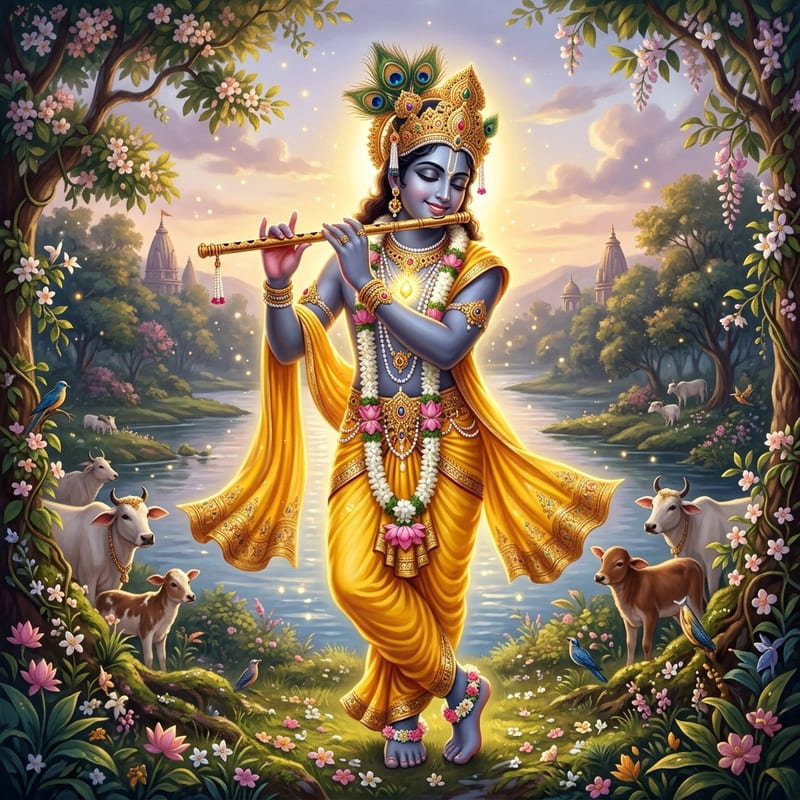
gadī śaṃkhī cakrī vimalavanamālī sthiraruciḥ śaraṇyo lokeśo mama bhavatu kṛṣṇo'kṣiviṣayaḥ || 1||
- śriyāby Shri
- āśliṣṭaḥheld close
- viṣṇuḥVishnu
- sthiracaravapuḥwhose body is all that stands still and all that moves
- vedaviṣayaḥof whom the Veda speaks
- dhiyāmof the thoughts of all
- sākṣīthe witness
- śuddhaḥclean
- hariḥHari
- asurahantāwho makes an end of the asuras
- abjanayanaḥwhose eyes are lotuses
- gadīcarrying the mace
- śaṃkhīcarrying the conch
- cakrīcarrying the discus
- vimalavanamālīwearing a fresh garland of wild flowers
- sthiraruciḥwhose light never dims
- śaraṇyaḥthe refuge
- lokeśaḥlord of the worlds
- mamamy
- bhavatumay he become
- kṛṣṇaḥKrishna
- akṣiviṣayaḥwhat my eyes see
anvaya śriyā āśliṣṭaḥ viṣṇuḥ sthiracaravapuḥ vedaviṣayaḥ dhiyām sākṣī śuddhaḥ asurahantā abjanayanaḥ hariḥ gadī śaṃkhī cakrī vimalavanamālī sthiraruciḥ śaraṇyaḥ lokeśaḥ kṛṣṇaḥ mama akṣiviṣayaḥ bhavatu
chandas Śikhariṇī, 17 syllables in each of 4 pādas
akṣiviṣayaḥ what the eyes see — Viṣaya is what a sense takes in. The prayer is not for knowledge of him but for sight of him, and this is what the whole hymn asks for.
dhiyām sākṣī the witness of all thoughts — Sākṣī is the one who was there and saw. He sits in every mind as the one who watches it.
sthiracaravapuḥ whose body is the still and the moving — Sthira is what stays put, cara what walks about. The pair covers everything there is.
note The fourth pāda of this verse is the refrain of the whole hymn. In verses 2 to 8 the printed text shortens it to śaraṇyo. and the reciter supplies the rest: śaraṇyo lokeśo mama bhavatu kṛṣṇo'kṣiviṣayaḥ. The copy of this hymn we started from wrote every visarga as a plain colon and carried six spelling slips, among them sthirarūciḥ for sthiraruciḥ. They were corrected against printed editions on 18 September 2026, and every pāda now scans as Śikhariṇī. Some editions read sthiracaraguruḥ, the teacher of the still and the moving, where this text reads sthiracaravapuḥ.
laye sarvaṃ svasmin harati kalayā yastu sa vibhuḥ | śaraṇyo. ||2||
- yataḥfrom whom
- sarvamall
- jātamcame to be
- viyadanilamukhyamsky and air first of all
- jagatthe world
- idamthis
- sthitauwhile it stands
- niḥśeṣamleaving none of it out
- yaḥwho
- avatikeeps alive
- nijasukhāṃśenawith a portion of his own happiness
- madhuhāthe killer of Madhu
- layewhen it folds up
- sarvamall of it
- svasmininto himself
- haratidraws
- kalayāwith a fraction of his power
- yaḥwho
- tuindeed
- saḥhe
- vibhuḥthe one who holds it all
- śaraṇyaḥthe refuge
anvaya yataḥ idam sarvam jagat viyadanilamukhyam jātam yaḥ madhuhā sthitau nijasukhāṃśena niḥśeṣam avati yaḥ tu laye kalayā sarvam svasmin harati saḥ vibhuḥ śaraṇyaḥ
chandas Śikhariṇī, 17 syllables in each of 4 pādas
sthitau laye in the standing, in the folding up — The three works of God, making, keeping and taking back, are laid out across the verse in that order.
kalayā with a fraction — Kalā is a small part of something. Even the taking back of the world costs him only a fraction.
madhuhā the killer of Madhu — Madhu was an asura killed by Vishnu, which is where the name Madhusudana comes from.
note The printed fourth pāda is the shortened refrain śaraṇyo., standing for śaraṇyo lokeśo mama bhavatu kṛṣṇo'kṣiviṣayaḥ.
yamīḍyaṃ paśyanti pravaramatayo māyinamasau | śaraṇyo. ||3||
- asūnthe breaths
- āyamyahaving held in
- ādaufirst
- yamaniyamamukhyaiḥby yama, niyama and the rest
- sukaraṇaiḥby good means
- nirudhyahaving checked
- idamthis
- cittammind
- hṛdiin the heart
- vimalammade clean
- ānīyahaving brought
- sakalamthe whole of it
- yamwhom
- īḍyamworthy of praise
- paśyantithey see
- pravaramatayaḥthose of the best minds
- māyinamthe one who wields maya
- asauhe
- śaraṇyaḥthe refuge
anvaya pravaramatayaḥ ādau asūn āyamya yamaniyamamukhyaiḥ sukaraṇaiḥ idam cittam nirudhya sakalam vimalam hṛdi ānīya yam īḍyam māyinam paśyanti asau śaraṇyaḥ
chandas Śikhariṇī, 17 syllables in each of 4 pādas
yamaniyama yama and niyama — The first two of the eight steps of yoga: what to hold back from, and what to keep up. The verse names them as the beginning of the road to seeing him.
māyinam the one who wields maya — Māyin is the holder of maya, the power by which the world is spread out. The word is used of a conjurer as well, one who makes what is seen.
note Three words in this verse were corrected: niryerudhyedaṃ to nirudhyedaṃ, which is nirudhya and idam joined, hradi to hṛdi, and yamīḍayaṃ to yamīḍyam. Some editions read vilayamānīya, brought to rest, where this text reads vimalamānīya, brought clean; the gloss follows the text as it stands. The fourth pāda is the shortened refrain.
niyantāraṃ dhyeyaṃ munisuranṛṇāṃ mokṣadamasau | śaraṇyo. ||4||
- pṛthivyāmin the earth
- tiṣṭhanstanding
- yaḥwho
- yamayatiholds in check
- mahīmthe earth
- vedaknows
- nanot
- dharāthe earth
- yamwhom
- itiin these words
- ādauat the beginning
- vedaḥthe Veda
- vadatispeaks
- jagatāmof the worlds
- īśamthe lord
- amalamspotless
- niyantāramthe one who holds all in check
- dhyeyamto be meditated on
- munisuranṛṇāmby sages, gods and men
- mokṣadamthe giver of release
- asauhe
- śaraṇyaḥthe refuge
anvaya yaḥ pṛthivyām tiṣṭhan mahīm yamayati dharā yam na veda iti ādau vedaḥ vadati jagatām īśam amalam niyantāram munisuranṛṇām dhyeyam mokṣadam asau śaraṇyaḥ
chandas Śikhariṇī, 17 syllables in each of 4 pādas
pṛthivyāṃ tiṣṭhan standing in the earth — The words come from the Antaryamin passage of the Brihadaranyaka Upanishad, where the one who is inside the earth is described in just this way, unknown to what he is inside.
niyantāram the one who holds all in check — A niyantā is a driver, the one with the reins. The verse uses the verb of the same root twice before it names him.
note The text read prathivyāṃ, corrected to pṛthivyāṃ. The fourth pāda is the shortened refrain.
kavitvādergarvaṃ pariharati yo'sau vijayinaḥ | śaraṇyo. ||5||
- mahendrādiḥMahendra and the rest
- devaḥthe god
- jayatiwins
- ditijānover the sons of Diti
- asyahis
- balataḥby the strength
- nanot
- kasyaof anyone
- svātantryambeing one's own master
- kvacitanywhere
- apieven
- kṛtauin what is done
- yatkṛtimhis doing
- ṛteapart from
- kavitvādeḥin poetry and the rest
- garvamthe pride
- pariharatitakes away
- yaḥwho
- asauhe
- vijayinaḥof the winner
- śaraṇyaḥthe refuge
anvaya mahendrādiḥ devaḥ asya balataḥ ditijān jayati yatkṛtim ṛte kasya api kṛtau kvacit svātantryam na yaḥ asau vijayinaḥ kavitvādeḥ garvam pariharati śaraṇyaḥ
chandas Śikhariṇī, 17 syllables in each of 4 pādas
ditijān the sons of Diti — Diti's children are the daityas, who stand against the gods. Their half-brothers, the sons of Aditi, are the gods themselves.
svātantryam being one's own master — Svātantrya is doing a thing on one's own account. The verse takes it away from everyone except him.
kavitvādeḥ garvam the pride taken in poetry and the rest — A poet writing a hymn names his own kind of pride first. The line is a check on the one saying it.
note The printed fourth pāda is the shortened refrain.
vinā yasya smṛtyā kṛmiśatajaniṃ yāti sa vibhuḥ | śaraṇyo. ||6||
- vināwithout
- yasyahis
- dhyānammeditation
- vrajatigoes down to
- paśutāmthe state of an animal
- sūkaramukhāmwith a boar's face
- vināwithout
- yasyahis
- jñānamknowledge
- janimṛtibhayamthe fear of birth and death
- yāticomes to
- janatāpeople
- vināwithout
- yasyahis
- smṛtyāby remembering
- kṛmiśatajanima hundred births as a worm
- yāticomes to
- saḥhe
- vibhuḥthe one who holds it all
- śaraṇyaḥthe refuge
anvaya yasya dhyānam vinā paśutām sūkaramukhām vrajati yasya jñānam vinā janatā janimṛtibhayam yāti yasya smṛtyā vinā kṛmiśatajanim yāti saḥ vibhuḥ śaraṇyaḥ
chandas Śikhariṇī, 17 syllables in each of 4 pādas
vinā without — The word opens each of the three lines and gives the verse its shape: without meditating, without knowing, without remembering.
kṛmiśatajanim a hundred births as a worm — The text read क्रमि, corrected to कृमि, a worm. The smallest birth there is gets set against the sight of God the verse asks for.
note The three lines are a warning rather than a description, which makes this verse the hardest in the hymn. The fourth pāda is the shortened refrain.
svayambhūrbhūtānāṃ janaka ucitācārasukhadaḥ | śaraṇyo. ||7||
- narātaṃkottaṃkaḥwho roots out the fears that afflict people
- śaraṇaśaraṇaḥthe refuge of all who look for refuge
- bhrāntiharaṇaḥwho takes away the whirl of confusion
- ghanaśyāmaḥdark as a rain cloud
- kāmaḥthe one who is wanted
- vrajaśiśuvayasyaḥplaymate of the children of Vraja
- arjunasakhaḥfriend of Arjuna
- svayambhūḥself-existent
- bhūtānāmof all beings
- janakaḥthe father
- ucitācārasukhadaḥwho gives joy to those whose conduct is right
- śaraṇyaḥthe refuge
anvaya śaraṇaśaraṇaḥ bhrāntiharaṇaḥ ghanaśyāmaḥ kāmaḥ vrajaśiśuvayasyaḥ arjunasakhaḥ svayambhūḥ bhūtānām janakaḥ ucitācārasukhadaḥ narātaṃkottaṃkaḥ śaraṇyaḥ
chandas Śikhariṇī, 17 syllables in each of 4 pādas
narātaṃkottaṃkaḥ who roots out the fears that afflict people — Narātaṅka is the fear or the pain that people suffer. Uttaṅka is a rare word, and published translations of this hymn read the compound as the uprooting of that pain, which is the sense given here.
vrajaśiśuvayasyaḥ playmate of the children of Vraja — Vayasya is someone of the same age, a companion in play. After six verses on the maker of the world, this is the first mention of the cowherd boy.
ghanaśyāmaḥ dark as a rain cloud — Ghana is a heavy cloud. The colour is his own, and the name Krishna means dark.
note The verse turns from God as the cause of the world to Krishna in Vraja, playmate and friend. Some editions read ghanaśyāmo vāmo, dark and lovely, where this text reads ghanaśyāmaḥ kāmo. The fourth pāda is the shortened refrain.
satāṃ dhātā svaccho nigamagaṇagīto vrajapatiḥ | śaraṇyo ||8||
- yadāwhen
- dharmaglāniḥthe weakening of dharma
- bhavaticomes about
- jagatāmof the worlds
- kṣobhakaraṇīwhich sets them shaking
- tadāthen
- lokasvāmīthe lord of the world
- prakaṭitavapuḥshowing himself in a body
- setudhṛkwho holds the dam in place
- ajaḥunborn
- satāmof the good
- dhātāthe carrier
- svacchaḥclear through and through
- nigamagaṇagītaḥsung by the books of the Veda
- vrajapatiḥlord of Vraja
- śaraṇyaḥthe refuge
anvaya yadā jagatām kṣobhakaraṇī dharmaglāniḥ bhavati tadā ajaḥ lokasvāmī setudhṛk prakaṭitavapuḥ satām dhātā svacchaḥ nigamagaṇagītaḥ vrajapatiḥ śaraṇyaḥ
chandas Śikhariṇī, 17 syllables in each of 4 pādas
dharmaglāniḥ the weakening of dharma — The same words Krishna uses of himself in the Gita, yadā yadā hi dharmasya glānir bhavati. The verse is written to be heard against that line.
setudhṛk who holds the dam in place — A setu is a dam or a causeway, and dharma is spoken of as one: what keeps the water where it belongs. He is the one who holds it.
ajaḥ unborn — Set beside prakaṭitavapuḥ, showing himself in a body, in the same line. The one who is never born is the one who takes birth.
note The eighth verse completes the set of eight. The printed fourth pāda is the shortened refrain.
yativaranikaṭe śrīyukta āvirbabhūva svaguṇavṛta udāraḥ śaṃkhacakrābjahastaḥ ||9||
- itiso
- hariḥHari
- akhilātmāthe self of all
- ārādhitaḥwas worshipped
- śaṃkareṇaby Shankara
- śrutiviśadaguṇaḥwhose qualities the Veda sets out plainly
- asauhe
- mātṛmokṣārthamfor his mother's release
- ādyaḥthe first of all
- yativaranikaṭebeside that best of ascetics
- śrīyuktaḥwith Shri beside him
- āvirbabhūvaappeared
- svaguṇavṛtaḥheld about by his own qualities
- udāraḥopen-handed
- śaṃkhacakrābjahastaḥwith conch, discus and lotus in his hands
anvaya iti akhilātmā śrutiviśadaguṇaḥ ādyaḥ asau hariḥ mātṛmokṣārtham śaṃkareṇa ārādhitaḥ yativaranikaṭe śrīyuktaḥ svaguṇavṛtaḥ udāraḥ śaṃkhacakrābjahastaḥ āvirbabhūva
chandas Mālinī, 15 syllables in each of 4 pādas
mātṛmokṣārtham for his mother's release — Shankara is said to have sung this hymn at his mother's deathbed, having promised her that she would see Vishnu at the end. This verse is the record of that.
yativaranikaṭe beside the best of ascetics — The yati is Shankara himself, and the verse speaks of him in the third person, as a pupil's closing verse would.
note A ninth verse standing outside the eight, in a different metre, telling the occasion of the hymn rather than praising Krishna. It is why the work is given to Shankaracharya.