
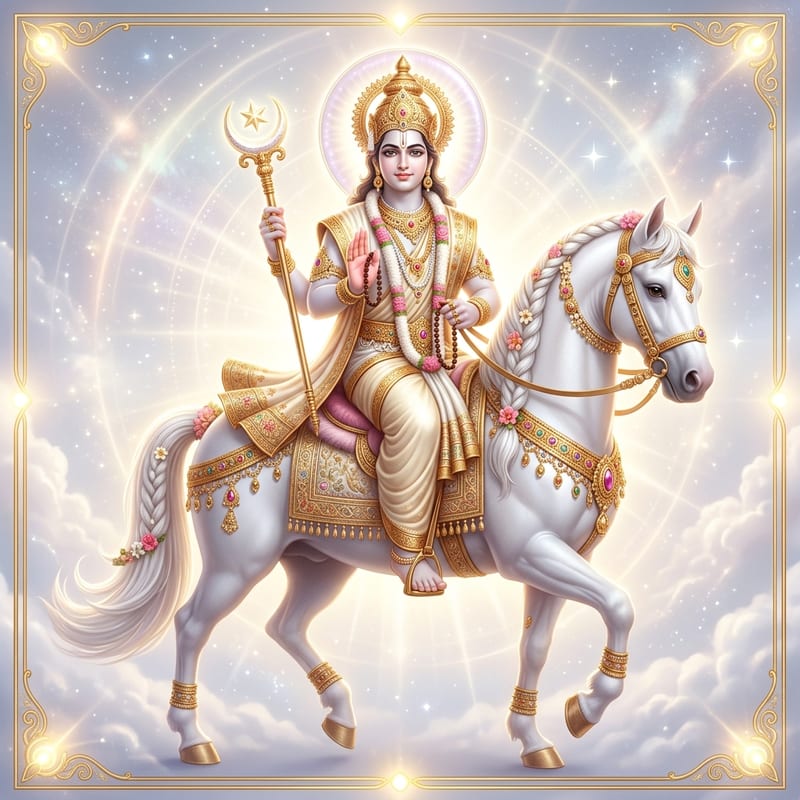
śukraḥ śuciḥ śubhaguṇaḥ śubhadaḥ śubhalakṣaṇaḥ |
śobhanākṣaḥ śubhrarūpaḥ śuddhasphaṭikabhāsvaraḥ || 1 ||
śobhanākṣaḥ śubhrarūpaḥ śuddhasphaṭikabhāsvaraḥ || 1 ||
- Śukrabright / Venus
- Śucipure
- Śubhaguṇaof auspicious qualities
- Śubhadagiver of auspiciousness
- Śubhalakṣaṇaof auspicious marks
- Śobhanākṣaof beautiful eyes
- Śubhrarūpaof bright form
- Śuddhasphaṭikabhāsvararadiant as pure crystal
dīnārtihārako daityaguruḥ devābhivanditaḥ |
kāvyāsaktaḥ kāmapālaḥ kaviḥ kalyāṇadāyakaḥ || 2 ||
kāvyāsaktaḥ kāmapālaḥ kaviḥ kalyāṇadāyakaḥ || 2 ||
- Dīnārtihārakaremover of the affliction of the poor
- Daityagurupreceptor of the demons
- Devābhivanditasaluted by the gods
- Kāvyāsaktadevoted to the arts of poetry
- Kāmapālaguardian of desire
- Kavithe seer-poet
- Kalyāṇadāyakabestower of all welfare
bhadramūrtirbhadraguṇo bhārgavo bhaktapālanaḥ |
bhogado bhuvanādhyakṣo bhuktimuktiphalapradaḥ || 3 ||
bhogado bhuvanādhyakṣo bhuktimuktiphalapradaḥ || 3 ||
- Bhadramūrtiof auspicious form
- Bhadraguṇaof auspicious qualities
- Bhārgavason of Bhṛgu
- Bhaktapālanaprotector of devotees
- Bhogadagiver of enjoyment
- Bhuvanādhyakṣaoverseer of the worlds
- Bhuktimuktiphalapradagiver of the fruits of enjoyment and liberation
cāruśīlaścārurūpaścārucandranibhānanaḥ |
nidhirnikhilaśāstrajño nītividyādhurandharaḥ || 4 ||
nidhirnikhilaśāstrajño nītividyādhurandharaḥ || 4 ||
- Cāruśīlaof charming character
- Cārurūpaof beautiful form
- Cārucandranibhānanaface like the beautiful moon
- Nidhia great treasure
- Nikhilaśāstrajñaknower of all scriptures
- Nītividyādhurandharaforemost in the science of ethics
sarvalakṣaṇasampannaḥ sarvāvaguṇavarjitaḥ |
samānādhikanirmuktaḥ sakalāgamapāragaḥ || 5 ||
samānādhikanirmuktaḥ sakalāgamapāragaḥ || 5 ||
- Sarvalakṣaṇasampannaendowed with all auspicious marks
- Sarvāvaguṇavarjitafree from all faults
- Samānādhikanirmuktabeyond equal and superior
- Sakalāgamapāragafully versed in all sacred sciences
bhṛgurbhogakaro bhūmisurapālanatatparaḥ |
manasvī mānado mānyo māyātīto mahāśayaḥ || 6 ||
manasvī mānado mānyo māyātīto mahāśayaḥ || 6 ||
- Bhṛguson of Bhṛgu
- Bhogakaragiver of enjoyment
- Bhūmisurapālanatatparadevoted to protecting the brāhmaṇas
- Manasvīof great mind
- Mānadābestower of honour
- Mānyaworthy of honour
- Māyātītabeyond māyā
- Mahāśayaof great heart
baliprasanno'bhayado balī balaparākramaḥ |
bhavapāśaparityāgo balibandhavimocakaḥ || 7 ||
bhavapāśaparityāgo balibandhavimocakaḥ || 7 ||
- Baliprasannapleased with the offering
- Abhayadagiver of fearlessness
- Balīpowerful
- Balaparākramastrong and valiant
- Bhavapāśaparityāgarenouncer of the bonds of existence
- Balibandhavimocakaliberator from the bondage of Bali
ghanāśayo ghanādhyakṣo kambugrīvaḥ kalādharaḥ |
kāruṇyarasasampūrṇaḥ kalyāṇaguṇavardhanaḥ || 8 ||
kāruṇyarasasampūrṇaḥ kalyāṇaguṇavardhanaḥ || 8 ||
- Ghanāśayadwelling in the dense realm
- Ghanādhyakṣaoverseer of the dense
- Kambugrīvaof conch-shaped neck
- Kaḷādharabearer of the phases
- Kāruṇyarasasampūrṇafull of the essence of compassion
- Kalyāṇaguṇavardhanaincreaser of auspicious qualities
śvetāmbaraḥ śvetavapuścaturbhujasamanvitaḥ |
akṣamālādharo'cintyo akṣīṇaguṇabhāsuraḥ || 9 ||
akṣamālādharo'cintyo akṣīṇaguṇabhāsuraḥ || 9 ||
- Śvetāmbarawearing white robes
- Śvetavapuof white body
- Chaturbhujasamanvitaendowed with four arms
- Akṣamālādharabearing a rosary
- Acintyainconceivable
- Akṣīṇaguṇabhāsurabrilliant with inexhaustible virtues
nakṣatragaṇasañcāro nayado nītimārgadaḥ |
varṣaprado hṛṣīkeśaḥ kleśanāśakaraḥ kaviḥ || 10 ||
varṣaprado hṛṣīkeśaḥ kleśanāśakaraḥ kaviḥ || 10 ||
- Nakṣatragaṇasañcāramoving through the groups of nakṣatras
- Nayadagiver of right counsel
- Nītimārgadaguide on the path of ethics
- Varṣapradagiver of rain
- Hṛṣīkeśalord of the senses
- Kleśanāśakaradestroyer of afflictions
- Kavithe seer-poet
cintitārthapradaḥ śāntamatiḥ cittasamādhikṛt |
ādhivyādhiharo bhūrivikramaḥ puṇyadāyakaḥ || 11 ||
ādhivyādhiharo bhūrivikramaḥ puṇyadāyakaḥ || 11 ||
- Cintitārthapradagiver of the object of one's thought
- Śāntamatiof peaceful mind
- Cittasamādhikṛtmaker of mental concentration
- Ādhivyādhihararemover of mental and physical afflictions
- Bhūrivikramaof great valour
- Puṇyadāyakabestower of merit
purāṇapuruṣaḥ pūjyaḥ puruhūtādisannutaḥ |
ajeyo vijitārātirvividhābharaṇojjvalaḥ || 12 ||
ajeyo vijitārātirvividhābharaṇojjvalaḥ || 12 ||
- Purāṇapuruṣathe primeval being
- Pūjyaworthy of worship
- Puruhūtādisannutapraised by Indra and others
- Ajeyaunconquerable
- Vijitārāticonqueror of enemies
- Vividhābharaṇojjvalaresplendent with various ornaments
kundapuṣpapratīkāśo mandahāso mahāmatiḥ |
muktāphalasamānābho muktido munisannutaḥ || 13 ||
muktāphalasamānābho muktido munisannutaḥ || 13 ||
- Kundapuṣpapratīkāśalike the kunda flower
- Mandahāsaof gentle smile
- Mahāmatiof great intellect
- Muktāphalasamānābhaof the lustre of a pearl
- Muktidagiver of liberation
- Munisannutapraised by the sages
ratnasiṃhāsanārūḍho rathastho rajataprabhaḥ |
sūryaprāgdeśasañcāraḥ suraśatrusuhṛt kaviḥ || 14 ||
sūryaprāgdeśasañcāraḥ suraśatrusuhṛt kaviḥ || 14 ||
- Ratnasiṃhāsanārūḍhaseated on a jewelled lion-throne
- Rathasthariding a chariot
- Rajataprabhaof silver radiance
- Sūryaprāgdeśasañcāramoving in the eastern zone of the Sun
- Suraśatrusuhṛtfriend of the enemies of the gods / demon-ally
- Kavithe seer-poet
tulāvṛṣabharāśīśo durdharo dharmapālakaḥ |
bhāgyado bhavyacāritro bhavapāśavimocakaḥ || 15 ||
bhāgyado bhavyacāritro bhavapāśavimocakaḥ || 15 ||
- Tulāvṛṣabharāśīśalord of Libra and Taurus
- Durdharahard to restrain
- Dharmapālakaprotector of dharma
- Bhāgyadabestower of fortune
- Bhavyacāritraof auspicious conduct
- Bhavapāśavimocakaliberator from the bonds of existence
gauḍadeśeśvaro goptā guṇī guṇavibhūṣaṇaḥ |
jyeṣṭhānakṣatrasambhūto jyeṣṭhaḥ śreṣṭhaḥ śucismitaḥ || 16 ||
jyeṣṭhānakṣatrasambhūto jyeṣṭhaḥ śreṣṭhaḥ śucismitaḥ || 16 ||
- Gauḍadeśeśvaralord of the Gauḍa country
- Goptāthe protector
- Guṇīvirtuous
- Guṇavibhūṣaṇaadorned with virtues
- Jyeṣṭhānakṣatrasambhūtaborn under the Jyeṣṭhā nakṣatra
- Jyeṣṭhathe eldest
- Śreṣṭhathe best
- Śucismitaof pure smile
apavargaprado'nantaḥ santānaphaladāyakaḥ |
sarvaiśvaryapradaḥ sarvagīrvāṇagaṇasannutaḥ || 17 ||
sarvaiśvaryapradaḥ sarvagīrvāṇagaṇasannutaḥ || 17 ||
- Apavargapradabestower of liberation
- Anantaendless
- Santānaphaladāyakagiver of the fruit of progeny
- Sarvaiśvaryapradagiver of all prosperity
- Sarvagīrvāṇagaṇasannutapraised by all the hosts of heaven
evaṃ śukragrahasyaiva kramādaṣṭottaraṃ śatam |
sarvapāpapraśamanaṃ sarvapuṇyaphalapradam |
yaḥ paṭhecchṛṇuyādvāpi sarvān kāmānavāpnuyāt || 18 ||
sarvapāpapraśamanaṃ sarvapuṇyaphalapradam |
yaḥ paṭhecchṛṇuyādvāpi sarvān kāmānavāpnuyāt || 18 ||
- evamthus
- śukragrahasyaof the planet Śukra
- kramātin order
- aṣṭottaram śatama hundred and eight
- sarvapāpapraśamanamquelling every sin
- sarvapuṇyaphalapradamgiving the fruit of all merit
- yaḥ paṭhet śṛṇuyāt vāwhoever recites or hears
- sarvān kāmān avāpnuyātshall obtain every desire
iti śrī śukra aṣṭottaraśatanāma stotram |