
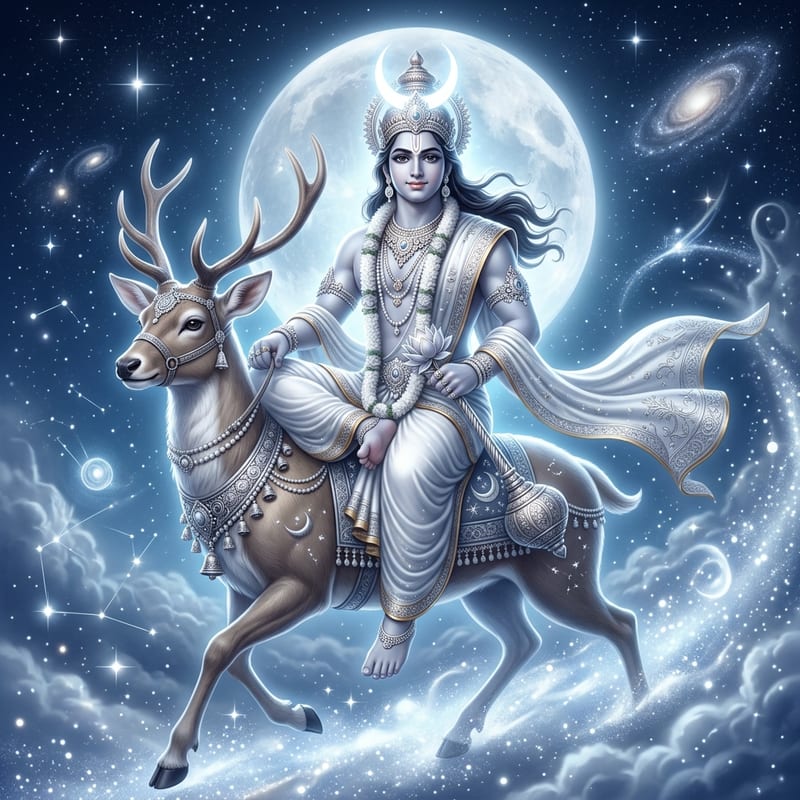
śrīmān śaśadharaścandro tārādhīśo niśākaraḥ |
sudhānidhiḥ sadārādhyaḥ satpatiḥ sādhupūjitaḥ || 1 ||
sudhānidhiḥ sadārādhyaḥ satpatiḥ sādhupūjitaḥ || 1 ||
- Śrīmānthe auspicious
- Śaśadharabearer of the hare
- Chandrathe Moon
- Tārādhīśalord of the stars
- Niśākaramaker of night
- Sudhānidhitreasure of nectar
- Sadārādhyaever worshipped
- Satpatilord of the good
- Sādhupūjitaworshipped by the saintly
jitendriyo jagadyoniḥ jyotiścakrapravartakaḥ |
vikartanānujo vīro viśveśo viduṣāṃ patiḥ || 2 ||
vikartanānujo vīro viśveśo viduṣāṃ patiḥ || 2 ||
- jitendriyaḥconqueror of the senses
- jagad-jagad-yoniḥwomb of the world
- jyotiś-cakra-jyotiś-cakra-pravartakaḥmover of the wheel of luminaries
- vikartana-vikartana-anujaḥyounger brother of the Sun
- vīraḥthe heroic
- viśva-viśva-īśaḥlord of the universe
- viduṣām patiḥlord of the learned
doṣākaro duṣṭadūraḥ puṣṭimān śiṣṭapālakaḥ |
aṣṭamūrtipriyo'nantakaṣṭadārukuṭhārakaḥ || 3 ||
aṣṭamūrtipriyo'nantakaṣṭadārukuṭhārakaḥ || 3 ||
- Doṣākaramaker of the night
- Duṣṭadūrafar from the wicked
- Puṣṭimānnourishing
- Śiṣṭapālakaprotector of the righteous
- Aṣṭamūrtipriyabeloved of the eight-formed Śiva
- Anantaendless
- Kaṣṭadārukuṭhārakaaxe to the tree of suffering
svaprakāśaḥ prakāśātmā dyucaro devabhojanaḥ |
kalādharaḥ kālahetuḥ kāmakṛtkāmadāyakaḥ || 4 ||
kalādharaḥ kālahetuḥ kāmakṛtkāmadāyakaḥ || 4 ||
- sva-sva-prakāśaḥself-luminous
- prakāśa-prakāśa-ātmāof luminous essence
- dyu-dyu-caraḥmoving through the sky
- deva-deva-bhojanaḥthe nectar that is food of the gods
- kalā-kalā-dharaḥholder of the lunar phases
- kāla-kāla-hetuḥcause of time
- kāma-kāma-kṛtmaker of desires
- kāma-kāma-dāyakaḥfulfiller of desires
mṛtyusaṃhārako'martyo nityānuṣṭhānadāyakaḥ |
kṣapākaraḥ kṣīṇapāpaḥ kṣayavṛddhisamanvitaḥ || 5 ||
kṣapākaraḥ kṣīṇapāpaḥ kṣayavṛddhisamanvitaḥ || 5 ||
- Mṛtyusaṃhārakadestroyer of death
- Amartyaimmortal
- Nityānuṣṭhānadāyakagiver of daily spiritual practice
- Kṣapākaramaker of night
- Kṣīṇapāpaone whose sins are destroyed
- Kṣayavṛddhisamanvitaaccompanied by waning and waxing
jaivātṛkaḥ śucī śubhro jayī jayaphalapradaḥ |
sudhāmayaḥ surasvāmī bhaktanāmiṣṭadāyakaḥ || 6 ||
sudhāmayaḥ surasvāmī bhaktanāmiṣṭadāyakaḥ || 6 ||
- Jaivātṛkathe life-giver
- Śucipure
- Śubhrabrilliantly white
- Jayīvictorious
- Jayaphalapradagiver of the fruit of victory
- Sudhāmayamade of nectar
- Surasvāmīlord of the gods
- Bhaktanāmiṣṭadāyakafulfiller of all desires of devotees
bhuktido muktido bhadro bhaktadāridryabhañjakaḥ |
sāmagānapriyaḥ sarvarakṣakaḥ sāgarodbhavaḥ || 7 ||
sāmagānapriyaḥ sarvarakṣakaḥ sāgarodbhavaḥ || 7 ||
- Bhuktidagiver of enjoyment
- Muktidagiver of liberation
- Bhadraauspicious
- Bhaktadāridryabhañjakadestroyer of devotees' poverty
- Sāmagānapriyafond of Sāma Veda chanting
- Sarvarakṣakaprotector of all
- Sāgarodbhavaborn of the ocean
bhayāntakṛdbhaktigamyo bhavabandhavimocakaḥ |
jagatprakāśakiraṇo jagadānandakāraṇaḥ || 8 ||
jagatprakāśakiraṇo jagadānandakāraṇaḥ || 8 ||
- Bhayāntakṛtdestroyer of fear
- Bhaktigamyaattained through devotion
- Bhavabandhavimocakaliberator from the bonds of existence
- Jagatprakāśakiraṇarays that illuminate the world
- Jagadānandakāraṇacause of the world's joy
nissapatno nirāhāro nirvikāro nirāmayaḥ |
bhūcchāyā''cchādito bhavyo bhuvanapratipālakaḥ || 9 ||
bhūcchāyā''cchādito bhavyo bhuvanapratipālakaḥ || 9 ||
- nis-nis-sapatnaḥwithout a rival
- nir-nir-āhāraḥbeyond all nourishment
- nir-nir-vikāraḥwithout modification
- nir-nir-āmayaḥfree from disease
- bhū-chāyā-bhū-chāyā-ācchāditaḥveiled by the earth’s shadow in eclipse
- bhavyaḥauspicious
- bhuvana-bhuvana-pratipālakaḥsustainer of all the worlds
sakalārtiharaḥ saumyajanakaḥ sādhuvanditaḥ |
sarvāgamajñaḥ sarvajño sanakādimunistutaḥ || 10 ||
sarvāgamajñaḥ sarvajño sanakādimunistutaḥ || 10 ||
- Sakalārtihararemover of all afflictions
- Saumyajanakafather of Mercury
- Sādhuvanditaḥsaluted by the saintly
- Sarvāgamajñaknower of all sacred sciences
- Sarvajñaomniscient
- Sanakādimunistutapraised by Sanaka and the other great sages
sitacchatradhvajopetaḥ sitāṅgo sitabhūṣaṇaḥ |
śvetamālyāmbaradharaḥ śvetagandhānulepanaḥ || 11 ||
śvetamālyāmbaradharaḥ śvetagandhānulepanaḥ || 11 ||
- Sitacchatradhvajopetaendowed with white parasol and banner
- Sitāṅgaof white limbs
- Sitabhūṣaṇawith white ornaments
- Śvetamālyāmbaradharawearing white garlands and robes
- Śvetagandhānulepanaanointed with white sandal paste
daśāśvarathasaṃrūḍho daṇḍapāṇiḥ dhanurdharaḥ |
kundapuṣpojjvalākāro nayanābjasamudbhavaḥ || 12 ||
kundapuṣpojjvalākāro nayanābjasamudbhavaḥ || 12 ||
- Daśāśvarathasaṃrūḍhamounted on a ten-horse chariot
- Daṇḍapāṇistaff in hand
- Dhanurdharabearing a bow
- Kundapuṣpojjvalākāraresplendent as the kunda flower
- Nayanābjasamudbhavaborn from the lotus-eye of Viṣṇu
ātreyagotrajo'tyantavinayaḥ priyadāyakaḥ |
karuṇārasasampūrṇaḥ karkaṭaprabhuravyayaḥ || 13 ||
karuṇārasasampūrṇaḥ karkaṭaprabhuravyayaḥ || 13 ||
- Atyantavinayaexceedingly humble
- Priyadāyakagiver of joy
- Karuṇārasasampūrṇafull of the essence of compassion
- Karkaṭaprabhulord of Cancer
- Avyayaimperishable
caturaśrāsanārūḍhaścaturo divyavāhanaḥ |
vivasvanmaṇḍalāgneyavāso vasusamṛddhidaḥ || 14 ||
vivasvanmaṇḍalāgneyavāso vasusamṛddhidaḥ || 14 ||
- Chaturaśrāsanārūḍhaseated on a square throne
- Caturathe clever one
- Divyavāhanaof divine vehicle
- Vivasvanmaṇḍalāgneyavāsadwelling in the fiery orb of the Sun
- Vasusamṛddhidagiver of abundant wealth
maheśvarapriyo dāntaḥ merugotrapradakṣiṇaḥ |
grahamaṇḍalamadhyastho grasitārko grahādhipaḥ || 15 ||
grahamaṇḍalamadhyastho grasitārko grahādhipaḥ || 15 ||
- Maheśvarapriyabeloved of Maheśvara
- Dāntaself-controlled
- Merugotrapradakṣiṇacircumambulating the Meru range
- Grahamaṇḍalamadhyasthadwelling at the centre of the planetary orb
- Grasitārkaswallower of the Sun in eclipse
- Grahādhipalord of the planets
dvijarājo dyutilako dvibhujo dvijapūjitaḥ |
audumbaranagāvāsa udāro rohiṇīpatiḥ || 16 ||
audumbaranagāvāsa udāro rohiṇīpatiḥ || 16 ||
- dvija-dvija-rājaḥking of the twice-born
- dyuti-dyuti-lakaḥthe very mark of light
- dvi-dvi-bhujaḥtwo-armed
- dvija-dvija-pūjitaḥworshipped by the twice-born
- audumbara-naga-audumbara-naga-āvāsaḥdwelling in the udumbara tree
- udāraḥnoble
- rohiṇī-rohiṇī-patiḥlord of Rohiṇī
nityodayo munistutyo nityānandaphalapradaḥ |
sakalāhlādanakaraḥ palāśasamidhapriyaḥ || 17 ||
evaṃ nakṣatranāthasya nāmnāmaṣṭottaraṃ śatam ||
sakalāhlādanakaraḥ palāśasamidhapriyaḥ || 17 ||
evaṃ nakṣatranāthasya nāmnāmaṣṭottaraṃ śatam ||
- nitya-nitya-udayaḥthe ever-rising
- muni-muni-stutyaḥpraised by the sages
- nitya-ānanda-phala-nitya-ānanda-phala-pradaḥgiver of the fruit of unceasing bliss
- sakala-āhlādana-sakala-āhlādana-karaḥwho gladdens every being
- palāśa-samidh-palāśa-samidh-priyaḥto whom palāśa kindling is dear
- evamthus
- nakṣatra-nakṣatra-nāthasyaof the lord of the constellations
- nāmnāmof the names
- aṣṭa-aṣṭa-uttaram śatama hundred and eight
iti śrī candra aṣṭottaraśatanāma stotram |