
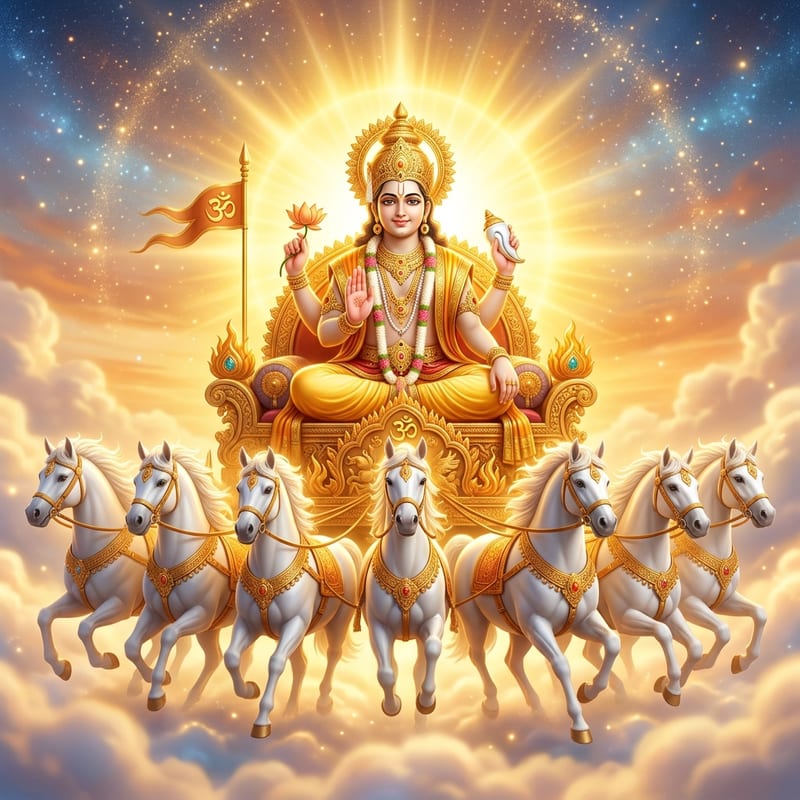
- navagrahadhyānaślokamthe verse for meditating on the nine planets
anvaya navagrahadhyānaślokam
note A heading rather than a verse. It names what follows.
guru śukra śanibhyaśca rāhave ketave namaḥ ||
- ādityāyato Āditya, the Sun
- caand
- somāyato Soma, the Moon
- maṅgalāyato Maṅgala, Mars
- budhāyato Budha, Mercury
- caand
- guru-śukra-guru-śukra-śanibhyaḥto Guru, Śukra and Śani
- caand
- rāhaveto Rāhu
- ketaveto Ketu
- namaḥsalutation
anvaya ādityāya ca somāya ca maṅgalāya budhāya ca guruśukraśanibhyaḥ rāhave ketave namaḥ
chandas Anuṣṭubh, 8 syllables in each of 4 pādas
rāhave ketave to Rahu, to Ketu — The last two of the nine are not bodies in the sky. They are the two points where the moon's path crosses the sun's, and an eclipse can happen only near them.
namaḥ salutation — One namaḥ at the end covers all nine names, each of them in the dative.
note The nine are named in the order of the weekdays, Sunday to Saturday, with Rahu and Ketu added at the end. The nine verses that follow take them one at a time in the same order.
japākusuma saṅkāśaṃ kāśyapeyaṃ mahādyutim |
tamo'riṃ sarva pāpaghnaṃ praṇatosmi divākaram ||
- raviḥthe Sun
- japā-kusuma-japā-kusuma-saṅkāśamlike the hibiscus flower
- kāśyapeyamson of Kaśyapa
- mahā-mahā-dyutimof great brilliance
- tamaḥ-tamaḥ-arimthe foe of darkness
- sarva-pāpa-sarva-pāpa-ghnamslayer of every sin
- praṇataḥ asmiI stand bowed
- divākarambefore the maker of day
anvaya raviḥ japākusumasaṅkāśam kāśyapeyam mahādyutim tamo'rim sarvapāpaghnam divākaram praṇataḥ asmi
chandas Anuṣṭubh, 8 syllables in each of 4 pādas
japākusuma the hibiscus flower — The deep red china rose. Each of the nine verses opens with a colour, and this is the Sun's.
kāśyapeyam son of Kashyapa — Kashyapa is the sage from whom the Adityas are descended, which is why the Sun is Aditya.
tamo'rim the foe of darkness — Tamas is darkness, and in the same word the dullness in a person.
note Each of the nine verses gives its planet a colour, a parentage and a work it does, then bows to it by a second name. Here the second name is Divakara, the maker of day.
dadhiśaṅkha tuṣārābhaṃ kṣīrārṇava samudbhavam (kṣīrodārṇava sambhavam) |
namāmi śaśinaṃ somaṃ śambho-rmakuṭa bhūṣaṇam ||
- candraḥthe Moon
- dadhi-śaṅkha-tuṣāra-dadhi-śaṅkha-tuṣāra-ābhamof the sheen of curds, of conch and of snow
- kṣīra-arṇava-kṣīra-arṇava-samudbhavamrisen from the ocean of milk
- namāmiI bow to
- śaśinamthe hare-marked
- somamSoma
- śambhoḥ makuṭa-śambhoḥ makuṭa-bhūṣaṇamthe ornament upon Śambhu’s crown
anvaya candraḥ dadhiśaṅkhatuṣārābham kṣīrārṇavasamudbhavam śambhoḥ makuṭabhūṣaṇam śaśinam somam namāmi
chandas Anuṣṭubh, 8 syllables in each of 4 pādas
dadhiśaṅkhatuṣārābham with the sheen of curds, conch and frost — Three white things in one word, each a different white.
śaśinam the hare-marked one — Śaśa is a hare. The dark patches on the moon are seen as a hare rather than a face.
makuṭabhūṣaṇam the ornament on the crown — Shiva wears the crescent in his hair, so the moon is spoken of as his headpiece.
note The moon came up when the sea of milk was churned. The bracketed kṣīrodārṇava sambhavam in the printed text is another reading of the second pāda and says the same thing.
dharaṇī garbha sambhūtaṃ vidyutkānti samaprabham |
kumāraṃ śaktihastaṃ taṃ kujaṃ [maṅgalaṃ] praṇamāmyaham ||
- kujaḥMars, the earth-born
- dharaṇī-garbha-dharaṇī-garbha-sambhūtamborn of the womb of the Earth
- vidyut-kānti-sama-vidyut-kānti-sama-prabhamof a brilliance like the flash of lightning
- kumāramthe youth
- śakti-śakti-hastamwith the spear in his hand
- tam kujamto him, Kuja
- maṅgalamMaṅgala (a variant reading)
- praṇamāmi ahamI bow
anvaya kujaḥ dharaṇīgarbhasambhūtam vidyutkāntisamaprabham kumāram śaktihastam tam kujam aham praṇamāmi
chandas Anuṣṭubh, 8 syllables in each of 4 pādas
kujam the earth-born — Ku is the earth, ja born of it. Mars is counted a son of the Earth, which the first pāda states outright.
śaktihastam with the spear in his hand — Śakti here is the weapon, a short spear. It is the sense of the word in this verse rather than power in the abstract.
note Printed with maṅgalaṃ in brackets as another name for the same planet; that is the name used in speech and in the weekday Mangalvar.
priyaṅgu kalikāśyāmaṃ rūpeṇā pratimaṃ budham |
saumyaṃ saumya (satva) guṇopetaṃ taṃ budhaṃ praṇamāmyaham ||
- budhaḥMercury
- priyaṅgu-kalikā-priyaṅgu-kalikā-śyāmamdark as the priyaṅgu bud
- rūpeṇa apratimammatchless in beauty
- budhamBudha
- saumyamgentle
- saumya-guṇa-saumya-guṇa-upetamendowed with a gentle nature
- sattva-guṇa-sattva-guṇa-upetamendowed with the quality of sattva (a variant reading)
- tam budhamto that Budha
- praṇamāmi ahamI bow
anvaya budhaḥ priyaṅgukalikāśyāmam rūpeṇa apratimam saumyam saumyaguṇopetam budham tam budham aham praṇamāmi
chandas Anuṣṭubh, 8 syllables in each of 4 pādas
priyaṅgukalikā the priyangu bud — A dark green bud, the colour given to Mercury.
saumyam gentle — The word is built on Soma, the moon, and Budha is the moon's son. So it says gentle and says whose son he is at once.
note Printed rūpeṇā pratimaṃ; read as rūpeṇa apratimaṃ, matchless in form, which is how it is recited. The bracketed satva is another reading for the second saumya, giving the quality of sattva.
devānāṃ ca ṛṣīṇāṃ ca guruṃ kāñcanasannibham |
buddhimantaṃ trilokeśaṃ taṃ namāmi bṛhaspatim ||
- guruḥJupiter
- devānām ca ṛṣīṇām caof gods and of seers alike
- gurumthe preceptor
- kāñcana-kāñcana-sannibhamlike gold to look upon
- buddhimantamfull of understanding
- tri-loka-tri-loka-īśamlord of the three worlds
- tam namāmito him I bow
- bṛhaspatimBṛhaspati
anvaya guruḥ devānām ca ṛṣīṇām ca gurum kāñcanasannibham buddhimantam trilokeśam tam bṛhaspatim namāmi
chandas Anuṣṭubh, 8 syllables in each of 4 pādas
kāñcanasannibham like gold to look at — Kāñcana is gold. Jupiter's colour in this set is yellow.
bṛhaspatim Brihaspati — The teacher of the gods. Thursday is named after him, Guruvar.
note This verse and the next make a pair: the teacher of the gods, then the teacher of their opponents.
himakunda mṛṇālābhaṃ daityānaṃ paramaṃ gurum |
sarvaśāstra pravaktāraṃ bhārgavaṃ praṇamāmyaham ||
- śukraḥVenus
- hima-kunda-mṛṇāla-hima-kunda-mṛṇāla-ābhamof the sheen of snow, jasmine and the lotus stalk
- daityānāmof the daityas
- paramam gurumthe supreme preceptor
- sarva-śāstra-sarva-śāstra-pravaktāramthe expounder of every scripture
- bhārgavamBhārgava
- praṇamāmi ahamI bow
anvaya śukraḥ himakundamṛṇālābham daityānām paramam gurum sarvaśāstrapravaktāram bhārgavam aham praṇamāmi
chandas Anuṣṭubh, 8 syllables in each of 4 pādas
mṛṇāla the lotus stalk — White where it is broken. Snow, jasmine and the lotus stalk give Venus three whites, as the moon had three.
bhārgavam Bhargava — Son of Bhrigu. Shukra is teacher to the daityas, the gods' opponents, and the verse calls him their highest one.
note Printed daityānaṃ for daityānām, a short spelling common in printed texts.
nīlāñjana samābhāsaṃ raviputraṃ yamāgrajam |
chāyā mārtāṇḍa sambhūtaṃ taṃ namāmi śanaiścaram ||
- śaniḥSaturn
- nīla-añjana-sama-nīla-añjana-sama-ābhāsamshining dark as black collyrium
- ravi-ravi-putramson of the Sun
- yama-yama-agrajamelder brother of Yama
- chāyā-mārtāṇḍa-chāyā-mārtāṇḍa-sambhūtamborn of Chāyā and Mārtāṇḍa
- tam namāmito him I bow
- śanaiścaramŚanaiścara, the slow-mover
anvaya śaniḥ nīlāñjanasamābhāsam raviputram yamāgrajam chāyāmārtāṇḍasambhūtam tam śanaiścaram namāmi
chandas Anuṣṭubh, 8 syllables in each of 4 pādas
nīlāñjana dark eye-black — The black paste put on the eyes. Saturn's colour is that blue-black.
chāyāmārtāṇḍasambhūtam born of Chhaya and the Sun — Chhaya, whose name means shadow, is the Sun's second wife. Yama is her husband's son by another, which is why Saturn is called Yama's younger brother here.
śanaiścaram the slow walker — Śanaiḥ is slowly and cara moving. Saturn takes about thirty years to come round the sky, and the name says so.
note Printed yamāgrajam, which reads as the elder brother of Yama. The usual telling makes Yama the elder of the two.
ardhakāyaṃ mahāvīraṃ candrāditya vimardhanam |
siṃhikā garbha sambhūtaṃ taṃ rāhuṃ praṇamāmyaham ||
- rāhuḥRāhu
- ardha-ardha-kāyamhaving but half a body
- mahā-mahā-vīramthe great warrior
- candra-āditya-candra-āditya-vimardanamthe crusher of Moon and Sun
- siṃhikā-garbha-siṃhikā-garbha-sambhūtamborn of the womb of Siṃhikā
- tam rāhumto him, Rāhu
- praṇamāmi ahamI bow
anvaya rāhuḥ ardhakāyam mahāvīram candrādityavimardhanam siṃhikāgarbhasambhūtam tam rāhum aham praṇamāmi
chandas Anuṣṭubh, 8 syllables in each of 4 pādas
ardhakāyam having only half a body — In the story of the churning his head was cut from his body after he drank the nectar. The head stayed alive and became Rahu.
candrādityavimardhanam who presses hard upon moon and sun — Printed विमर्धन for विमर्दन, crushing. Eclipses are told as his seizing of the two lights.
siṃhikā Simhika — His mother, named in the Puranas as a daughter of Kashyapa.
note Rahu and Ketu are the head and the tail of one figure, which is why the last two verses answer each other.
palāśa puṣpa saṅkāśaṃ tārakāgrahamastakam |
raudraṃ raudrātmakaṃ ghoraṃ taṃ ketuṃ praṇamāmyaham ||
- ketuḥKetu
- palāśa-puṣpa-palāśa-puṣpa-saṅkāśamlike the palāśa blossom
- tārakā-graha-tārakā-graha-mastakamwho bears the stars and planets upon his head
- raudramfierce
- raudra-raudra-ātmakamfierce in his very nature
- ghoramterrible
- tam ketumto him, Ketu
- praṇamāmi ahamI bow
anvaya ketuḥ palāśapuṣpasaṅkāśam tārakāgrahamastakam raudram raudrātmakam ghoram tam ketum aham praṇamāmi
chandas Anuṣṭubh, 8 syllables in each of 4 pādas
palāśapuṣpa the flame-of-the-forest flower — A hot orange red. It is the last of the nine colours in the hymn.
tārakāgrahamastakam who carries stars and planets at his head — The compound is printed as one word and is read in more than one way. What is certain is that the stars and the planets stand at his head.
note The third pāda puts three words for the same fierceness side by side. Ketu is the comet or the tail, and the verse does not soften him.
iti vyāsa mukhodgītaṃ yaḥ paṭhetsu samāhitaḥ |
divā vā yadi vā rātrau vighnaśānti-rbhaviṣyati ||
- phala-phala-śrutiḥthe declaration of the fruit
- itithus
- vyāsa-mukha-vyāsa-mukha-udgītamsung forth from the mouth of Vyāsa
- yaḥ paṭhetwhoever recites it
- su-su-samāhitaḥwith a well-composed mind
- divā vā yadi vā rātrauwhether by day or by night
- vighna-vighna-śāntiḥthe quieting of obstacles
- bhaviṣyatishall come about
anvaya phalaśrutiḥ yaḥ susamāhitaḥ divā vā yadi vā rātrau iti vyāsamukhodgītam paṭhet vighnaśāntiḥ bhaviṣyati
chandas Anuṣṭubh, 8 syllables in each of 4 pādas
phalaśrutiḥ the telling of what comes of it — The closing part of a stotra, where what the reciting is good for is stated. Three verses of it end this hymn.
vyāsamukhodgītam sung from the mouth of Vyasa — The hymn is given to Vyasa, and the last verse repeats his name as a seal on it.
susamāhitaḥ with the mind well gathered — Samāhita is collected, put together. The fruit is promised for reciting done with attention.
note Printed paṭhetsu samāhitaḥ, which is read as paṭhet susamāhitaḥ.
aiśvaryamatulaṃ teṣāmārogyaṃ puṣṭi vardhanam ||
- nara-nārī-nara-nārī-nṛpāṇāmfor men, for women and for kings
- caand
- bhavetthere shall be
- duḥsvapna-duḥsvapna-nāśanamthe undoing of evil dreams
- aiśvaryam atulamprosperity beyond compare
- teṣāmfor them
- ārogyamhealth
- puṣṭi-puṣṭi-vardhanamand increase of strength
anvaya naranārīnṛpāṇām duḥsvapnanāśanam bhavet ca teṣām atulam aiśvaryam ārogyam puṣṭivardhanam
chandas Anuṣṭubh, 8 syllables in each of 4 pādas
duḥsvapnanāśanam the undoing of bad dreams — Bad dreams are read in this literature as a sign that the planets are unfavourable, so they are the first thing named.
puṣṭivardhanam a gain in strength — Puṣṭi is being well fed and well grown.
note Men, women and kings are listed separately, which is the older way of saying everyone, whatever their station.
tāssarvāḥ praśamaṃ yānti vyāso brūte na saṃśayaḥ ||
- graha-nakṣatra-graha-nakṣatra-jāḥborn of the planets and the constellations
- pīḍāḥafflictions
- taskara-agni-taskara-agni-samudbhavāḥarising from thieves and from fire
- tāḥ sarvāḥall of them
- praśamam yāntigo to quietness
- vyāsaḥ brūteso Vyāsa declares
- na saṃśayaḥand there is no doubt
anvaya grahanakṣatrajāḥ taskarāgnisamudbhavāḥ pīḍāḥ tāḥ sarvāḥ praśamam yānti vyāsaḥ brūte na saṃśayaḥ
chandas Anuṣṭubh, 8 syllables in each of 4 pādas
praśamam yānti go quiet — Praśama is the settling of something that was disturbed, the same word used of a fire going down.
taskara a thief — Thieves and fire are put beside the planets and stars, so the troubles counted run from the sky to the house.
note The hymn ends by naming Vyasa as the one who says it, and by adding that there is no doubt about it.