
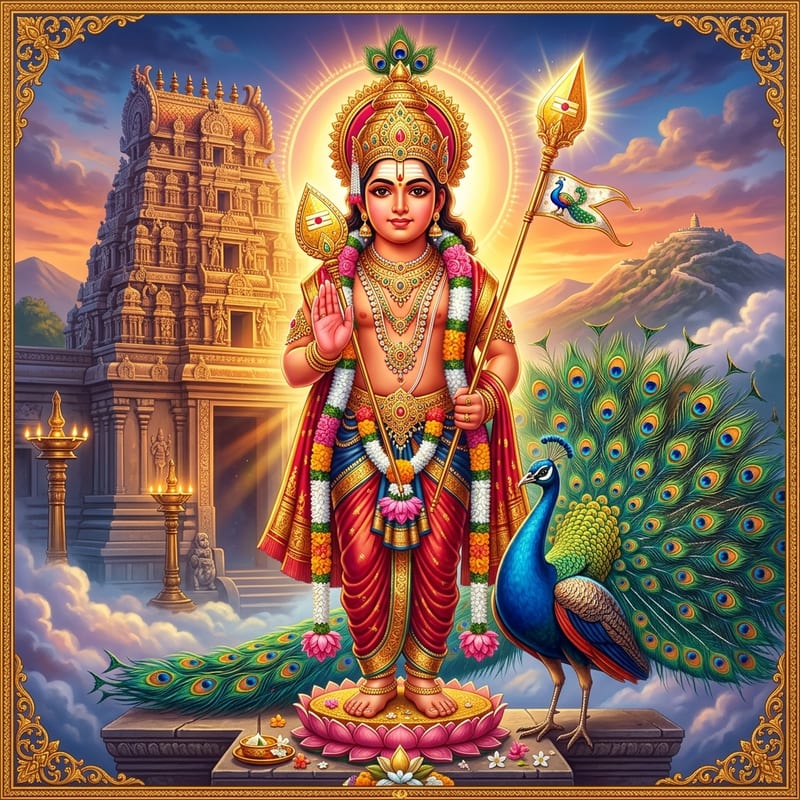
asya śrīsubrahmaṇyakavacastotramahāmantrasya, brahmā ṛṣiḥ, anuṣṭupchandaḥ, śrīsubrahmaṇyo devatā, oṃ nama iti bījaṃ, bhagavata iti śaktiḥ, subrahmaṇyāyeti kīlakaṃ, śrīsubrahmaṇya prasādasiddhyarthe jape viniyogaḥ ||
- asyaof this
- śrī-subrahmaṇya-kavaca-stotra-mahā-śrī-subrahmaṇya-kavaca-stotra-mahā-mantrasyagreat mantra, the Śrī Subrahmaṇya Kavaca Stotra
- brahmāBrahmā
- ṛṣiḥis the seer
- anuṣṭup chandaḥAnuṣṭubh is the metre
- śrī-śrī-subrahmaṇyaḥŚrī Subrahmaṇya
- devatāis the deity
- oṃ namaḥ itithe words "oṃ namaḥ"
- bījamare the seed
- bhagavate itithe word "bhagavate"
- śaktiḥis the power
- subrahmaṇyāya itithe word "subrahmaṇyāya"
- kīlakamis the pin that holds it fast
- śrī-subrahmaṇya-prasāda-śrī-subrahmaṇya-prasāda-siddhyarthefor the winning of Śrī Subrahmaṇya’s grace
- japein the recitation
- viniyogaḥis its appointed use
karanyāsaḥ –
oṃ sāṃ aṅguṣṭhābhyāṃ namaḥ |
oṃ sīṃ tarjanībhyāṃ namaḥ |
oṃ sūṃ madhyamābhyāṃ namaḥ |
oṃ saiṃ anāmikābhyāṃ namaḥ |
oṃ sauṃ kaniṣṭhikābhyāṃ namaḥ |
oṃ saḥ karatalakarapṛṣṭhābhyāṃ namaḥ ||
oṃ sāṃ aṅguṣṭhābhyāṃ namaḥ |
oṃ sīṃ tarjanībhyāṃ namaḥ |
oṃ sūṃ madhyamābhyāṃ namaḥ |
oṃ saiṃ anāmikābhyāṃ namaḥ |
oṃ sauṃ kaniṣṭhikābhyāṃ namaḥ |
oṃ saḥ karatalakarapṛṣṭhābhyāṃ namaḥ ||
- kara-nyāsaḥthe placing of the syllables upon the hands
- oṃ sāṃthe first seed
- aṅguṣṭhābhyāṃ namaḥsalutation with the two thumbs
- oṃ sīṃthe second
- tarjanībhyāṃ namaḥwith the two forefingers
- oṃ sūṃthe third
- madhyamābhyāṃ namaḥwith the two middle fingers
- oṃ saiṃthe fourth
- anāmikābhyāṃ namaḥwith the two ring fingers
- oṃ sauṃthe fifth
- kaniṣṭhikābhyāṃ namaḥwith the two little fingers
- oṃ saḥthe sixth
- karatala-karatala-karapṛṣṭhābhyāṃ namaḥwith the palms and the backs of the hands
aṅganyāsaḥ –
oṃ sāṃ hṛdayāya namaḥ |
oṃ sīṃ śirase svāhā |
oṃ sūṃ śikhāyai vaṣaṭ |
oṃ saiṃ kavacāya hum |
oṃ sauṃ netratrayāya vauṣaṭ |
oṃ saḥ astrāya phaṭ |
bhūrbhuvassuvaromiti digbandhaḥ ||
oṃ sāṃ hṛdayāya namaḥ |
oṃ sīṃ śirase svāhā |
oṃ sūṃ śikhāyai vaṣaṭ |
oṃ saiṃ kavacāya hum |
oṃ sauṃ netratrayāya vauṣaṭ |
oṃ saḥ astrāya phaṭ |
bhūrbhuvassuvaromiti digbandhaḥ ||
- aṅga-nyāsaḥthe placing of the syllables upon the body
- oṃ sāṃthe first seed
- hṛdayāya namaḥsalutation to the heart
- oṃ sīṃthe second
- śirase svāhāsvāhā to the head
- oṃ sūṃthe third
- śikhāyai vaṣaṭvaṣaṭ to the crown-lock
- oṃ saiṃthe fourth
- kavacāya humhum to the armour
- oṃ sauṃthe fifth
- netra-netra-trayāya vauṣaṭvauṣaṭ to the three eyes
- oṃ saḥthe sixth
- astrāya phaṭphaṭ to the weapon
- bhūr bhuvas suvar om itiwith these words
- dig-dig-bandhaḥthe quarters are bound about
dhyānam |
sindūrāruṇamindukāntivadanaṃ keyūrahārādibhiḥ
divyairābharaṇairvibhūṣitatanuṃ svargādisaukhyapradam |
ambhojābhayaśaktikukkuṭadharaṃ raktāṅgarāgojjvalaṃ
subrahmaṇyamupāsmahe praṇamatāṃ sarvārthasiddhipradam || [bhītipraṇāśodyatam]
lamityādi pañcapūjā |
oṃ laṃ pṛthivyātmane subrahmaṇyāya gandhaṃ samarpayāmi |
oṃ haṃ ākāśātmane subrahmaṇyāya puṣpāṇi samarpayāmi |
oṃ yaṃ vāyvātmane subrahmaṇyāya dhūpamāghrāpayāmi |
oṃ raṃ agnyātmane subrahmaṇyāya dīpaṃ darśayāmi |
oṃ vaṃ amṛtātmane subrahmaṇyāya svādannaṃ nivedayāmi |
oṃ saṃ sarvātmane subrahmaṇyāya sarvopacārān samarpayāmi |
- dhyānamthe meditation
- sindūra-aruṇa-indu-kānti-sindūrāruṇa-indu-kānti-vadanamhis face red as vermilion and lovely as the moon
- keyūra-hāra-keyūra-hārādibhiḥwith armlets, necklaces and the rest
- divyair ābharaṇaiḥwith divine ornaments
- vibhūṣita-vibhūṣita-tanumhis body adorned
- svarga-ādi-saukhya-svargādi-saukhya-pradamwho grants the joys of heaven and of what lies past it
- ambhoja-abhaya-śakti-kukkuṭa-ambhoja-abhaya-śakti-kukkuṭa-dharambearing lotus, the gesture of safety, the spear and the cock
- rakta-aṅga-rāga-raktāṅga-rāgojjvalambright with red unguent on his limbs
- subrahmaṇyamSubrahmaṇya
- upāsmahewe worship
- praṇamatāmfor those who bow to him
- sarva-artha-siddhi-sarvārtha-siddhi-pradamwho brings every aim to fulfilment
- bhīti-praṇāśa-bhīti-praṇāśodyatamever ready to make fear vanish – a variant for the closing phrase
- lam ityādi pañca-laṃ ityādi pañca-pūjāthe fivefold worship beginning with laṃ
- oṃ laṃ pṛthivī-oṃ laṃ pṛthivy-ātmaneto him whose self is earth
- gandhaṃ samarpayāmiI offer sandal paste
- oṃ haṃ ākāśa-oṃ haṃ ākāśātmaneto him whose self is space
- puṣpāṇi samarpayāmiI offer flowers
- oṃ yaṃ vāyu-oṃ yaṃ vāyv-ātmaneto him whose self is wind
- dhūpam āghrāpayāmiI let the incense be breathed in
- oṃ raṃ agni-oṃ raṃ agny-ātmaneto him whose self is fire
- dīpaṃ darśayāmiI show the lamp
- oṃ vaṃ amṛta-oṃ vaṃ amṛtātmaneto him whose self is the nectar of deathlessness
- svādannaṃ nivedayāmiI present the sweet food
- oṃ saṃ sarva-oṃ saṃ sarvātmaneto him whose self is all
- sarva-sarvopacārān samarpayāmiI offer every service of worship
kavacam |
subrahmaṇyo'grataḥ pātu senānīḥ pātu pṛṣṭhataḥ |
guho māṃ dakṣiṇe pātu vahnijaḥ pātu vāmataḥ || 1 ||
subrahmaṇyo'grataḥ pātu senānīḥ pātu pṛṣṭhataḥ |
guho māṃ dakṣiṇe pātu vahnijaḥ pātu vāmataḥ || 1 ||
- kavacamthe armour
- subrahmaṇyaḥSubrahmaṇya
- agrataḥin front
- pātumay he guard
- senānīḥthe Commander
- pātumay he guard
- pṛṣṭhataḥbehind
- guhaḥGuha, the hidden one
- māmme
- dakṣiṇeon the right
- pātumay he guard
- vahnijaḥhe who was born of fire
- pātumay he guard
- vāmataḥon the left
śiraḥ pātu mahāsenaḥ skando rakṣellalāṭakam |
netre me dvādaśākṣaśca śrotre rakṣatu viśvabhṛt || 2 ||
netre me dvādaśākṣaśca śrotre rakṣatu viśvabhṛt || 2 ||
- śiraḥthe head
- pātumay he guard
- mahāsenaḥMahāsena, lord of the great host
- skandaḥSkanda
- rakṣetmay he protect
- lalāṭakamthe forehead
- netrethe two eyes
- memy
- dvādaśa-dvādaśākṣaḥthe twelve-eyed one
- caand
- śrotrethe two ears
- rakṣatumay he protect
- viśva-viśva-bhṛtthe bearer of the universe
mukhaṃ me ṣaṇmukhaḥ pātu nāsikāṃ śaṅkarātmajaḥ |
oṣṭhau vallīpatiḥ pātu jihvāṃ pātu ṣaḍānanaḥ || 3 ||
oṣṭhau vallīpatiḥ pātu jihvāṃ pātu ṣaḍānanaḥ || 3 ||
- Śaṅkarātmajason of Śaṅkara
- Vallīpatilord of Vaḷḷī
- Ṣaḍānanathe six-faced lord
devasenāpatirdantān cibukaṃ bahulodbhavaḥ |
kaṇṭhaṃ tārakajitpātu bāhū dvādaśabāhukaḥ || 4 ||
kaṇṭhaṃ tārakajitpātu bāhū dvādaśabāhukaḥ || 4 ||
- deva-senā-deva-senā-patiḥthe lord of the army of the gods
- dantānthe teeth
- cibukamthe chin
- bahula-bahulodbhavaḥhe who arose among the Kṛttikās
- kaṇṭhamthe throat
- tāraka-tāraka-jitthe conqueror of Tāraka
- pātumay he guard
- bāhūthe two arms
- dvādaśa-dvādaśa-bāhukaḥthe twelve-armed one
hastau śaktidharaḥ pātu vakṣaḥ pātu śarodbhavaḥ |
hṛdayaṃ vahnibhūḥ pātu kukṣiṃ pātvambikāsutaḥ || 5 ||
hṛdayaṃ vahnibhūḥ pātu kukṣiṃ pātvambikāsutaḥ || 5 ||
- hastauthe two hands
- śakti-śakti-dharaḥthe bearer of the spear
- pātumay he guard
- vakṣaḥthe chest
- pātumay he guard
- śara-śarodbhavaḥhe born among the reeds
- hṛdayamthe heart
- vahni-vahni-bhūḥhe sprung from fire
- pātumay he guard
- kukṣimthe belly
- pātumay he guard
- ambikā-ambikā-sutaḥthe son of Ambikā
nābhiṃ śambhusutaḥ pātu kaṭiṃ pātu harātmajaḥ |
ūrū pātu gajārūḍho jānū me jāhnavīsutaḥ || 6 ||
ūrū pātu gajārūḍho jānū me jāhnavīsutaḥ || 6 ||
- Śambhusutason of Śambhu / Śiva
- Harātmajason of Hara
- Gajārūḍhathe mighty, elephant-conquering lord
- Jāhnavīsutason of the Gaṅgā
jaṅghe viśākho me pātu pādau me śikhivāhanaḥ |
sarvāṇyaṅgāni bhūteśaḥ sarvadhātūṃśca pāvakiḥ || 7 ||
sarvāṇyaṅgāni bhūteśaḥ sarvadhātūṃśca pāvakiḥ || 7 ||
- Śikhivāhanathe peacock-vehicled lord
- Bhūtēśalord of all beings
- Pāvakison of fire, Agni's son
sandhyākāle niśīthinyāṃ divā prātarjale'gniṣu |
durgame ca mahāraṇye rājadvāre mahābhaye || 8 ||
durgame ca mahāraṇye rājadvāre mahābhaye || 8 ||
- sandhyā-sandhyā-kāleat the twilight hour
- niśīthinyāmin the depth of night
- divāby day
- prātaḥat dawn
- jalein water
- agniṣuin fires
- durgamein trackless country
- caand
- mahā-mahāraṇyein the great forest
- rāja-rāja-dvāreat a king’s gate
- mahā-mahā-bhayein great danger
tumule raṇyamadhye ca sarvaduṣṭamṛgādiṣu |
corādisādhvase'bhedye jvarādivyādhipīḍane || 9 ||
corādisādhvase'bhedye jvarādivyādhipīḍane || 9 ||
- tumulein the din of battle
- raṇa-raṇa-madhyein the midst of the fight (printed रण्यमध्ये)
- caand
- sarva-duṣṭa-mṛga-sarva-duṣṭa-mṛgādiṣuamong all savage beasts and their like
- cora-ādi-corādi-sādhvasein the terror of thieves and their kind
- abhedyewhere there is no way through
- jvara-ādi-vyādhi-jvarādi-vyādhi-pīḍanein the torment of fever and every other disease
duṣṭagrahādibhītau ca durnimittādibhīṣaṇe |
astraśastranipāte ca pātu māṃ krauñcarandhrakṛt || 10 ||
astraśastranipāte ca pātu māṃ krauñcarandhrakṛt || 10 ||
- duṣṭa-graha-ādi-duṣṭa-grahādi-bhītauin the fear of malign planets and the like
- caand
- durnimitta-ādi-durnimittādi-bhīṣaṇein the dread of ill omens
- astra-śastra-astra-śastra-nipātewhen missiles and blades come down
- caand
- pātumay he guard
- māmme
- krauñca-randhra-krauñca-randhra-kṛthe who bored the passage through Krauñca
yaḥ subrahmaṇyakavacaṃ iṣṭasiddhipradaṃ paṭhet |
tasya tāpatrayaṃ nāsti satyaṃ satyaṃ vadāmyaham || 11 ||
tasya tāpatrayaṃ nāsti satyaṃ satyaṃ vadāmyaham || 11 ||
- yaḥwhoever
- subrahmaṇya-subrahmaṇya-kavacamthe Subrahmaṇya armour
- iṣṭa-siddhi-iṣṭa-siddhi-pradamwhich grants what is longed for
- paṭhetrecites
- tasyafor him
- tāpa-tāpa-trayamthe threefold burning – from oneself, from other creatures, from fate
- nāstiis not
- satyaṃ satyamtruly, truly
- vadāmido I say it
- ahamI
dharmārthī labhate dharmamarthārthī cārthamāpnuyāt |
kāmārthī labhate kāmaṃ mokṣārthī mokṣamāpnuyāt || 12 ||
kāmārthī labhate kāmaṃ mokṣārthī mokṣamāpnuyāt || 12 ||
- dharma-dharma-arthīhe who seeks right living
- labhategains
- dharmamit
- artha-artha-arthīhe who seeks wealth
- caand
- arthamwealth
- āpnuyātwould obtain
- kāma-kāma-arthīhe who seeks pleasure
- labhategains
- kāmamit
- mokṣa-mokṣa-arthīhe who seeks release
- mokṣamrelease
- āpnuyātwould obtain
yatra yatra japedbhaktyā tatra sannihito guhaḥ |
pūjāpratiṣṭhākāle ca japakāle paṭhedidam || 13 ||
pūjāpratiṣṭhākāle ca japakāle paṭhedidam || 13 ||
- yatra yatrawherever
- japetone murmurs it
- bhaktyāwith devotion
- tatrathere
- sannihitaḥclose at hand
- guhaḥis Guha
- pūjā-pratiṣṭhā-pūjā-pratiṣṭhā-kāleat the hour of worship and of consecration
- caand
- japa-japa-kāleat the hour of recitation
- paṭhetone should recite
- idamthis
teṣāmeva phalāvāptiḥ mahāpātakanāśanam |
yaḥ paṭhecchṛṇuyādbhaktyā nityaṃ devasya sannidhau |
sarvānkāmāniha prāpya so'nte skandapuraṃ vrajet || 14 ||
yaḥ paṭhecchṛṇuyādbhaktyā nityaṃ devasya sannidhau |
sarvānkāmāniha prāpya so'nte skandapuraṃ vrajet || 14 ||
- teṣām evaof those very rites
- phala-phala-avāptiḥthe fruit is gained
- mahā-pātaka-mahā-pātaka-nāśanamand the great sins are undone
- yaḥwhoever
- paṭhetrecites
- śṛṇuyātor hears
- bhaktyāwith devotion
- nityamday after day
- devasya sannidhauin the presence of the god
- sarvān kāmānall that he desires
- ihahere in this world
- prāpyahaving obtained
- saḥhe
- anteat the end
- skanda-skanda-puramto Skanda’s city
- vrajetwould go
uttaranyāsaḥ ||
karanyāsaḥ –
oṃ sāṃ aṅguṣṭhābhyāṃ namaḥ |
oṃ sīṃ tarjanībhyāṃ namaḥ |
oṃ sūṃ madhyamābhyāṃ namaḥ |
oṃ saiṃ anāmikābhyāṃ namaḥ |
oṃ sauṃ kaniṣṭhikābhyāṃ namaḥ |
oṃ saḥ karatalakarapṛṣṭhābhyāṃ namaḥ ||
karanyāsaḥ –
oṃ sāṃ aṅguṣṭhābhyāṃ namaḥ |
oṃ sīṃ tarjanībhyāṃ namaḥ |
oṃ sūṃ madhyamābhyāṃ namaḥ |
oṃ saiṃ anāmikābhyāṃ namaḥ |
oṃ sauṃ kaniṣṭhikābhyāṃ namaḥ |
oṃ saḥ karatalakarapṛṣṭhābhyāṃ namaḥ ||
- uttara-uttara-nyāsaḥthe closing placement, made once the hymn is finished
- kara-nyāsaḥupon the hands
- oṃ sāṃthe first seed
- aṅguṣṭhābhyāṃ namaḥsalutation with the two thumbs
- oṃ sīṃthe second
- tarjanībhyāṃ namaḥwith the two forefingers
- oṃ sūṃthe third
- madhyamābhyāṃ namaḥwith the two middle fingers
- oṃ saiṃthe fourth
- anāmikābhyāṃ namaḥwith the two ring fingers
- oṃ sauṃthe fifth
- kaniṣṭhikābhyāṃ namaḥwith the two little fingers
- oṃ saḥthe sixth
- karatala-karatala-karapṛṣṭhābhyāṃ namaḥwith the palms and the backs of the hands
aṅganyāsaḥ –
oṃ sāṃ hṛdayāya namaḥ |
oṃ sīṃ śirase svāhā |
oṃ sūṃ śikhāyai vaṣaṭ |
oṃ saiṃ kavacāya hum |
oṃ sauṃ netratrayāya vauṣaṭ |
oṃ saḥ astrāya phaṭ |
bhūrbhuvassuvaromiti digvimokaḥ ||
oṃ sāṃ hṛdayāya namaḥ |
oṃ sīṃ śirase svāhā |
oṃ sūṃ śikhāyai vaṣaṭ |
oṃ saiṃ kavacāya hum |
oṃ sauṃ netratrayāya vauṣaṭ |
oṃ saḥ astrāya phaṭ |
bhūrbhuvassuvaromiti digvimokaḥ ||
- aṅga-nyāsaḥthe placing of the syllables upon the body
- oṃ sāṃthe first seed
- hṛdayāya namaḥsalutation to the heart
- oṃ sīṃthe second
- śirase svāhāsvāhā to the head
- oṃ sūṃthe third
- śikhāyai vaṣaṭvaṣaṭ to the crown-lock
- oṃ saiṃthe fourth
- kavacāya humhum to the armour
- oṃ sauṃthe fifth
- netra-netra-trayāya vauṣaṭvauṣaṭ to the three eyes
- oṃ saḥthe sixth
- astrāya phaṭphaṭ to the weapon
- bhūr bhuvas suvar om itiwith these words
- dig-dig-vimokaḥthe quarters that were bound are now released
iti śrī subrahmaṇya kavaca stotram |