
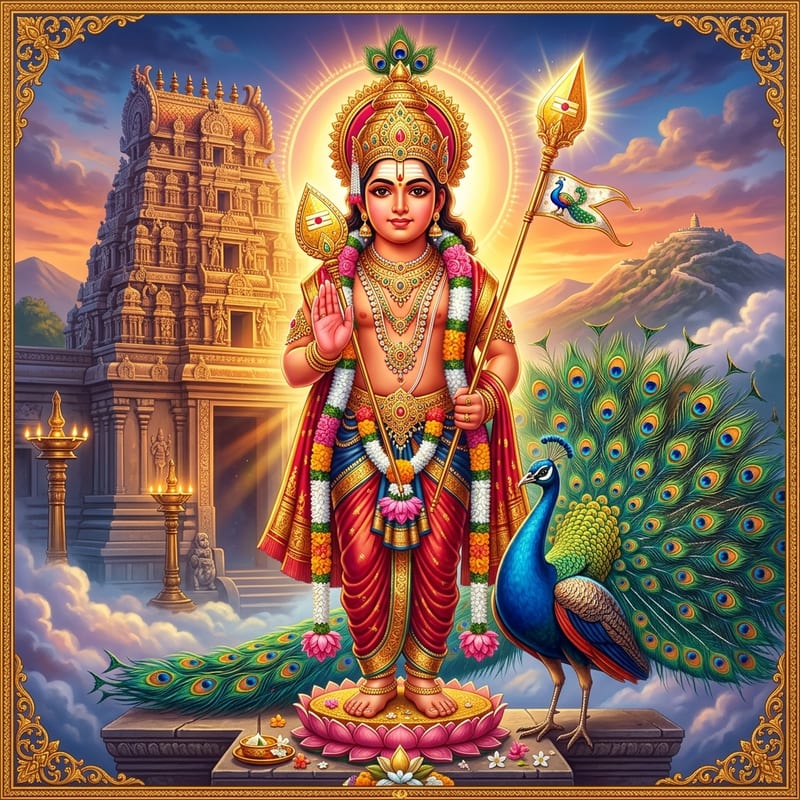
asya śrīsubrahmaṇyahṛdayastotramahāmantrasya, agastyo bhagavān ṛṣiḥ, anuṣṭupchandaḥ, śrīsubrahmaṇyo devatā, sauṃ bījaṃ, svāhā śaktiḥ, śrīṃ kīlakaṃ, śrīsubrahmaṇya prasādasiddhyarthe jape viniyogaḥ ||
- asyaof this
- hṛdayastotramahāmantrasyaof the great mantra that is the Heart-hymn
- agastyaḥ ṛṣiḥAgastya is the seer
- anuṣṭup chandaḥanuṣṭubh is the metre
- subrahmaṇyaḥ devatāSubrahmaṇya is the deity
- sauṃ bījamsauṃ is the seed
- svāhā śaktiḥsvāhā is the power
karanyāsaḥ –
subrahmaṇyāya aṅguṣṭhābhyāṃ namaḥ |
ṣaṇmukhāya tarjanībhyāṃ namaḥ |
śaktidharāya madhyamābhyāṃ namaḥ |
ṣaṭkoṇasaṃsthitāya anāmikābhyāṃ namaḥ |
sarvatomukhāya kaniṣṭhikābhyāṃ namaḥ |
tārakāntakāya karatalakarapṛṣṭhābhyāṃ namaḥ ||
subrahmaṇyāya aṅguṣṭhābhyāṃ namaḥ |
ṣaṇmukhāya tarjanībhyāṃ namaḥ |
śaktidharāya madhyamābhyāṃ namaḥ |
ṣaṭkoṇasaṃsthitāya anāmikābhyāṃ namaḥ |
sarvatomukhāya kaniṣṭhikābhyāṃ namaḥ |
tārakāntakāya karatalakarapṛṣṭhābhyāṃ namaḥ ||
- karanyāsaḥthe placing upon the hands
- subrahmaṇyāya aṅguṣṭhābhyāmto Subrahmaṇya, with the thumbs
- ṣaṇmukhāya tarjanībhyāmto the six-faced, with the forefingers
- śaktidharāya madhyamābhyāmto the spear-bearer, with the middle fingers
- ṣaṭkoṇasaṃsthitāya anāmikābhyāmto him seated in the hexagram, with the ring fingers
hṛdayādi nyāsaḥ –
subrahmaṇyāya hṛdayāya namaḥ |
ṣaṇmukhāya śirase svāhā |
śaktidharāya śikhāyai vaṣaṭ |
ṣaṭkoṇasaṃsthitāya kavacāya hum |
sarvatomukhāya netratrayāya vauṣaṭ |
tārakāntakāya astrāya phaṭ |
bhūrbhuvassuvaromiti digbandhaḥ ||
subrahmaṇyāya hṛdayāya namaḥ |
ṣaṇmukhāya śirase svāhā |
śaktidharāya śikhāyai vaṣaṭ |
ṣaṭkoṇasaṃsthitāya kavacāya hum |
sarvatomukhāya netratrayāya vauṣaṭ |
tārakāntakāya astrāya phaṭ |
bhūrbhuvassuvaromiti digbandhaḥ ||
- hṛdayādinyāsaḥthe placing beginning with the heart
- hṛdayāya namaḥto the heart, salutation
- śirase svāhāto the head, svāhā
- śikhāyai vaṣaṭto the crest-lock, vaṣaṭ
- kavacāya humto the armour, hum
- sarvatomukhāyato him whose faces are turned every way
dhyānam |
ṣaḍvaktraṃ śikhivāhanaṃ trinayanaṃ citrāmbarālaṅkṛtaṃ
vajraṃ śaktimasiṃ triśūlamabhayaṃ kheṭaṃ dhanuścakrakam |
pāśaṃ kukkuṭamaṅkuśaṃ ca varadaṃ dorbhirdadhānaṃ sadā
dhyāyāmīpsita siddhidaṃ śivasutaṃ śrīdvādaśākṣaṃ guham ||
lamityādi pañcapūjāṃ kuryāt |
ṣaḍvaktraṃ śikhivāhanaṃ trinayanaṃ citrāmbarālaṅkṛtaṃ
vajraṃ śaktimasiṃ triśūlamabhayaṃ kheṭaṃ dhanuścakrakam |
pāśaṃ kukkuṭamaṅkuśaṃ ca varadaṃ dorbhirdadhānaṃ sadā
dhyāyāmīpsita siddhidaṃ śivasutaṃ śrīdvādaśākṣaṃ guham ||
lamityādi pañcapūjāṃ kuryāt |
- dhyānammeditation
- ṣaḍvaktramsix-faced
- śikhivāhanamborne by the peacock
- trinayanamthree-eyed
- citrāmbarālaṅkṛtamadorned with bright raiment
- vajram śaktim asim triśūlamthunderbolt, spear, sword, trident
- abhayamthe gesture of fearlessness
- kheṭam dhanuḥ cakramshield, bow, discus
- pāśam kukkuṭam aṅkuśamnoose, cock, goad
- varadamthe boon-giving gesture
pīṭhikā |
satyaloke sadānande munibhiḥ pariveṣṭitam |
papracchurmunayaḥ sarve brahmāṇaṃ jagatāṃ gurum || 1 ||
satyaloke sadānande munibhiḥ pariveṣṭitam |
papracchurmunayaḥ sarve brahmāṇaṃ jagatāṃ gurum || 1 ||
- pīṭhikāthe pedestal, the opening frame
- satyalokein the world of Truth
- sadānandeof unceasing bliss
- munibhiḥ pariveṣṭitamsurrounded by sages
- papracchuḥthey asked
- brahmāṇamBrahmā
- jagatām gurumteacher of the worlds
bhagavan sarvalokeśa sarvajña kamalāsana |
sadānanda jñānamūrte sarvabhūtahite rata || 2 ||
sadānanda jñānamūrte sarvabhūtahite rata || 2 ||
- bhagavanO Blessed One
- sarvalokeśalord of all worlds
- sarvajñaall-knowing
- kamalāsanalotus-seated
- sadānandaof unceasing bliss
- jñānamūrtewhose form is knowledge
- sarvabhūtahite ratadevoted to the good of all beings
bahudhā proktametasya guhasya caritaṃ mahat |
hṛdayaṃ śrotumicchāmaḥ tasyaiva krauñcabhedinaḥ || 3 ||
hṛdayaṃ śrotumicchāmaḥ tasyaiva krauñcabhedinaḥ || 3 ||
- bahudhāin many ways
- proktamhas been told
- etasya guhasyaof this Guha
- caritam mahatthe great deeds
- hṛdayamthe Heart-hymn
- śrotum icchāmaḥwe wish to hear
- krauñcabhedinaḥof him who split the Krauñca mountain
brahmovāca |
śṛṇvantu munayaḥ sarve guhyādguhyataraṃ mahat |
subrahmaṇyasya hṛdayaṃ sarvabhūtahitodayam || 4 ||
śṛṇvantu munayaḥ sarve guhyādguhyataraṃ mahat |
subrahmaṇyasya hṛdayaṃ sarvabhūtahitodayam || 4 ||
- brahmā uvācaBrahmā said
- śṛṇvantulet them hear
- munayaḥ sarveall the sages
- guhyāt guhyatarammore secret than the secret
- subrahmaṇyasya hṛdayamthe Heart of Subrahmaṇya
- sarvabhūtahitodayamarising for the good of all beings
sarvārthasiddhidaṃ puṇyaṃ sarvakāryaika sādhanam |
dharmārthakāmadaṃ guhyaṃ dhanadhānyapravardhanam || 5 ||
dharmārthakāmadaṃ guhyaṃ dhanadhānyapravardhanam || 5 ||
- sarvārthasiddhidamgiving success in every aim
- puṇyammeritorious
- sarvakāryaikasādhanamthe one means to every task
- dharmārthakāmadamgranting dharma, wealth and desire
- guhyamsecret
- dhanadhānyapravardhanamincreasing wealth and grain
rahasyametaddevānāṃ adeyaṃ yasya kasyacit |
sarvamitrakaraṃ gopyaṃ tejobalasamanvitam || 6 ||
sarvamitrakaraṃ gopyaṃ tejobalasamanvitam || 6 ||
- rahasyama secret
- etat devānāmthis, of the gods
- adeyamnot to be given
- yasya kasyacitto just anyone
- sarvamitrakarammaking all men friends
- gopyamto be kept hidden
- tejobalasamanvitamendowed with radiance and strength
pravakṣyāmi hitārthaṃ vaḥ parituṣṭena cetasā |
hṛtpadmakarṇikāmadhye dhyāyetsarvamanoharam || 7 ||
hṛtpadmakarṇikāmadhye dhyāyetsarvamanoharam || 7 ||
- pravakṣyāmiI shall declare
- hitārtham vaḥfor your good
- parituṣṭena cetasāwith a well-pleased mind
- hṛtpadmakarṇikāmadhyein the pericarp of the heart-lotus
- dhyāyetone should meditate
- sarvamanoharamon the all-enchanting
atha hṛdayam |
suvarṇamaṇḍapaṃ divyaṃ ratnatoraṇarājitam |
ratnastambhasahasraiśca śobhitaṃ paramādbhutam || 8 ||
suvarṇamaṇḍapaṃ divyaṃ ratnatoraṇarājitam |
ratnastambhasahasraiśca śobhitaṃ paramādbhutam || 8 ||
- atha hṛdayamnow the Heart
- suvarṇamaṇḍapama golden pavilion
- divyamdivine
- ratnatoraṇarājitamshining with jewelled arches
- ratnastambhasahasraiḥwith a thousand jewelled pillars
- śobhitamadorned
- paramādbhutamsupremely wondrous
paramānandanilayaṃ bhāsvatsūryasamaprabham |
devadānavagandharvagaruḍairyakṣakinnaraiḥ | || 9 ||
devadānavagandharvagaruḍairyakṣakinnaraiḥ | || 9 ||
- paramānandanilayamabode of supreme bliss
- bhāsvatsūryasamaprabhamradiant as the blazing sun
- devadānavagandharvagaruḍaiḥby gods, dānavas, gandharvas and garuḍas
- yakṣakinnaraiḥby yakṣas and kinnaras
sevārthamāgataiḥ siddhaiḥ sādhyairadhyuṣitaṃ sadā |
mahāyogīndrasaṃsevyaṃ mandāratarumaṇḍitam || 10 ||
mahāyogīndrasaṃsevyaṃ mandāratarumaṇḍitam || 10 ||
- sevārtham āgataiḥcome for service
- siddhaiḥ sādhyaiḥby siddhas and sādhyas
- adhyuṣitam sadāever inhabited
- mahāyogīndrasaṃsevyamserved by the great lords of yoga
- mandārataramaṇḍitamadorned with mandāra trees
maṇividrumavedībhirmahatībhirudañcitam |
tanmadhye'nantaratna śrīcchaṭāmaṇḍalaśobhitam || 11 ||
tanmadhye'nantaratna śrīcchaṭāmaṇḍalaśobhitam || 11 ||
- maṇividrumavedībhiḥwith altars of gem and coral
- mahatībhiḥgreat
- udañcitamraised up
- tanmadhyein the midst of it
- anantaratnaśrīcchaṭāmaṇḍalaśobhitamshining with a halo of endless jewelled splendour
ratnasiṃhāsanaṃ divyaṃ ravikoṭisamaprabham |
sarvāścaryamayaṃ puṇyaṃ sarvataḥ supariṣkṛtam || 12 ||
sarvāścaryamayaṃ puṇyaṃ sarvataḥ supariṣkṛtam || 12 ||
- ratnasiṃhāsanama jewelled lion-throne
- divyamdivine
- ravikoṭisamaprabhambright as a crore of suns
- sarvāścaryamayammade of every wonder
- puṇyamholy
- sarvataḥ supariṣkṛtamfinely wrought on every side
tanmadhye'ṣṭadalaṃ padmaṃ udyadarkaprabhodayam |
nigamāgamarolambalambitaṃ cinmayodayam || 13 ||
nigamāgamarolambalambitaṃ cinmayodayam || 13 ||
- tanmadhyein its midst
- aṣṭadalam padmaman eight-petalled lotus
- udyadarkaprabhodayamwith the rising splendour of the dawning sun
- nigamāgamarolambalambitamhung about by the bees that are Veda and Āgama
- cinmayodayamthe dawning of pure consciousness
divyaṃ tejomayaṃ divyaṃ devatābhirnamaskṛtam |
dedīpyamānaṃ rucibhirviśālaṃ sumanoharam || 14 ||
dedīpyamānaṃ rucibhirviśālaṃ sumanoharam || 14 ||
- divyamdivine
- tejomayammade of radiance
- devatābhiḥ namaskṛtamsaluted by the deities
- dedīpyamānamblazing forth
- rucibhiḥwith beams
- viśālamvast
- sumanoharammost enchanting
tanmadhye sarvalokeśaṃ dhyāyetsarvāṅgasundaram |
anantādityasaṅkāśaṃ āśritābhīṣṭadāyakam || 15 ||
anantādityasaṅkāśaṃ āśritābhīṣṭadāyakam || 15 ||
- tanmadhyein its midst
- sarvalokeśamlord of all worlds
- dhyāyetone should meditate
- sarvāṅgasundarambeautiful in every limb
- anantādityasaṅkāśamresembling endless suns
- āśritābhīṣṭadāyakamgiving what those who take refuge desire
acintyajñānavijñānatejobalasamanvitam |
sarvāyudhadharaṃ divyaṃ sarvāścaryamayaṃ guham || 16 ||
sarvāyudhadharaṃ divyaṃ sarvāścaryamayaṃ guham || 16 ||
- acintyajñānavijñānatejobalasamanvitamendowed with unthinkable knowledge, discernment, radiance and strength
- sarvāyudhadharambearing every weapon
- divyamdivine
- sarvāścaryamayamfull of every wonder
- guhamGuha
mahārha ratnakhacita ṣaṭkirīṭavirājitam |
śaśāṅkārdhakalāramya samudyanmaulibhūṣaṇam || 17 ||
śaśāṅkārdhakalāramya samudyanmaulibhūṣaṇam || 17 ||
- mahārharatnakhacitaṣaṭkirīṭavirājitamresplendent with six diadems set with precious gems
- śaśāṅkārdhakalāramyamlovely with the half-moon’s digit
- samudyanmaulibhūṣaṇamwith the crest-ornament rising high
madanojjvalakodaṇḍamaṅgalabhrūvirājitam |
vistīrṇāruṇapadmaśrī vilasaddvādaśekṣaṇam || 18 ||
vistīrṇāruṇapadmaśrī vilasaddvādaśekṣaṇam || 18 ||
- madanojjvalakodaṇḍamaṅgalabhrūvirājitamgraced with auspicious brows like Kāma’s gleaming bow
- vistīrṇāruṇapadmaśrīvilasaddvādaśekṣaṇamwhose twelve eyes shine with the beauty of wide red lotuses
cāruśrīvarṇasampūrṇamukhaśobhāvibhāsuram |
maṇiprabhāsamagraśrīsphuranmakarakuṇḍalam || 19 ||
maṇiprabhāsamagraśrīsphuranmakarakuṇḍalam || 19 ||
- cāruśrīvarṇasampūrṇamukhaśobhāvibhāsuramblazing with the beauty of faces full of lovely radiance
- maṇiprabhāsamagraśrīsphuranmakarakuṇḍalamwith makara earrings flashing in full jewelled splendour
lasaddarpaṇadarpāḍhya gaṇḍasthalavirājitam |
divyakāñcanapuṣpaśrīnāsāpuṭavirājitam || 20 ||
divyakāñcanapuṣpaśrīnāsāpuṭavirājitam || 20 ||
- lasaddarpaṇadarpāḍhyagaṇḍasthalavirājitamwith cheeks resplendent, rivalling a gleaming mirror
- divyakāñcanapuṣpaśrīnāsāpuṭavirājitamwith nostrils lovely as a golden flower
mandahāsaprabhājālamadhurādhara śobhitam |
sarvalakṣaṇalakṣmībhṛtkambukandhara sundaram || 21 ||
sarvalakṣaṇalakṣmībhṛtkambukandhara sundaram || 21 ||
- mandahāsaprabhājālamadhurādharaśobhitamadorned with sweet lips wreathed in the light of a gentle smile
- sarvalakṣaṇalakṣmībhṛtkambukandharasundarambeautiful with a conch-like neck bearing every auspicious mark
mahānarghamahāratnadivyahāravirājitam |
samagranāgakeyūrasannaddhabhujamaṇḍalam || 22 ||
samagranāgakeyūrasannaddhabhujamaṇḍalam || 22 ||
- mahānarghamahāratnadivyahāravirājitamresplendent with a divine necklace of priceless great gems
- samagranāgakeyūrasannaddhabhujamaṇḍalamarms encircled with serpent-armlets
ratnakaṅkaṇasambhāsvatkarāgra śrīmahojjvalam |
mahāmaṇikavāṭābhavakṣaḥsthalavirājitam || 23 ||
mahāmaṇikavāṭābhavakṣaḥsthalavirājitam || 23 ||
- ratnakaṅkaṇasambhāsvatkarāgraśrīmahojjvalamfingertips blazing with the splendour of jewelled bracelets
- mahāmaṇikavāṭābhavakṣaḥsthalavirājitama chest broad as a door of great gems
atigāmbhīryasambhāvyanābhīnavasaroruham |
ratnaśrīkalitābaddhalasanmadhyapradeśakam || 24 ||
ratnaśrīkalitābaddhalasanmadhyapradeśakam || 24 ||
- atigāmbhīryasambhāvyanābhīnavasaroruhama navel like a fresh lotus, conceived in utter depth
- ratnaśrīkalitābaddhalasanmadhyapradeśakama waist girt and gleaming with jewelled beauty
sphuratkanakasaṃvītapītāmbarasamāvṛtam |
śṛṅgārarasasampūrṇa ratnastambhopamorukam || 25 ||
śṛṅgārarasasampūrṇa ratnastambhopamorukam || 25 ||
- sphuratkanakasaṃvītapītāmbarasamāvṛtamwrapped in yellow silk shot with flashing gold
- śṛṅgārarasasampūrṇaratnastambhopamorukamthighs like jewelled pillars, full of the savour of beauty
svarṇakāhalarociṣṇu jaṅghāyugalamaṇḍalam |
ratnamañjīrasannaddha ramaṇīya padāmbujam || 26 ||
ratnamañjīrasannaddha ramaṇīya padāmbujam || 26 ||
- svarṇakāhalarociṣṇujaṅghāyugalamaṇḍalama pair of calves shining like golden trumpets
- ratnamañjīrasannaddharamaṇīyapadāmbujamlotus feet lovely with jewelled anklets
bhaktābhīṣṭapradaṃ devaṃ brahmaviṣṇvādisaṃstutam |
kaṭākṣaiḥ karuṇādakṣaistoṣayantaṃ jagatpatim || 27 ||
kaṭākṣaiḥ karuṇādakṣaistoṣayantaṃ jagatpatim || 27 ||
- bhaktābhīṣṭapradamgranting what devotees desire
- devamthe god
- brahmaviṣṇvādisaṃstutampraised by Brahmā, Viṣṇu and the rest
- kaṭākṣaiḥwith sidelong glances
- karuṇādakṣaiḥskilled in compassion
- toṣayantamgladdening
- jagatpatimlord of the world
cidānandajñānamūrtiṃ sarvalokapriyaṅkaram |
śaṅkarasyātmajaṃ devaṃ dhyāyeccharavaṇodbhavam || 28 ||
śaṅkarasyātmajaṃ devaṃ dhyāyeccharavaṇodbhavam || 28 ||
- cidānandajñānamūrtimwhose form is consciousness, bliss and knowledge
- sarvalokapriyaṅkaramdear to all the worlds
- śaṅkarasya ātmajamson of Śaṅkara
- dhyāyetone should meditate
- śaravaṇodbhavamborn in the reed-thicket
anantādityacandrāgni tejaḥ sampūrṇavigraham |
sarvalokaikavaradaṃ sarvavidyārthatattvakam || 29 ||
sarvalokaikavaradaṃ sarvavidyārthatattvakam || 29 ||
- anantādityacandrāgnitejaḥsampūrṇavigrahamwhose body is filled with the radiance of endless suns, moons and fires
- sarvalokaikavaradamthe one boon-giver to all worlds
- sarvavidyārthatattvakamthe very truth of the meaning of all knowledge
sarveśvaraṃ sarvavibhuṃ sarvabhūtahite ratam |
evaṃ dhyātvā tu hṛdayaṃ ṣaṇmukhasya mahātmanaḥ || 30 ||
evaṃ dhyātvā tu hṛdayaṃ ṣaṇmukhasya mahātmanaḥ || 30 ||
- sarveśvaramlord of all
- sarvavibhumall-pervading
- sarvabhūtahite ratamdevoted to the good of all beings
- evam dhyātvāhaving meditated thus
- hṛdayamthe Heart
- ṣaṇmukhasyaof the six-faced
- mahātmanaḥthe great-souled
sarvānkāmānavāpnoti samyak jñānaṃ ca vindati |
śucau deśe samāsīnaḥ śuddhātmā caritāhnikaḥ || 31 ||
śucau deśe samāsīnaḥ śuddhātmā caritāhnikaḥ || 31 ||
- sarvān kāmānall desires
- avāpnotihe obtains
- samyak jñānamright knowledge
- vindatihe finds
- śucau deśein a clean place
- samāsīnaḥseated
- śuddhātmāpure of self
- caritāhnikaḥhaving performed the daily rites
prāṅmukho yatacittaśca japeddhṛdayamuttamam |
sakṛdeva manuṃ japtvā samprāpnotyakhilaṃ śubham || 32 ||
sakṛdeva manuṃ japtvā samprāpnotyakhilaṃ śubham || 32 ||
- prāṅmukhaḥfacing east
- yatacittaḥwith restrained mind
- japetshould recite
- hṛdayam uttamamthe supreme Heart
- sakṛt evaeven once
- manum japtvāhaving muttered the mantra
- samprāpnotihe obtains
- akhilam śubhamevery good
idaṃ sarvāghaharaṇaṃ mṛtyudāridryanāśanam |
sarvasampatkaraṃ puṇyaṃ sarvaroganivāraṇam || 33 ||
sarvasampatkaraṃ puṇyaṃ sarvaroganivāraṇam || 33 ||
- idamthis
- sarvāghaharaṇamremoving every sin
- mṛtyudāridryanāśanamdestroying death and poverty
- sarvasampatkarambringing all prosperity
- puṇyamholy
- sarvaroganivāraṇamwarding off every disease
sarvakāmakaraṃ divyaṃ sarvābhīṣṭapradāyakam |
prajākaraṃ rājyakaraṃ bhāgyadaṃ bahupuṇyadam || 34 ||
prajākaraṃ rājyakaraṃ bhāgyadaṃ bahupuṇyadam || 34 ||
- sarvakāmakaramfulfilling every desire
- divyamdivine
- sarvābhīṣṭapradāyakamgiving all that is wished
- prajākaramgiving offspring
- rājyakaramgiving kingdom
- bhāgyadamgiving fortune
- bahupuṇyadamgiving abundant merit
guhyādguhyataraṃ bhūyo devānāmapi durlabham |
idaṃ tu nātapaskāya nābhaktāya kadācana || 35 ||
idaṃ tu nātapaskāya nābhaktāya kadācana || 35 ||
- guhyāt guhyatarammore secret than the secret
- bhūyaḥyet more
- devānām api durlabhamhard to obtain even for the gods
- idam tubut this
- na atapaskāyanot to one without austerity
- na abhaktāyanot to one without devotion
- kadācanaever
na cāśuśrūṣave deyaṃ na madāndhāya karhicit |
sacchiṣyāya kulīnāya skandabhaktiratāya ca || 36 ||
sacchiṣyāya kulīnāya skandabhaktiratāya ca || 36 ||
- na ca aśuśrūṣavenor to one unwilling to serve
- deyamto be given
- na madāndhāyanot to one blind with pride
- karhicitat any time
- sacchiṣyāyato a true disciple
- kulīnāyawell-born
- skandabhaktiratāyadevoted to Skanda
satāmabhimatāyedaṃ dātavyaṃ dharmavardhanam |
ya idaṃ paramaṃ puṇyaṃ nityaṃ japati mānavaḥ |
tasya śrī bhagavān skandaḥ prasanno bhavati dhruvam || 37 ||
ya idaṃ paramaṃ puṇyaṃ nityaṃ japati mānavaḥ |
tasya śrī bhagavān skandaḥ prasanno bhavati dhruvam || 37 ||
- satām abhimatāyato one esteemed by the good
- idamthis
- dātavyamshould be given
- dharmavardhanamincreasing dharma
- yaḥ idamwhoever this
- paramam puṇyamsupremely holy
- nityam japatidaily recites
- tasyato him
- bhagavān skandaḥthe blessed Skanda
- prasannaḥ bhavatibecomes gracious
- dhruvamassuredly
iti śrīskāndapurāṇe subrahmaṇyahṛdayastotram ||